1006
Cartier
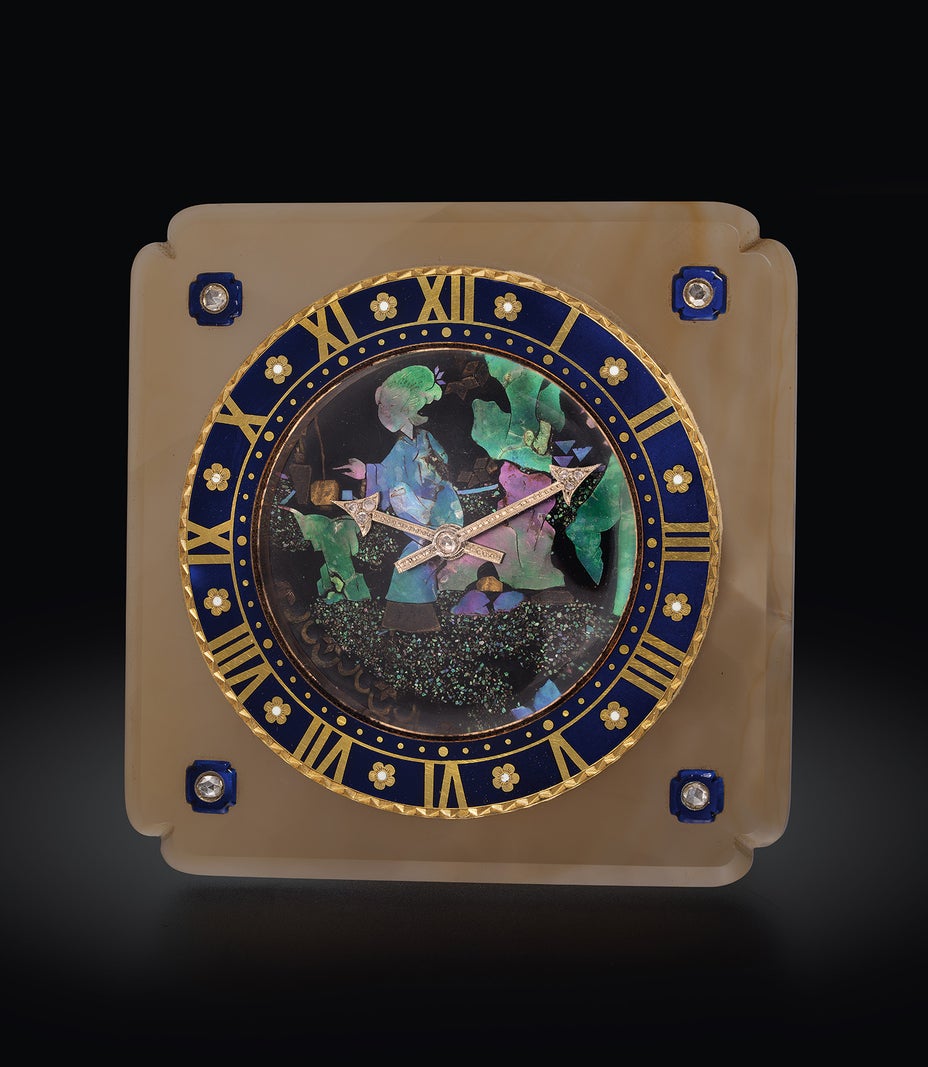
A unique and attractive desk clock with strut, “Laque Burgauté” panel, agate, mother-of-pearl, gold, enamel, sapphire cabochons and diamonds
Full-Cataloguing
Incorporating artworks evoking Chinese life and traditions with various materials such as lacquer, jade and enamel found from everyday Chinese lacquerwares, Cartier extracted these beautiful panels and fostered elegance and refinement with a twist of Art Deco influences. Chinoiseries Objets d’art such as large clocks to small items such as vanity cases, scent bottles, lip sticks alike began to blossom during the 1900s.
The Chinese have long been fascinated by the play of light and have many ways to use it. Which the Chinese have ‘shadow theatre’, Cartier transformed this through the iridescence plates into jewels, imbuing everyday objects into exotic gems. One of the most exquisite Asian techniques that provides the perfect canvas is Laque Burgauté. The technique refers to decorating lacquer with intricate inlays of tinted mother-of-pearl. This technique was often used between China and Japan, as early as the Ming Dynasty (1368-1644) and reached peak popularity during the Qing Dynasty (1644 - 1911/12). Its popularity spread to the Ryukyu Islands between China and Japan and thence to Japan itself. In China the technique is called 'lo tien' 螺鈿 and in Japan 'aogai'青貝塗. The mother-of-pearl are usually tinted in purple or green, with a layer of lacquer applied on top and later rubbed with pumice stone to create a smooth and unblemished surface.
With recurring themes such as poetries, gardens and festivals, the quality of the rich black lacquer evokes twilight scenes under the moon light naturally sprinkled with stones and pearls. Depicted elegantly, the present scene features an elegant lady submerged in an oriental garden. Gestured with an serene, elongated hand, the lady seemed to be enjoying the night with a vase and a teacup in front of her.
Squared with four Japanese corners “Coin Japonaise”, this desk clock is crafted with translucent agate with a hint of pink hue. Each corner is decorated with a matching Japanese corner sapphire cabochon with a single diamond mounted. The hours and minutes are finished with gold and blue enamel, each Roman numeral is separated with a gold Sakura to complete the 12 hours. Crafted in platinum and adorned with diamonds, the hands are shaped with a finely pointed arrow that complements the lady’s hand.
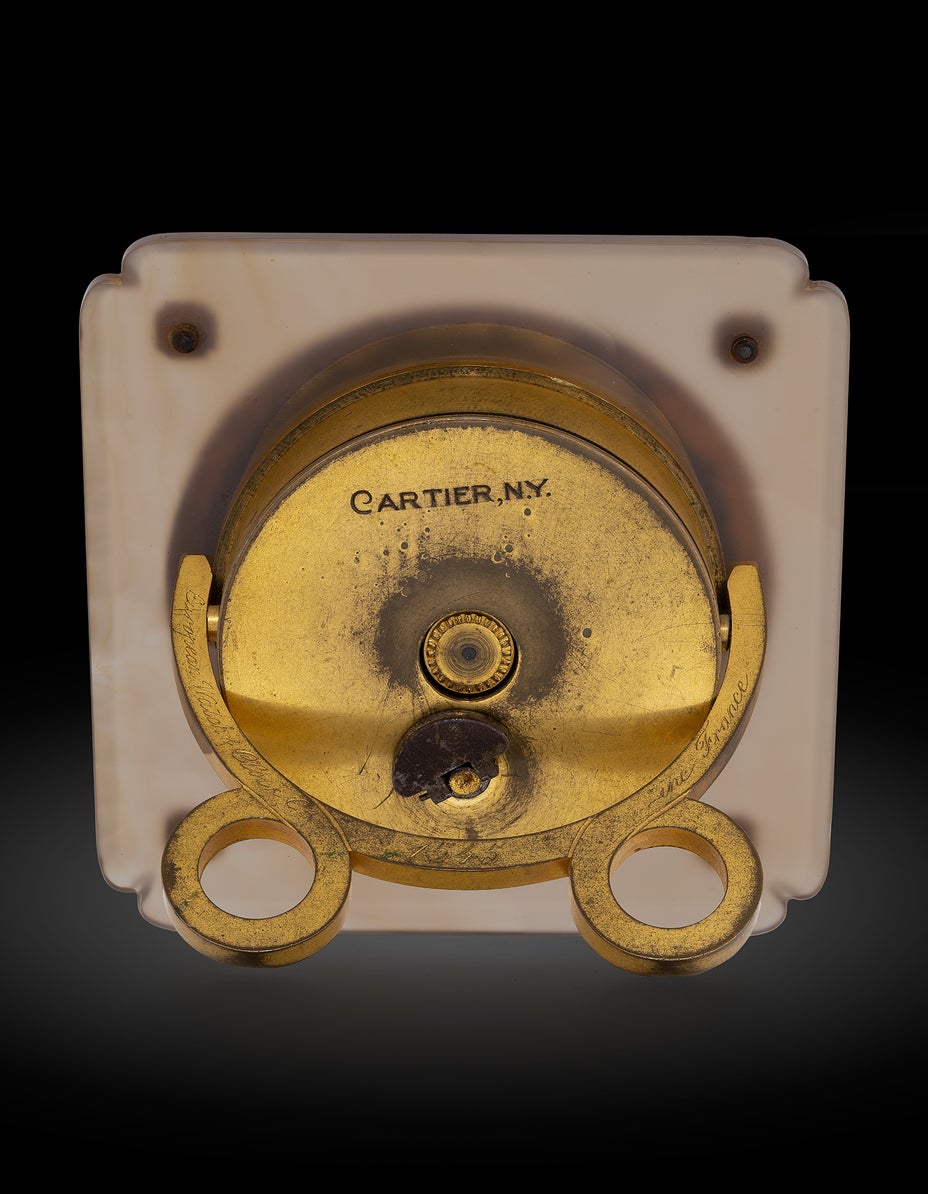
Well-preserved and retaining its crisp engravings of “European Watch And Clock Co. inc France” on the strut, the case is further stamped Cartier N. Y indicating where this clock was potentially sold in New York.
Cartier
FrenchWith the Constitution of 1848 came a new standard for luxury in France. Founded one year prior by Louis-Francois Cartier, the house of Cartier was one of the first to use platinum in jewelry making. This incredibly expensive material became the stepping-stone for Cartier to experiment in form, mechanisms and attitude. It helped men move from pocket watches to wristwatches, effectively making the watch much more functional and prominent in a man's overall wardrobe.
Cartier did not only touch on functionality. Inspired by a commissioned painting by George Barbier featuring a black panther at the feet of an elegantly bejeweled woman, Cartier began incorporating wild animals in his designs—most notably, Cartier Panthère rings, bangle bracelets and watches. Yet it wasn't until the late 1960s that the house of Cartier debuted their iconic yellow and rose gold LOVE collection, which includes the famous bracelet that only a special screwdriver can open.