US import tariffs: Non-US origin lots in this sale (including watches and timepieces with Swiss-made or non-US made movements) will be subject to special tariffs upon import to the USA, currently ranging from 10% to 39% on the total invoice price (hammer price plus buyer’s premium). Buyers are responsible for paying any applicable tariffs, duties, taxes and charges when importing their purchased lots. Due to the evolving nature of international trade regulations, we recommend clients consult with their local customs office or advisor for up-to-date information on the applicable tariffs.
134
Cartier Paris
Model A
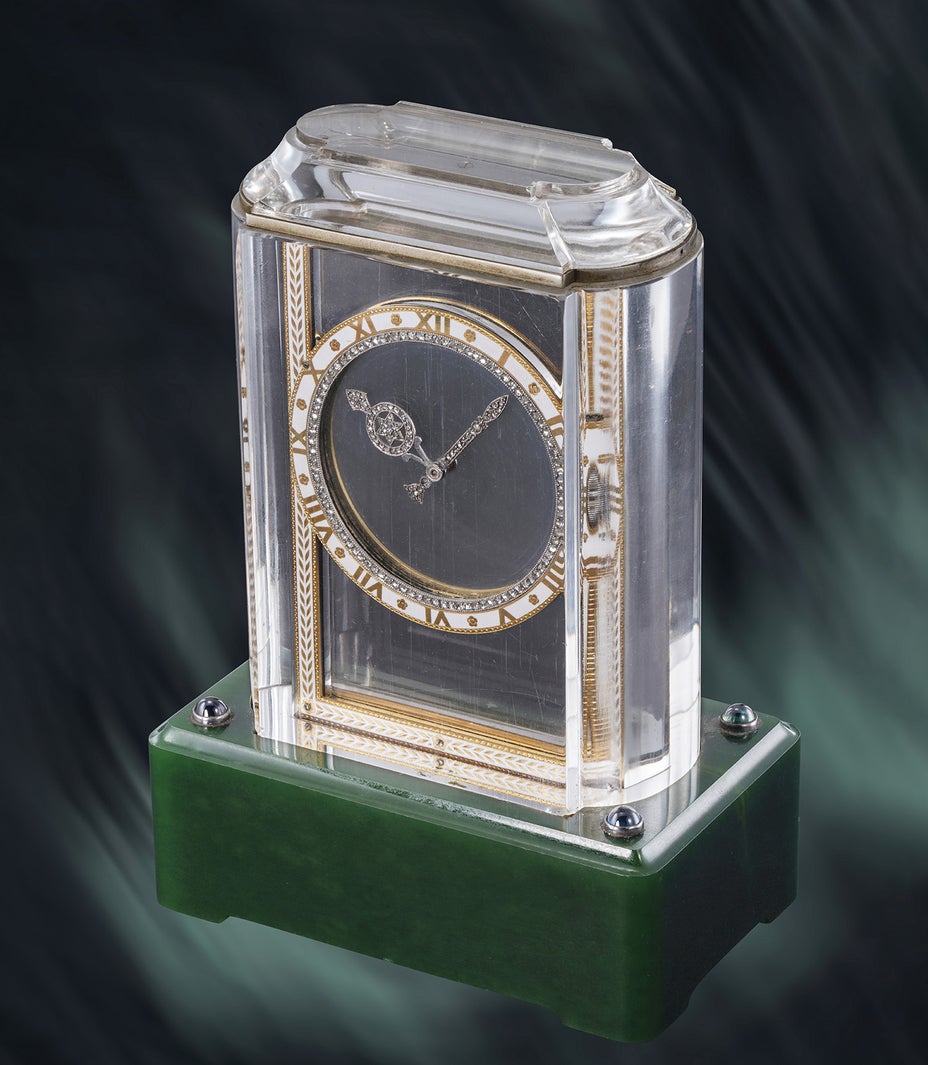
A unique, extremely rare and historically important rock crystal, mother-of-pearl, yellow gold, nephrite and diamond-set Art Deco mystery clock, the first Mystery Clock made by Cartier and sold to J.P. Morgan Jr
Estimate
CHF300,000–600,000
€324,000–647,000
$377,000–754,000
Sold For
CHF698,500
Manufacturer
Cartier Paris
Year
1912 and delivered in 1913
Case No
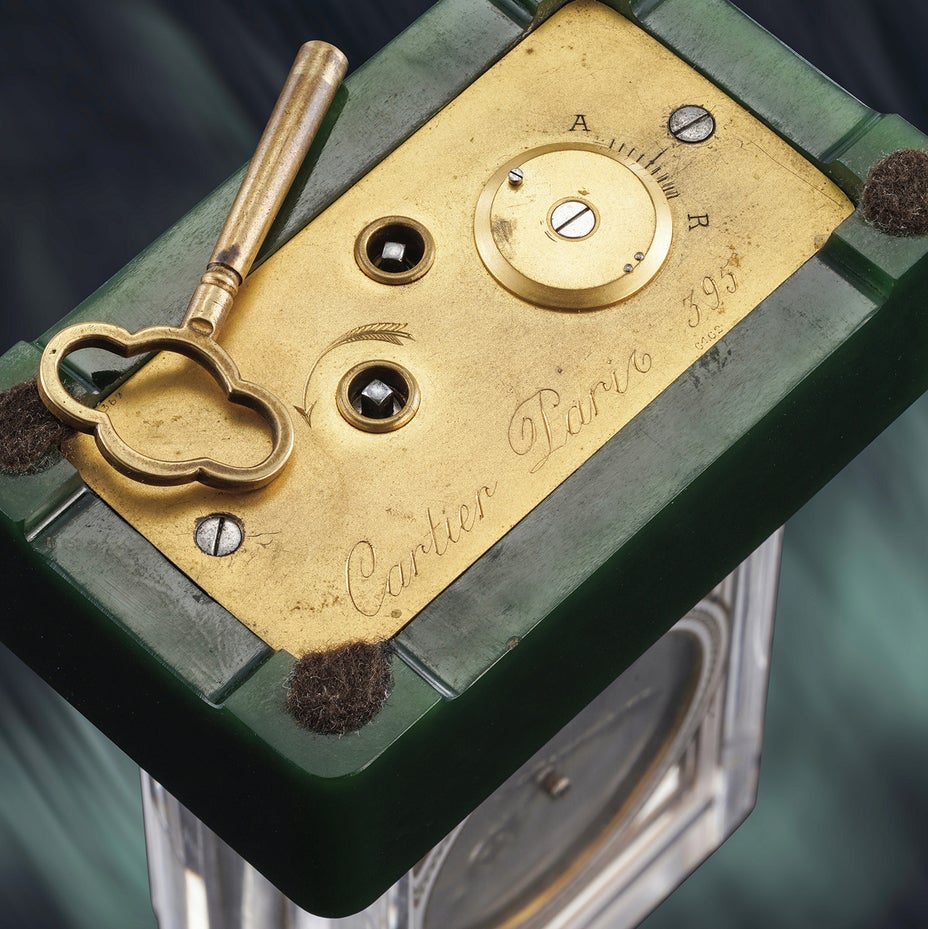
395 and 6462
Model Name
Model A
Material
18K yellow gold, rock crystal, nephrite and diamonds
Calibre
Manual, jeweled
Dimensions
85mm length, 50mm width and 125mm height
Signed
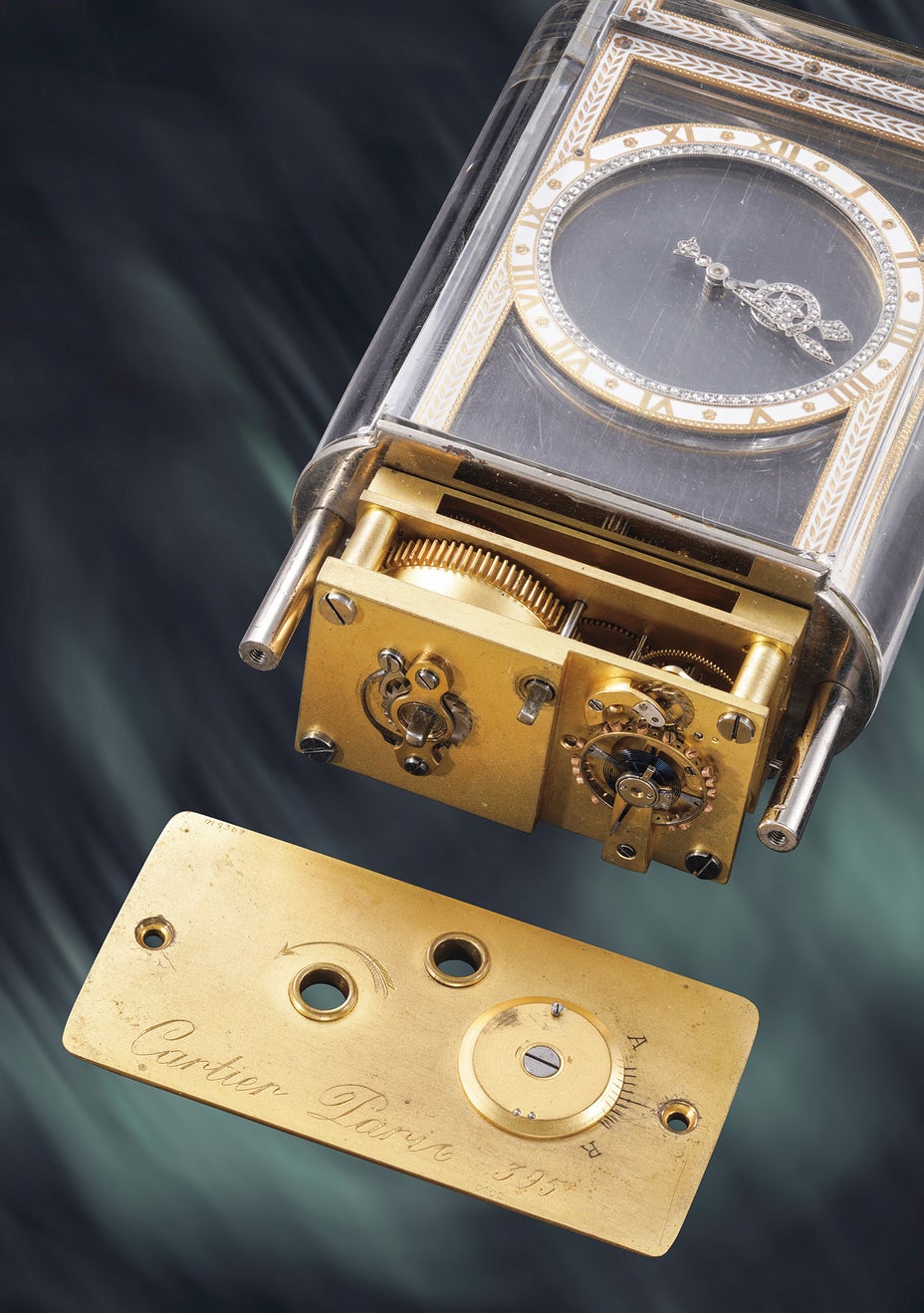
Case with hand stamped numbers and signed Cartier
Accessories
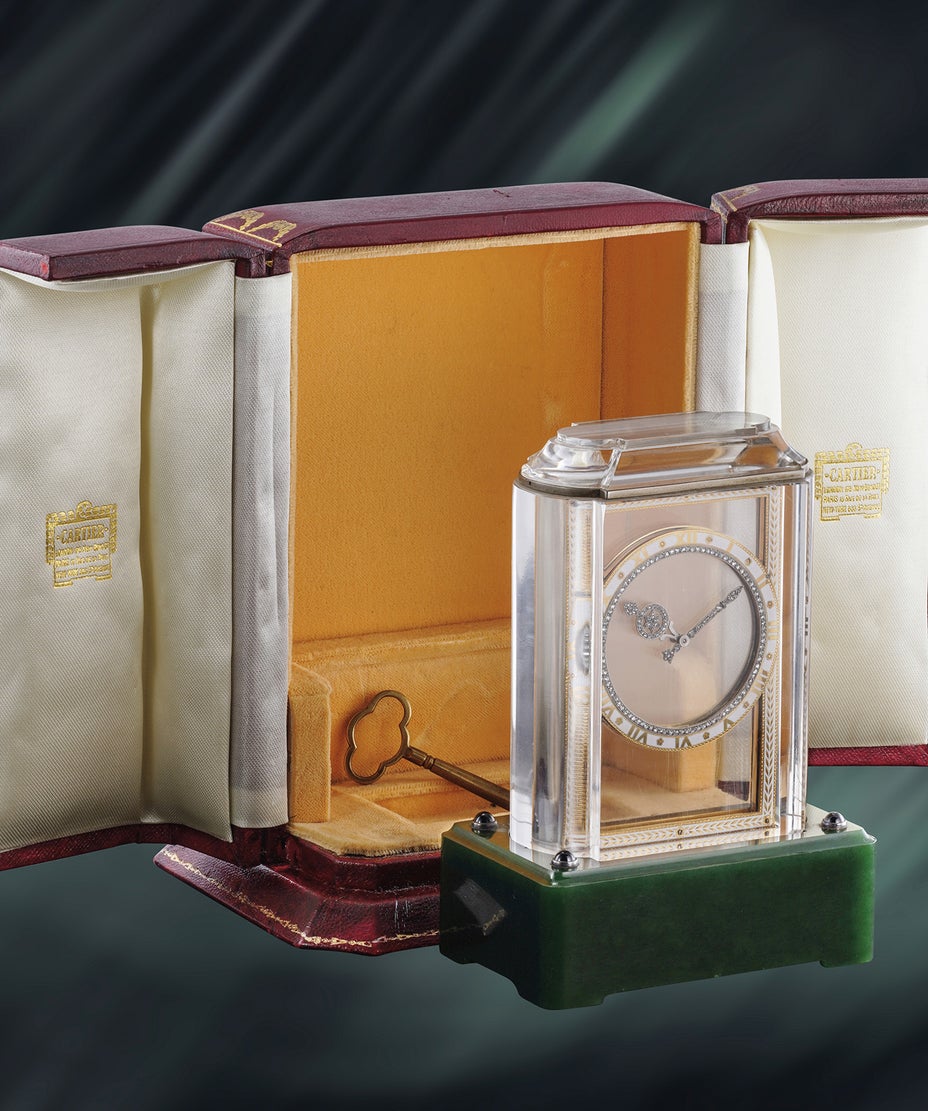
Accompanied by Cartier presentation box and key. Furthermore accompanied by a copy of a Cartier letter.
Full-Cataloguing
Among the most magnificent, enchanting, and captivating horological wonders of the 20th century, Cartier’s mystery clocks undoubtedly stand out as some of the most extraordinary creations ever made. Few brands have ever produced such magical, inventive, and remarkable timepieces as Cartier has. The mystery clock served as the ideal canvas for the brand to demonstrate its boundless creativity, resulting from a fusion of two core principles: combining exquisite craftsmanship with the art of horology.
Truly a first of its kind, the Model A Mystery clock made its public debut in 1912 as the very first mystery clock in the world, and immediately captivated the world with its seemingly levitated hands within its pellucid block-shaped rock crystal. These early creations of the Model A were bejewelled art pieces that highlights the mastery of Cartier’s craftsmanship and design skills. First devised with a double-axle mechanism and soon after with a single central axle, the “Mystery” is solved thanks to the separate crystal disc hidden within. These discs are each surrounded by a tooth-edged boarder and driven by screws fixed at the ends of the axles, working at the levels of 3 and 9 o’clock, the driving pinions of the hands are hidden in the base of the frame. The rotation of the axles is activated by the movement hidden in the base, therefore, it is not the hands which move but each disc on which they are individually set at two different speeds, one for the hours and one for the minutes. The technical feat of floating hands was created by Maurice Coüet, a clockmaker who initially supplied Cartier before joining the company. Coüet was inspired by the work of Jean-Eugène Robert-Houdin, a 19th-century clockmaker and magician, who is credited with inventing the mystery clock design. A ground breaking timepiece, Model A Mystery Clocks were acquired by glamorous celebrities and important figures of the society.
Each unique, these handmade clocks boasted variations on the type of base: agate, onyx, obsidian, nephrite, lapis lazuli, gold and jade, while other difference involved the decorations on the frames and chapter rings.
The present watch is possibly the most important mystery clock made by Cartier. It is not just any Model A, but the very first Mystery Clock made by Cartier, and sold to none other than J.P. Morgan Jr in 1913. Thus, it is the progenitor of all mystery clocks, representing an "Adam and Eve" moment that later influenced and launched countless variations and designs throughout the history of Cartier until today. As such, its historical significance cannot be overstated, especially when one considers the fact that it was sold one year before the First World War, and to one of the most important financiers in history. Having last appeared at auction in 1993, it has safely been kept in a safe until its re-appearance on the public arena today. At the time of its sale at auction in 1993, it was accompanied by a letter from Cartier confirming that the clock was the very first example sold - a photocopy of this letter accompanies the watch, underscoring its importance. Another letter from the Archives of the Morgan Museum shows that the clock was bought from Cartier, intended as a gift.
The present example is fitted with a stylish white enamel bezel and frame upon a nephrite base, with rose-cut diamonds in an inner ring on the dial. Gold leaves on the outer rims furthermore add to the design and flair. Its condition is exceptional, with all panels intact. Furthermore, the rock crystal dial and clock itself does not display cracks or fissures.
Considering the historical importance and significance of this Modèle A, its appearance at auction marks an important moment in Cartier's history. Once this example is sold, it is unlikely that another of such caliber and consequence will grace the auction market for years—if ever again.
J.P. Morgan Jr. (1867–1943): Financier, Connoisseur, and Custodian of Time
John Pierpont Morgan Jr., heir to one of the most powerful financial dynasties in American history, was not only a pivotal figure in global banking, but also a discerning patron of the arts—with a particular and refined appreciation for horology.
Born on September 7, 1867, Morgan Jr. inherited both the immense wealth and cultural sensibilities of his father, J.P. Morgan Sr., a legendary collector of art, manuscripts, and timepieces. Following his father's death in 1913, J.P. Morgan Jr. assumed control of J.P. Morgan & Co., guiding it through some of the most turbulent financial periods in modern history, including World War I, during which he arranged enormous loans and procurement contracts for the Allied powers.
Among his many private passions was a profound appreciation for fine watches and mechanical objects. Morgan Jr. continued the Morgan family's patronage of the horological arts, often acquiring pieces that exemplified both technical mastery and timeless elegance - some of the most famous timepieces owned by the Morgan family include several dozen watches from Frodsham and a double-dial, astronomical pocket watch made by J. Player & Son. So avid was Morgan Sr that he commissioned a catalog of his timepieces printed on Japanese vellum, with the deluxe version of the first edition included 92 hand-painted and gilded plates depicting reproductions of the watches.
A patron of the arts, Morgan Jr. generously endowed various institutions throughout his lifetime, especially The Pierpont Morgan Library and The Metropolitan Museum of Art.
Truly a first of its kind, the Model A Mystery clock made its public debut in 1912 as the very first mystery clock in the world, and immediately captivated the world with its seemingly levitated hands within its pellucid block-shaped rock crystal. These early creations of the Model A were bejewelled art pieces that highlights the mastery of Cartier’s craftsmanship and design skills. First devised with a double-axle mechanism and soon after with a single central axle, the “Mystery” is solved thanks to the separate crystal disc hidden within. These discs are each surrounded by a tooth-edged boarder and driven by screws fixed at the ends of the axles, working at the levels of 3 and 9 o’clock, the driving pinions of the hands are hidden in the base of the frame. The rotation of the axles is activated by the movement hidden in the base, therefore, it is not the hands which move but each disc on which they are individually set at two different speeds, one for the hours and one for the minutes. The technical feat of floating hands was created by Maurice Coüet, a clockmaker who initially supplied Cartier before joining the company. Coüet was inspired by the work of Jean-Eugène Robert-Houdin, a 19th-century clockmaker and magician, who is credited with inventing the mystery clock design. A ground breaking timepiece, Model A Mystery Clocks were acquired by glamorous celebrities and important figures of the society.
Each unique, these handmade clocks boasted variations on the type of base: agate, onyx, obsidian, nephrite, lapis lazuli, gold and jade, while other difference involved the decorations on the frames and chapter rings.
The present watch is possibly the most important mystery clock made by Cartier. It is not just any Model A, but the very first Mystery Clock made by Cartier, and sold to none other than J.P. Morgan Jr in 1913. Thus, it is the progenitor of all mystery clocks, representing an "Adam and Eve" moment that later influenced and launched countless variations and designs throughout the history of Cartier until today. As such, its historical significance cannot be overstated, especially when one considers the fact that it was sold one year before the First World War, and to one of the most important financiers in history. Having last appeared at auction in 1993, it has safely been kept in a safe until its re-appearance on the public arena today. At the time of its sale at auction in 1993, it was accompanied by a letter from Cartier confirming that the clock was the very first example sold - a photocopy of this letter accompanies the watch, underscoring its importance. Another letter from the Archives of the Morgan Museum shows that the clock was bought from Cartier, intended as a gift.
The present example is fitted with a stylish white enamel bezel and frame upon a nephrite base, with rose-cut diamonds in an inner ring on the dial. Gold leaves on the outer rims furthermore add to the design and flair. Its condition is exceptional, with all panels intact. Furthermore, the rock crystal dial and clock itself does not display cracks or fissures.
Considering the historical importance and significance of this Modèle A, its appearance at auction marks an important moment in Cartier's history. Once this example is sold, it is unlikely that another of such caliber and consequence will grace the auction market for years—if ever again.
J.P. Morgan Jr. (1867–1943): Financier, Connoisseur, and Custodian of Time
John Pierpont Morgan Jr., heir to one of the most powerful financial dynasties in American history, was not only a pivotal figure in global banking, but also a discerning patron of the arts—with a particular and refined appreciation for horology.
Born on September 7, 1867, Morgan Jr. inherited both the immense wealth and cultural sensibilities of his father, J.P. Morgan Sr., a legendary collector of art, manuscripts, and timepieces. Following his father's death in 1913, J.P. Morgan Jr. assumed control of J.P. Morgan & Co., guiding it through some of the most turbulent financial periods in modern history, including World War I, during which he arranged enormous loans and procurement contracts for the Allied powers.
Among his many private passions was a profound appreciation for fine watches and mechanical objects. Morgan Jr. continued the Morgan family's patronage of the horological arts, often acquiring pieces that exemplified both technical mastery and timeless elegance - some of the most famous timepieces owned by the Morgan family include several dozen watches from Frodsham and a double-dial, astronomical pocket watch made by J. Player & Son. So avid was Morgan Sr that he commissioned a catalog of his timepieces printed on Japanese vellum, with the deluxe version of the first edition included 92 hand-painted and gilded plates depicting reproductions of the watches.
A patron of the arts, Morgan Jr. generously endowed various institutions throughout his lifetime, especially The Pierpont Morgan Library and The Metropolitan Museum of Art.