165
Carlos Cruz-Diez
Chromointerférence Mécanique
Estimate
$180,000–220,000
Sold For
$162,500
signed with the artist's initials, titled, inscribed and dated "C.D. 'CHROMOINTERFERENCE' CRUZ-DIEZ PARIS 1970" on the reverse
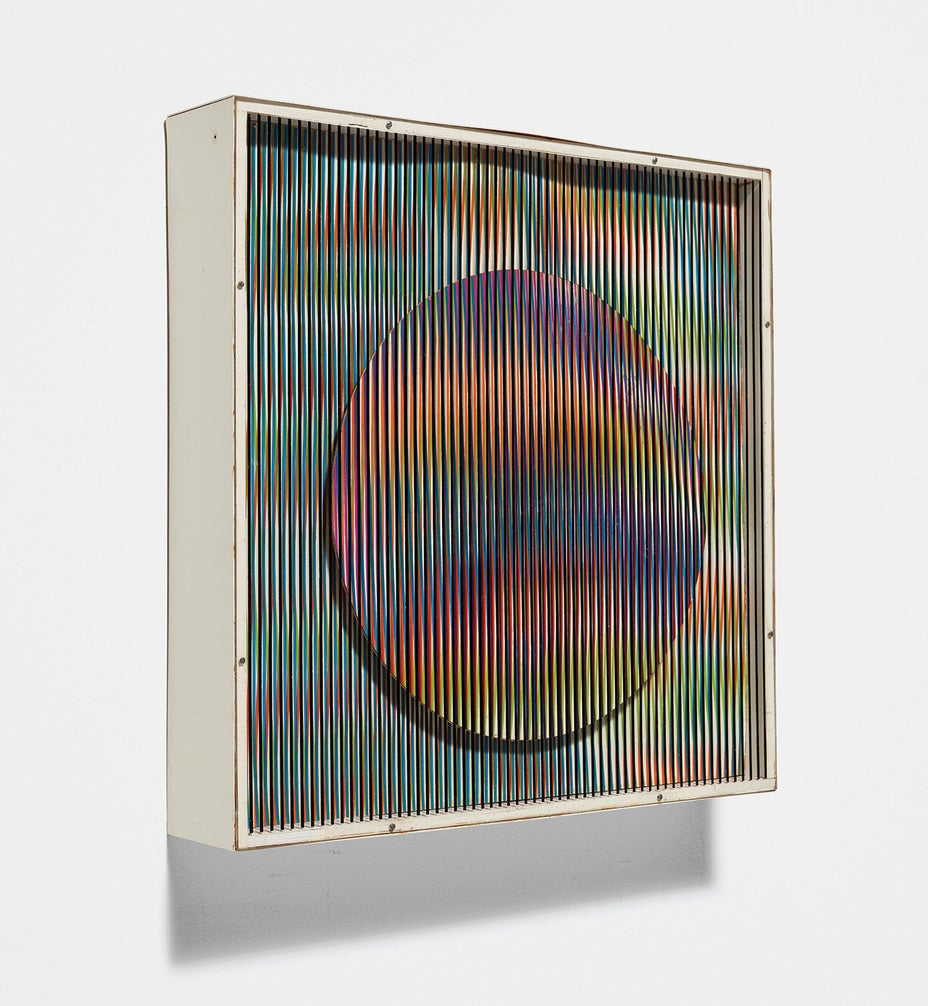
silkscreen on paper and plastic, motor and wood
23 5/8 x 23 5/8 in. (60 x 60 cm.)
Executed in 1970.
This work will be included in the forthcoming catalogue raisonné being prepared by the Cruz-Diez Art Foundation.
This work will be included in the forthcoming catalogue raisonné being prepared by the Cruz-Diez Art Foundation.
Full-Cataloguing
Debuted at the Venice Biennale in 1970, Carlos Cruz-Diez’s Chromointerférence Mécanique perfectly synthesizes the artist’s exploration of color that has put him at the forefront of contemporary art discourse for the past six decades. Its title distills the core elements of Cruz-Diez’s practice: Chromointerférence expresses his understanding of color as an ephemeral phenomenon produced by light and movement, independent of representation or even form, while Mécanique underpins the kinetic component of his work that places him alongside such pioneering artists as Jesús Rafael Soto. In the present work, a circular piece of Plexiglas printed with a pattern of lines rotates above the multi-colored background of his so-called Couleur additive modules. What was left to the movement of the observer in his famous Physiochromies, is here established objectively by automated movement. New colors emerge from the apparent blending of pre-existing ones.
It was in 1959 during a brief visit to Venezuela that Cruz-Diez had an epiphany, prompting a series that in 1966 culminated in his Chromointerférence works. Exploring how the interference of patterned line with identical or varied frequencies generate a range of colors, a year later he pushed the central tenets of this series even further through the inclusion of a motor. It was with works such as Chromointerférence Mécanique that Cruz-Diez cemented his international recognition when he exhibited at the Venezuelan Pavilion in the 35th Venice Biennale in 1970. The present work was one of twelve mechanical Chromointerférences included, each producing varying and astonishing patterns of movement.
It was in 1959 during a brief visit to Venezuela that Cruz-Diez had an epiphany, prompting a series that in 1966 culminated in his Chromointerférence works. Exploring how the interference of patterned line with identical or varied frequencies generate a range of colors, a year later he pushed the central tenets of this series even further through the inclusion of a motor. It was with works such as Chromointerférence Mécanique that Cruz-Diez cemented his international recognition when he exhibited at the Venezuelan Pavilion in the 35th Venice Biennale in 1970. The present work was one of twelve mechanical Chromointerférences included, each producing varying and astonishing patterns of movement.
Carlos Cruz-Diez
Venezuelan | B. 1923 D. 2019Carlos Cruz-Diez moved from his native Caracas to Paris in 1960. He is a major protagonist in the field of kinetic and Op Art, a movement based on "an awareness of the instability of reality."
Inspired by such artists as Georges Seurat and Josef Albers, his work focuses on the kinetic energy of color and its existence as an autonomous and evolving reality, independent from form or structure. Much of his work, in particular his Physichromie series, is created by plotting lines of contrasting color alongside each other, creating an illusion of movement as the viewer's position relative to the artwork shifts.