2
Carlo Mollino
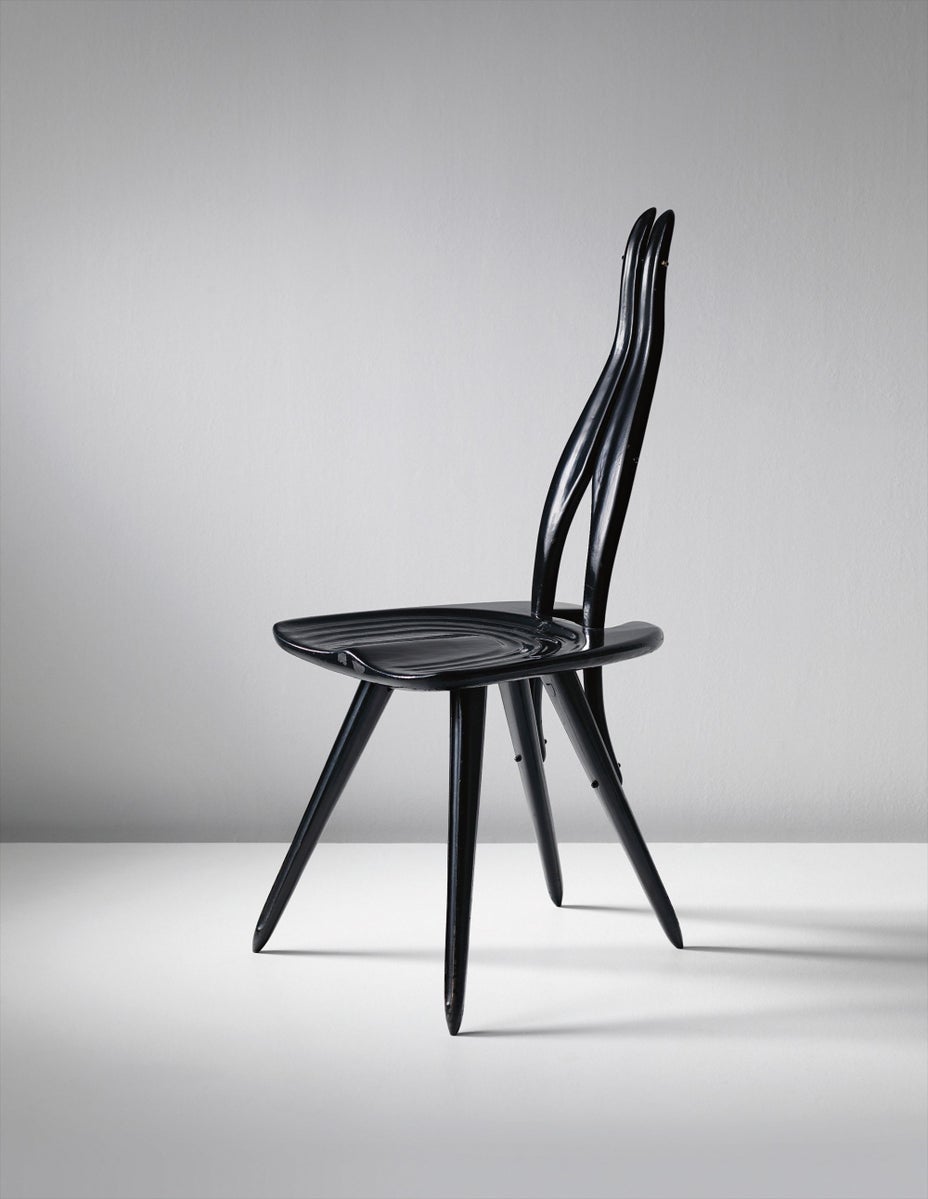
Important side chair, designed for Carlo Mollino's office at the Facoltà di Architettura, Politecnico di Torino
Full-Cataloguing
Phillips would like to thank Fulvio Ferrari and Napoleone Ferrari, Museo Casa Mollino, Turin, and Barry Friedman, New York, for their assistance cataloguing the present lot.
Mollino designed a set of eight side chairs for his office at the Turin Polytechnic’s Faculty of Architecture, where he was a Director. Six chairs were produced in a natural finish, of which four remain at the Polytechnic, one is in a private European collection, and the location of the sixth is unknown. Two other chairs, originally painted black, never appeared at the Polytechnic. Mollino gifted one, now in a private collection, to his friend and client Ada Minola. He installed the other, the present lot, in 1959 in his Villa Scalero garconnière, a small apartment where the chair served literally and figuratively as the support for many of his Polaroids of subsequent years.
MOLLINO’S CHAIR
Through singular work, artists express themselves, with their inner essence, and animate canvases, music, architecture, and even chairs, offering “poetry.”
What makes this object so special?
It is necessary to clarify that Mollino was not an industrial designer; he was not interested in designing objects for industrial production, which would require compromising the object in order to keep down production costs, to allow for mass production, for packaging, and so forth. Mollino’s furniture is unique and was expensively handmade by extraordinarily talented cabinetmakers with a very specific method, described by one of his students:
“Mollino used to shape an idea and make a technical drawing, specifying the construction method and adding notes on various aspects. I used to pick up these drawings from his studio and with Apelli convert it on a 1:1 scale on spolvero paper. Mollino used to come (running like a fawn), to check, review, amend, and then approve or redesign with a graphite pencil. Production was next. Hard times for the craftsman...”1
(It needs to be mentioned that for the present chair Mollino made a 1:1 drawing.)
With this chair, Mollino synthesized two different, apparently opposite, aspects of making art: the romantic, for which “art is expression of a feeling/emotion,” and the rational, according to which “the useful is art.” This is the foundation of how Mollino works, a man who was able to condense different worlds and to visualize things with a Zen heart.
As illustrated in the Polaroids which appear here, Mollino makes visible, with an immediate photographic representation, how he intends the chair to be a synthesis of the female body’s perfection of beauty and sensuality, represented by the chair’s physiognomy, which alludes to the female form. On the other hand this chair is formally perfect: it is well-planted to the ground; the back is segmented to account for the human backbone; and the seat, modeled to be as comfortable as possible, is functional and ergonomic.
This chair embodies and testifies to the history of human tradition. Mollino had a strong knowledge of ancient history and culture and was able to penetrate to the essence of objects. It is from the Alps tradition that Mollino deduced the structure of his chair: comparing this example with a traditional 19th-century Alpine chair, from which Mollino took his inspiration, it is clear that the two share the same height, the same inclination to back and legs, the same simple and perfect technique used to mount the back, the same seat and legs that give this chair an incredible structure. It is a refined and functional elegance, the work of an engineer.
This particular example, which he personally owned, was burled and finished with black shellack typical of a piano bench, an ulterior expression of a sort of “musicality” that, once again, transcends and unifies.
FULVIO FERRARI
NAPOLEONE FERRARI
Turin, November 2014
Pier Carlo Jorio in: Ferrari, The Furniture of Carlo Mollino, Phaidon, 2006, p. 16
Carlo Mollino
Italian | B. 1905 D. 1973Carlo Mollino made sexy furniture. His style may have grown out of the whiplash curves of Art Nouveau, but the sinuous lines of his furniture were more humanoid than vegetal, evoking arched backs and other body parts. Mollino was also an avid aviator, skier and racecar driver — he designed his own car for Le Mans. His love of speed and danger comes across in his designs, which MoMA curator Paola Antonelli has described as having "frisson."
Mollino had no interest in industrial design and the attendant constraints of material costs and packaging. His independent wealth allowed him to pick and choose projects, resulting in an oeuvre of unique, often site-specific works that were mostly executed by the Turin joinery firm Apelli & Varesio. Apart from a coffee table that he designed in 1950 for the American company Singer & Sons, his furniture never went into production. Notwithstanding the support of Gio Ponti, Mollino's design contemporaries largely dismissed him as an eccentric outsider. However, the combination of scarcity (Mollino only made several hundred works in his lifetime), exquisite craftsmanship and idiosyncratic "frisson" has rightly placed Carlo Mollino in the highest tier of twentieth-century design collecting.