PROPERTY FROM THE ESTATE OF HOLLIS FRAMPTON
224
Carl Andre
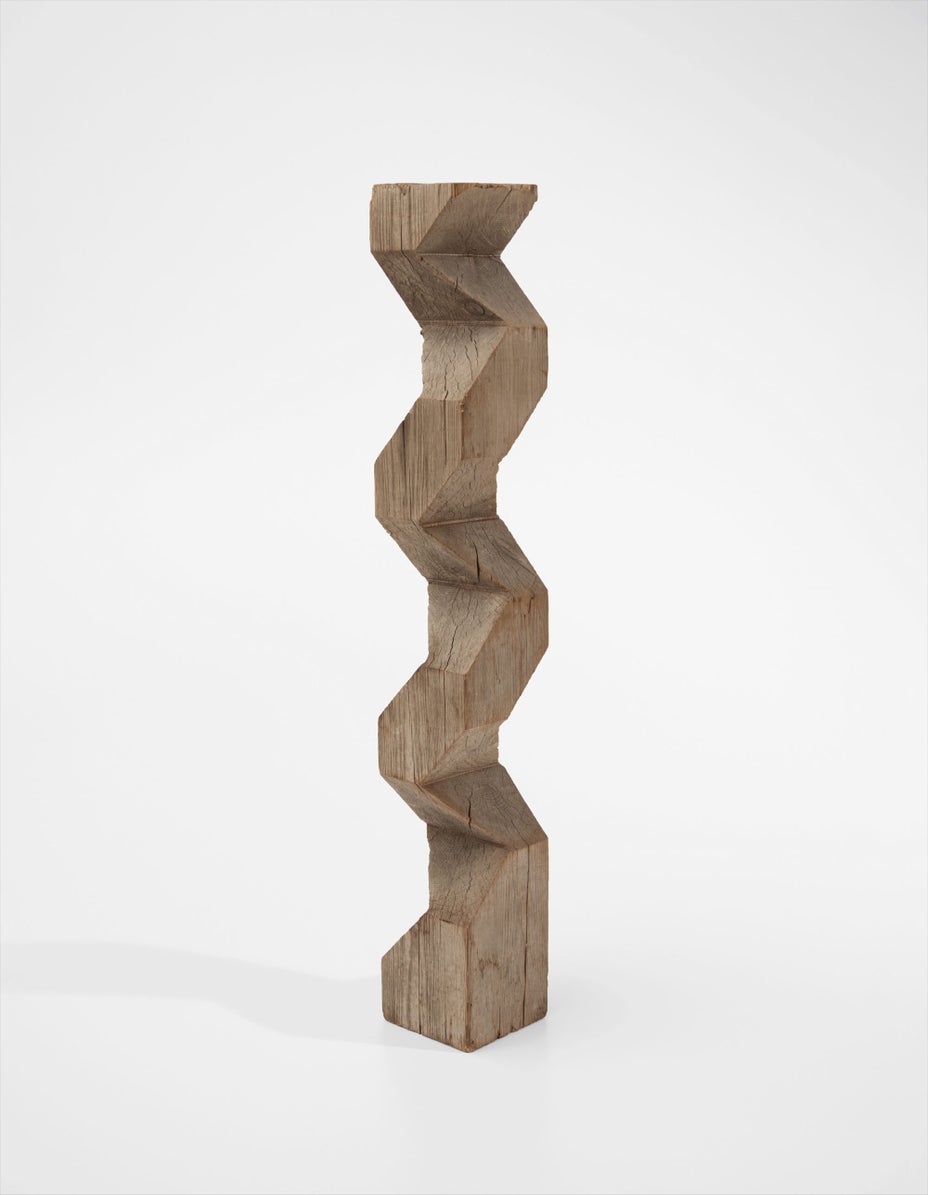
Wood Saw-Cut Exercise
Estimate
$150,000–200,000
Sold For
$162,500
wood
24 x 3 1/2 x 3 1/2 in. (61 x 8.9 x 8.9 cm.)
Executed in 1958, this work is accompanied by a certificate of authenticity signed by the artist.
Full-Cataloguing
It was in 1958 when Carl Andre made his foray onto the New York art scene by befriending some of the key members of the emerging Minimalist circle, such as Hollis Frampton and Frank Stella. These friendships inspired many of the artist’s earliest sculptures in his prolific oeuvre, some of which were even composed of materials supplied by Frampton and Stella themselves. In fact, Stella offered up his own studio space for Andre to begin carving, burning and carbonizing, experimenting with materials such as found wood beams and plastic parts. The resulting works created during this time exemplify a uniquely organic quality that illuminate Andre’s methodical sculptural practice in a way that his later more industrial works do not.
An elegant wooden tower measuring two feet tall, the present lot from this period is intricately carved in a sequence of receding positive and negative spaces. In its organic grace, the sculpture bears a distinct resemblance to the Italian Futurist Constantin Brancusi’s Columns from the earlier part of the century. Indeed, Andre was inspired by the regularity of shapes achieved in Brancusi’s sculpture, and thus began chiseling, and later burning, away parts of his own wooden towers. Andre’s receding areas of Wood Saw-Cut Exercise are even deeper and more varied than those in Brancusi’s Columns, emphasizing Andre’s interest in what he has coined “negative sculpture”. In 1972, Andre reflected on this preoccupation: “I had this thing about negative sculpture. What I wanted to do was cut into the body of the block of plastic or block of wood: [the forms] were concave instead of convex. Which I think was a silly idea. But I think that was my response to Brancusi” (Carl Andre, quoted in Paul Cummings, “Taped Interview with Carl Andre in His Studio in Westbeth, September, 1972”, reprinted in James Meyer, ed., Carl Andre, Cuts: Texts 1959 – 2004, Cambridge, 2005). Its structure oscillating and interacting with the varying textures of the wood grain, Wood Saw-Cut Exercise is a testament to Andre’s ability to turn a found material into the highest form of art.
An elegant wooden tower measuring two feet tall, the present lot from this period is intricately carved in a sequence of receding positive and negative spaces. In its organic grace, the sculpture bears a distinct resemblance to the Italian Futurist Constantin Brancusi’s Columns from the earlier part of the century. Indeed, Andre was inspired by the regularity of shapes achieved in Brancusi’s sculpture, and thus began chiseling, and later burning, away parts of his own wooden towers. Andre’s receding areas of Wood Saw-Cut Exercise are even deeper and more varied than those in Brancusi’s Columns, emphasizing Andre’s interest in what he has coined “negative sculpture”. In 1972, Andre reflected on this preoccupation: “I had this thing about negative sculpture. What I wanted to do was cut into the body of the block of plastic or block of wood: [the forms] were concave instead of convex. Which I think was a silly idea. But I think that was my response to Brancusi” (Carl Andre, quoted in Paul Cummings, “Taped Interview with Carl Andre in His Studio in Westbeth, September, 1972”, reprinted in James Meyer, ed., Carl Andre, Cuts: Texts 1959 – 2004, Cambridge, 2005). Its structure oscillating and interacting with the varying textures of the wood grain, Wood Saw-Cut Exercise is a testament to Andre’s ability to turn a found material into the highest form of art.