963
Cabestan
Winch Tourbillon Vertical
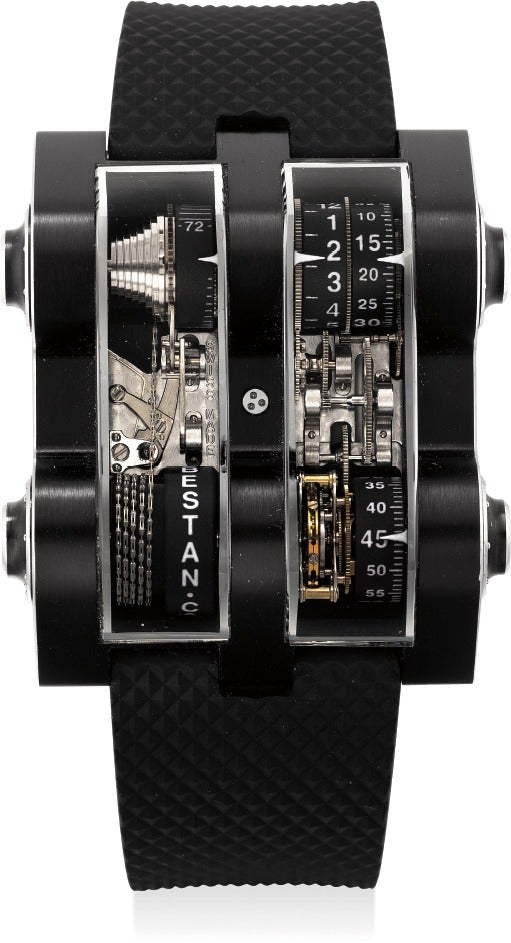
A very fine and highly unusual PVD-coated titanium wristwatch with vertical tourbillon, fuseé-chaine, Certificate and box. Number 50 of a limited edition of 110 pieces
Estimate
HK$300,000–500,000
€33,000–55,000
$38,500–64,100
Sold For
HK$437,500
Manufacturer
Cabestan
Year
Circa 2016
Movement No
CAB 0093
Case No
50/110
Model Name
Winch Tourbillon Vertical
Material
PVD-coated titanium
Calibre
Manual, winch-wound, jewelled
Bracelet/Strap
Rubber strap
Clasp/Buckle
PVD-coated titanium Cabestan deployant clasp
Dimensions
36mm width, 46mm length
Signed
Case, movement and clasp signed
Accessories
Accompanied by Cabestan Certificate of Origin and Purchase stamped by Vesenaz, Switzerland retailer CP Luxe and date December 16, 2016, fitted presentation box and outer packaging
Full-Cataloguing
Cabestan is one of the most eclectic independent watch brands. Active since 2003, it is renowned for the eccentricity and complexity of its creation. The present piece perfectly represents this ethos, as it is a very unusual and modernist take on two of the most traditional complications: the tourbillon and the fusee chain. Featuring an incredibly intricate movement comprising 910 components, this timepiece can be considered one of the most fascinating and futuristic fusions of traditional and contemporary watchmaking.
The tourbillon was created by A. L. Breguet to counterbalance the deviation induced by gravity on the balance wheel by having it revolve over time, thus creating a mean deviation over one revolution theoretically equal to zero. In this instance, it is placed vertically rather than the common horizontal configuration, allowing it to double, thanks to its coupling to a graduated barrel, as the constant second indication.
The chain fusee is instead one of the earliest solutions to the problem of constant force. As the mainspring unwinds, the force it supplies to the movement decreases. While a balance wheel has a theoretical rate which is independent from the force applied, in practice the variable force has an impact on the constance of the balance wheel rate. To counter this, the energy is transmitted from the barrel to the movement through a chain which coils around a conical element. As the mainspring unwinds, the lever used to transmit the force to the movement gets longer as the chain is anchored to the larger base of the cone. An increase in the length of the lever results in an increase in the force, thus compensating the loss from the unwinding spring.
A final piece of mechanical oddity is provided by the mean by which the watch is wound. A tiny winch lever is housed in the clasp. By connecting it to the top left socket, one winds the watch. The socket on the top right is instead used for time setting.
The tourbillon was created by A. L. Breguet to counterbalance the deviation induced by gravity on the balance wheel by having it revolve over time, thus creating a mean deviation over one revolution theoretically equal to zero. In this instance, it is placed vertically rather than the common horizontal configuration, allowing it to double, thanks to its coupling to a graduated barrel, as the constant second indication.
The chain fusee is instead one of the earliest solutions to the problem of constant force. As the mainspring unwinds, the force it supplies to the movement decreases. While a balance wheel has a theoretical rate which is independent from the force applied, in practice the variable force has an impact on the constance of the balance wheel rate. To counter this, the energy is transmitted from the barrel to the movement through a chain which coils around a conical element. As the mainspring unwinds, the lever used to transmit the force to the movement gets longer as the chain is anchored to the larger base of the cone. An increase in the length of the lever results in an increase in the force, thus compensating the loss from the unwinding spring.
A final piece of mechanical oddity is provided by the mean by which the watch is wound. A tiny winch lever is housed in the clasp. By connecting it to the top left socket, one winds the watch. The socket on the top right is instead used for time setting.