17Ο︎◆︎
Brice Marden
Star (for Patti Smith)
Full-Cataloguing
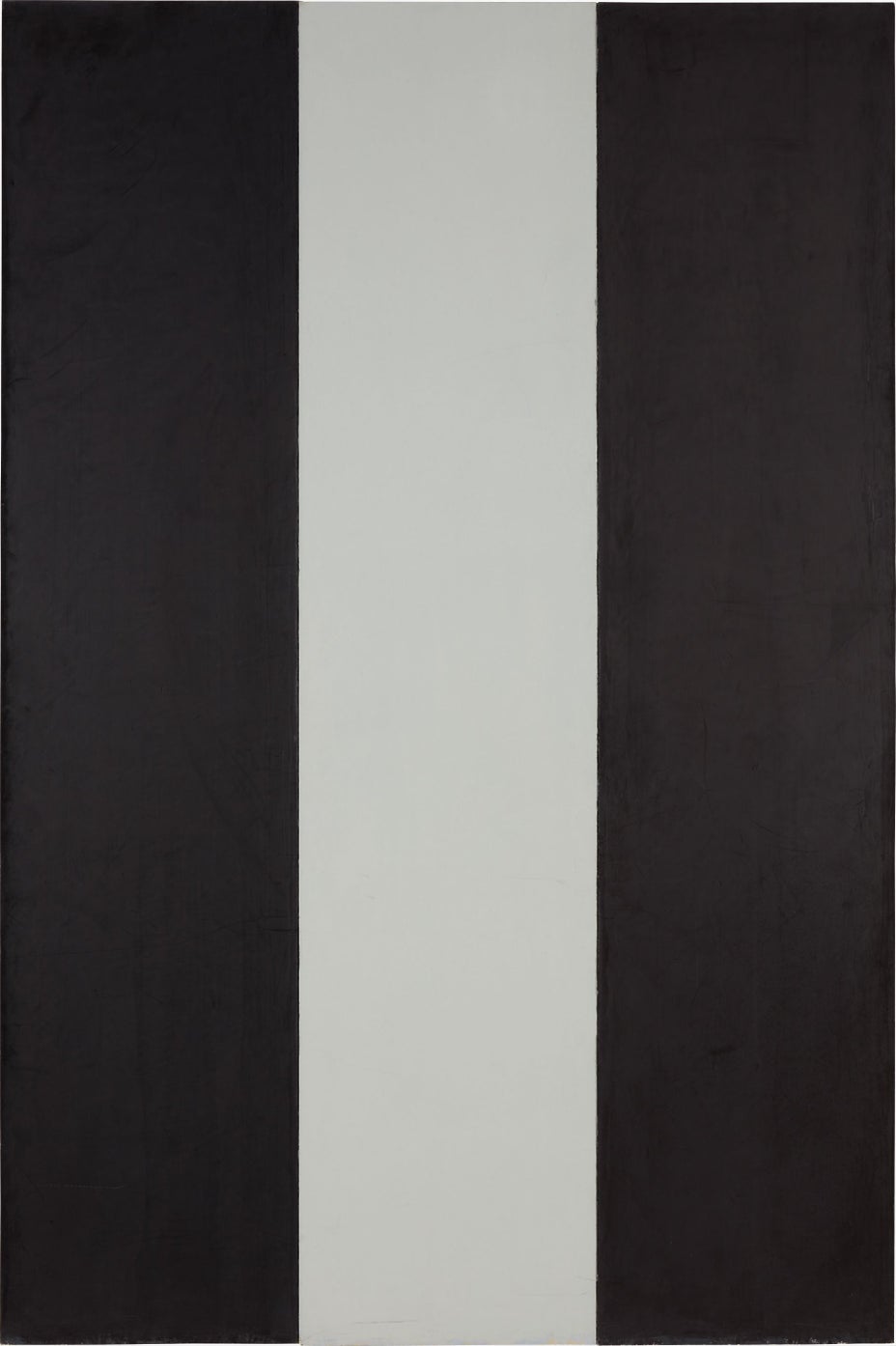
Brice Marden’s Star (for Patti Smith), 1972-74, is an elegant and luminous portrait of the artist’s close friend and rock star Patti Smith. The painting stands as one of the artist’s celebrated abstract “portraits,” many of which are held in important institutions' collections including For Carl Andre, 1966 in the Collection of Crystal Bridges Museum of American Art and The Dylan Painting, 1966-86 in the Collection of the San Francisco Museum of Modern Art.
Rendered in minimalist subdued tones, Star (for Patti Smith) honors the musician and writer whose musical and poetic output drew on the influences of The Velvet Underground and The Doors, along with French symbolist and Beat strains of introspective and sensual poetry. Marden’s succinct rendering of the artist in his own minimalist language, “evokes an exciting and intensely creative moment in New York’s cultural history,” art historian Eileen Costello explains, describing Star (for Patti Smith) as one of Marden’s most celebrated portraits. “In the 70’s, the city might have been dirty, dangerous and destitute, but downtown had a passionately experimental and vital art scene. When Marden met Smith, she was a waif poet who used to come to his studio to use his typewriter – an Olivetti – because she thought it improved the quality of the rock criticism she was writing for Creem and Rolling Stone.” (Eileen Costello, Brice Marden, London: Phaidon Press, 2013, p. 56.)
Seeking to distill Smith’s own stark and direct writing style, which would come to define her as the reigning “punk poet laureate” of the downtown art scene, Marden conceived a composition of three vertical stripes. Each separate panel precisely measures Smith’s height and shoulder-width. Indeed, in Star (for Patti Smith) the physical proportions of the individual are mapped like a grid onto the abstracted portrait, at once retaining and vacating the human presence from the elemental, geometric components of the painting. The lustrously soft, yet dynamic surface of the work was created through successive layers of oil paint, melted beeswax and turpentine. This encaustic medium, once manipulated by the deft touches of Marden’s palette knife, yielded a sculptural nuance to the surface of the work. This, in tandem with the matte-ness of the material, creates a surface tension that encourages the eye to actively traverse the expanse of work, probing the paradoxical depth and flatness that Marden’s composition presents. The beeswax acts as a coating sealant, joining the individual three colored panels into a singular composition.
Executed over a two year span, Marden first exhibited his portrait of Smith at his solo show at Bykert Gallery, New York in February 1972. The work was exhibited with the third panel in what the artist described as “buttery yellow.” Marden subsequently re-visited his composition and re-imaged the portrait as two matte midnight black bands which frame his luminous gray “figure” of Smith. As Marden explains in his statement and proposal for Star (for Patti Smith) at the time, “Now I plan to work two blacks, warm and cool, against a strong value change to the white-grey flesh, but to keep the flesh strong as color to make the whole strong color. I will think about Zurbaran monk paintings as I work on it, but not in terms of a superficial color resemblance. I want the plane to have that fanatic Zurbaran intensity.” (Brice Marden, Statement and Proposal: Star (for Patti Smith), January 1973) His ultimate composition perfectly distills the cool reticence and the convention-breaking energy of Smith’s personality and artistry. The adherence to a minimal language of form veils, according to the artist, a deep subjective response to Smith’s star quality and her immediate human presence. “My idea for Star was to make a portrait, not a picture of a person. I hoped to embody a spirit.”(Brice Marden, Statement and Proposal: Star (for Patti Smith), 1973)
Brice Marden
American | 1938Born in Bronxville and working between New York City, Tivoli, New York, and Hydra, Greece, Brice Marden developed a unique style that departs from his Abstract Expressionist and Minimalist contemporaries. Drawing from his personal experiences and global travels, Marden’s works demonstrate a gestural and organic emotion channeled through the power of color. By the late 1960s, Marden received international recognition as the master of the monochrome panel and, in the late 1970s, began exploring the relationship between horizontal and vertical planes. His practice is deeply informed by his knowledge of classical architecture, world religion, ancient history, and spirituality. Elected to the American Academy of Arts and Letters in 1998, Marden is represented in notable institutional collections including the Whitney Museum of Art, New York, Philadelphia Museum of Art, Stedelijk Museum, Amsterdam, and Centre Georges Pompidou, Paris.