PROPERTY FROM THE COLLECTION OF CEIL AND MICHAEL PULITZER
24
Arshile Gorky
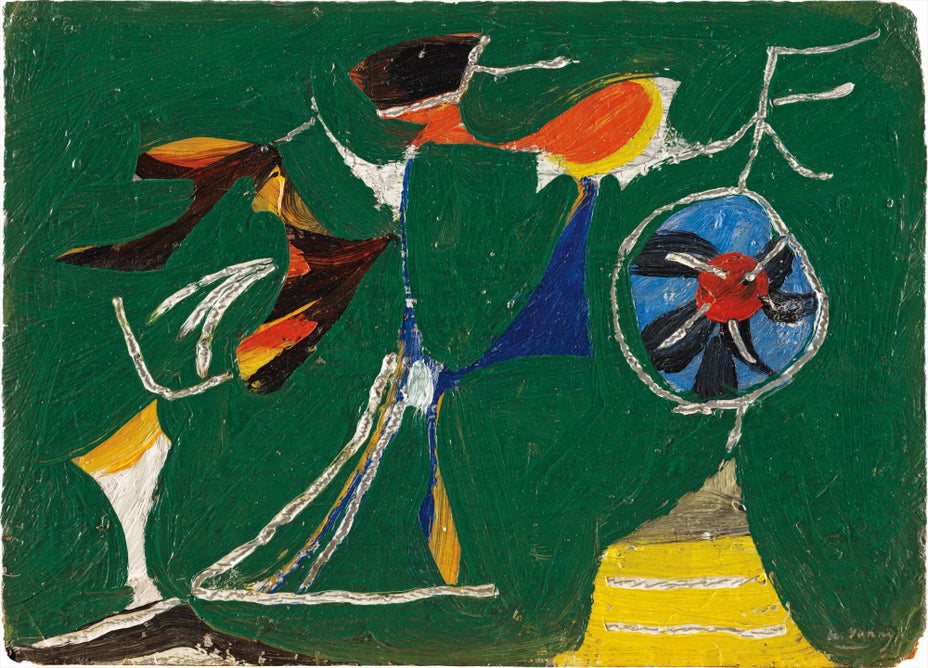
Study for Sochi
Estimate
$250,000–350,000
oil on board
10 x 14 in. (25.4 x 35.6 cm)
Signed "A Gorky" lower right. This work is catalogued in the Arshile Gorky Foundation Archives as P249.
Full-Cataloguing
"In my art I often drawn our gardens and recreate its precious greenery and life. Can a son forgeth the soil which sires him?”Arshile Gorky
The present lot, Arshile Gorky’s 1941, Study for Sochi, reflects a wonderful period in the artist’s life personally as well as artistically. A tribute to his father’s lush garden located in Khorkom, the series of works have remained a seemingly enigmatic scene to his contemporaries. Shortly after his marriage to Agnes Magruder and upon his return to New York, Gorky began this important and career defining series of works by forging a creative style all his own. By actively diverging from his previous influencers, the Surrealists artists such as Joan Miró and Jean Arp, Gorky pulled in childhood motifs from his past and re-contextualized them as abstracted components in a newly formed artistic language. “The Garden in Sochi series may have been the last of his works to deal directly with Armenia, the subject continued to exercise a power over him. Almost as if he dreaded losing contact with the past, with his earliest memories of his native land, its serenity and dignity...." (H. Rand, Arshile Gorky: The Implications of Symbols, Oakland: University of California Press, 1991, p. 101)
Gorky’s Sochi series of works reference the Russian Black Sea resort of Sochi in their titles, however the title is now believed to be a mis-translation. In Gorky’s native Armenian the word for poplar tree is Sos or Soi, a type of tree that would have resided in the natural and nostalgic setting of his youth. In the present lot, deep crimson, pale blue and canary yellow forms float upon a lush green background while a fan, described in other works as a “pinwheel mechanism,” sits stoically in the center of the painting. The twisting shapes seem to climb like ivy from the left hand corner of the canvas, meandering and tunneling to the right half of the picture plane. Unable to be captured, the shapes march off into the distance, “Gorky would not release his grip on that idyllic and pastoral moment, although memory naturally and inexorably allowed the scenes to fade.” (IBID, p. 101)
The present lot, Arshile Gorky’s 1941, Study for Sochi, reflects a wonderful period in the artist’s life personally as well as artistically. A tribute to his father’s lush garden located in Khorkom, the series of works have remained a seemingly enigmatic scene to his contemporaries. Shortly after his marriage to Agnes Magruder and upon his return to New York, Gorky began this important and career defining series of works by forging a creative style all his own. By actively diverging from his previous influencers, the Surrealists artists such as Joan Miró and Jean Arp, Gorky pulled in childhood motifs from his past and re-contextualized them as abstracted components in a newly formed artistic language. “The Garden in Sochi series may have been the last of his works to deal directly with Armenia, the subject continued to exercise a power over him. Almost as if he dreaded losing contact with the past, with his earliest memories of his native land, its serenity and dignity...." (H. Rand, Arshile Gorky: The Implications of Symbols, Oakland: University of California Press, 1991, p. 101)
Gorky’s Sochi series of works reference the Russian Black Sea resort of Sochi in their titles, however the title is now believed to be a mis-translation. In Gorky’s native Armenian the word for poplar tree is Sos or Soi, a type of tree that would have resided in the natural and nostalgic setting of his youth. In the present lot, deep crimson, pale blue and canary yellow forms float upon a lush green background while a fan, described in other works as a “pinwheel mechanism,” sits stoically in the center of the painting. The twisting shapes seem to climb like ivy from the left hand corner of the canvas, meandering and tunneling to the right half of the picture plane. Unable to be captured, the shapes march off into the distance, “Gorky would not release his grip on that idyllic and pastoral moment, although memory naturally and inexorably allowed the scenes to fade.” (IBID, p. 101)