27Ο︎
Armando Reverón
Ranchos de Macuto
Full-Cataloguing
In Macuto, Reverón purchased a large plot of land and established his home and studio, which he named, El Castillete (Little Castle). In 1924, Reverón began to paint landscapes, inspired by the coastal Caribbean scenery. Referred to as the white period, Reverón began experimenting with stark white color palettes and alternative materials including burlap and paper bags in replacement of traditional canvases. In 1935, Reverón began his “sepia period” following a major schizophrenic attack in 1933. During this time, the artist experimented with a more subdued color palette often leaving much of the canvas untouched, creating a raw texture and emulating the visual quality of blinding light.
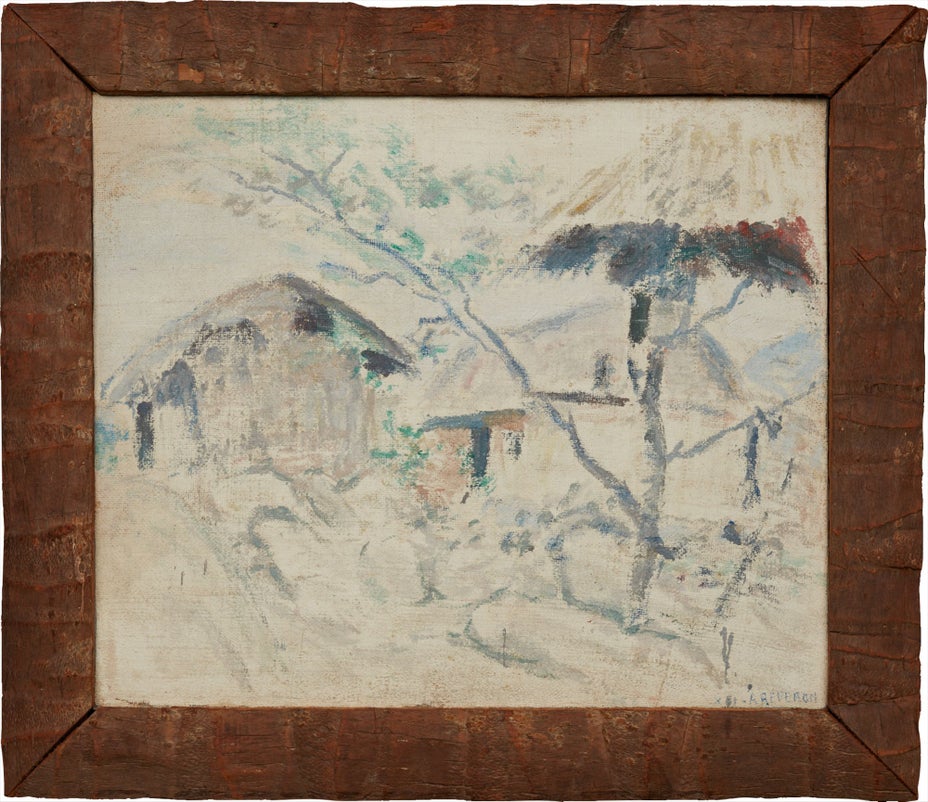
The present lot, Ranchos de Macuto (1941) is a prime example of Reverón’s later modernist style. Composed of deeper jewel tones such as greens, blues, ochre and grey, the artist created an expressionistic composition. In the foreground, Reverón depicted a slender tree, whose long branches separate the picture plane diagonally. The huts in the background are merely outlined and rendered with loose painterly brushstrokes. Similar to many of his earlier works, Reverón left much of the canvas untouched, reminiscent of his sepia period. Although Reverón executed many landscapes throughout his career, Ranchos de Macuto is unique in its compositional liberty. The instability of the formal elements creates a dynamic composition which illustrates the artist’s tactile style and anticipates later chromatic abstract paintings. One of the important elements of this work is the original coconut frame, which Reverón created from coconut trees found on his property in Macuto. According to expert Rafael Romero, there are less than 12 works with this original coconut frame. This frame is not only rare, but it also highlights Reverón’s interest in creating his own artistic tools including frames, brushes and burlap canvases. Ranchos de Macuto is one of the few complete examples of Reverón’s revolutionary modernist technique and exemplifies the influence of his surroundings and the incorporation of natural materials in his art.
Armando Reverón
Venezuelan | B. 1889 D. 1954Armando Reverón was born into a wealthy Venezuelan family where he found an early interest in art, studying in Caracas and Spain under Ignacio Zuloaga. Upon his return to Venezuela he was diagnosed with schizophrenia, causing him to retreat to the coastal village of Macuto with his lifelong partner, Juanita.
Often depicting landscapes and nudes, Reverón developed a singular painting technique utilizing a highly textured monochromatic white palette. Many of his works also feature touches of blue, gray, aquamarine and occasional areas of bare canvas. This color scheme emulates the blinding luminosity of light one would experience on the beaches of Venezuela. Reverón worked in isolation and made most of his painting supplies himself, including brushes, canvases and coconut tree frames.