152
Andy Warhol
Torso
Full-Cataloguing
Andy Warhol
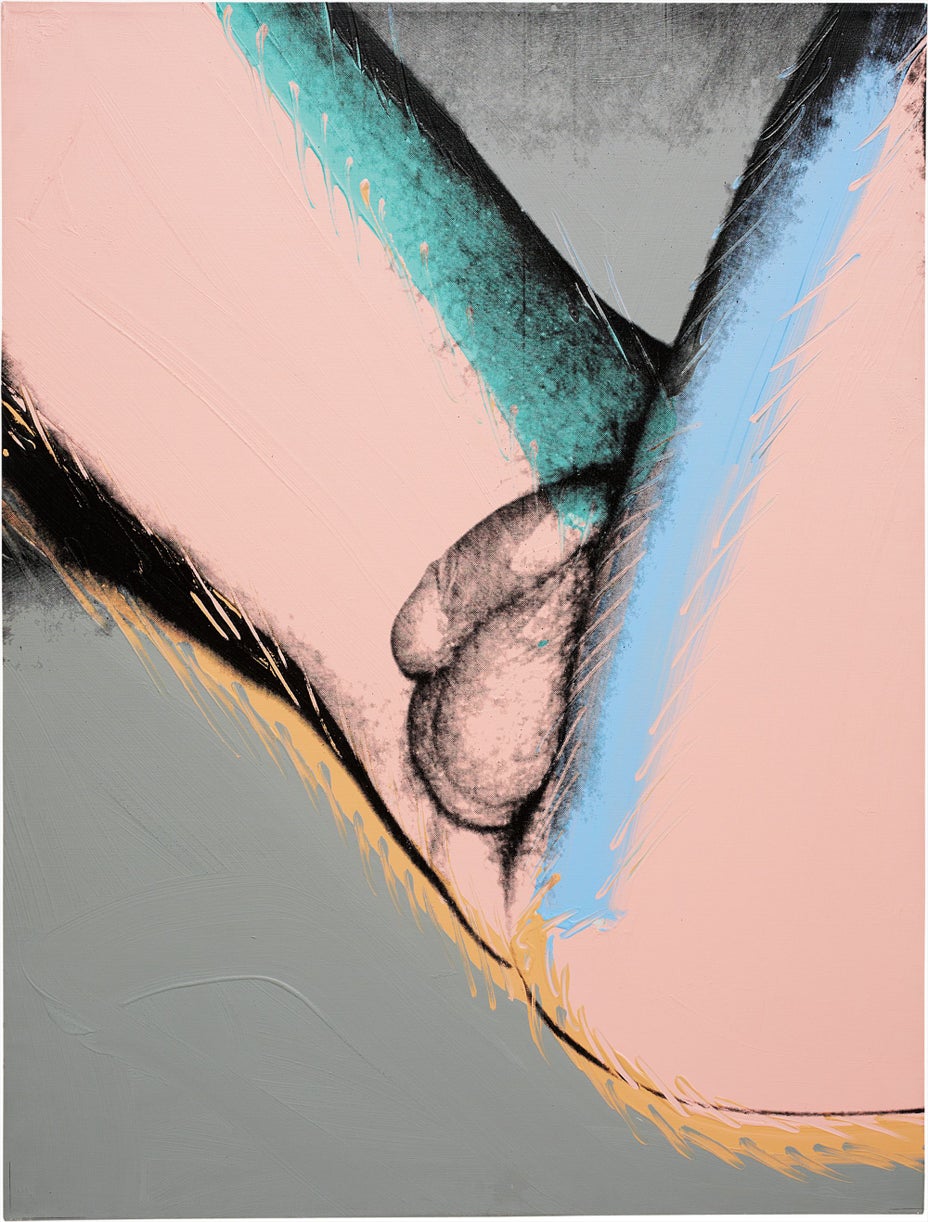
Throughout Warhol’s vast and varied output of images, the whole human body is never fully rendered in his oeuvre. The intensification of the close-up, exemplified in the present lot, represents nearly all of Warhol’s small series of the naked human body. Most interesting is the framing of the nude works; heads are excised from the pictures, leaving the subject’s identity a mystery. This close-crop of the subject, focusing exclusively on an intimate fragment of the sitter, hearkens back to Courbet’s L'Origine du monde; however, here the form is accented with bold hues in hand-painted. The application of dramatic tones infuses the painting with a commerciality that recalls the vibrancy of Warhol’s earliest silkscreens—Marilyns and soup cans.
In the present lot, Torso, 1977, the pornographic implications of the phallus are conveyed as a sophisticated construct in a closely-cropped presentation. A map is created from the male form, highlighting the curves and convexities of the body’s terrain. The contrast between the pink fleshy planes of the legs and the hair-like brushstrokes offers a topographical study of form. Within this palette, Torso, 1977, emerges as a landscape: the pink thighs as hills, the blue vertical stroke as the sky, the green diagonal line as a meadow, and the swaths of ochre yellow as the setting sun. "Victor came down with a nude pose-er. I’m having boys come and model nude for photos for the new paintings I’m doing. But I shouldn’t call them nudes. It should be something more artistic. Like 'Landscapes.' Landscapes." (Andy Warhol, The Andy Warhol Diaries, p. 32.)
The framing of each Torso painting is based on Polaroid images by Warhol of the sitters, behind closed doors and were usually taken at the Factory or in Victor Hugo’s loft. The erotic nature of each shot is heightened by the glory-hole perspective of the scene and the anonymity of the sitter. The resulting paintings, screen-printed and hand-painted, exemplify Warhol’s ability to define his artistic output, as in the Torso series, via a purely unique and timely aestheticism.
Andy Warhol
American | B. 1928 D. 1987Andy Warhol was the leading exponent of the Pop Art movement in the U.S. in the 1960s. Following an early career as a commercial illustrator, Warhol achieved fame with his revolutionary series of silkscreened prints and paintings of familiar objects, such as Campbell's soup tins, and celebrities, such as Marilyn Monroe. Obsessed with popular culture, celebrity and advertising, Warhol created his slick, seemingly mass-produced images of everyday subject matter from his famed Factory studio in New York City. His use of mechanical methods of reproduction, notably the commercial technique of silk screening, wholly revolutionized art-making.
Working as an artist, but also director and producer, Warhol produced a number of avant-garde films in addition to managing the experimental rock band The Velvet Underground and founding Interview magazine. A central figure in the New York art scene until his untimely death in 1987, Warhol was notably also a mentor to such artists as Keith Haring and Jean-Michel Basquiat.