70
Andy Warhol
Flowers
Full-Cataloguing
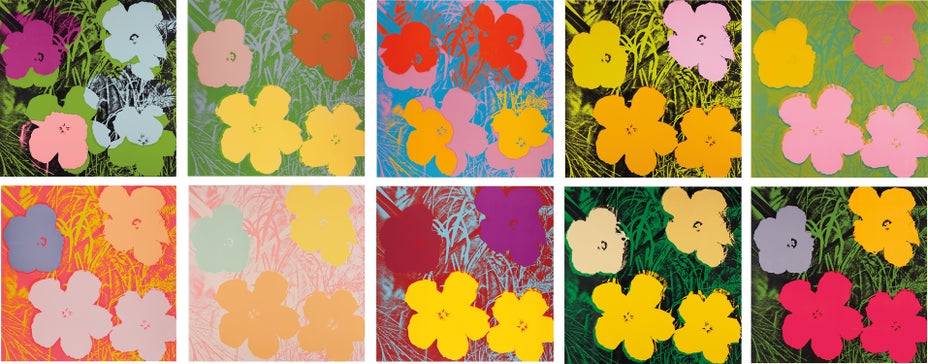
Flowers served up a rainbow spectrum of technicolor possibilities; Warhol’s budding blossoms evoked self-improvement, that most American enterprise. The hypnotic repetition of this flowery image that was clipped from a magazine mimicked the obsessive nature of a postwar public — inundated with images of opulence both on television as well as in printed ads — that was fixated like never before on beauty.
At attraction’s apex, these hibiscuses were most vulnerable, blooming in abundance for just fleeting moments — much like Warhol’s favorite movie stars. Only after some demise would he capture Marilyn Monroe and Liz Taylor. These ten screenprints were a clique of inevitably fading beauties verging upon surreal. At Factory Additions, Andy Warhol engineered the ephemeral into the immortal and ordinary into grandeur; no more so than in this wall-to-wall garden that alchemized commonplace florals into fresh buds that bloom on forever.
Andy Warhol
American | B. 1928 D. 1987Andy Warhol was the leading exponent of the Pop Art movement in the U.S. in the 1960s. Following an early career as a commercial illustrator, Warhol achieved fame with his revolutionary series of silkscreened prints and paintings of familiar objects, such as Campbell's soup tins, and celebrities, such as Marilyn Monroe. Obsessed with popular culture, celebrity and advertising, Warhol created his slick, seemingly mass-produced images of everyday subject matter from his famed Factory studio in New York City. His use of mechanical methods of reproduction, notably the commercial technique of silk screening, wholly revolutionized art-making.
Working as an artist, but also director and producer, Warhol produced a number of avant-garde films in addition to managing the experimental rock band The Velvet Underground and founding Interview magazine. A central figure in the New York art scene until his untimely death in 1987, Warhol was notably also a mentor to such artists as Keith Haring and Jean-Michel Basquiat.