48
Andreas Gursky
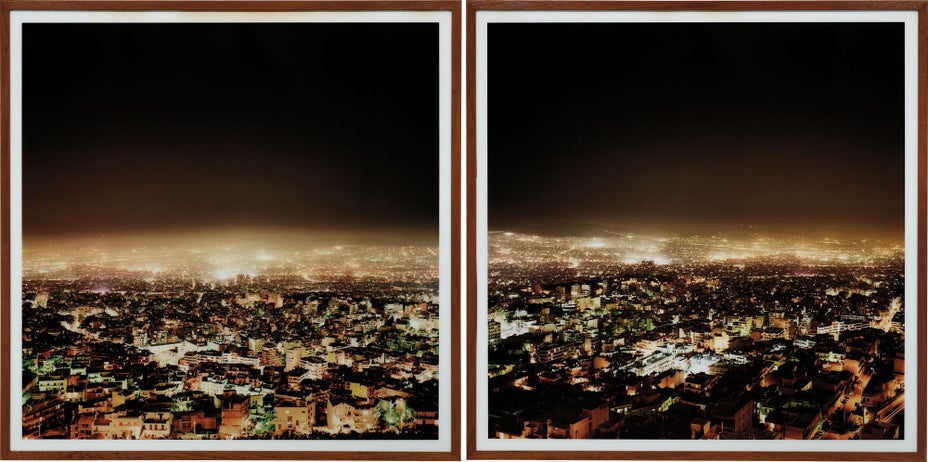
Athens, 1995
Estimate
$250,000–350,000
Sold For
$401,000
1995
Inkjet print diptych, printed later, face-mounted to Plexiglas.
Overall 72 3/4 x 144 3/4 in. (184.8 x 367.7 cm)
Signed on the verso; signed in ink, printed title, date and number 3/6 on an artist's label affixed to the frame backing of the left panel.
Full-Cataloguing
The spectacular view seen in Andreas Gursky’s Athens, 1995 appears to be taken from a distant peak looking down upon the city below. It is warm and thick, a sepia toned tapestry made up of endless tungsten lit buildings that are fluoresced in splashes across the picture plane by street lamps and car lights. In the distance particulate matter gathers to create a glowing dome over this man-made marvel of a starless night. Gursky’s photographs have often been compared to paintings because of their sensuous impact upon the viewer. Athens with its complexly abstract patterning and dynamic overall spattering of light indeed has the brunt shock of recognition similar to the physical effect one receives upon viewing a painting by Jackson Pollock.
Andreas Gursky is one of the greatest contemporary European photographers. Born in 1955 in Leipzig, former East Germany, Gursky attended the Folkwang School in Essen (1978–1981) followed by the Düsseldorf Art Academy (1981–1987) where he studied under Bernd and Hilla Becher. Since the 1990s he has become internationally recognized for his amazing large-scale color photographs. Gursky’s subject matter has been written about as being “architectural structures that reflect our contemporary global environment”. And indeed he does photograph manufacturing plants and supermarkets, hotel lobbies, apartment buildings, and stock exchanges from around the world. But the main theme of Gursky’s work is the conceptually rigorous interweaving of the micro details into a macro structure.
It is this tension between what we see and what we think we are seeing, between the surface details of a photographic image and what our minds seek to understand that holds us captivated by Gursky’s art. This he achieves in Athens, through his artful use of color, impressive scale (the combination of two mural size photographs) as well as an elevated and seemingly cool and distant point of view. All of which he combined with the subtle use of new technology and digital manipulation to create an image which appears to be seen from a place that is dizzily beyond normal human perception: a technological omnipresent vision of the HERE and NOW.
Andreas Gursky is one of the greatest contemporary European photographers. Born in 1955 in Leipzig, former East Germany, Gursky attended the Folkwang School in Essen (1978–1981) followed by the Düsseldorf Art Academy (1981–1987) where he studied under Bernd and Hilla Becher. Since the 1990s he has become internationally recognized for his amazing large-scale color photographs. Gursky’s subject matter has been written about as being “architectural structures that reflect our contemporary global environment”. And indeed he does photograph manufacturing plants and supermarkets, hotel lobbies, apartment buildings, and stock exchanges from around the world. But the main theme of Gursky’s work is the conceptually rigorous interweaving of the micro details into a macro structure.
It is this tension between what we see and what we think we are seeing, between the surface details of a photographic image and what our minds seek to understand that holds us captivated by Gursky’s art. This he achieves in Athens, through his artful use of color, impressive scale (the combination of two mural size photographs) as well as an elevated and seemingly cool and distant point of view. All of which he combined with the subtle use of new technology and digital manipulation to create an image which appears to be seen from a place that is dizzily beyond normal human perception: a technological omnipresent vision of the HERE and NOW.