205
Andreas Gursky
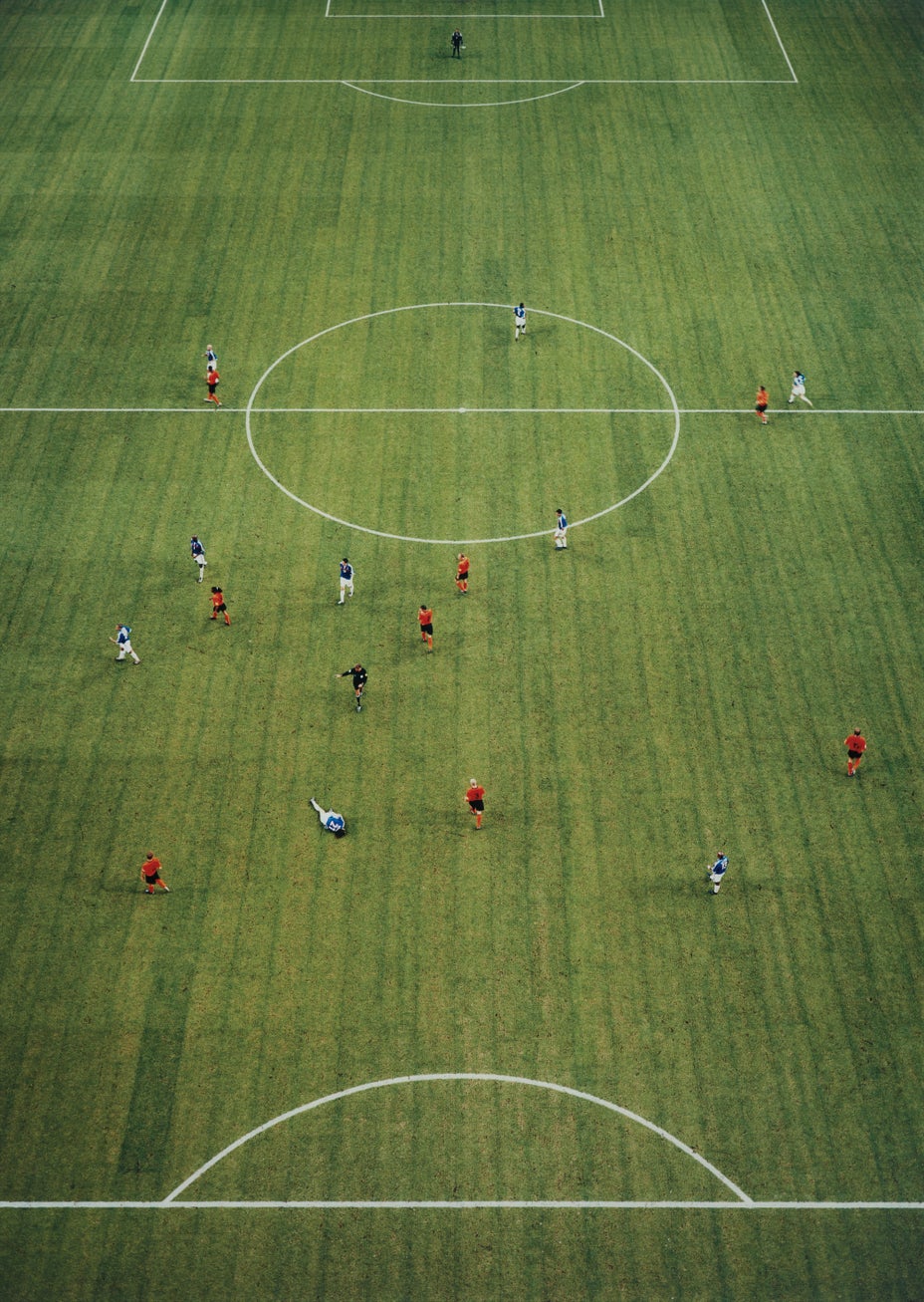
EM, Arena, Amsterdam I
Estimate
$350,000–450,000
Sold For
$331,250
2000
Chromogenic print, face-mounted to Plexiglas.
81 1/2 x 65 5/8 in. (207 x 166.7 cm)
Overall 109 1/2 x 83 3/8 in. (278.1 x 211.8 cm)
Overall 109 1/2 x 83 3/8 in. (278.1 x 211.8 cm)
Signed, titled, dated and numbered 4/6 in pencil on the verso; printed title, date and number on a gallery label affixed to the reverse of the frame.
Full-Cataloguing
While a student at the Kunstakademie in Düsseldorf, Andreas Gurksy studied under the guidance of Bernd Becher. Though clearly influenced by the conceptual nature of Bernd and his wife Hilla’s cool and detached typologies, Gursky was not beholden to the black-and-white aesthetic nor the objective documentary style of their photographs. As the son of a commercial photographer, he understood the merits and appeal of color photography, and in the early 1990s began to incorporate digital post-production into his image‐making process. By manipulating his images—combining negatives, altering details, or wholly constructing scenes as he has done in more recent photographs—Gursky’s goal is not to overtly fictionalize his work but to create hyperreal scenes that transcended any visual, spacial or technical limitations. With its powerful combination of color and monumental scale, EM, Arena, Amsterdam I, 2005, is one such scene: a spectacularly quiet and abstracted tableau captured amidst the chaos of its greater environment.
In his introductory essay to Andreas Gursky, Peter Galassi writes of the photographer’s “favored polarity between realism and abstraction.” Indeed, Gursky’s brilliance lay in his ability to present a scene that is at once “real” yet unknown. While the subject of a soccer match connotes an array of imagery— from the pulsating energy of the players as they dart across the field to the excitement of the screaming fans in the stands— what Gursky actually presents to us is far different.
Shooting from what seems an impossibly elevated vantage point, Gursky captures a scene so distant that viewers are removed from the details of the match unfolding below. He crops the field so as to show only a selection of isolated players and eliminates the crowd populating the stadium. Without a horizon line to orient the viewer, the picture plane is completely flattened thereby bringing focus to the grid-like pattern of the grass and the white markings that divide it. By abstracting the scene in the way that he does, Gursky creates an image whose subject is as much the formalist tenets of color, line and composition as it is the soccer match itself. Gursky reinforces the connection between this image and painting through its impressive size which, at nearly 9 x 7 feet, rivals the scale of canvases by 20th century masters such as Mark Rothko and Jackson Pollack, among others.
In EM, Arena, Amsterdam I, Gursky’s representation of reality through a matrix of abstraction frees his subject from traditional expectations, thus allowing viewers to immerse themselves in a wholly new experience.
In his introductory essay to Andreas Gursky, Peter Galassi writes of the photographer’s “favored polarity between realism and abstraction.” Indeed, Gursky’s brilliance lay in his ability to present a scene that is at once “real” yet unknown. While the subject of a soccer match connotes an array of imagery— from the pulsating energy of the players as they dart across the field to the excitement of the screaming fans in the stands— what Gursky actually presents to us is far different.
Shooting from what seems an impossibly elevated vantage point, Gursky captures a scene so distant that viewers are removed from the details of the match unfolding below. He crops the field so as to show only a selection of isolated players and eliminates the crowd populating the stadium. Without a horizon line to orient the viewer, the picture plane is completely flattened thereby bringing focus to the grid-like pattern of the grass and the white markings that divide it. By abstracting the scene in the way that he does, Gursky creates an image whose subject is as much the formalist tenets of color, line and composition as it is the soccer match itself. Gursky reinforces the connection between this image and painting through its impressive size which, at nearly 9 x 7 feet, rivals the scale of canvases by 20th century masters such as Mark Rothko and Jackson Pollack, among others.
In EM, Arena, Amsterdam I, Gursky’s representation of reality through a matrix of abstraction frees his subject from traditional expectations, thus allowing viewers to immerse themselves in a wholly new experience.