9
Alfredo Volpi
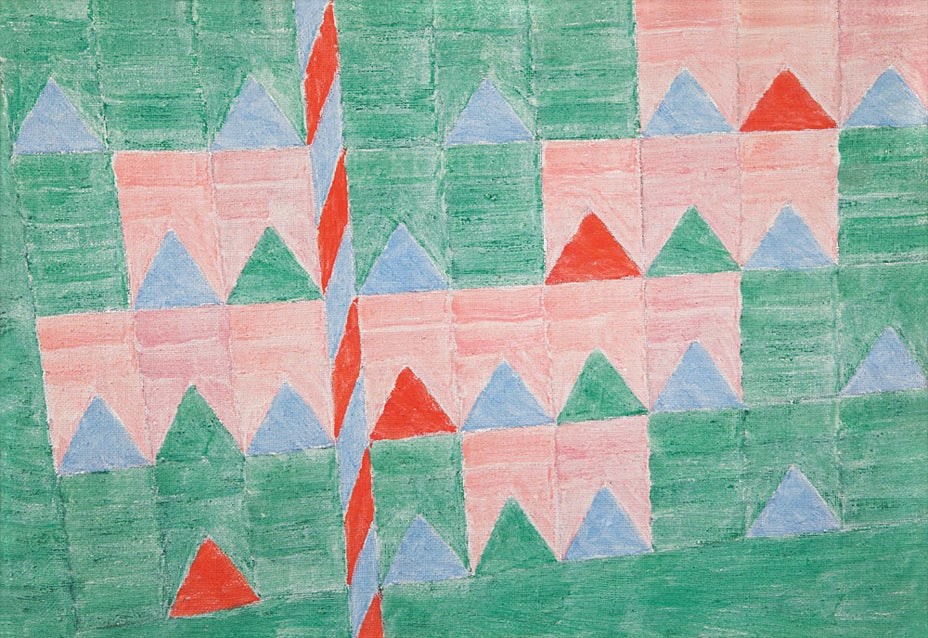
Banderinhas com mastro
Estimate
$100,000–150,000
Sold For
$125,000
tempera on canvas
12 3/8 x 18 in. (31.4 x 45.7 cm)
Painted circa 1970.
Full-Cataloguing
Alfredo Volpi’s significance within the international art milieu is intimately tied to his personal life. The son of Italian immigrants, Volpi grew up in a lower-middle-class neighborhood in Brazil, where he worked as a decorator, painting in Renaissance and Moorish styles. Despite being self-taught, he participated in dialogues with other artists and intellectuals in every phase of his oeuvre, acutely observing his neighborhood’s various landscapes, homes and terraces. In 1950, Volpi made a noteworthy trip to Italy and France. There—much like the self-taught conceptual artist Robert Ryman—Volpi studied medieval art extensively for six months. This prompted a radical shift in his style, resulting in his most important series of works, Banderihnas (Small Flags), exemplified in the work we see here.
In Banderihnas com maestro (circa 1970), Volpi used egg-based tempera instead of oil paint to achieve the luminous color palette, imbued with geometric rigor and precision. This simplified, yet striking series brought him international recognition, enabling the artist to exhibit in the first three editions of the São Paulo Bienal and later at the Venice Biennale. Most notably, this series won him the National Prize of Painting in the seminal 1953 São Paulo Bienal, considered one of the most important modern art exhibitions of the 20th century. Only now beginning to be once more acclaimed by the international art world, Volpi received much recognition during his lifetime, including receiving the Guggenheim International Award in 1958, among other accolades.
In Banderihnas com maestro (circa 1970), Volpi used egg-based tempera instead of oil paint to achieve the luminous color palette, imbued with geometric rigor and precision. This simplified, yet striking series brought him international recognition, enabling the artist to exhibit in the first three editions of the São Paulo Bienal and later at the Venice Biennale. Most notably, this series won him the National Prize of Painting in the seminal 1953 São Paulo Bienal, considered one of the most important modern art exhibitions of the 20th century. Only now beginning to be once more acclaimed by the international art world, Volpi received much recognition during his lifetime, including receiving the Guggenheim International Award in 1958, among other accolades.