134
Albert Sands Southworth and Josiah Johnson Hawes
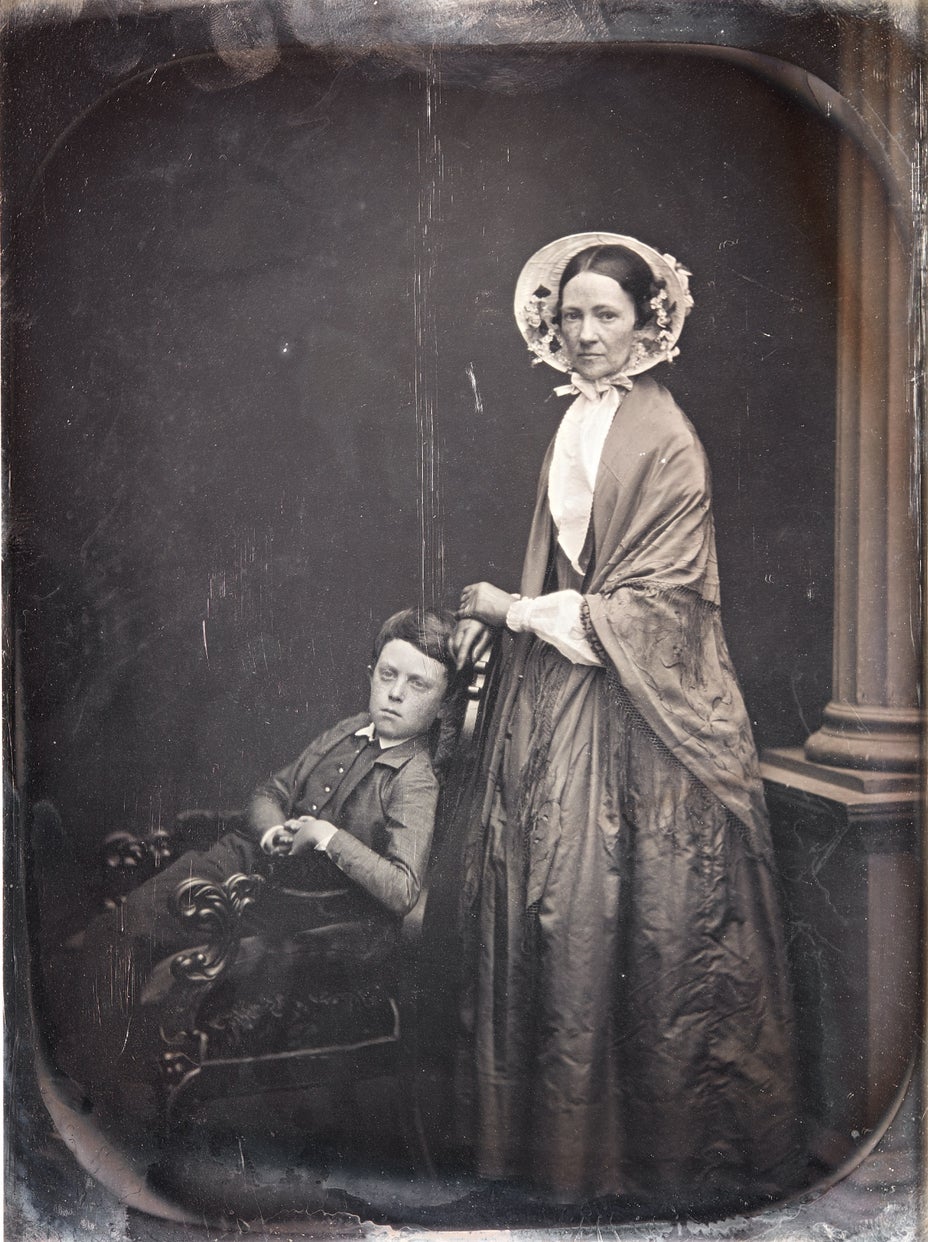
A Woman in Bonnet & Shawl, with Her Seated Son
Estimate
$10,000–15,000
Sold For
$35,000
circa 1850
Daguerreotype.
Whole plate.
Full-Cataloguing
This bravura whole-plate portrait was one of about 240 Southworth and Hawes daguerreotypes in the collection of David Feigenbaum (1917-1998) of Marblehead, Massachusetts, discovered after his death in 1998. This previously unknown group of daguerreotypes by these two formative American photographers constituted one of the largest holdings of their work and showcased the range and sophistication of their output. When found, most of the daguerreotypes were uncased and housed in slotted plate boxes. Their appearance at auction in 1999 represented the public debut of this unseen work and gave collectors an unprecedented opportunity to compete for material both rare and remarkable.
It is almost certain that Feigenbaum purchased the daguerreotypes from Boston’s Holman Print Shop, with whom Dr. Edward Hawes, son of Josiah Johnson Hawes and nephew of Albert Sands Southworth, arranged to sell the daguerreotypes that remained in the Southworth & Hawes studio. The Print Shop advertised sales of the material in 1934 and 1935, and it is likely that the young Feigenbaum built his collection during this period. His choices were made with a modern eye that was attuned to both the technical perfection of the daguerreotypes as well as their aesthetic qualities.
It is almost certain that Feigenbaum purchased the daguerreotypes from Boston’s Holman Print Shop, with whom Dr. Edward Hawes, son of Josiah Johnson Hawes and nephew of Albert Sands Southworth, arranged to sell the daguerreotypes that remained in the Southworth & Hawes studio. The Print Shop advertised sales of the material in 1934 and 1935, and it is likely that the young Feigenbaum built his collection during this period. His choices were made with a modern eye that was attuned to both the technical perfection of the daguerreotypes as well as their aesthetic qualities.