

201
A. Lange & Söhne
Hour Angle
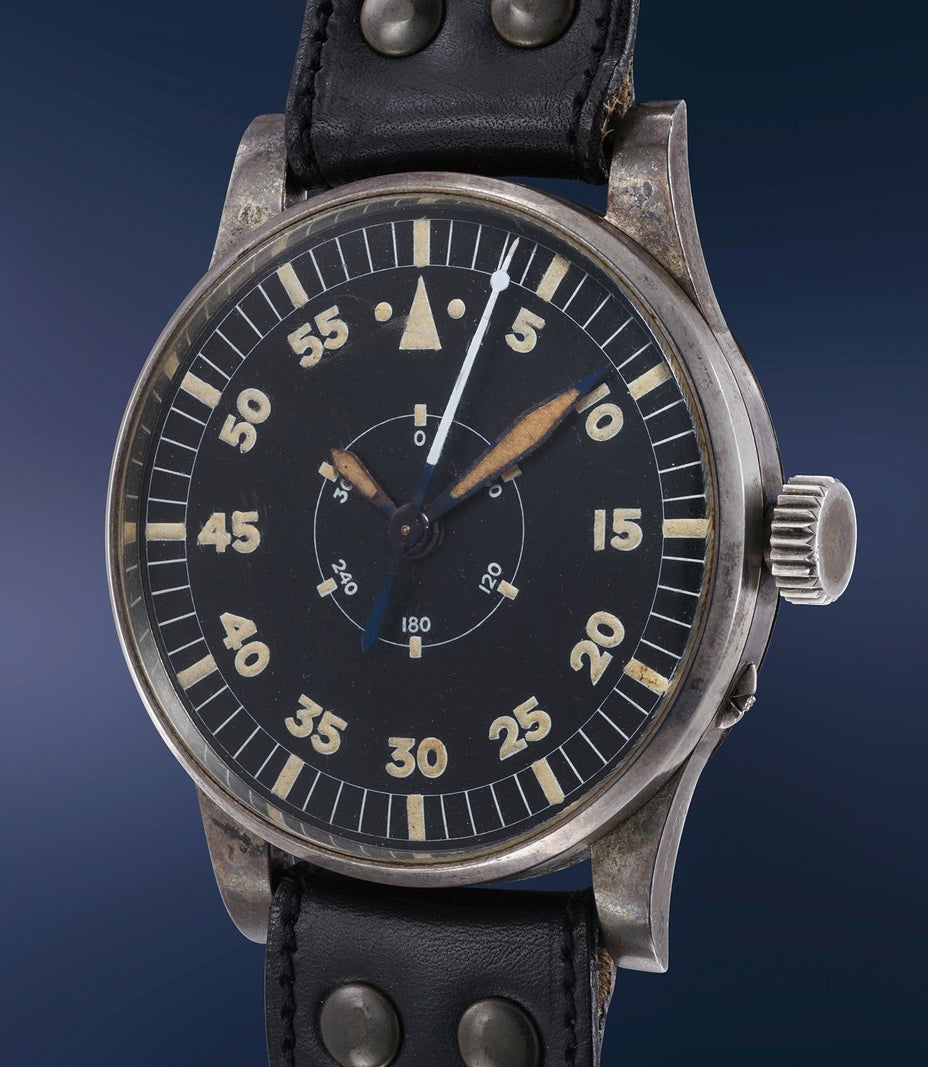
An oversized, possibly unique and historically relevant silver hour angle wristwatch with indirect center seconds, black luminous dial and guillaume balance, made for the German army
- Estimate
- CHF10,000 - 15,000€9,300 - 14,000$10,800 - 16,200
CHF102,060
Lot Details
- Manufacturer
- A. Lange & Söhne
- Year
- 1939
- Movement No
- 82'548
- Case No
- 82'548
- Model Name
- Hour Angle
- Material
- Silver
- Calibre
- Manual, jeweled
- Bracelet/Strap
- Leather
- Clasp/Buckle
- Pin buckle
- Dimensions
- 55mm Diameter
- Signed
- Case and movement signed
- Accessories
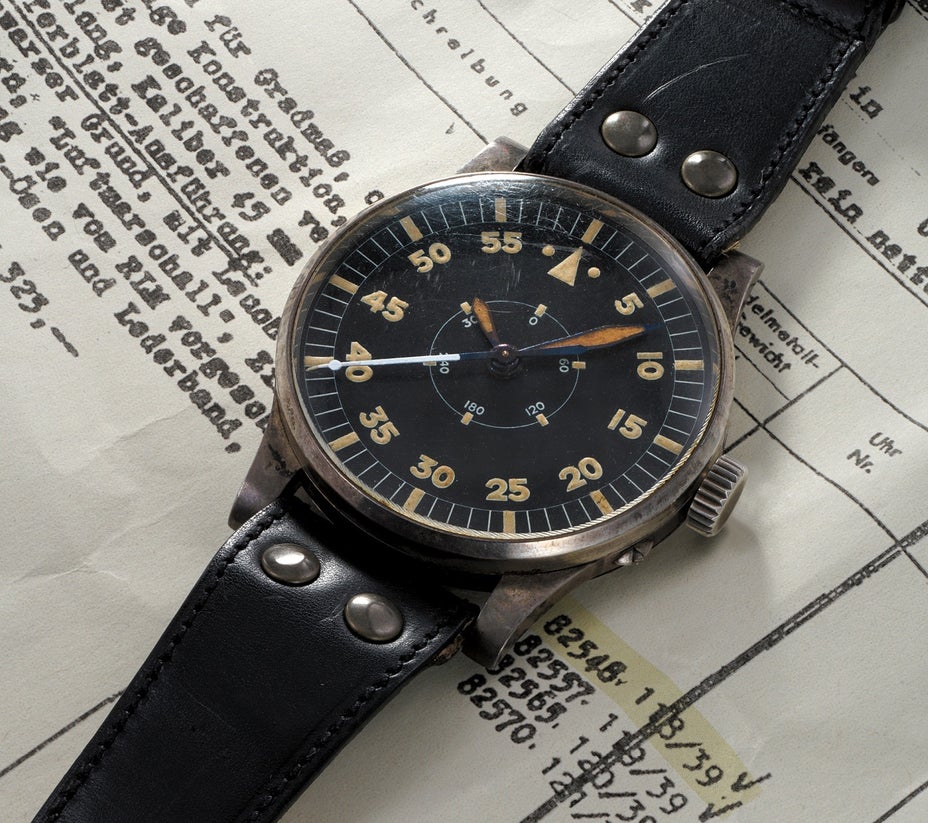
- Accompanied by copy of the original A. Lange & Söhne invoice in the name of "Reichsminister der Luftfahrt und Oberbefehlahaber der Lufftwaffe" and dated September 5, 1939.
Specialist
Full-Cataloguing
Catalogue Essay
The 1920s and 1930s were a golden era for aviation. The combination of a relatively novel field - holding the promise of flight nonetheless, one of humanity’s most ancient dream - relative socio-economic stability of the time, and the incumbent winds of war prompted the aggressive development of more and more reliable aircraft, eventually achieving transcontinental flight (Charles Linbergh, 1927).
One of the consequences of such developments was the need for more and more precise navigation instruments, and - thanks to inputs from Lindbergh himself together with other aviation legend Philip Van Horn Weems - a number of specific timepieces were developed. Without a doubt, the most rare among vintage aviator’s timepieces are those featuring “hour angle” dial, such as the present piece. These watches present time in degrees (rather than in minutes). As the earth is round and revolves once a day, the center indicator for the “hour” hand is divided in 360 degrees - the hand revolving once a day - and the outer track (“minute” hand) indicates the additional degrees to add to what shown on the central track. Minute and second hands proceed four times “slower” than on a normal watch, with one revolution every four minutes. Thus, one hour equal to 15 degrees: midday will be on this watch 180.0.0 degrees, and the “classic” 10:08:30 become 152.8.5.
With the advent of radio navigation such instruments became moot, thus their production span is extremely limited. In fact, such Hour Angle timepieces are among the scarcest watches one can look for: the German army tasked in 1934 A. Lange and Söhne alongside two Swiss manufacturers (Patek Philippe and Vacheron Constantin) to produce two hour angle models, one with split seconds, the other without. As testified by the copy of the original invoice delivered with the watch, it took 2 years for the company to deliver 4 prototype watches in 1939 at a cost of 323RM (Reichsmark) each
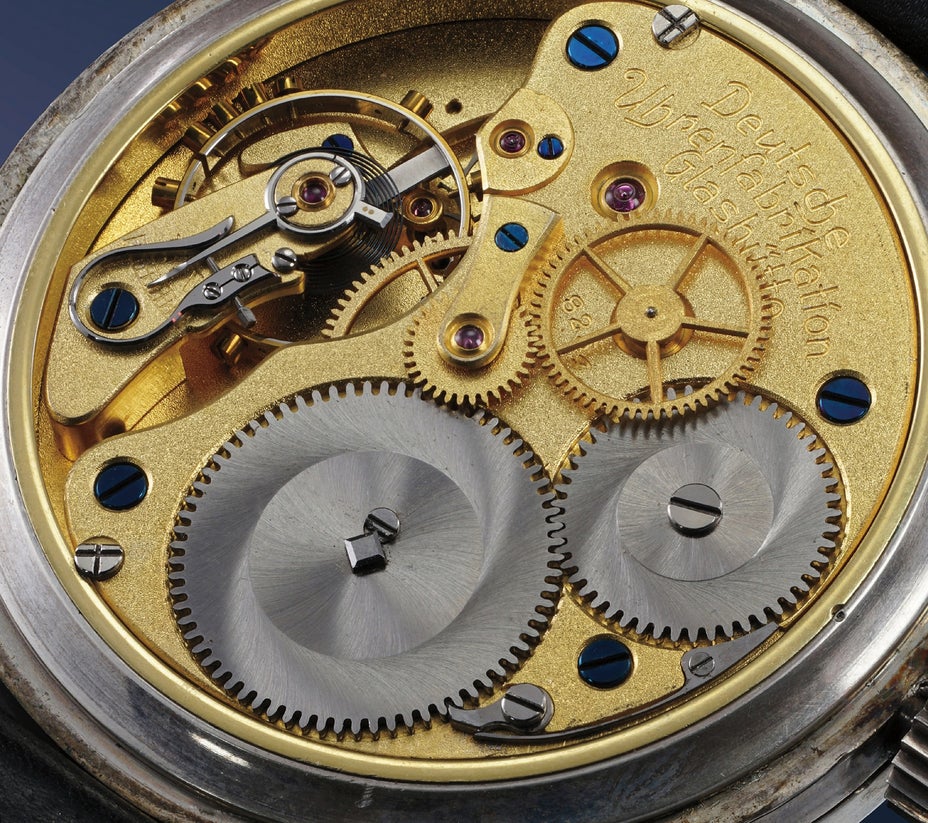
The movement betrays the technical nature of the piece: while lacking high-end aesthetic finish (cote de Geneve, perlage, anglage etc.), it features a guillaume balance for improved timekeeping.
Offered in superb condition, the present piece is a virtually unique opportunity for any watch enthusiast to own not only what can be arguably considered the rarest “complication” ever made by also a vintage Lange wristwatch, which are nearly as uncommon as hour angle watches themselves.
One of the consequences of such developments was the need for more and more precise navigation instruments, and - thanks to inputs from Lindbergh himself together with other aviation legend Philip Van Horn Weems - a number of specific timepieces were developed. Without a doubt, the most rare among vintage aviator’s timepieces are those featuring “hour angle” dial, such as the present piece. These watches present time in degrees (rather than in minutes). As the earth is round and revolves once a day, the center indicator for the “hour” hand is divided in 360 degrees - the hand revolving once a day - and the outer track (“minute” hand) indicates the additional degrees to add to what shown on the central track. Minute and second hands proceed four times “slower” than on a normal watch, with one revolution every four minutes. Thus, one hour equal to 15 degrees: midday will be on this watch 180.0.0 degrees, and the “classic” 10:08:30 become 152.8.5.
With the advent of radio navigation such instruments became moot, thus their production span is extremely limited. In fact, such Hour Angle timepieces are among the scarcest watches one can look for: the German army tasked in 1934 A. Lange and Söhne alongside two Swiss manufacturers (Patek Philippe and Vacheron Constantin) to produce two hour angle models, one with split seconds, the other without. As testified by the copy of the original invoice delivered with the watch, it took 2 years for the company to deliver 4 prototype watches in 1939 at a cost of 323RM (Reichsmark) each
The movement betrays the technical nature of the piece: while lacking high-end aesthetic finish (cote de Geneve, perlage, anglage etc.), it features a guillaume balance for improved timekeeping.
Offered in superb condition, the present piece is a virtually unique opportunity for any watch enthusiast to own not only what can be arguably considered the rarest “complication” ever made by also a vintage Lange wristwatch, which are nearly as uncommon as hour angle watches themselves.
A. Lange & Söhne
German | 1845Originally founded in 1845 by Ferdinand Adolph Lange in Glashütte, Dresden, Germany, the firm established an entire watchmaking culture and industry in Glashütte. The brand quickly became Germany's finest watchmaker, first creating dependable, easy-to-repair watches before going on to produce some of the world's finest complicated pocket watches, including Grande Sonnerie watches, tourbillon watches and Grande Complications.
On the final day of World War II, their factories were destroyed by Russian bombers, and in 1948 the brand was confiscated by the Soviet Union. Following the fall of the Berlin Wall in 1990, Ferdinand's great grandson Walter Lange re-established the brand with the objective to once again produce top-quality luxury watches. Now part of the Richemont Group, its original vintage and modern creations are highly coveted by collectors. Key models from the modern era include the Lange 1, Pour Le Mérite Tourbillon and the Zeitwerk.
Browse MakerOn the final day of World War II, their factories were destroyed by Russian bombers, and in 1948 the brand was confiscated by the Soviet Union. Following the fall of the Berlin Wall in 1990, Ferdinand's great grandson Walter Lange re-established the brand with the objective to once again produce top-quality luxury watches. Now part of the Richemont Group, its original vintage and modern creations are highly coveted by collectors. Key models from the modern era include the Lange 1, Pour Le Mérite Tourbillon and the Zeitwerk.