209
A. Lange & Söhne
Quarter Repeating Grande & Petite Sonnerie
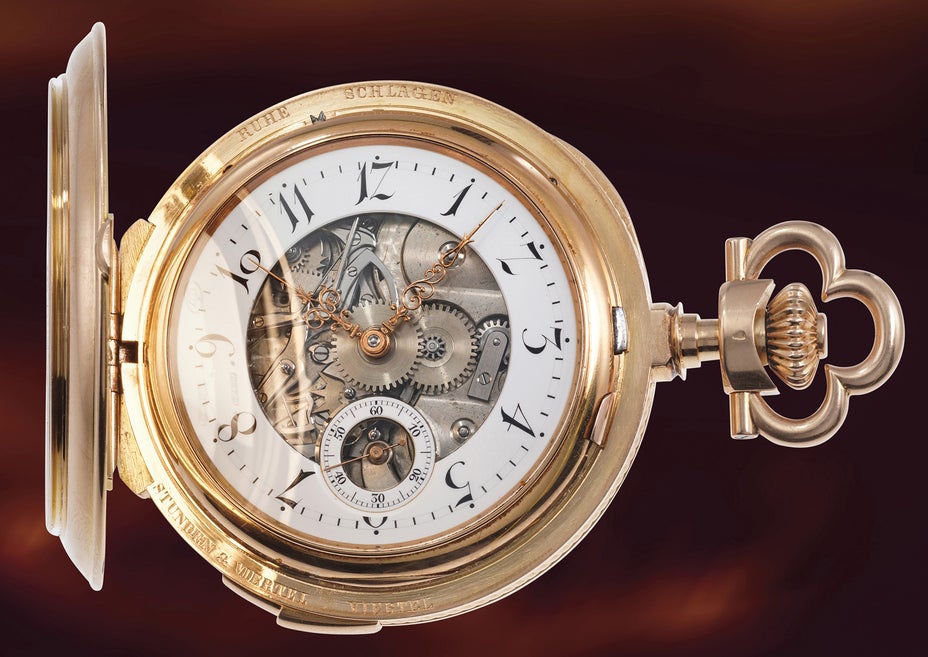
An impressive and massive yellow gold hunter cased two-train quarter repeating grande and petite sonnerie watch with lavishly engraved case
Full-Cataloguing
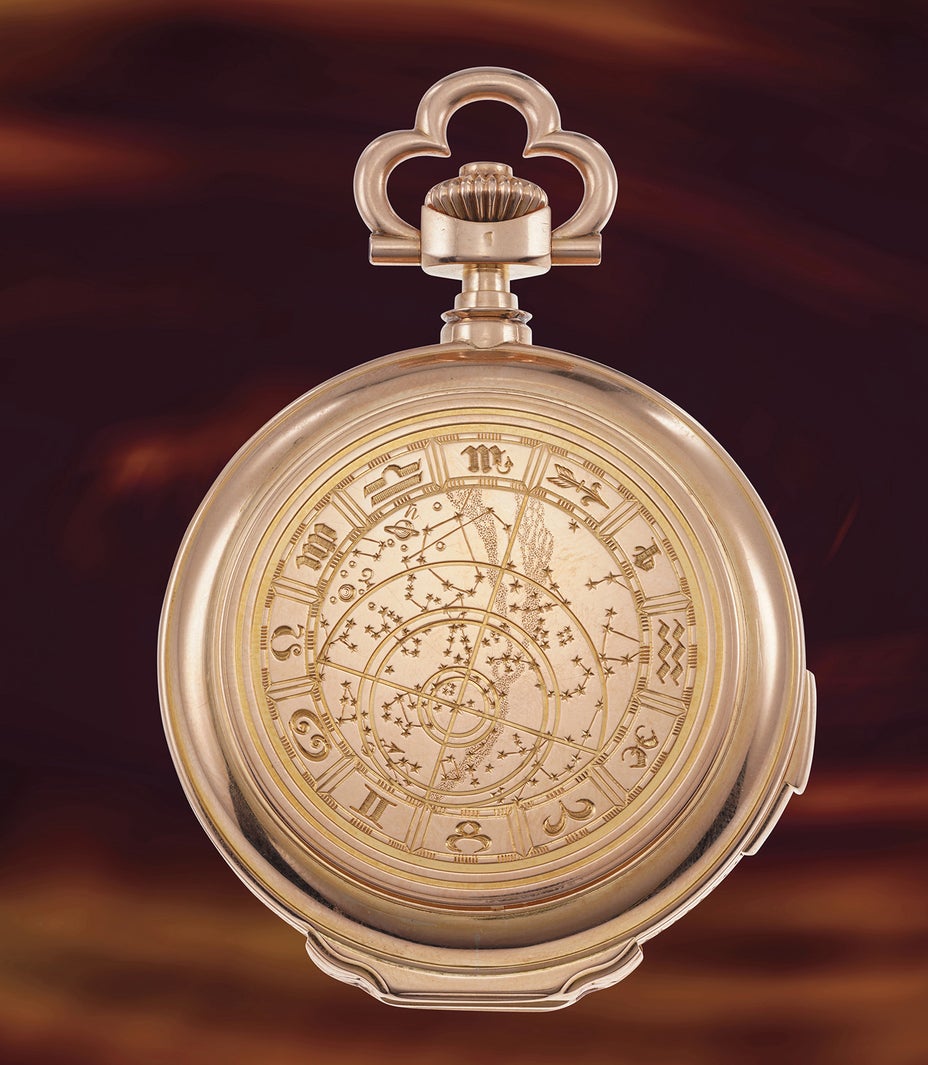
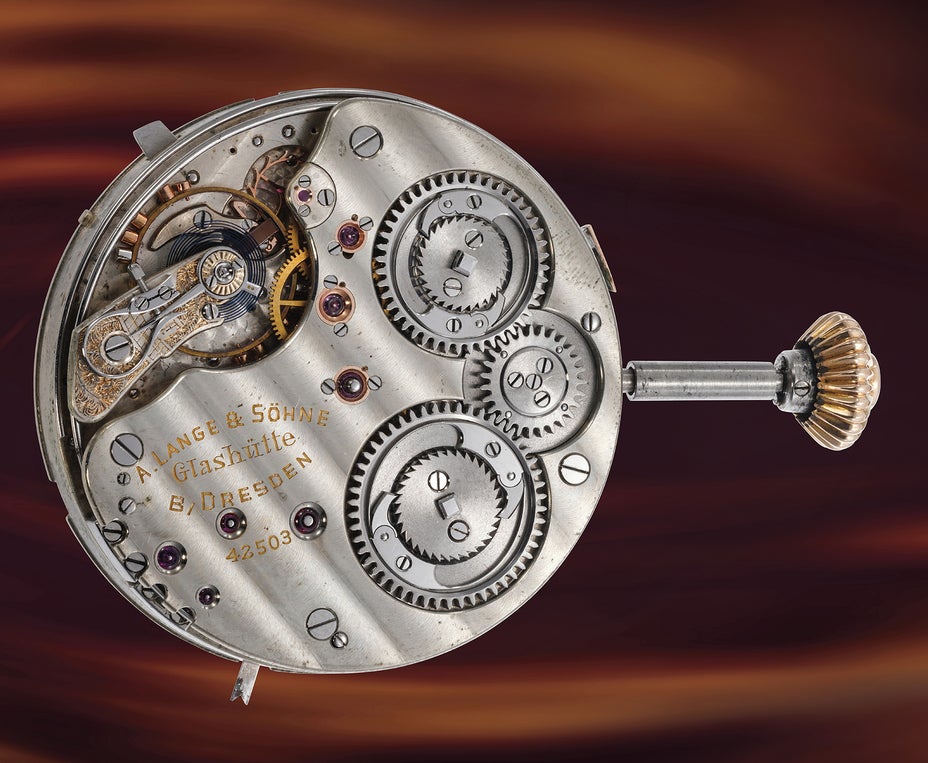
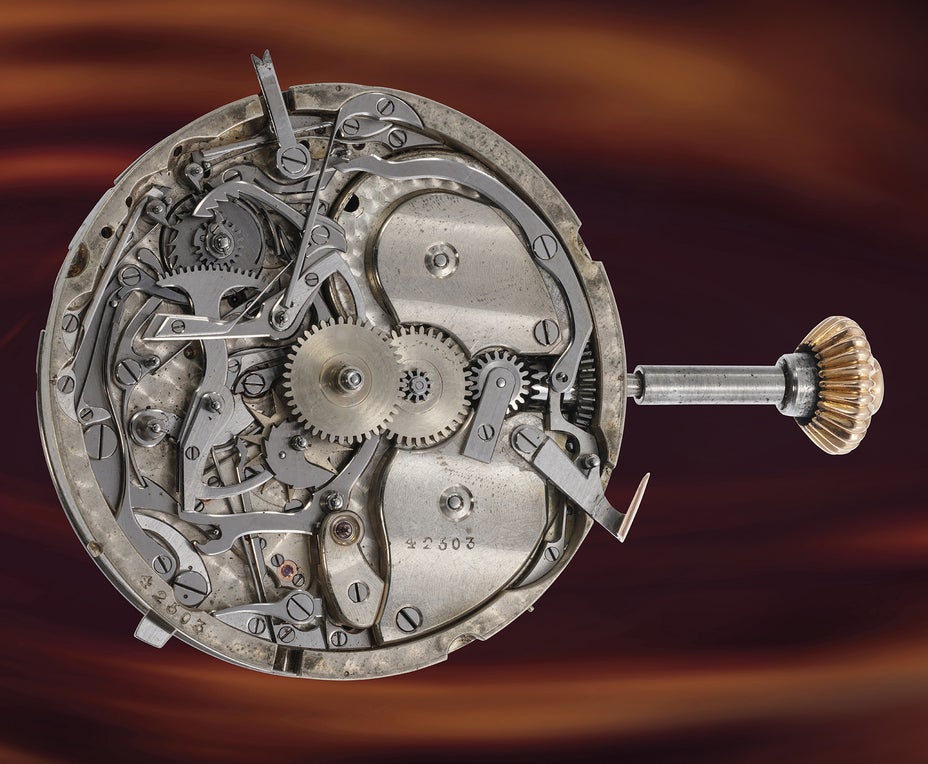
Dating from 1900 it is part of a very rare breed of pocket watches with open dial enabling one to admire the intricate movement beneath (based on a Piguet ébauche). The massive Louis XV-style case features five-bar hinges demonstrating the incredible attention to detail.
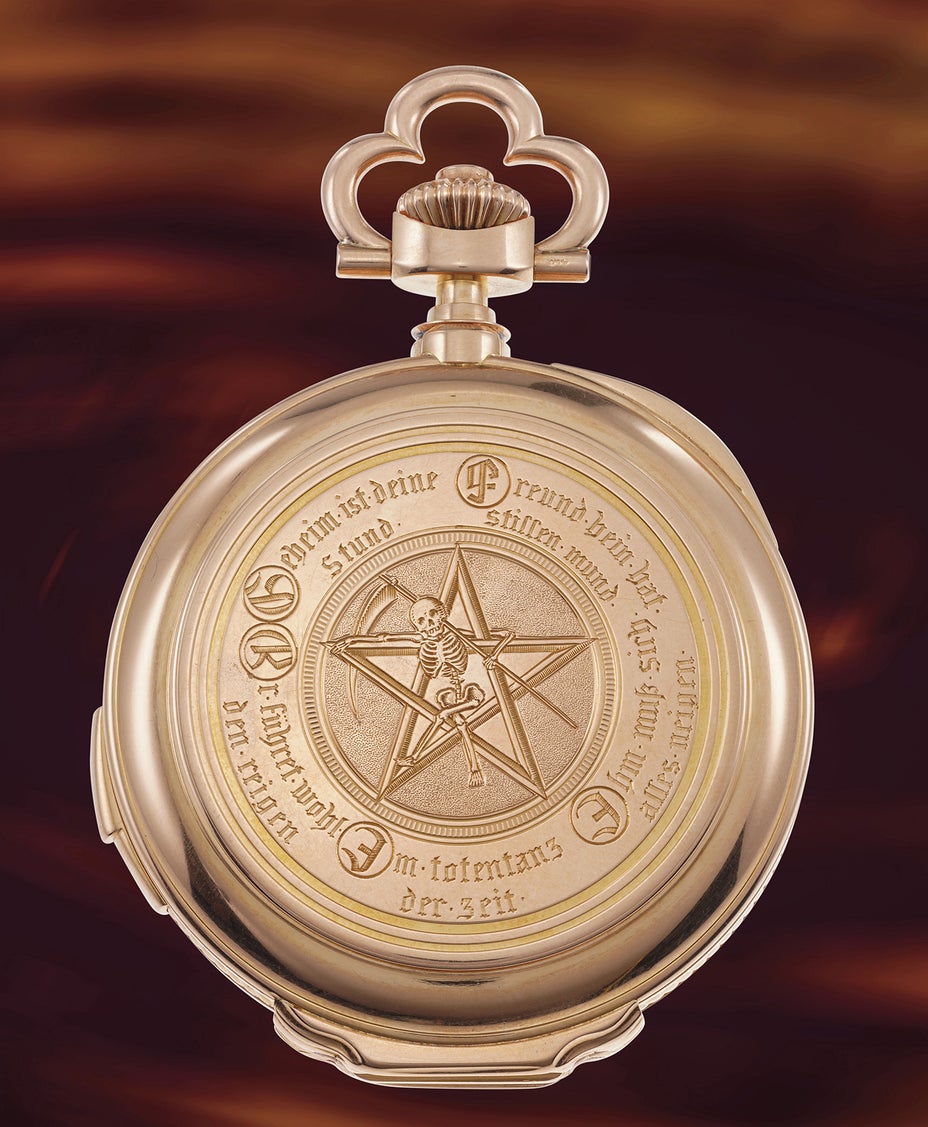
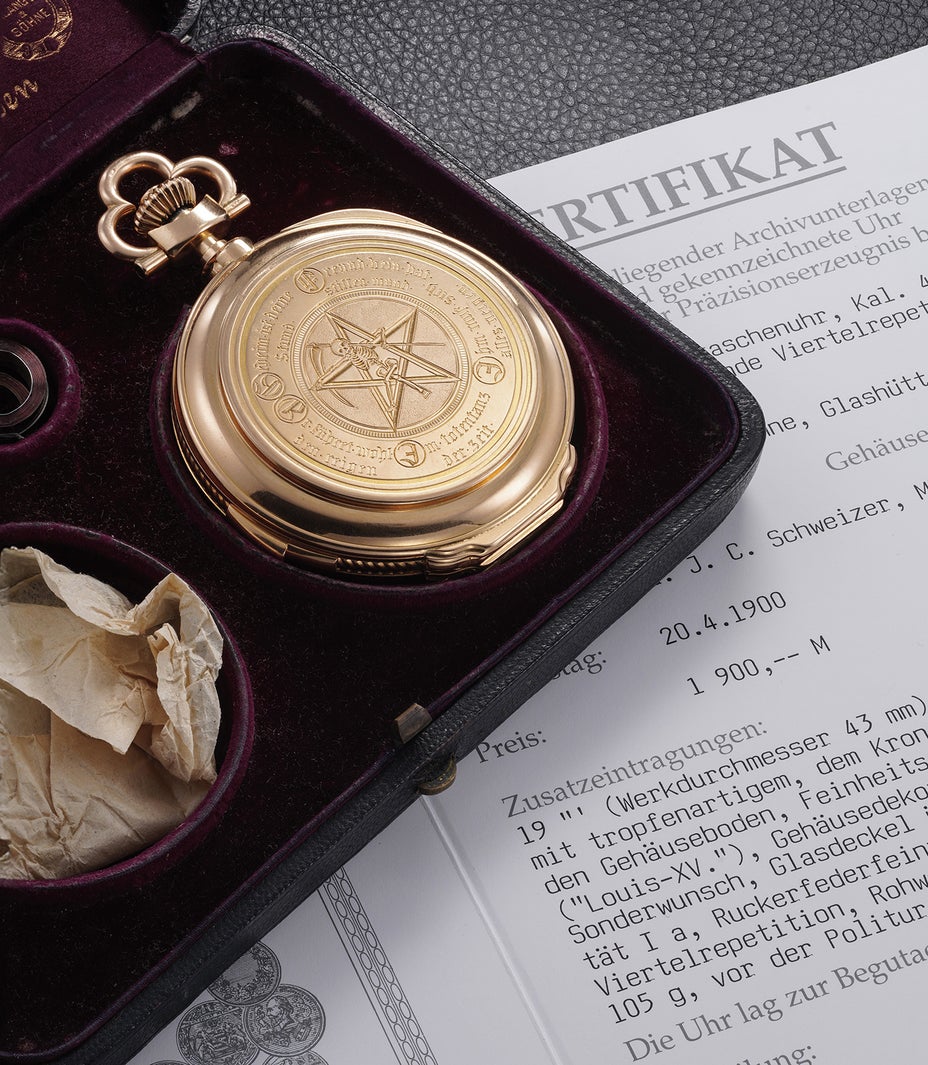
The front cover features a finely engraved star chart, surrounded by an outer ring divided into twelve sectors indicating the zodiac, the back cover is lavishly engraved with its center depicting a memento mori of a skeleton, carrying a scythe, dancing in front of a five-pointed star, surrounded by an inscription in German that translates as “Your Final Hour is a Secret – Old Friend Skeleton remains Silent – He is the Leader in the Roundelay – The Dance of the Death – To him all must bow”
Born in Dresden on 18 February 1815, Ferdinand Adolph Lange began his education at the Technische Bildungsanstalt in Dresden in 1829, where he split his time between theoretical studies and practical work under his master, Johann Christian Friedrich Gutkaes (the maker of the famous 5-minute clock at the Dresden Semperoper). After completing his apprenticeship in 1835, Lange worked with Gutkaes for two years before travelling across Europe to gain further experience in watchmaking. He spent time in France, managing the workshop of Joseph Thaddäus Winnerl, and later travelled to Switzerland and England to refine his skills.
Lange returned to Dresden in 1841 with the goal of establishing a watchmaking industry in Saxony. He sought government support to start a factory in Glashütte, an economically struggling region and founded A. Lange & Cie in 1845. He aimed to industrialize the area and train apprentices, encouraging them to start their own businesses, thus creating a watchmaking hub in the region.
Lange's innovations included the adoption of the metric system in watchmaking and the development of precision tools, including a micrometer capable of measuring millimeters to the thousandth. His company grew over the years, and in 1868, his son Richard joined the business, leading to the name change to A. Lange & Söhne. Ferdinand Lange was also active in local politics, serving as the mayor of Glashütte for 18 years before passing away on December 3, 1875.
Under Richard and Emil Lange, the company continued to thrive. Emil earned prestigious honors, including the French Legion of Honor and the title of commercial councillor from King Frederick Augustus III of Saxony. A. Lange & Söhne became known for its high-quality hand-made watches, even as machine-made watches from other companies like Glashütte Präzisons-Uhrenfabrik began to dominate the market.
The present watch is featured in Die Uhren von A. Lange & Söhne, by Huber p. 181, table 68, where it is listed as one of only two Quarter Repeating Grande & Petite Sonnerie watches produced by A. Lange & Söhne, the other one having a different case.
A. Lange & Söhne
German | 1845Originally founded in 1845 by Ferdinand Adolph Lange in Glashütte, Dresden, Germany, the firm established an entire watchmaking culture and industry in Glashütte. The brand quickly became Germany's finest watchmaker, first creating dependable, easy-to-repair watches before going on to produce some of the world's finest complicated pocket watches, including Grande Sonnerie watches, tourbillon watches and Grande Complications.
On the final day of World War II, their factories were destroyed by Russian bombers, and in 1948 the brand was confiscated by the Soviet Union. Following the fall of the Berlin Wall in 1990, Ferdinand's great grandson Walter Lange re-established the brand with the objective to once again produce top-quality luxury watches. Now part of the Richemont Group, its original vintage and modern creations are highly coveted by collectors. Key models from the modern era include the Lange 1, Pour Le Mérite Tourbillon and the Zeitwerk.