33Ο︎
Shiro Kuramata
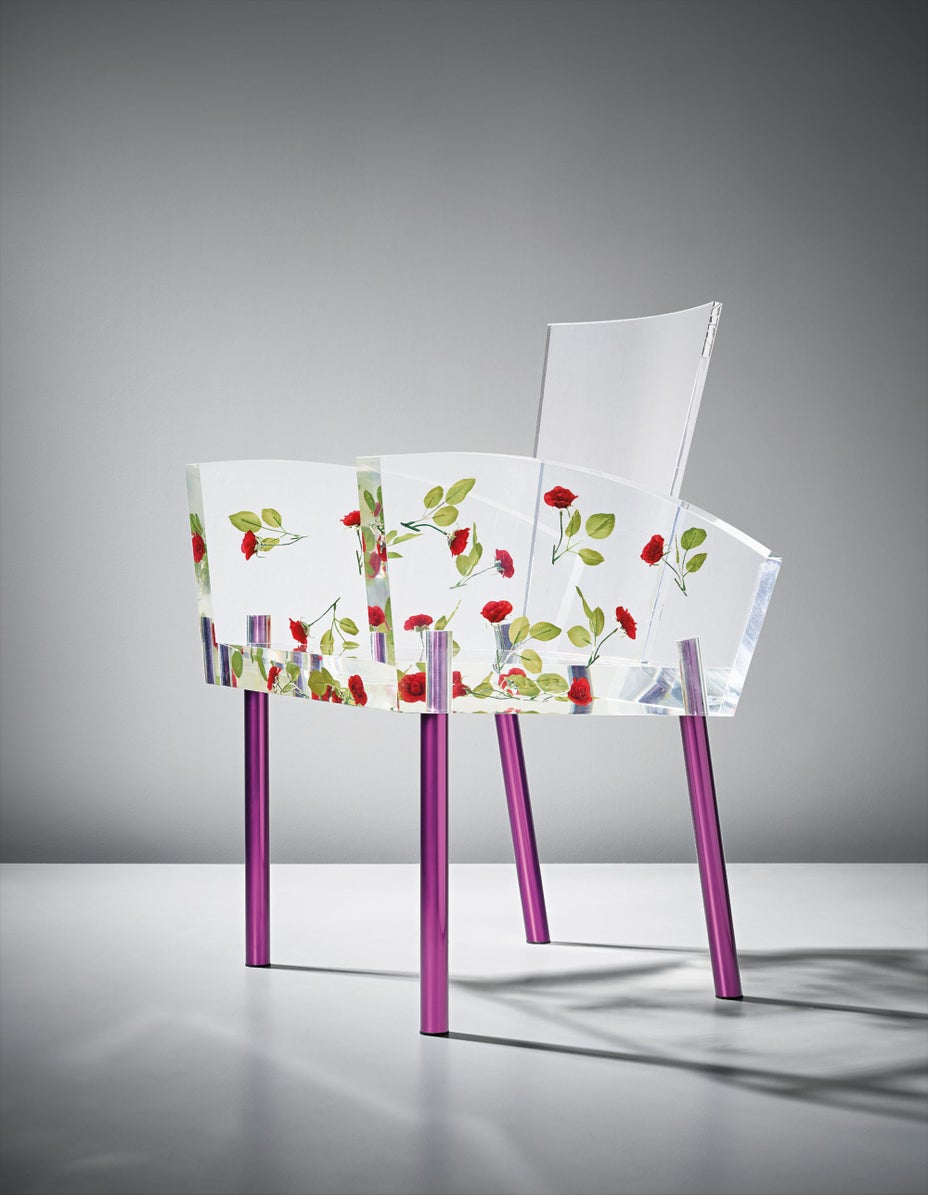
'Miss Blanche' chair
Designed in 1988.
Full-Cataloguing
Shiro Kuramata was one of the greatest designers of the 20th century. A distinctive, brilliant and complex talent, he helped push modern Japan into becoming an exporter of creativity, not just an importer. Kuramata designed a series of remarkably beautiful interiors, almost all of them now destroyed. His furniture has survived and is now his principle legacy. It is the 'Miss Blanche' chair that most powerfully embodies his poetic approach to design. It combines an unnerving kind of beauty, a strong narrative, and a commitment to the craft values of making.
Named after the central character in the famed play A Streetcar Named Desire, Blanche Dubois, the chair resonates with the idea of her tragic beauty, shelled in dreamlike delusion. It is impossible not to be touched by the serene seeming beauty of a graceful transparent object, in which roses float in air, held in place by nothing tangible. The chair seems effortless. However, the craftsmanship behind the creation of the chair was so demanding that many of the craftsmen were reluctant ever to work with Kuramata afterwards.
Working through trial and error, Kuramata’s craftsmen found that pouring liquid acrylic resin to various heights of the mould, then dropping in the flowers, waiting eight hours for the acrylic to harden, and subsequently repeating this, created the best effect. The roses needed to be held in position with tweezers until the resin hardened enough to ensure that they did not sink. Care was taken to make sure there was a good spread of flowers throughout the mould, and that they made a good pattern. The first batch of rose-studded acrylic sheet yielded just eight useable chairs, with one failure.
A total of 56 'Miss Blanche' chairs have been produced over the years - a number that reflects Kuramata’s age at the time of his death. Kuramata experimented with real roses and expensive artificial flowers, but cheap acrylic flowers turned out to work best in retaining colour and shape.
Three crucial relationships demonstrate the significant influence that Kuramata has left in the world of design. Japanese fashion designer Issey Miyake, who still collects his work, commissioned him to design some of his most beautiful shops. Kuramata was also a close friend of Italian architect and designer Ettore Sottsass, who later invited Kuramata to join the Memphis Group that Ettore founded in 1981. British architectural designer John Pawson was so inspired by the experience of working in Kuramata’s studio in Japan that he returned to England and eventually began his own practice in 1981.
Deyan Sudjic
Director of the Design Museum, London
The ‘Miss Blanche’ is included in the following important and international museum collections: Museum of Modern Art, New York; Museum of Modern Art, San Francisco; DMA, Dallas; M+ Museum, Hong Kong.
Shiro Kuramata
Japanese | B. 1934 D. 1991Shiro Kuramata is widely admired for his ability to free his designs from gravity and use materials in ways that defied convention. After a restless childhood, his ideas of being an illustrator having been discouraged, Kuramata discovered design during his time at the Teikoku Kizai Furniture Factory in Arakawa-ku in 1954. The next year he started formal training at the Department of Interior Design at the Kuwasawa Design Institute. His early work centered on commercial interiors and window displays. In 1965, at the age of 31, he opened his own firm: Kuramata Design Office.
Throughout his career he found inspiration in many places, including the work of Italian designers (particularly those embodying the Memphis style) and American conceptual artists like Donald Judd, and combined such inspirations with his own ingenuity and creativity. His dynamic use of materials, particularly those that were transparent, combination of surfaces and awareness of the potential of light in design led him to create objects that stretched structural boundaries and were also visually captivating. These qualities are embodied in his famous Glass Chair (1976).