The Enduring Image: Photographs from the Dr. Saul Unter Collection
95
Man Ray
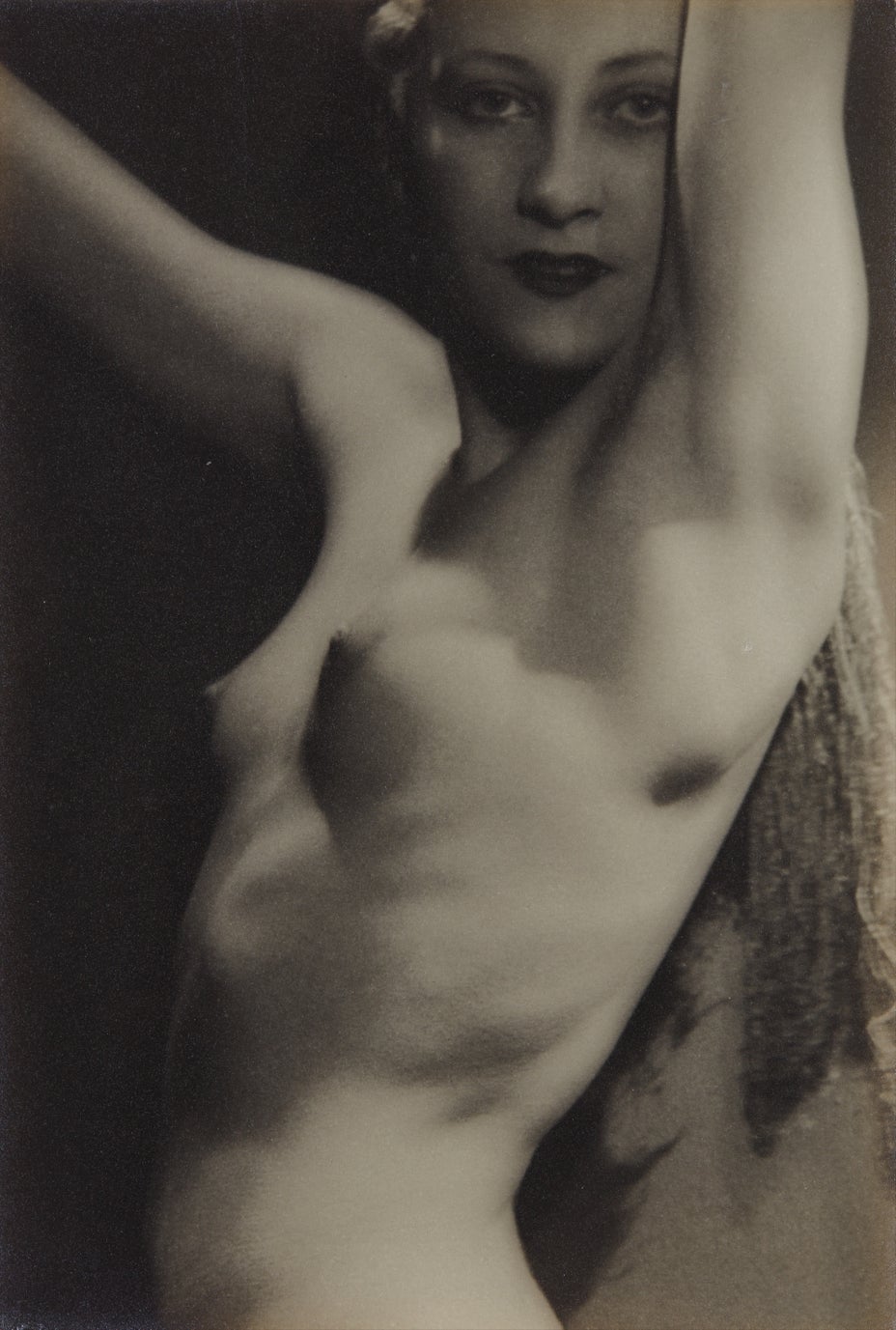
Nude
Estimate
$50,000–70,000
1927
Gelatin silver print.
10 1/4 x 7 in. (26 x 17.8 cm)
'31 bis, Rue Campagne-Premiére, Paris XIVe' (Manford M6) credit stamp, titled, dated and annotated ‘Soby. 13’ in an unidentified hand in pencil on the verso.
Full-Cataloguing
This nude study was originally in the collection of art critic, curator, and collector James Thrall Soby. Soby was the publisher of Man Ray’s first monograph, Photographs by Man Ray 1920 Paris 1934, and the organizer of his 1934 exhibition at the Wadsworth Atheneum, the photographer’s first solo showing at an American museum. The photograph offered here was part of Soby’s historic gift of over 100 Man Ray photographs to The Museum of Modern Art in 1940, which included many of the images used in, or considered for, Man Ray’s seminal monograph.
By the 1930s, nudes comprised a significant portion of Man Ray’s oeuvre, and an entire passage of Photographs by Man Ray 1920 Paris 1934 is devoted to the female form. The elegant nude offered here is at once representational and dreamlike. As in the best of Man Ray’s photographs, conventional artistic subject matter is raised to the level of Surrealism and is reflective of Man Ray’s distinctive vision. Through Man Ray’s deft use of lighting and his mastery of darkroom technique, he has created in this image a nude whose form seems poised between human flesh and sculpted stone.
Like his contemporary, László Moholy-Nagy, Man Ray was a tireless experimenter in a variety of media. Both fully exploited the flexibility of photography to achieve new types of images. In his essay L’Age de la Lumière, Man Ray wrote that a disregard for a medium’s conventions was necessary to be truly creative. He wrote that when a photographer, “working directly with light and chemistry, so deforms his subject as almost to hide the identity of the original, and creates new form, the ensuing violation of the medium employed is the most perfect assurance of the author’s convictions. A certain amount of contempt for the material employed to express an idea is indispensable to the purest realization of this idea” (Man Ray 1920 Paris 1934, n.p.).
L’Age de la Lumière was originally published in the surrealist journal Minotaure in 1933, which also reproduced a multiple-exposure variant of the image offered here (cf. Arturo Schwarz, Man Ray: The Rigour of Imagination, pl. 450).
By the 1930s, nudes comprised a significant portion of Man Ray’s oeuvre, and an entire passage of Photographs by Man Ray 1920 Paris 1934 is devoted to the female form. The elegant nude offered here is at once representational and dreamlike. As in the best of Man Ray’s photographs, conventional artistic subject matter is raised to the level of Surrealism and is reflective of Man Ray’s distinctive vision. Through Man Ray’s deft use of lighting and his mastery of darkroom technique, he has created in this image a nude whose form seems poised between human flesh and sculpted stone.
Like his contemporary, László Moholy-Nagy, Man Ray was a tireless experimenter in a variety of media. Both fully exploited the flexibility of photography to achieve new types of images. In his essay L’Age de la Lumière, Man Ray wrote that a disregard for a medium’s conventions was necessary to be truly creative. He wrote that when a photographer, “working directly with light and chemistry, so deforms his subject as almost to hide the identity of the original, and creates new form, the ensuing violation of the medium employed is the most perfect assurance of the author’s convictions. A certain amount of contempt for the material employed to express an idea is indispensable to the purest realization of this idea” (Man Ray 1920 Paris 1934, n.p.).
L’Age de la Lumière was originally published in the surrealist journal Minotaure in 1933, which also reproduced a multiple-exposure variant of the image offered here (cf. Arturo Schwarz, Man Ray: The Rigour of Imagination, pl. 450).