16Ο︎
Diego Rivera
Retrato de Marevna (Portrait of Marevna)
Full-Cataloguing
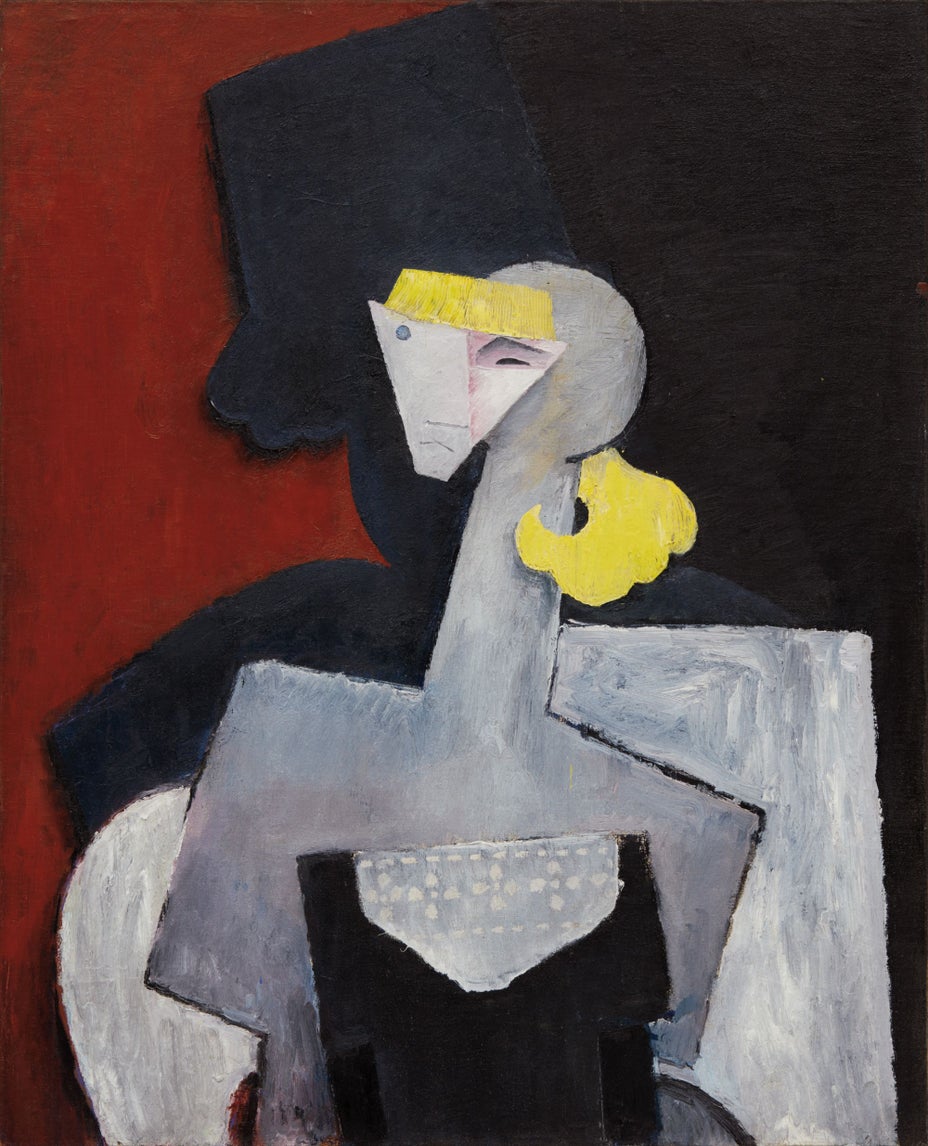
Around the year 1916, Diego Rivera began to refine his Cubism towards a more purist abstraction of austere geometric shapes, as seen in this portrait, which was incorrectly catalogued as a portrait of Angeline Beloff for decades. In reality, this painting is a portrait of another Russian painter, Marie Bronislava Vorobyeva-Stebelska, “Marevna” (1892-1984), whom Riviera met around the year 1915 as a result of their mutual friendship with the poet Ilya Ehrenburg. Rivera had a passionate affair with Marvena, which although ephemeral, produced a daughter named Marika. On the other hand, Rivera maintained his romantic attachment with the painter Angeline Beloff (1879-1969) from the time he met her in 1909. With Beloff, who became his common-law wife, Rivera had a male child, Diegito, who died a few months after birth. This produced difficult moments of avoidance and rejection in his relationship with his stable romantic partner. It was within this period of instability that Rivera was briefly involved with Marevna, whose savage beauty and overflowing sexual energy the polar opposite of the serene and maternal presence of Angeline captivated the Mexican painter, estranging him for a period from the marital relationship he had with Beloff between 1911 and 1921.
This is the second Cubist portrait of three portraits of Marevna created by Rivera. The first one is in the Art Institute of Chicago’s permanent collection and shares the same characteristic geometric facial features with this second painting. The last one, created in 1917 and known as Mujer sentada en una butaca (Woman sitting in an armchair), is included in the collection of the Instituto Nacional de Bellas Artes in Mexico City. This present lot painted in 1916 is a magnificent work that has only been held in two private collections, since it was acquired directly from the painter, and evidences to what point Rivera had managed to strip himself from any decorative and accessory elements in his conception of Cubism. Marevna’s blond hair and figure are shown from the front and back, rotating on the same central axis, with a chromatic play on blacks versus whites, creating the juxtaposition of grand positive spaces confronted by richly textured dark planes. Thus, Marevna’s mercurial personality, which Rivera found “exciting” but which also defined her as a “she-devil,” is reflected in the shifting perspectives of her body now geometric with her hands on her hips, shaped as a cube dancing seductively on the canvas surface, growing dynamic and full of energy as a result of Rivera’s compositional talent and the spatial innovations he achieved as a renowned Cubist painter in Paris.
Professor Luis-Martín Lozano
Art Historian
Diego Rivera
Mexican | B. 1886 D. 1957Diego Rivera began drawing at the age of three, and by ten he was enrolled at the San Carlos Academy in Mexico City. In 1907, he traveled to Europe on a scholarship to continue his artistic studies. Whilst in Paris, Rivera embraced the advent of Cubism, and later Post-Impressionism, taking inspiration from such European artists as Picasso and Cézanne.
In 1921, Rivera returned to Mexico and became involved in the government-sponsored Mexican mural program. He became best-known for his frescoes painted in a distinctive style characterized by bold colors and ample, Renaissance-inspired figures. Rivera was an atheist and joined the Mexican Communist party in 1922. He was married five times, including twice to Frida Kahlo, with whom he had a famously volatile relationship.