
164
Diego Rivera
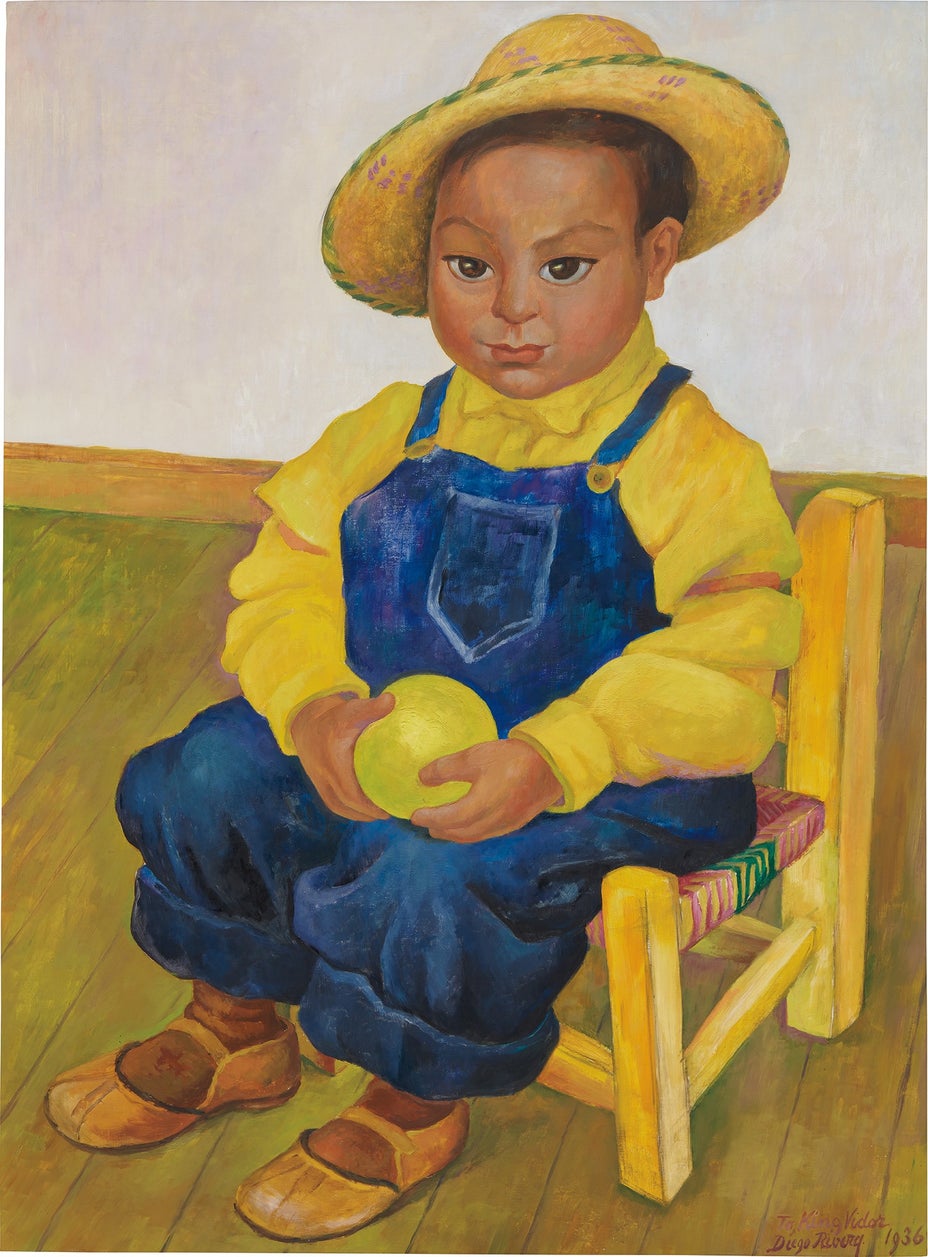
Don Lupito
- Estimate
- $350,000 - 450,000
$591,000
Lot Details
oil on Masonite
signed, dedicated and dated "To King Vidor Diego Rivera 1936" lower right; further titled and dated "Don Lupito Octobre 1936" on the reverse
32 x 23 3/4 in. (81.3 x 60.3 cm.)
Painted in 1936.
We are grateful to Professor Luis-Martín Lozano for his kind assistance in cataloguing this work.
Specialist
Full-Cataloguing
Catalogue Essay
The famed Mexican muralist, Diego Rivera, was also an accomplished portrait painter who created unique depictions of many of the most illustrious figures in Mexico and the United States, including in his iconic fresco murals, realized in San Francisco, Detroit and New York. Parallel to his work as a muralist, Rivera simultaneously cultivated the genre of easel painting with great mastery and knowledge of art history. Beginning in his formative years, while the artist studied at the Escuela Nacional de Bellas Artes in Mexico City, Rivera would often portray his contemporaries, and upon studying the paintings of Joaquín Sorolla, John Singer Sargent and Giovanni Boldini during his first trip to Europe in 1907, Rivera observed that portraiture could be an area of great experimentation and accomplishment. In fact, it was through his portraits and still life that Diego Rivera consolidated his position as a prominent cubist painter in avant-garde Paris, between 1913 and 1917.
Upon returning to Mexico in 1921, Rivera discovered a drastically different country than the one that he had left 14 years earlier. The first social revolution of the 20th century had passed, and a new post-revolutionary regime had been consolidated in which there was an unprecedented cultural renaissance. Rivera soon joined the group of muralists working under the direction of the Minister of Education, José Vasconcelos, and almost immediately became the most renowned artistic figure in contemporary Mexican culture. However, Rivera’s prestige went beyond Mexico’s borders, and by the 1930s he was exhibiting in the most illustrious museums in the United States, gaining much notoriety among American collectors both in New York and on the West Coast.
During the 1930s, Rivera won admiration from patrons who eagerly collected his work, including some of the most creative names in art and industry. Rivera admired the technological achievements of the Industrial Revolution in the United States, yet for him it was cinema that embodied the most faithful expression of modernity. Therefore, it is no wonder that leading producers, directors and actors were drawn to his art. Among them was renowned filmmaker King Wallis Vidor (1894-1982), who directed such important films as The Crowd (1928), for which he received his first Oscar nomination, and Hallelujah (1929), which for the first time included a cast of African-American actors. Rivera met King Vidor through the beautiful Mexican actress Dolores del Río, who had filmed the movie Bird of Paradise (1932) with Vidor in Hollywood.
Professor Luis-Martín Lozano
King Vidor acquired this painting directly from Rivera in November of 1936. Originally titled Niño sentado, the painting depicts an indigenous Mexican child named José Guadalupe Castro Sosa, who Rivera would paint many times and would come to refer to affectionately as “Don Lupito”. In this particular work, Rivera masterfully captures his sitter—a tender, restless child—through the inquisitive gaze beaming from his beautiful, almond-shaped eyes, as his small, playful hands are preoccupied with an orange.
Upon returning to Mexico in 1921, Rivera discovered a drastically different country than the one that he had left 14 years earlier. The first social revolution of the 20th century had passed, and a new post-revolutionary regime had been consolidated in which there was an unprecedented cultural renaissance. Rivera soon joined the group of muralists working under the direction of the Minister of Education, José Vasconcelos, and almost immediately became the most renowned artistic figure in contemporary Mexican culture. However, Rivera’s prestige went beyond Mexico’s borders, and by the 1930s he was exhibiting in the most illustrious museums in the United States, gaining much notoriety among American collectors both in New York and on the West Coast.
During the 1930s, Rivera won admiration from patrons who eagerly collected his work, including some of the most creative names in art and industry. Rivera admired the technological achievements of the Industrial Revolution in the United States, yet for him it was cinema that embodied the most faithful expression of modernity. Therefore, it is no wonder that leading producers, directors and actors were drawn to his art. Among them was renowned filmmaker King Wallis Vidor (1894-1982), who directed such important films as The Crowd (1928), for which he received his first Oscar nomination, and Hallelujah (1929), which for the first time included a cast of African-American actors. Rivera met King Vidor through the beautiful Mexican actress Dolores del Río, who had filmed the movie Bird of Paradise (1932) with Vidor in Hollywood.
Professor Luis-Martín Lozano
King Vidor acquired this painting directly from Rivera in November of 1936. Originally titled Niño sentado, the painting depicts an indigenous Mexican child named José Guadalupe Castro Sosa, who Rivera would paint many times and would come to refer to affectionately as “Don Lupito”. In this particular work, Rivera masterfully captures his sitter—a tender, restless child—through the inquisitive gaze beaming from his beautiful, almond-shaped eyes, as his small, playful hands are preoccupied with an orange.
Provenance
Literature
Diego Rivera
Mexican | B. 1886 D. 1957Diego Rivera began drawing at the age of three, and by ten he was enrolled at the San Carlos Academy in Mexico City. In 1907, he traveled to Europe on a scholarship to continue his artistic studies. Whilst in Paris, Rivera embraced the advent of Cubism, and later Post-Impressionism, taking inspiration from such European artists as Picasso and Cézanne.
In 1921, Rivera returned to Mexico and became involved in the government-sponsored Mexican mural program. He became best-known for his frescoes painted in a distinctive style characterized by bold colors and ample, Renaissance-inspired figures. Rivera was an atheist and joined the Mexican Communist party in 1922. He was married five times, including twice to Frida Kahlo, with whom he had a famously volatile relationship.
Browse ArtistIn 1921, Rivera returned to Mexico and became involved in the government-sponsored Mexican mural program. He became best-known for his frescoes painted in a distinctive style characterized by bold colors and ample, Renaissance-inspired figures. Rivera was an atheist and joined the Mexican Communist party in 1922. He was married five times, including twice to Frida Kahlo, with whom he had a famously volatile relationship.