7Ο︎
Andy Warhol
Flowers
Full-Cataloguing
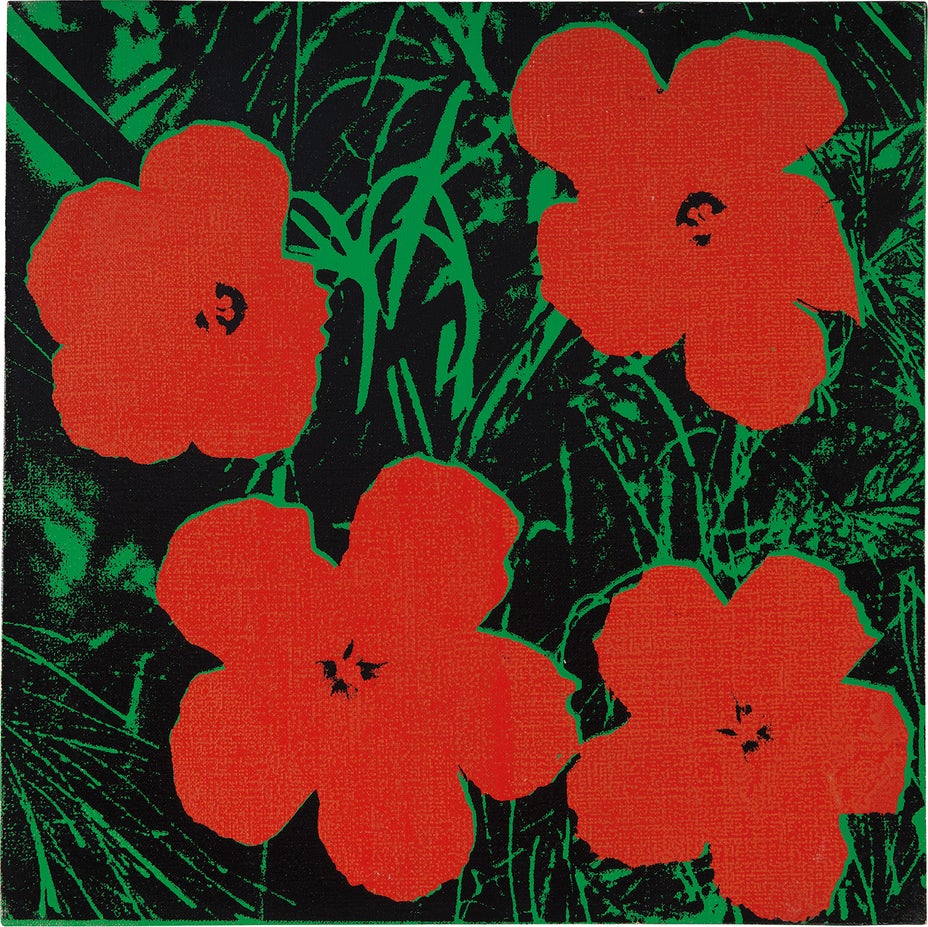
Conceived and executed within a seminal year, the Flowers paintings are regarded as the pinnacle of Warhol’s painterly output in the early sixties; a period in which he revolutionised the history of representation through his adoption of the silkscreen technique. In 1964 Warhol was beginning to turn away from painting, as signalled by his last exhibition with Eleanor Ward of the Stable Gallery, where he presented three-dimensional reproductions of commercial shipping cartons. However, for his first show with renowned art world impresario Leo Castelli and ahead of his temporary break from the painted medium, Warhol debuted one of his most iconic series – Flowers. Presenting a radical switch from the images of American consumerism that he championed in his early oeuvre, the show was an instant success, leading to subsequent Flowers paintings being produced for a show at Galerie Ileana Sonnabend in Paris, as well as a second consignment to Castelli. It was from this batch of 14 inch Flowers paintings that the present work originates. As a close associate of Castelli, the preeminent Minneapolis gallerist Gordon Locksley not only facilitated the acquisition of the present work by Miles and Shirley Fiterman, but also introduced the couple to Warhol around this time. The rare personal dedication on the back of the present work speaks of a flourishing friendship between the prominent collectors and the rising art star.
In the iconic composition, the aerial viewpoint of Warhol’s source photograph, and the way he cropped it to his perfect square format, succinctly dispenses with a sense of depth. As noted by art historian Nina Zimmer "Warhol reduced and radicalised his Flowers to such an extent that the banal subject matter was now transformed into a powerful pictorial concept. The directionless format contributed to this: the pictures can be read in all directions; like an abstract painting, top and bottom, left and right, have been revoked.”(Nina Zimmer, Exh. Cat., Basel, Kunstmuseum, Andy Warhol: The Early Sixties – Paintings and Drawings 1961-1964, Ostfildern 2011, p. 177) Diverging significantly from the original source image – a colour photograph of seven hibiscus blossoms that was printed in Modern Photography to illustrate Kodak colour processing – Warhol abstracts the photographic clarity of the image to focusing instead on the luscious hand-painted base forms. As his assistant Billy Linich would recount: “He didn’t want it to look like a photo at all. He just wanted the shape, the basic outline, of the flowers” (Billy Linich quoted in Tony Sherman and David Dalton, Pop: The Genius of Andy Warhol, New York 2009, p. 247). In the present work, Warhol selects two colours at opposite ends of the colour wheel, utilising their inherent sensational contrast to create an arresting sense of ocular disturbance. Despite both colours being found in nature the image is decidedly synthetic. Crucially Warhol purposefully allows for the slight misalignment of the colourful underpainting and the overriding image, leading to a profoundly holograph quality at the points where the red and green meet, un-curtailed by the silkscreen print.
Whilst the flowers appear eternally exuberant, their evident status as a manufactured image also illuminates the transience of the beauty expressed by nature. Flowers represent a profound visual shift from Warhol’s Death and Disaster images: here he offers a more subtle memento mori, recalling the vanitas tradition that he would return to once again in his skull paintings of 1976. Painted in the same year as Warhol debuted his provocative mural 13 Most Wanted Men at the New York World’s Fair, the renowned French author Jean Genet eloquently noted how Warhol was a master of expressing contrasts, whilst finding cohesion in his choice of subjects: “There is a close relationship between flowers and convicts. The fragility and delicacy of the former are of the same nature as the brutal insensitivity of the latter” (Jean Genet quoted in, Eykyn Maclean, Andy Warhol Flowers, New York, 2012, p. 6). Between the partial pathos of the verdant green foliage and the unbridled passion of the red petals, it is in Flowers that Warhol artfully probes the unassailable paradoxes of life at a meeting point between concepts of beauty, transience and a fearful obsession with our own mortality.
Andy Warhol
American | B. 1928 D. 1987Andy Warhol was the leading exponent of the Pop Art movement in the U.S. in the 1960s. Following an early career as a commercial illustrator, Warhol achieved fame with his revolutionary series of silkscreened prints and paintings of familiar objects, such as Campbell's soup tins, and celebrities, such as Marilyn Monroe. Obsessed with popular culture, celebrity and advertising, Warhol created his slick, seemingly mass-produced images of everyday subject matter from his famed Factory studio in New York City. His use of mechanical methods of reproduction, notably the commercial technique of silk screening, wholly revolutionized art-making.
Working as an artist, but also director and producer, Warhol produced a number of avant-garde films in addition to managing the experimental rock band The Velvet Underground and founding Interview magazine. A central figure in the New York art scene until his untimely death in 1987, Warhol was notably also a mentor to such artists as Keith Haring and Jean-Michel Basquiat.