Article | The Story Of The Cartier Portico Mystery Clocks
The Story of the Cartier Portico Mystery Clocks
The century-old mystery clocks keeping the auction world spellbound.
Phillips in Association with Bacs & Russo is delighted to present The Geneva Watch Auction: XXIV, a live auction taking place on 7–8 November 2026 at the Hotel President in Geneva. Featuring more than 220 exceptional luxury timepieces from leading makers including Patek Philippe, Rolex, Audemars Piguet, Cartier, and F.P. Journe, the sale includes the Cartier Portico Mystery Clock No. 4 featured in this story.
Our story begins in Paris in 1923. At this moment in time, the Cartier company was just 24 years young and very much a family business, with Louis Cartier leading operations in the French capital and his brothers Pierre and Jacques working in New York and London respectively.
In terms of style and fashion, Paris was in the thrall of the Art Deco era when geometry, symmetry, modernity, luxury, and a fascination with distant cultures was all the rage.
The Discovery of Asian Art
It was around this time that Louis Cartier sent his leading salesman Jules Glaenzer to the Far East to assess its potential as a commercial center. Glaenzer returned not only with tales of his travels but with pockets full of curiosities, gemstones, and other treasures. He handed them to the company’s chief designer Charles Jacqueau, who would turn them into the most extraordinary objects, including six unique Portico Mystery clocks, marking the start of one of the biggest cultural inspirations for Cartier.
Optical Illusions
The six Portico Mystery clocks were made between 1923 and 1925 and featured the jeweler’s famous mystery clock mechanism that was the magic show of the day. Invented by French clockmaker Maurice Coüet, these intriguing timekeepers were fitted with crystal dials that were completely transparent, except for the hour and minute hands that seemingly floated in thin air.

Maurice Couët (left) working in Cartier’s workshops, circa 1927. Photo: Cartier
The world was completely baffled by how they worked*, and soon Cartier’s top clients would all want one. The first ever mystery clock – the Model A – was created in 1912 and was sold to none other than the banker John Pierpont Morgan, with kings, queens, aristocrats, and titans of industry quickly following suit.
The Portico Mystery Clocks
The Cartier Portico Mystery Clocks, however, were on a totally different level with their Shinto temple gate structures and rock crystal dials suspended between two majestic columns. They were all different in one way or another. Four of them – numbers one, two, five, and six – were around 35cm in height, while numbers three and four were towering in size, exceeding 38cm.
The Portico Mystery Clocks were not only enigmatic in the way they worked but also provided Cartier with the ultimate canvas upon which to express its unfettered creativity. Let’s take a look at them in closer detail.
No. 1, 1923
The first Portico Mystery Clock features a polished gold platform supporting two cylindrical rock-crystal columns, each embellished at the top and bottom with gold and black enamel. The columns are set on cubic bases of onyx with four pieces of stepped rock crystal, while the lintel is crafted from gold and black enamel and houses the clock movement. Beneath the lintel is a 12-sided rock crystal that hangs from a crystal crossbar via two engraved yellow-gold fixtures. And if all this wasn’t impressive enough, the dial itself is encircled by a chapter ring in gold and black enamel with applied platinum and diamond Roman numerals. Crowning the creation are two coral cabochons and a Billiken figure carved from rock crystal.

Cartier Portico Mystery Clock No. 1
The first owner was the opera singer Mrs. Ganna Walska, creator of Lotusland in California, and wife of Harold F. McCormick, heir to the famous agricultural machinery production company. She was one of the most ardent enthusiasts of Cartier’s Asian style.
Since 1973, the clock has been in the Cartier Collection, and to the best of our knowledge, this was the first ever Cartier Collection acquisition, highlighting its historical importance.
No. 2, 1924
The second version was created the following year and is almost identical to the first, except for a rock crystal Buddha on the top, although it was originally crowned by a small crystal lion. It currently resides in an American collection.
No. 3, 1924
No. 3 was sold at Phillips Geneva Watch Auction XXI (lot 118) in 2025 for the impressive sum of CHF 3,932,000. This marked the highest price for a Cartier creation ever achieved and underlines its importance at the pinnacle of craftsmanship.
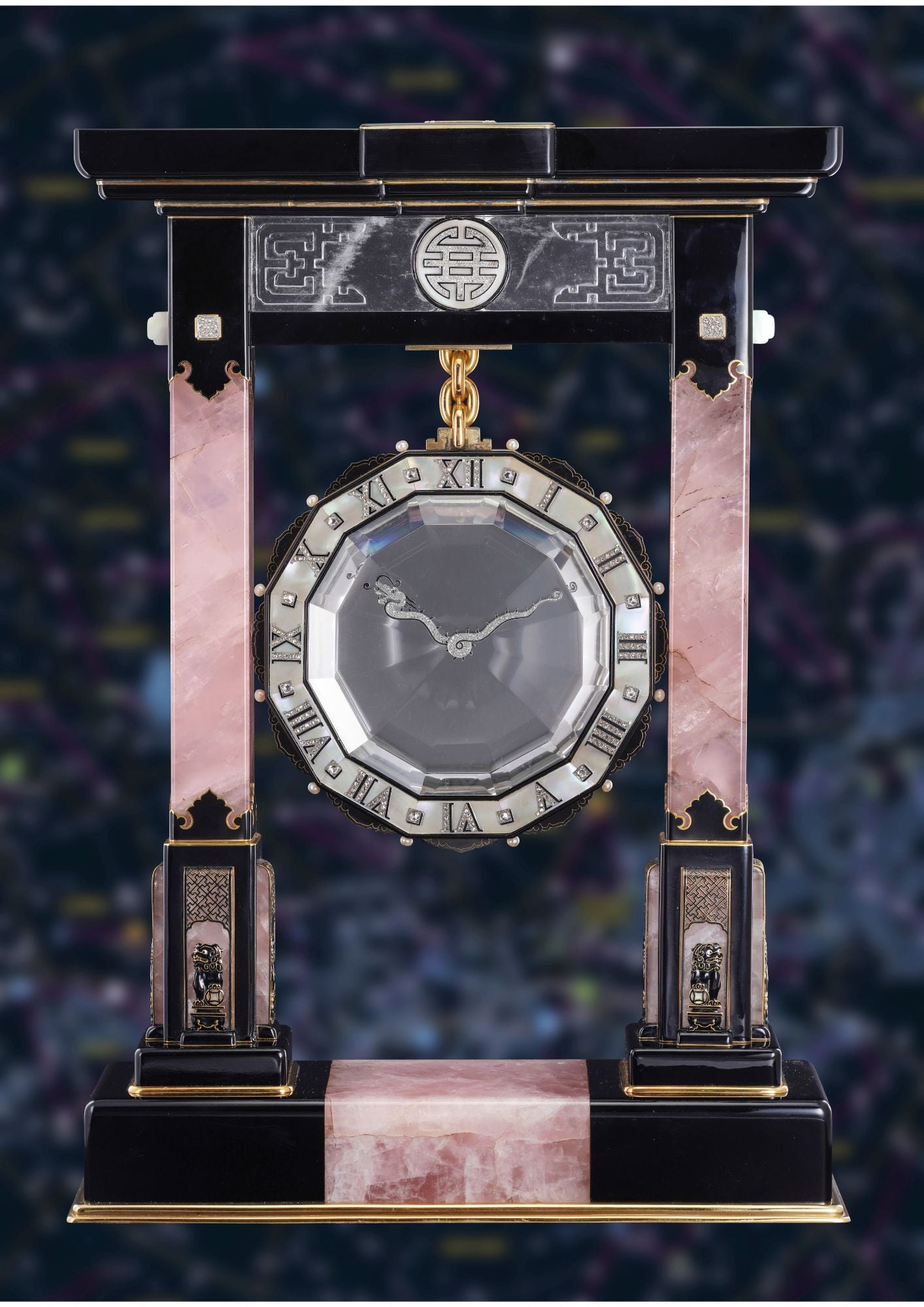
Cartier Portico Mystery Clock No. 3.
It is the only one to be crafted out of rose quartz and features jadeite jade, onyx, enamel, and rock crystal. Along with No. 4, it also has square columns, unlike the others that are all round. The dial is also made from rock crystal and is suspended via a yellow gold chain. The clock had remained in private hands for more than three decades before its return to auction. It is also famous for being displayed at the 1925 Exposition Internationale des Arts Décoratifs et Industriels Modernes in Paris and later at the Los Angeles County Museum of Art. It is now in a distinguished private collection.

The pink crystal square columns of the Cartier Portico Mystery Clock No. 3.
No. 4, 1924
Allow us a little more space to talk about No. 4 as this piece is waiting in the wings for its grand entrance at the Phillips Geneva Watch Auction XXIV (lot 220), which will take place on 7 & 8 November, 2026 at the Hotel President.
Crafted from rock crystal (square columns and dial), it is adorned with jadeite jade, onyx, pearls, mother-of-pearl and diamonds. Its columns are trimmed with inlays of jade flowers, which are most probably Chinese embellishments from the end of the 19th century. It is the only one of the six models that comes with a hexagonal dial – providing more space for decoration - while all the others have dodecagonal (12-sided) dials. The hands are in the form of a dragon with black enamel spikes on its back along with pavé-set diamonds outlined in black enamel. Along with No. 3, this model is among the two largest and most lavish Portico clocks made in the series, standing at 38.5cm high and weighing 10.6kg.

The 1924 Cartier Portico Mystery Clock No. 4, included as Lot 220 in The Geneva Watch Auction XXIV. Estimate: CHF 1,800,000–3,200,000
The No. 4 was formerly owned by Alain Cartier, grandson of Louis Cartier and the fifth generation of the Cartier company, though research indicates an earlier provenance can be traced back to the Maharajah of Nawanagar, ruler of the princely state in western India. It was last offered publicly in The Magical Art of Cartier sale in Geneva on November 19, 1996, over three decades ago.
In April 1991, the late Eric Nussbaum, the first director of the Cartier Collection, brought together all six Cartier Portico Mystery Clocks at the Salon International de la Haute Horlogerie (SIHH). At the time, he described No. 4 in these words: “Portico Clock No. 4 is the largest, most expressive, and most Art Deco of the family of six. This clock is crafted in rock crystal and decorated with jadeite jade, onyx, pearls and mother-of-pearl. It is the only one with a hexagonal face; the other five are 12-sided. Because it is hexagonal, the outline of the face is much more detailed than the others in the family…If you took the diamond hands out of the clock you could make the most magnificent brooch. It seems as if the tongue of the dragon is minute by minute trying to fetch one of the pearls on the bezel; it is like he is reaching for sugar balls.”
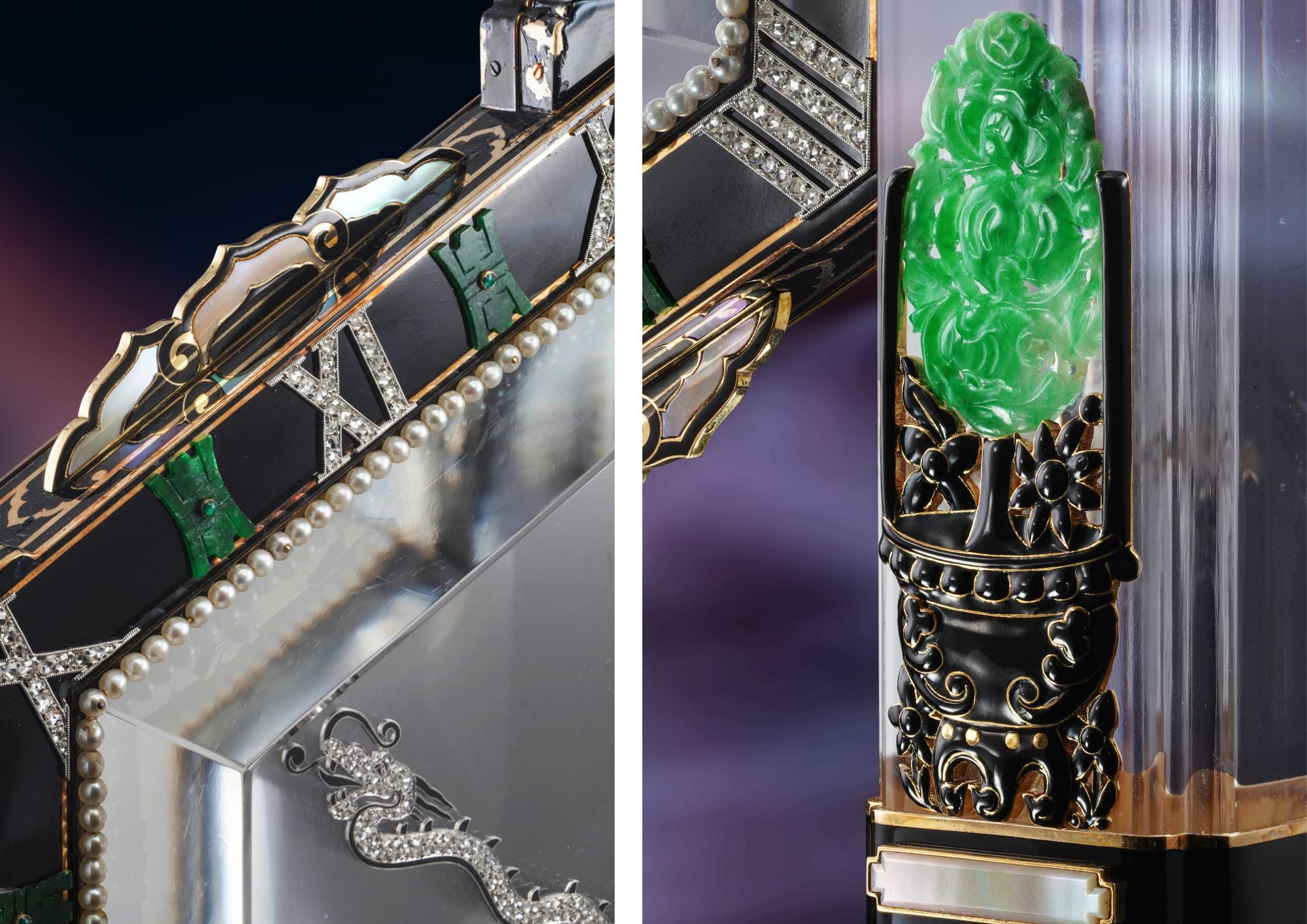
The 1924 Cartier Portico Mystery Clock No. 4, included as Lot 220 in The Geneva Watch Auction XXIV. Estimate: CHF 1,800,000–3,200,000
No. 5, 1925
The Portico Mystery Clock No. 5 is similar in design to the first two with its yellow gold, enamel and rock crystal. Like number one, it is also topped with a Buddha. It is part of an American collection.
No. 6, 1925
Last but by no means least is No. 6, which features yellow gold, enamel, and rock crystal, and is topped by a “Fo Dog”. It currently resides in the Gunter Sachs Collection.
To be able to view one of these incredible creations is a rare occurrence as they only come up for sale once in a generation, adding to their elusive nature. If you have never seen one, we would like to cordially invite you to join us at the Geneva Auction Preview from 4 to 7 November at Hotel President to witness the Cartier Portico Mystery Clock No. 4 before this treasure disappears again.
Spoiler
*If you haven’t figured out how the mystery clock works yet, here is the secret behind the magic! The movement is housed either in the base of the clock, or in the case of the Portico clocks, in the top. But the enigma does not stop there: although the hands look like they are floating, they are actually attached to two separate crystal discs with teeth around their outer edges that connect to the movement. It is therefore the discs, rather than the hands themselves, that rotate, creating an optical illusion.
You can learn more, place a bid, and view the entire Geneva Watch Auction: XXIV catalog here.