Article | Patek Philippe Perpetual Calendar Chronograph 1518 2499 3970 5970 5270 Phillips New York Watch Auction Xv December 2026
From 1518 to 5270: Patek Philippe’s Perpetual Calendar Chronograph
Six watches in The New York Watch Auction XV trace five generations of a signature Patek Philippe pairing.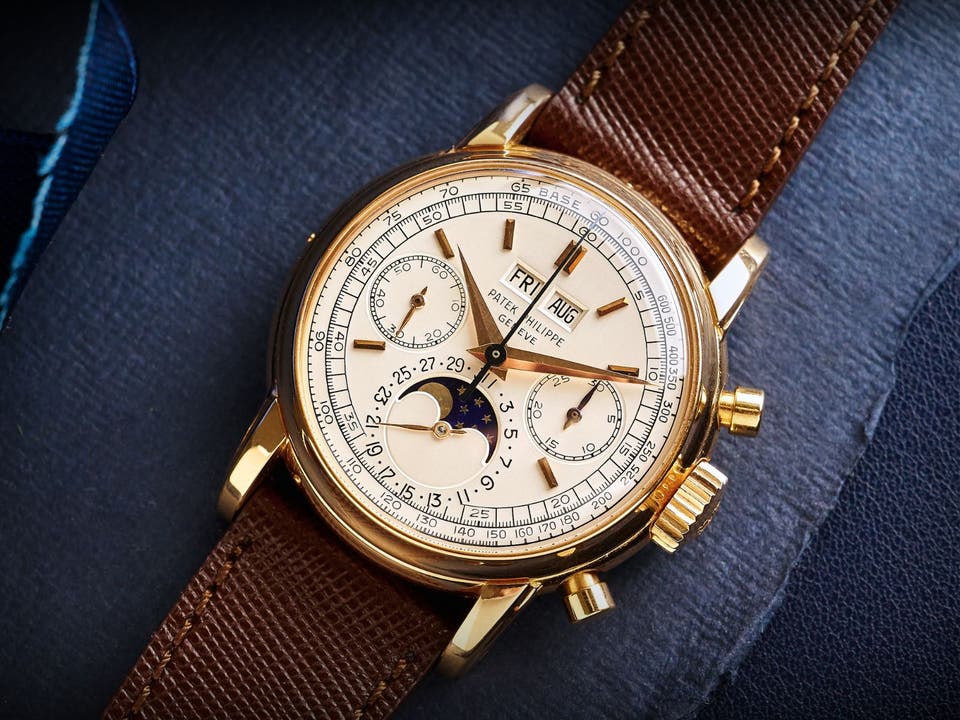
Phillips in Association with Bacs & Russo presents The New York Watch Auction XV, a live auction taking place on 5–6 December 2026 at our New York headquarters. Featuring close to 200 exceptional luxury timepieces from makers such as Patek Philippe, Rolex, Audemars Piguet, Cartier, Vacheron Constantin, and F.P. Journe, the sale includes the six Patek Philippe perpetual calendar chronographs covered in this story.
The New York Watch Auction XV includes all five main generations of Patek Philippe’s perpetual calendar chronograph. Over seven decades, cases grew and shrank, pushers changed shape, and dials gained new indications. Some of the biggest changes, though, happened beneath the dial. Others took decades to come full circle, as details the Geneva brand had dropped found their way back.
Six lots in the sale paint a picture of how this pairing of complications became a Patek Philippe signature.
The Dawn of the 1518
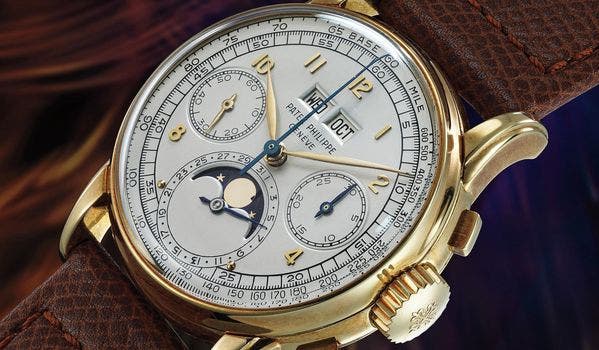
The story begins in 1941 with the Ref. 1518, the first perpetual calendar chronograph wristwatch produced in series. Combining a stopwatch with a calendar that accounts for months of different lengths and for leap years was one challenge. Giving the wearer a clear way to read all that information on a 35mm watch was another.
The 1518 used Patek Philippe’s caliber 13‴130 Q, based on the Valjoux 23. The chronograph layout put running seconds at 9 o’clock and elapsed minutes at 3, on either side of the dial.
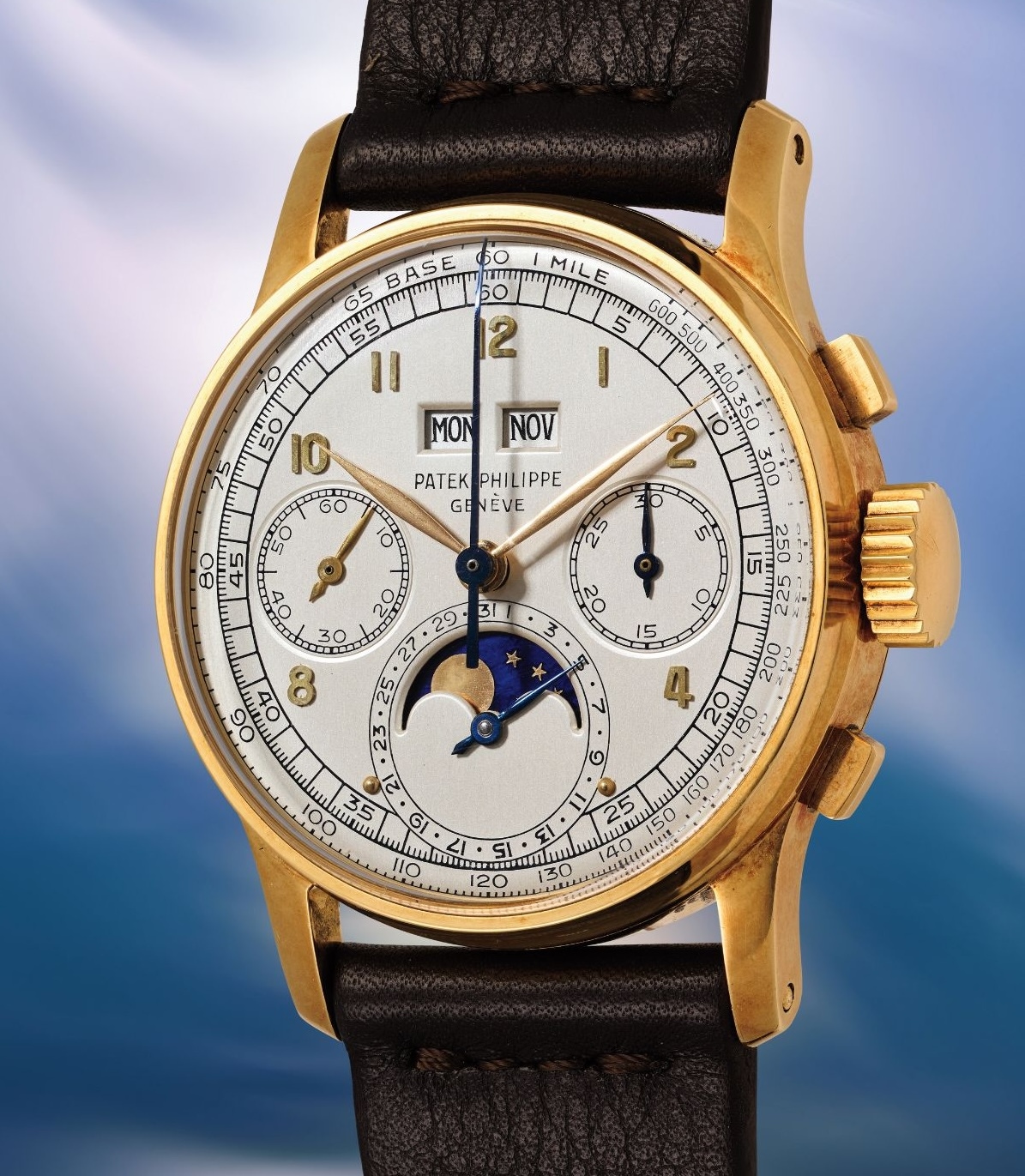
Lot 25: A 1950 Patek Philippe perpetual calendar chronograph Ref. 1518 in 18k yellow gold, included in The New York Watch Auction XV. Estimate: USD $500,000–1,000,000
The day and month were displayed in two windows at 12, and the date was arranged around the moon phase at 6. The calendar thus had a vertical axis of its own, while the chronograph’s central seconds hand could be read against the tachymeter at the edge of the dial.
That order is especially clear on the 1950 yellow gold example heading to New York. The raised hard-enamel printing remains crisp, so the small numerals around the moon phase and the markings at the dial’s edge are still easy to distinguish.
This example also has a story of its own. An engraving on the caseback links the watch to Eduardo Hernández Cházaro, a Mexican brigadier general and politician who commanded the 23rd Military Zone in Tlaxcala.
Two Takes on 2499
Introduced around 1950, the Ref. 2499 overlapped briefly with the 1518 and retained its caliber 13‴130 Q. Patek made more of a departure with the case, giving the 2499 a concave bezel and prominent lugs with a groove carved along their outer edges.
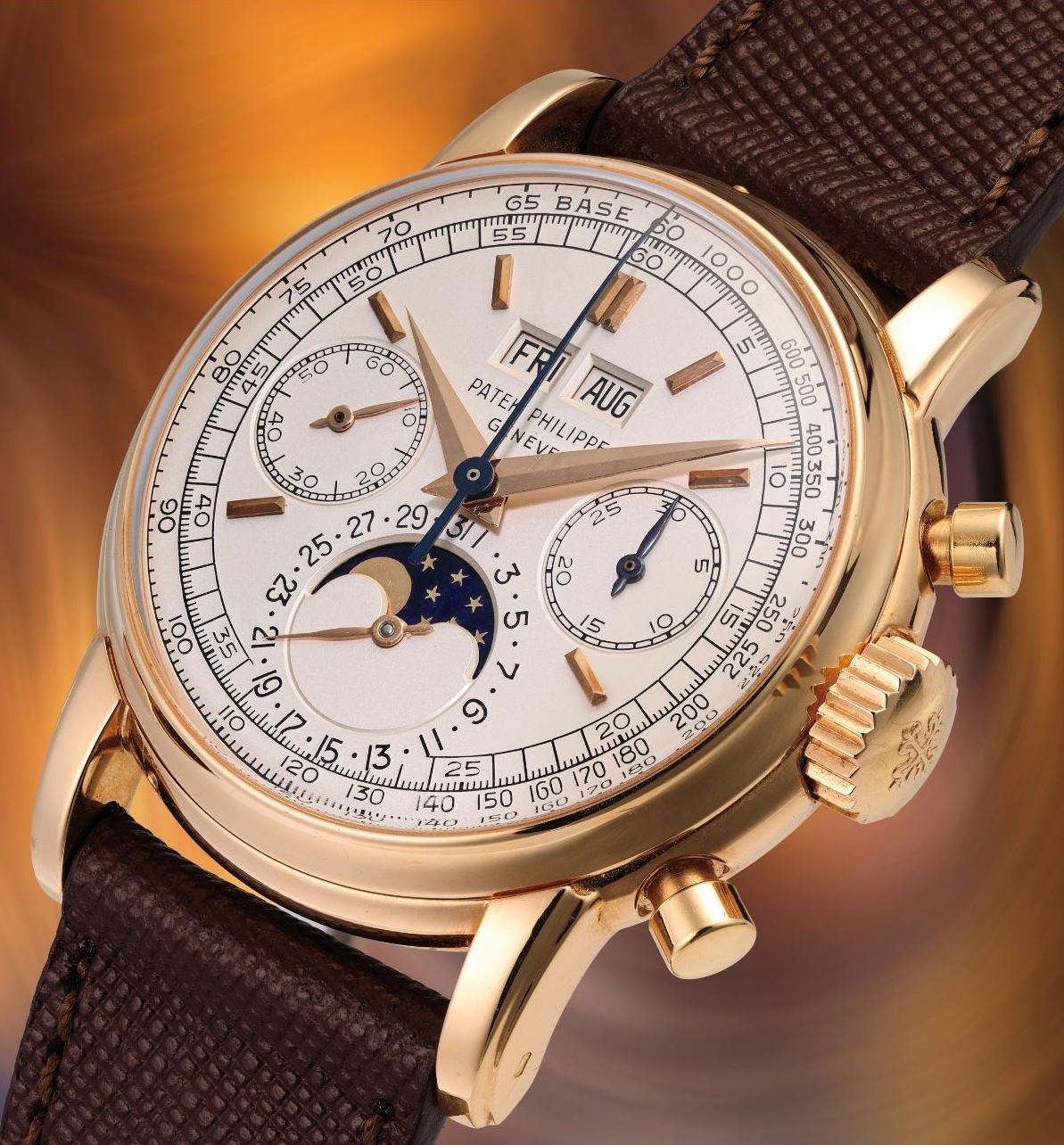
Lot 123: A 1953 Patek Philippe second-series perpetual calendar chronograph Ref. 2499 in 18k pink gold, included in The New York Watch Auction XV. In excess of USD $3,000,000
The first series kept the 1518’s rectangular pushers. By the second series, those had become round, while the tachymeter remained. On the 1953 pink gold watch coming to New York, the lugs retain their shape and the hallmarks are particularly crisp. Eight second-series examples in pink gold have been publicly identified, including this one.
By the third series, a simple seconds track had taken the place of the tachymeter, opening up the edge of the dial. The yellow gold example in the sale also shows how differently a 2499 could be worn.
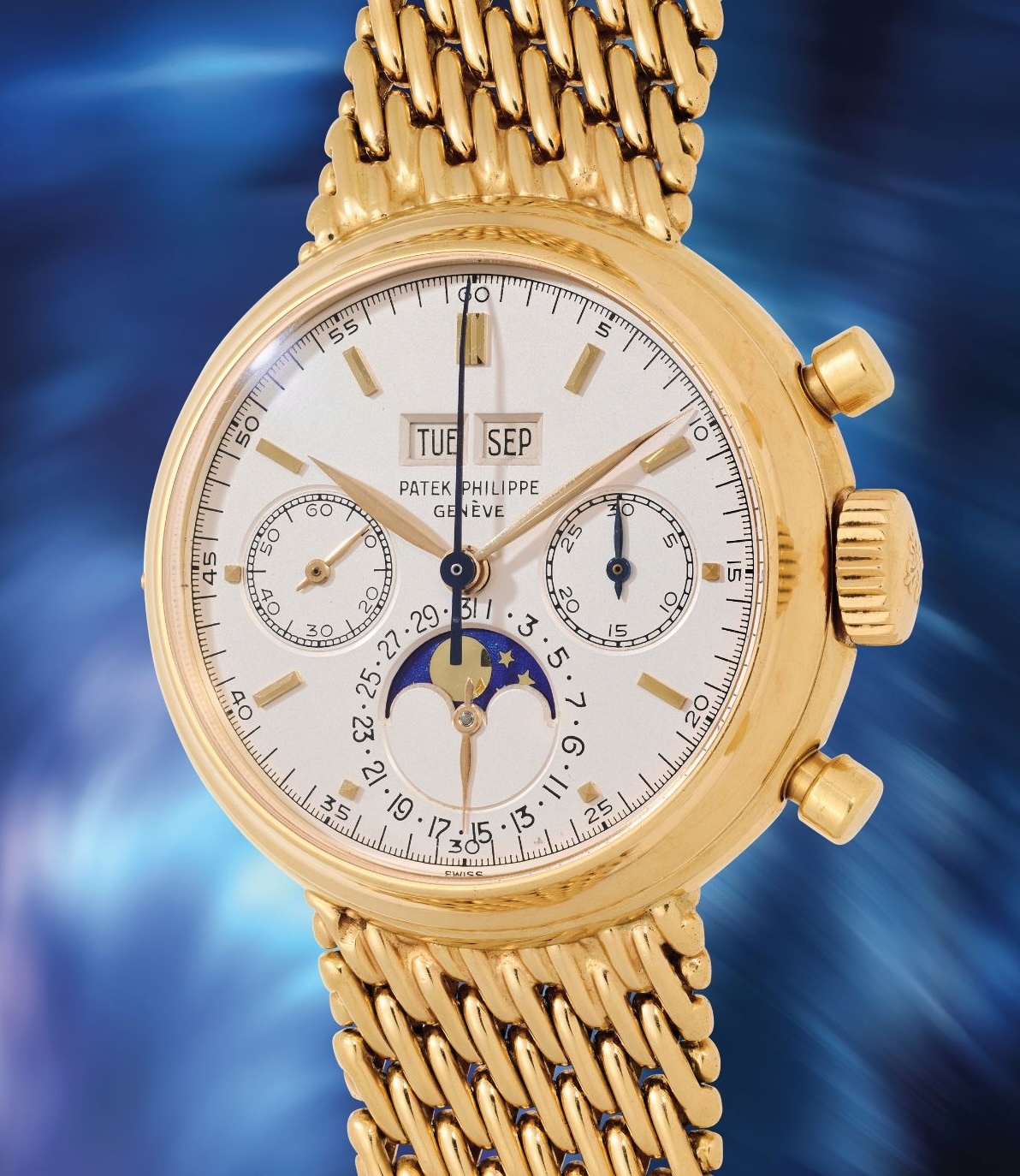
Lot 152: A Patek Philippe third-series perpetual calendar chronograph Ref. 2499 in 18k yellow gold, with an integrated gold bracelet later fitted by Patek Philippe, included in The New York Watch Auction XV. Estimate: USD $500,000–1,000,000
It originally had a gold bracelet, and a later owner asked Patek to fit it with a permanently integrated one. The Extract from the Archives dates the conversion to a service in 1988. The braided bracelet changes the outline of the watch, carrying the gold of the case around the wrist. And the watch is now making its auction debut after more than 40 years with the same family.
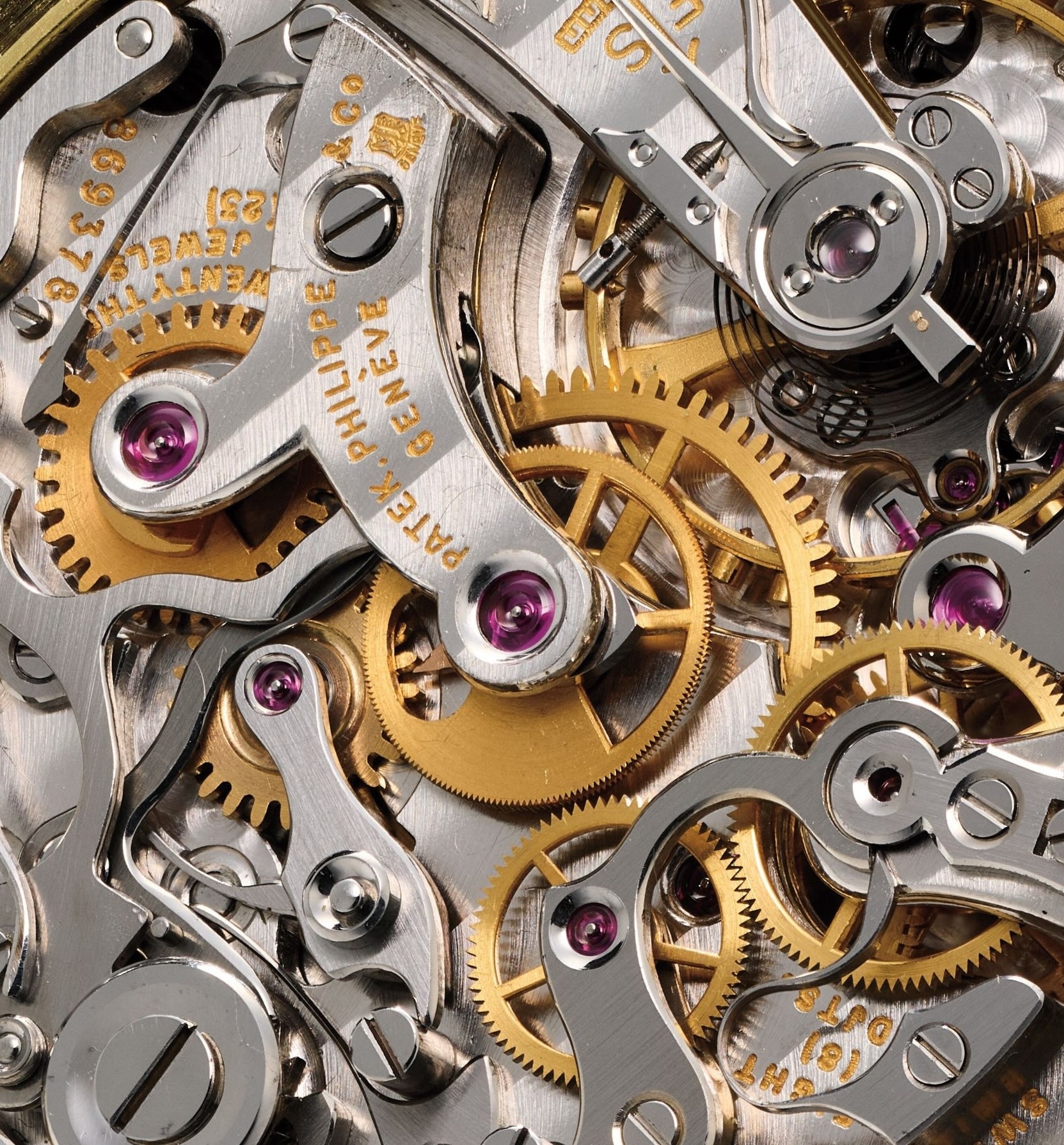
Lot 152: Close-up of the Valjoux 23-based caliber 13‴130 Q in the third-series Patek Philippe Ref. 2499 in 18k yellow gold, offered in The New York Watch Auction XV. Estimate: USD $500,000–1,000,000
Patek continued to develop the 2499 into the 1980s. The final series, known as the Ref. 2499/100, introduced a sapphire crystal and remained in regular production through 1985. The next big change to the line came the following year – inside the case.
A New Caliber
The Ref. 3970 arrived in 1986 with a new Lemania-based caliber, the CH 27-70 Q, and a 36mm case – 1.5mm smaller than either of the 2499s in the sale.
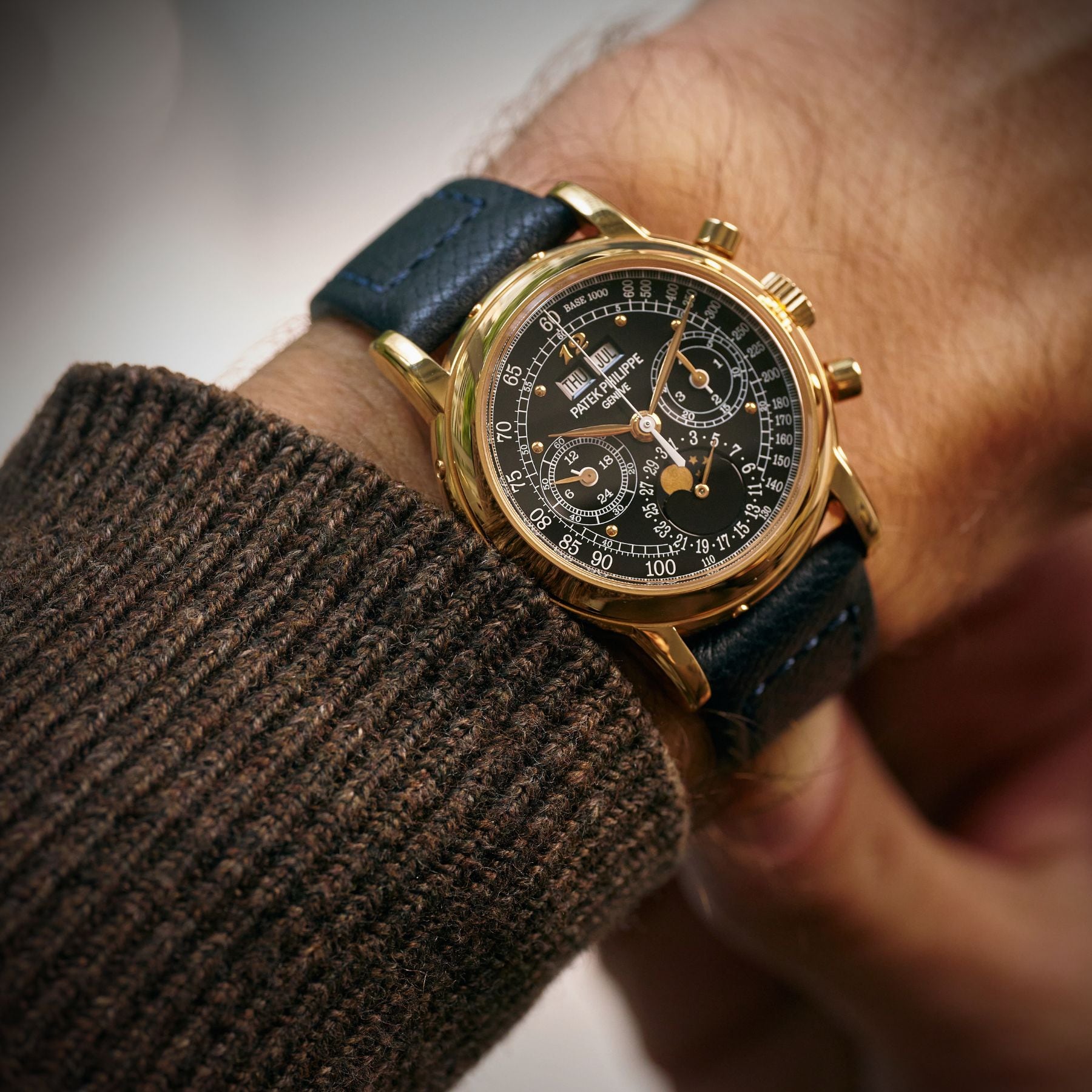
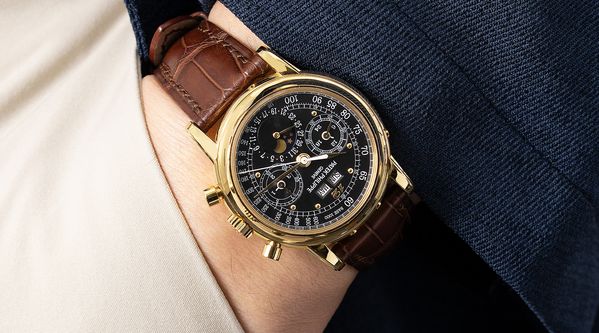
Lot 18: A 2015 Patek Philippe perpetual calendar chronograph Ref. 3970ER-028 in 18k pink gold with black dial, made for the London Watch Art Grand Exhibition, included in The New York Watch Auction XV. Estimate: USD $400,000–800,000
But its dial told the wearer more: a leap-year display showed where the calendar stood in its four-year cycle, and a 24-hour indication gave the owner a way to distinguish morning from evening when setting the watch. Patek fitted the two indications into the existing subdials at 3 and 9 o’clock, respectively.
Most 3970s did without a tachymeter, but the watch coming to New York has one. Patek made it in 2015 for its Watch Art Grand Exhibition at London’s Saatchi Gallery, reviving the discontinued reference for the occasion.
The company made five pink gold examples in this configuration, pairing the tachymeter with a black dial, dot hour markers, and an applied Breguet numeral at 12.
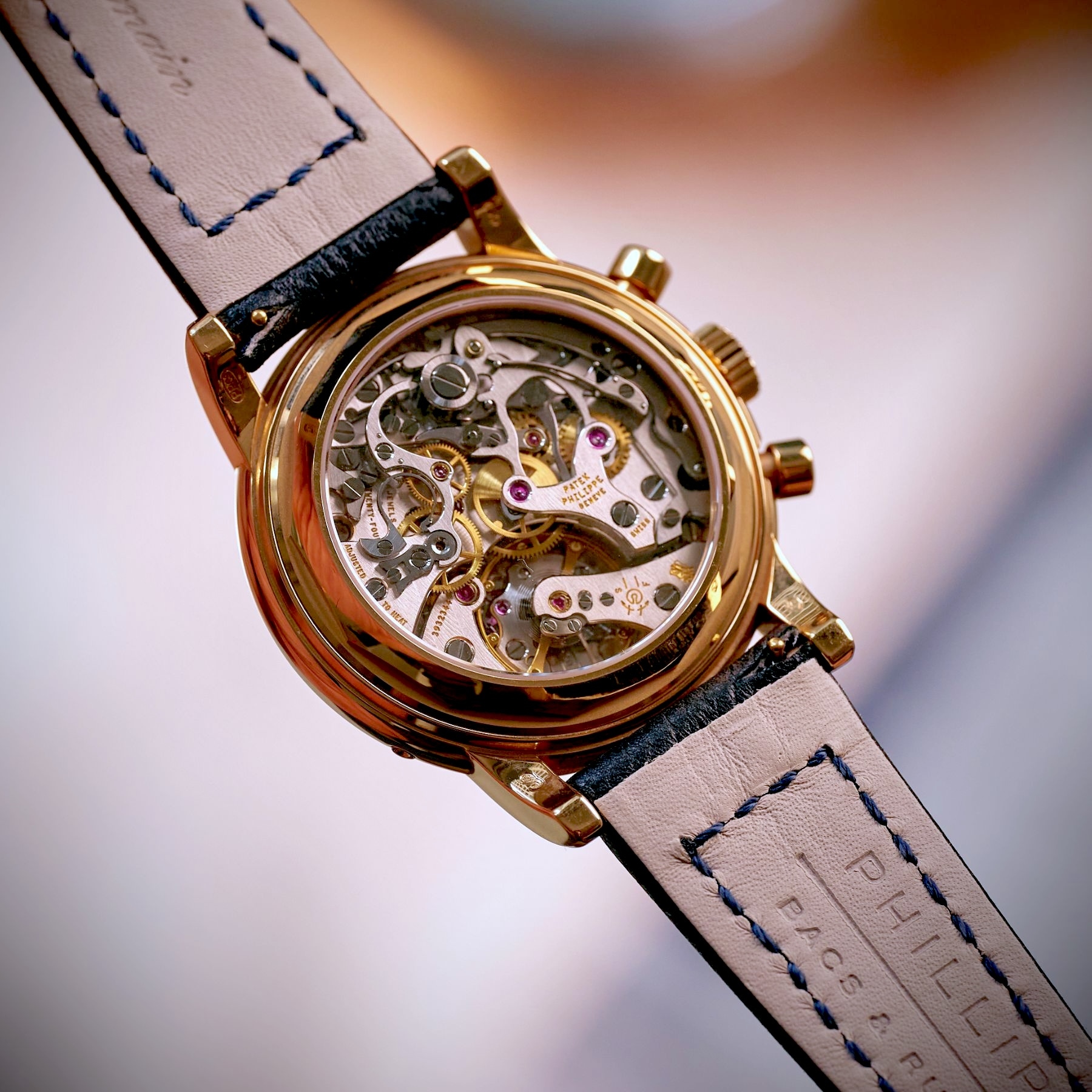
Lot 18: A 2015 Patek Philippe perpetual calendar chronograph Ref. 3970ER-028 in 18k pink gold with black dial, made for the London Watch Art Grand Exhibition, included in The New York Watch Auction XV. Estimate: USD $400,000–800,000
By then, the Ref. 5270 had already been introduced – more on that shortly – but the London edition showed how readily the earlier 3970 could take on a detail from the 1518 and early 2499.
Back to Rectangular Pushers
The Ref. 5970 succeeded the 3970 in 2004. Patek kept the Lemania-based caliber but enlarged the case to 40mm, giving the dial room for a tachymeter as well as the two indications introduced on the 3970. Rectangular pushers returned to the main line for the first time since the first-series 2499. Those older details worked well on a watch whose proportions were markedly different from those of its predecessors.
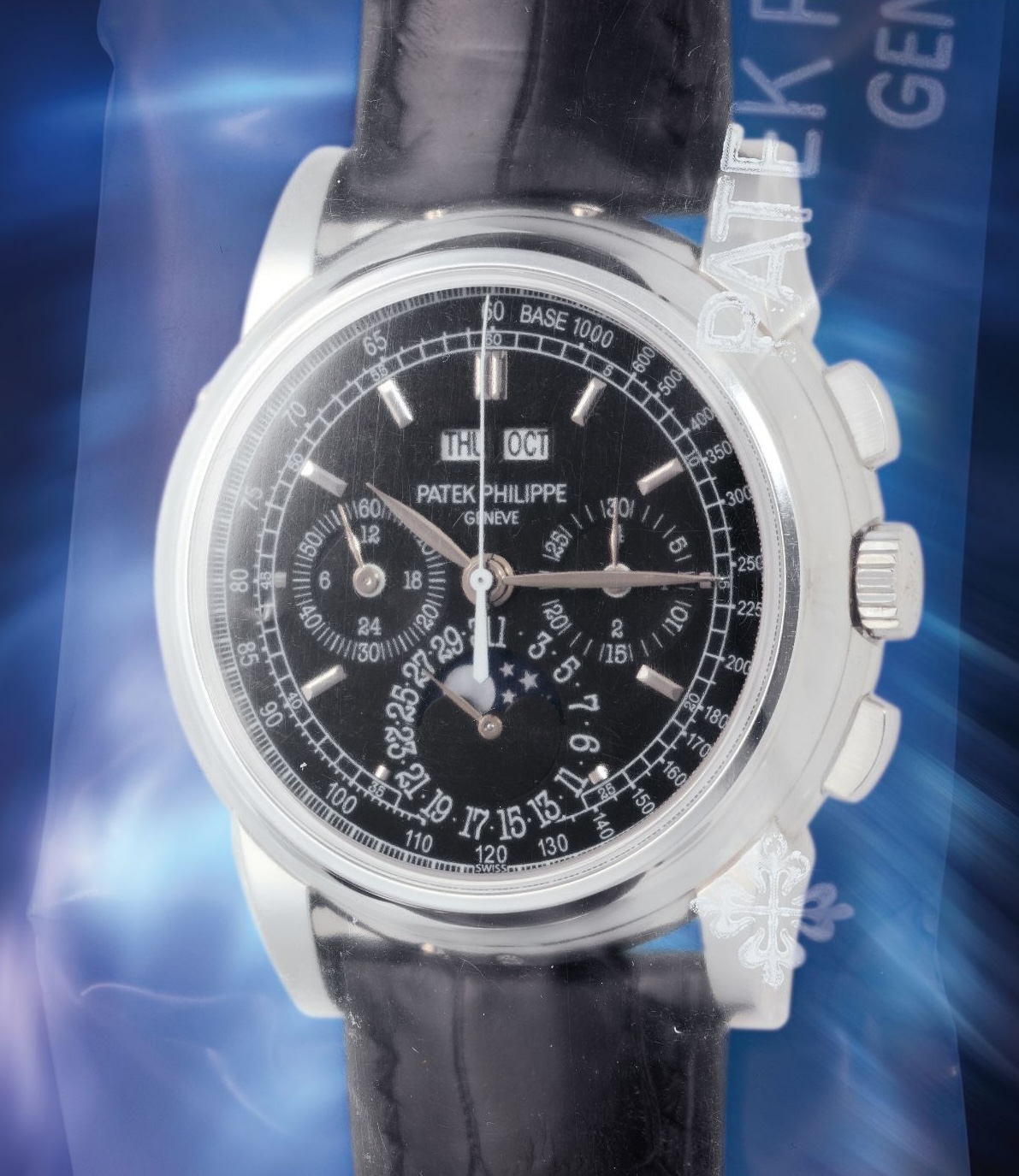
Lot 7: A 2009 Patek Philippe perpetual calendar chronograph Ref. 5970P-001 in platinum, factory single-sealed, included in The New York Watch Auction XV. Estimate: USD $150,000–300,000
The New York example dates to 2009 and pairs a black dial with a platinum case. It comes factory single-sealed and represents the last generation of the line to use the Lemania-based movement.
The Manufacture Caliber
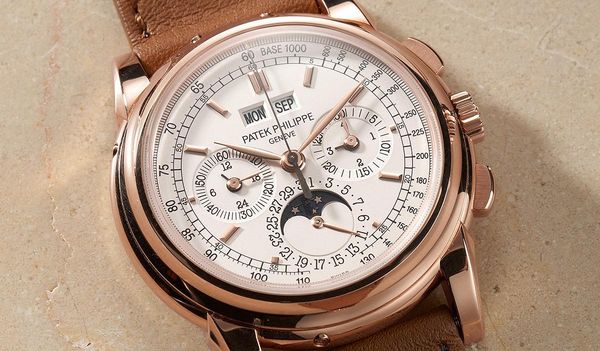
The current generation, the Ref. 5270, arrived in 2011 with the CH 29-535 PS Q, Patek’s first in-house perpetual calendar chronograph caliber.
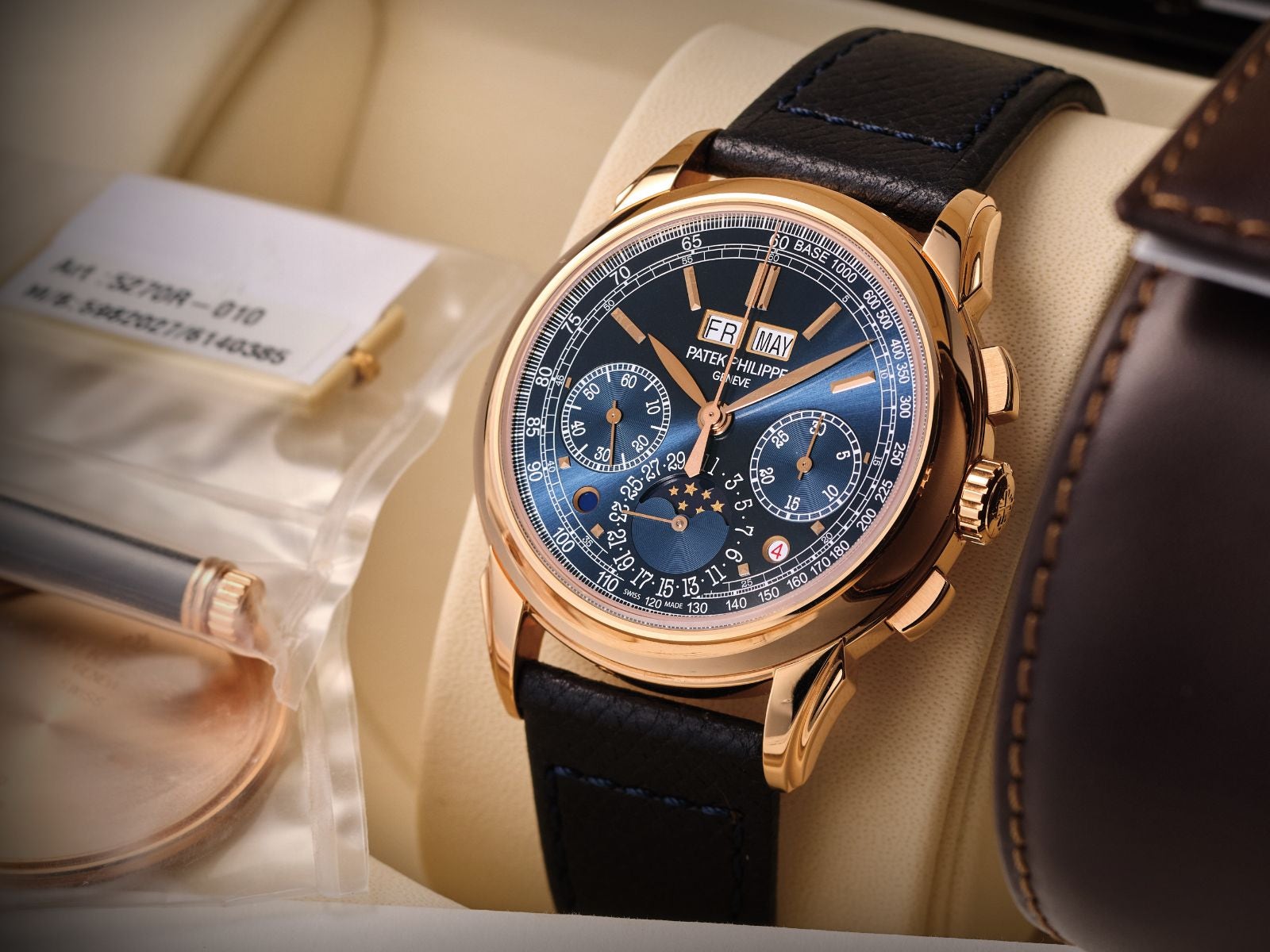
Lot 51: A 2017 Patek Philippe perpetual calendar chronograph Ref. 5270R-010 in 18k pink gold with “bleu nuage” dial, included in The New York Watch Auction XV. Estimate: USD $150,000–300,000
The change is visible on the dial. The running seconds and 30-minute counter sit a little below the horizontal centerline, and the day/night and leap-year indications have small windows of their own. The day and month still sit at 12 o’clock, with the date and moon phase at 6.
The 2017 watch in New York pairs pink gold with a “bleu nuage” dial, a color more commonly seen on white gold versions. The Certificate of Origin documents the pairing, which Phillips considers likely to have been a special order.
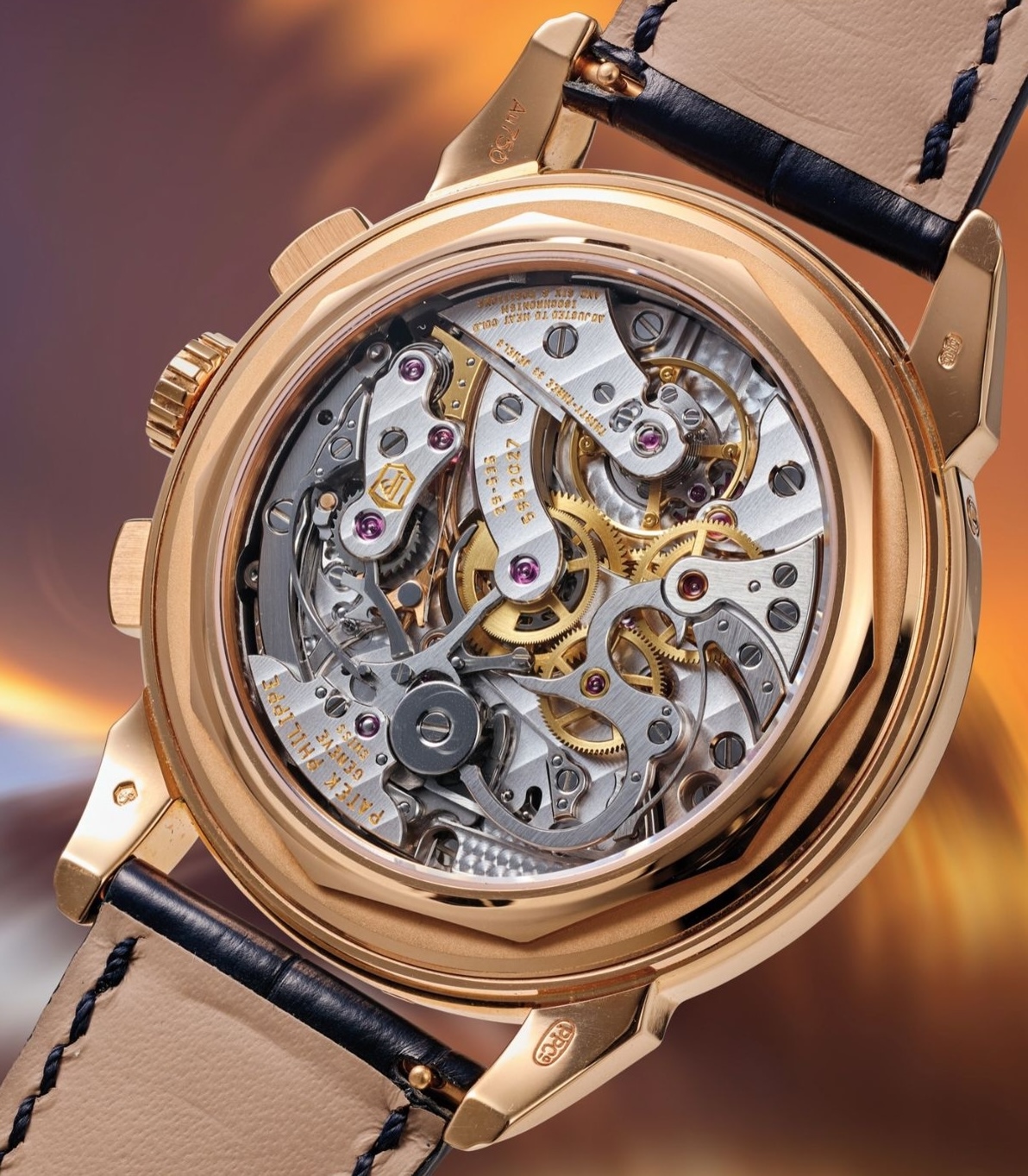
A close-up of the in-house caliber CH 29-535 PS Q in the 2017 Patek Philippe Ref. 5270R-010 in 18k pink gold, Lot 51 in The New York Watch Auction XV. The eccentric cap on the column wheel lets a watchmaker fine-tune how deeply the clutch wheel meshes with the chronograph wheel.
Seventy years after the 1518 kicked off Patek Philippe’s line of perpetual calendar chronographs, the case had grown from 35mm to 41mm, and the brand had built a caliber of its own. Reassuringly, though, an owner of the 1518 would still have known their way around the dial.
You can learn more, place a bid, and view the full catalog for The New York Watch Auction XV here.