Article | Early Fp Journe Rare Details Tourbillon Souverain Resonance Octa Phillips New York Watch Auction Xv December 2026
Early F.P. Journe: Rare Details Worth a Closer Look
Across six watches, a number stamped on a dial, a shallow caseback engraving, and a particular type of movement decoration offer clues to where each watch fits in the production sequence and how a watchmaker’s style took shape.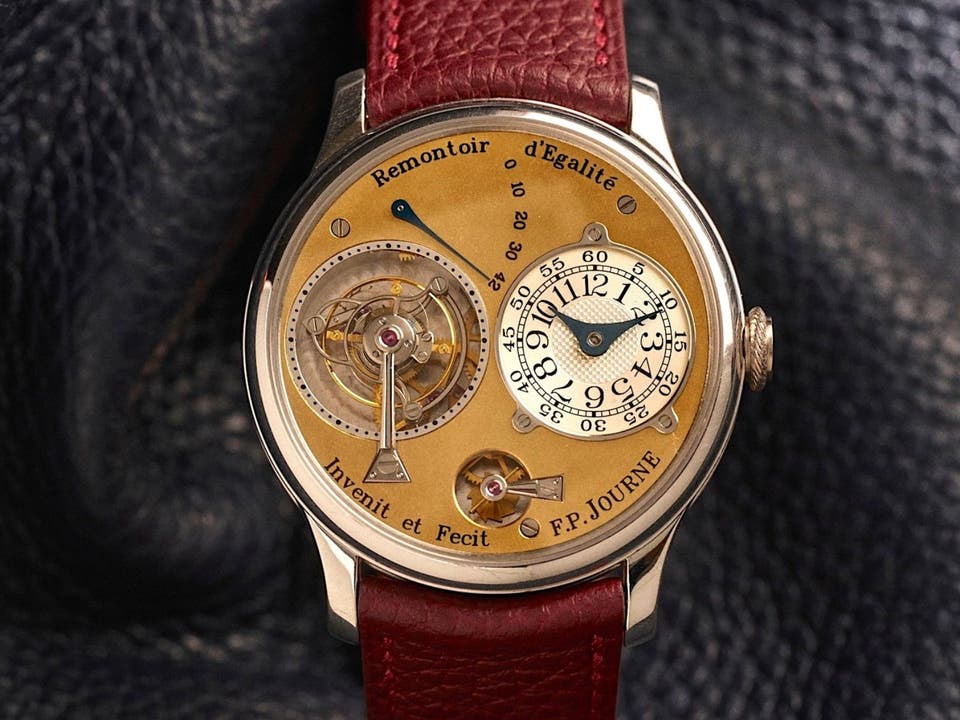
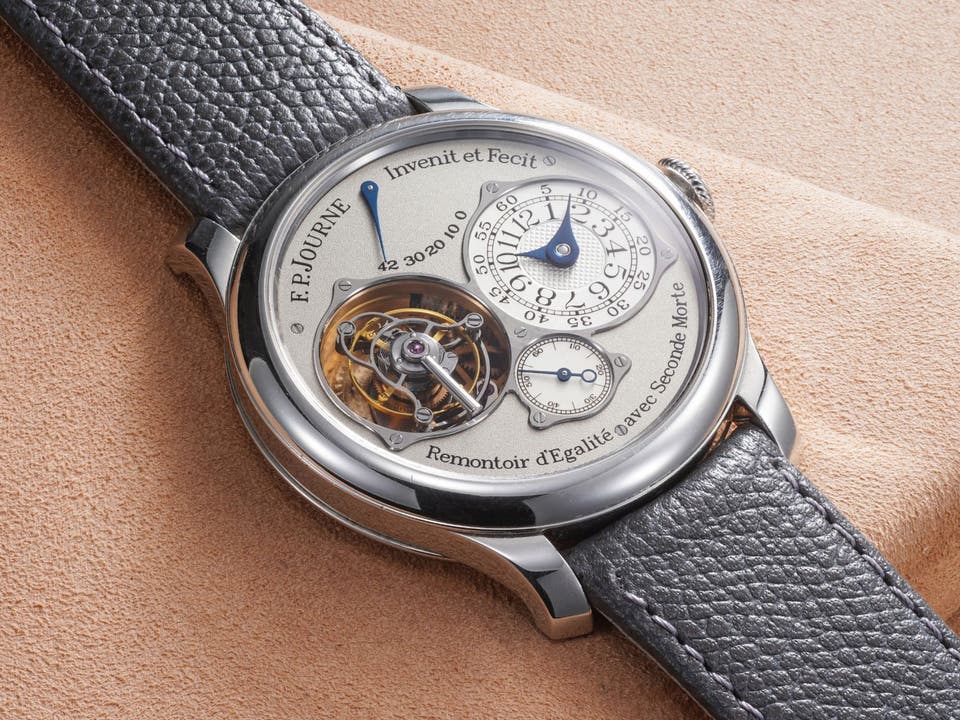
Lot 20: A 1999 F.P. Journe Tourbillon Souverain in platinum, case No. 036/99T, a second-generation example with shiny yellow gold dial, included in The New York Watch Auction XV. Estimate: USD $600,000–1,200,000
Phillips in Association with Bacs & Russo presents The New York Watch Auction XV, a live auction taking place on 5–6 December 2026 at our New York headquarters. Featuring close to 200 exceptional luxury timepieces from makers such as Patek Philippe, Rolex, Audemars Piguet, Cartier, Vacheron Constantin, and F.P. Journe, the sale includes the six early F.P. Journe watches covered in this story.
Part of the pleasure of collecting is learning to notice things you might once have passed over. Sometimes it’s one of those details that makes you covet a particular example. For instance, look just to the right of the power-reserve scale on the yellow gold dial of Lot 10 in The New York Watch Auction XV and you’ll see “13/20.”
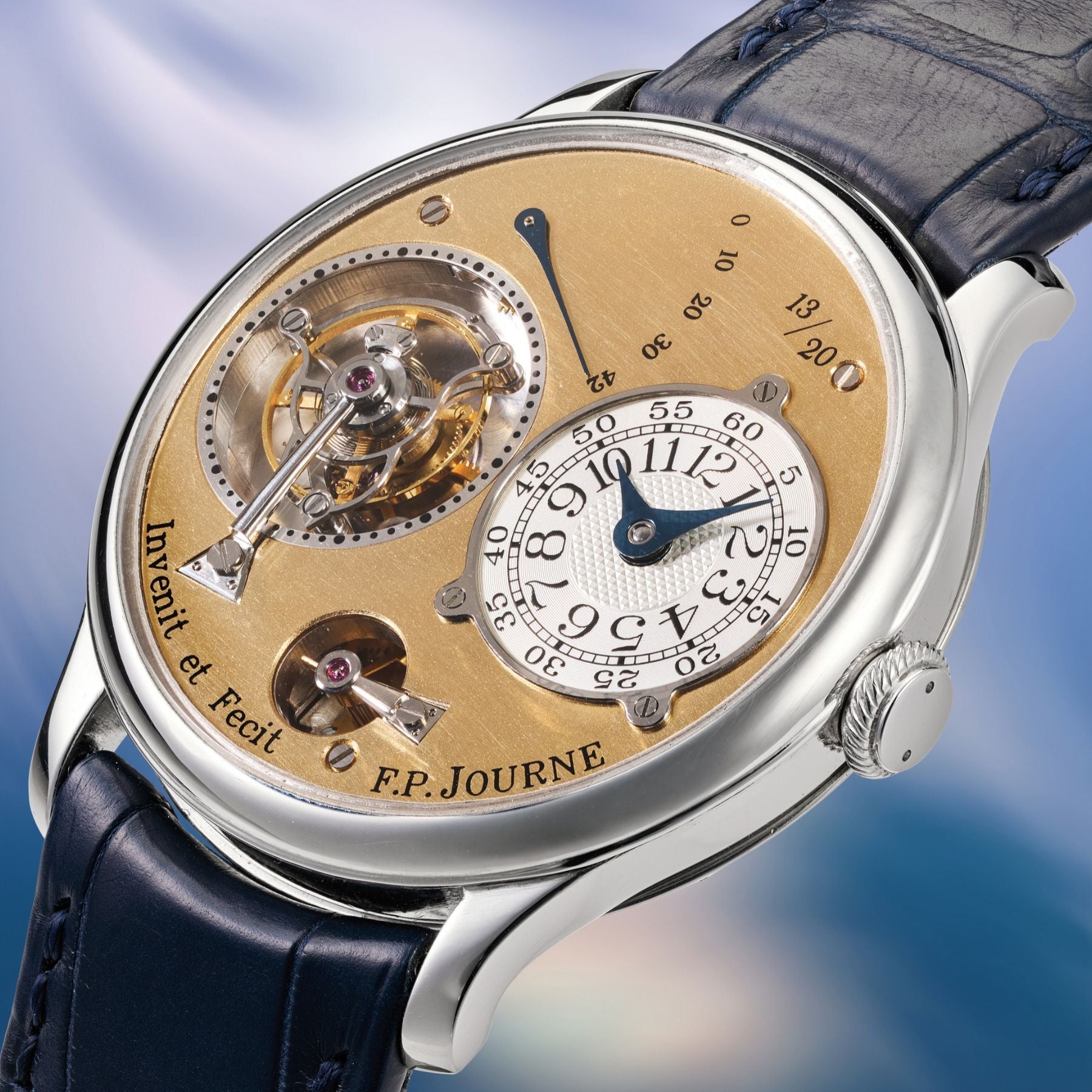
Lot 10: A 1999 F.P. Journe Tourbillon Souverain “Souscription No. 13” in platinum with yellow gold dial, one of the original 20 souscription tourbillons, included in The New York Watch Auction XV. Estimate: In excess of USD $1,000,000
The 13 appears again, this time in small italic engraving, on the back of the platinum case. It identifies one of the 20 Souscription Tourbillon Souverains that helped François-Paul Journe start the company that bears his name.
The original contract, signed by the watchmaker and dated 1998, comes with the watch. It sets out a subscription arrangement familiar to Abraham-Louis Breguet two centuries earlier. Subscribers committed to buying a watch before it had been made, paying a portion up front. Journe would get the funds to equip his workshop and make the watches, and they would get a preferential price and the first opportunity to buy subsequent models.
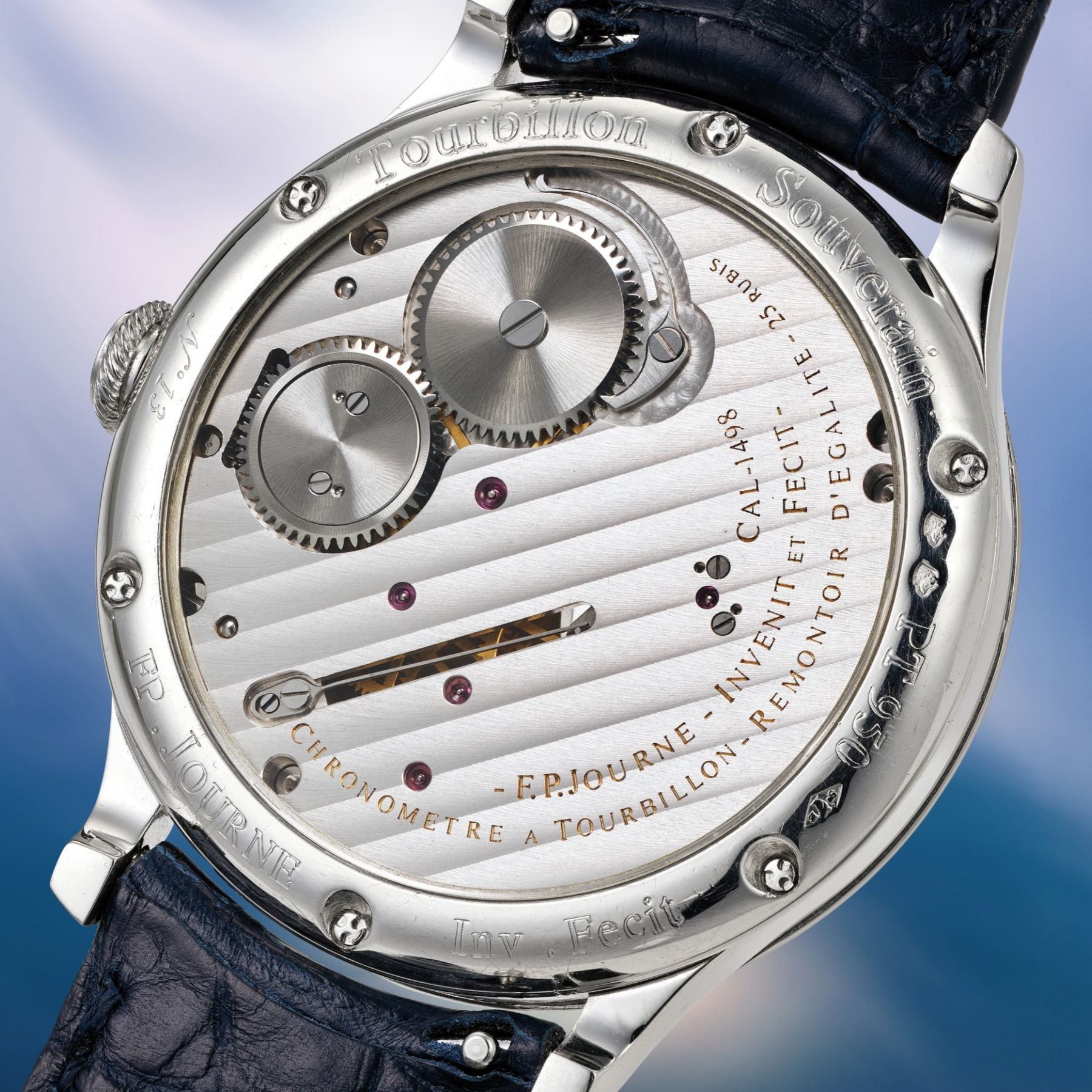
Lot 10: A 1999 F.P. Journe Tourbillon Souverain “Souscription No. 13” in platinum with yellow gold dial, one of the original 20 souscription tourbillons, included in The New York Watch Auction XV. Estimate: In excess of USD $1,000,000
There’s one more place to look for that number: it was written by hand on the original cardboard outer box, which has survived along with the contract and the remarkably well-preserved timepiece.
After the Souscription
Put that Souscription (Lot 10) next to the second-generation Tourbillon Souverain, case No. 036/99T (Lot 20), and the family resemblance is immediate. Both have 38mm platinum cases, reflective yellow gold dials, and the same small numerals along the power-reserve scale. Look a little farther up the second-generation dial and there’s something new, written along its curve – “Remontoir d’Egalité.”
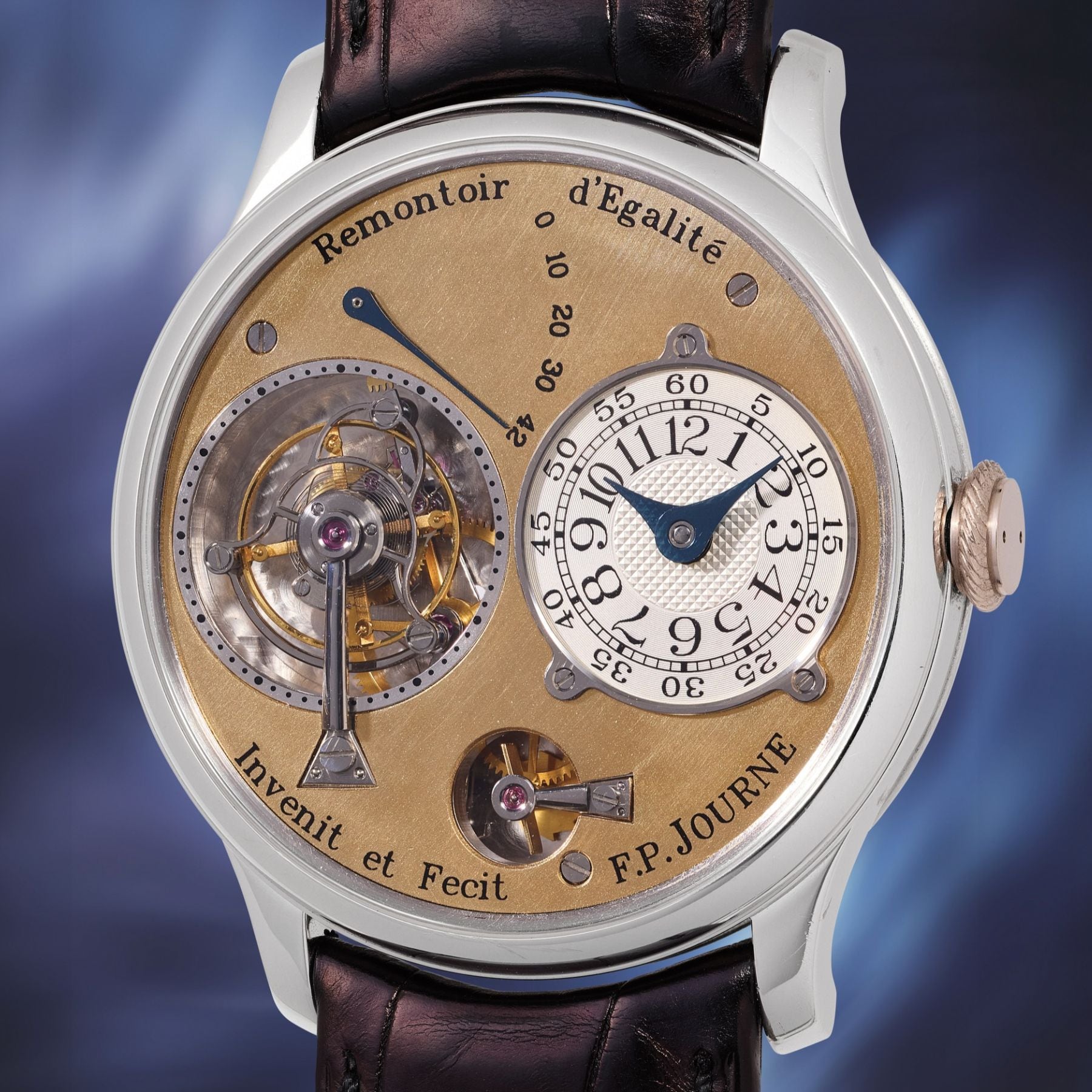
Lot 20: A 1999 F.P. Journe Tourbillon Souverain “No. 36” in platinum, a second-generation example with shiny yellow gold dial, included in The New York Watch Auction XV. Estimate: USD $600,000–1,200,000
The Souscription already had a remontoir. You can see part of it beneath the rounded bridge in the small opening near the bottom of either dial. It feeds energy to the escapement in regular amounts, helping the watch keep a steadier rate as the mainspring winds down.
What’s more, if you tilt the two watches, you can see how the light moves across the gold. The Souscription shows fine marks like brushstrokes. On the second-generation dial, straight lines come into view beneath the lacquer. Journe told the consignor that they came from his own preparation of the dial. At certain angles, the lettering appears to float above the surface.
Phillips estimates that sixteen second-generation watches were made, four fewer than in the Souscription series. Comparing company sales records, Journe researcher Osama Sendi found that someone bought a second-generation Tourbillon in May 1999, while some of Journe’s original subscribers may still have been waiting for their watches.
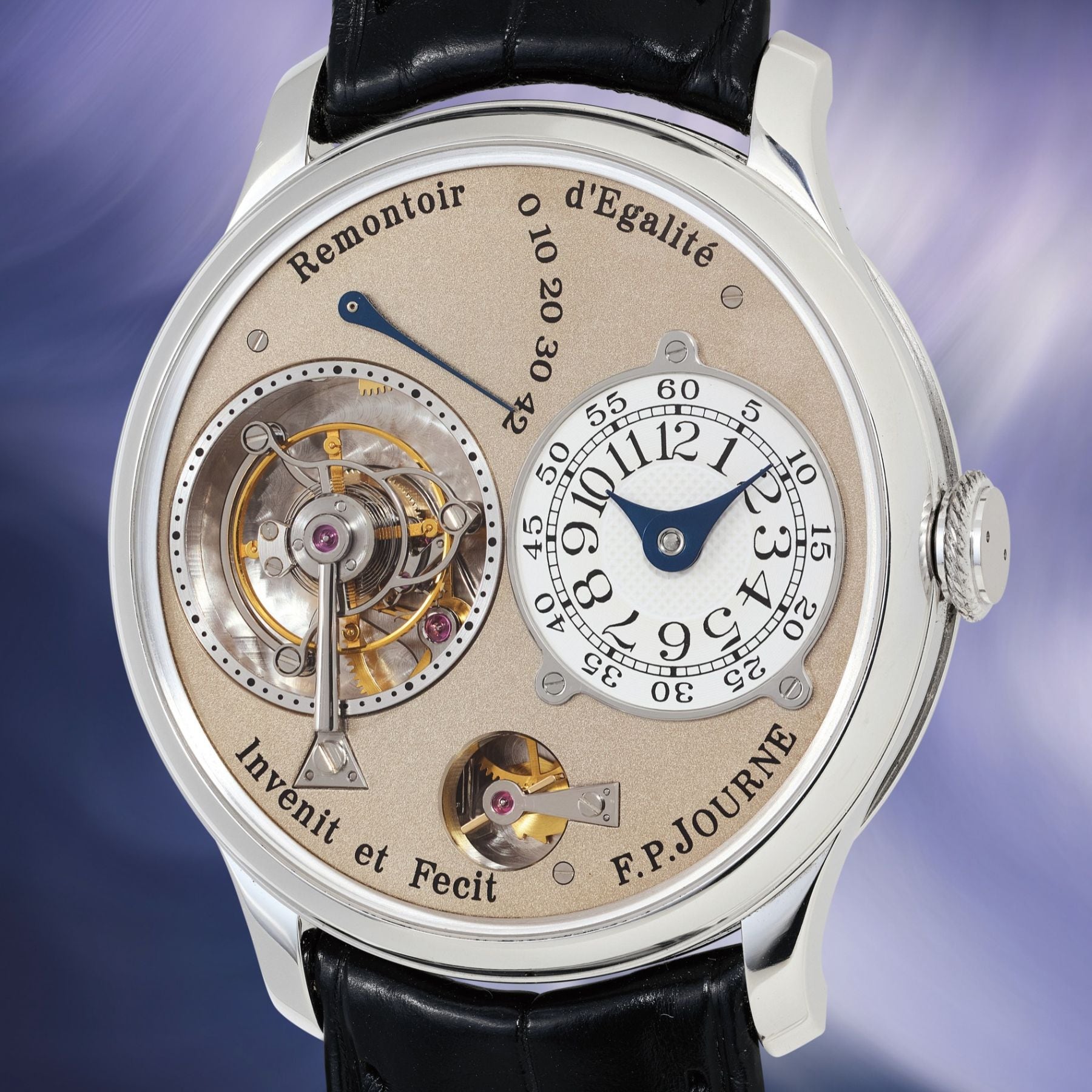
Lot 76: A 2003 F.P. Journe Tourbillon Souverain in platinum with white gold dial and brass movement, included in The New York Watch Auction XV. Estimate: USD $300,000–600,000
Now bring in the fourth-generation Tourbillon Souverain from 2003, case No. 219-03T (Lot 76). The case is still 38mm and still platinum. The white gold dial catches your eye first. Look at the power-reserve scale and the opening near six o’clock. The numerals are larger and the remontoir bridge is flat, two changes Journe had already made by the third generation. Then compare the screws holding the dial in place. They’re noticeably smaller than on either of the 1999 watches – a change introduced in the fourth generation.
A Pink Gold Résonance
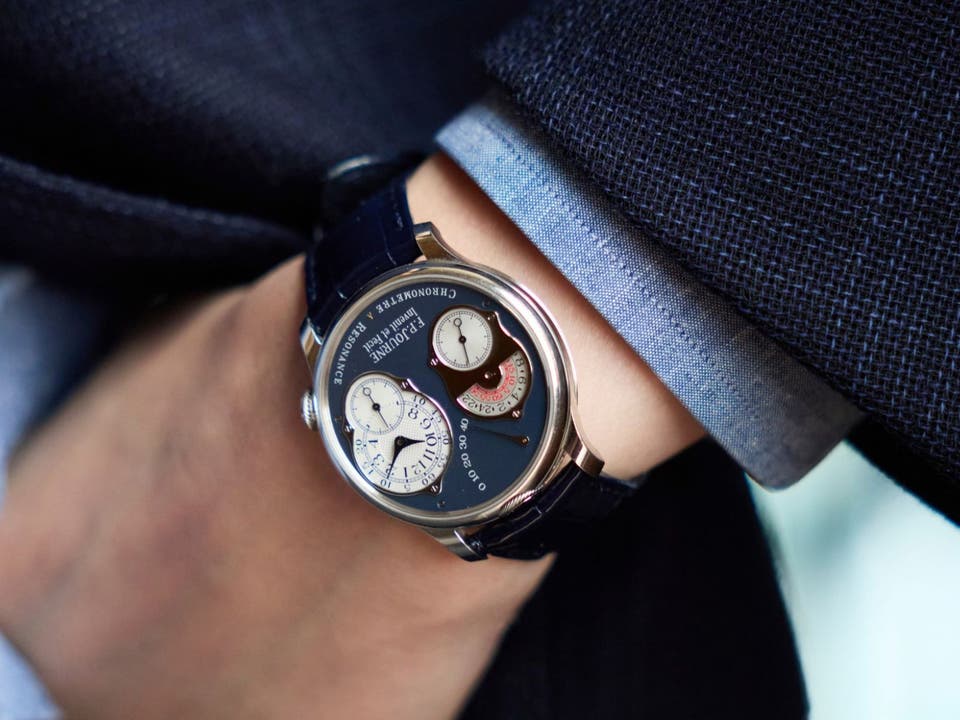
On Lot 33, a Chronomètre à Résonance, the two time displays are the brightest parts of the dial. Their silvery surfaces stand out against the grain of the white gold around them, and the pink gold case frames both. Phillips identifies it as the only known “Pre-Souscription” Résonance in pink gold. Its certificate of authenticity records its delivery to France in 2000.
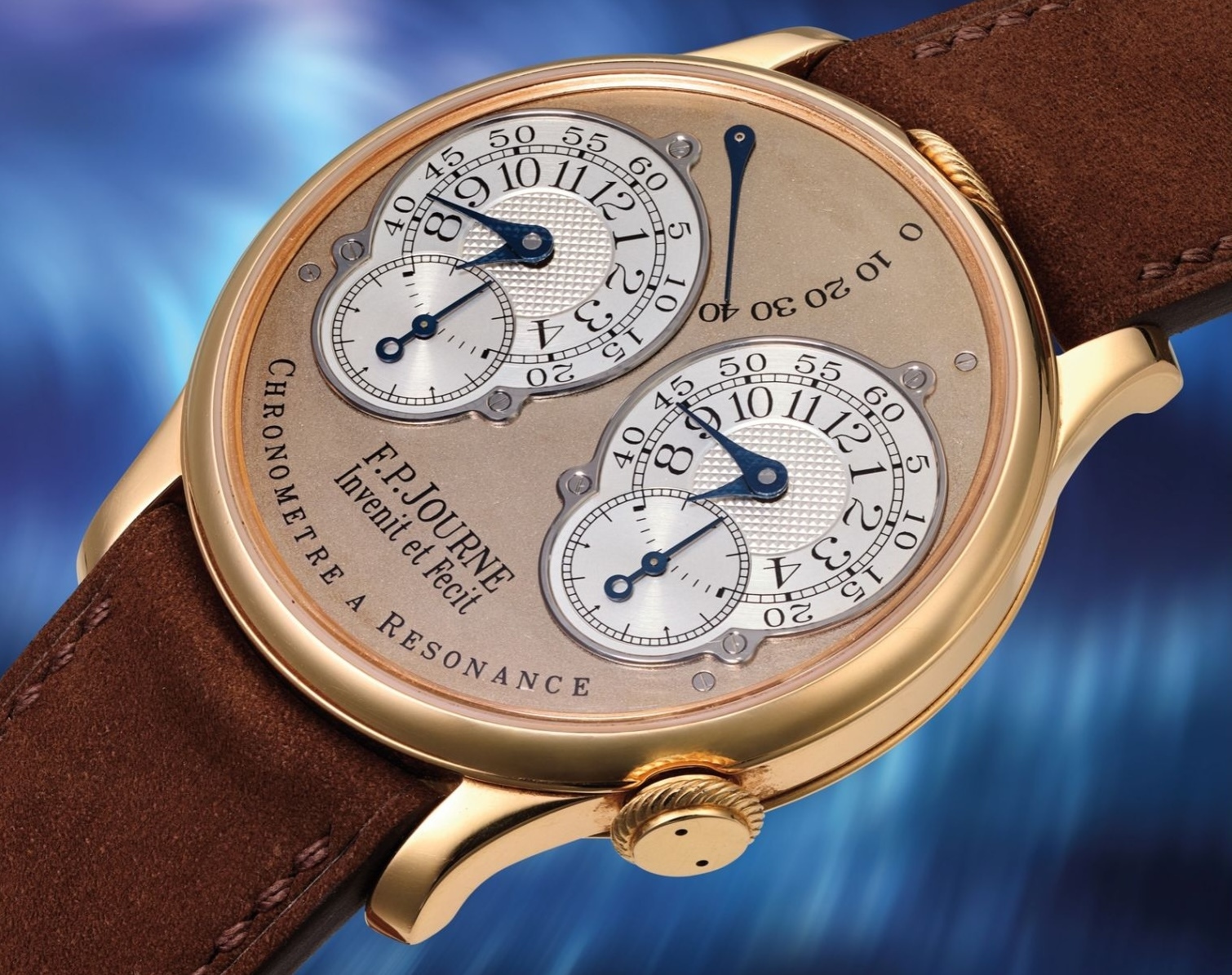
Lot 33: A 2000 F.P. Journe Chronomètre à Résonance “Pre-Souscription” in 18k pink gold with white gold dial and shallow caseback engravings, numbered 061/00R, included in The New York Watch Auction XV. Estimate: USD $600,000–1,200,000
Journe launched the Chronomètre à Résonance that year, drawing on the work of Antide Janvier and Abraham-Louis Breguet to bring the principle of resonance to the wrist.
Turn the watch over and you can see how close the two balance wheels sit to each other. When the two balances are adjusted to run at nearly the same rate, the subtle vibrations they generate can bring them into step, helping the watch keep time more consistently.
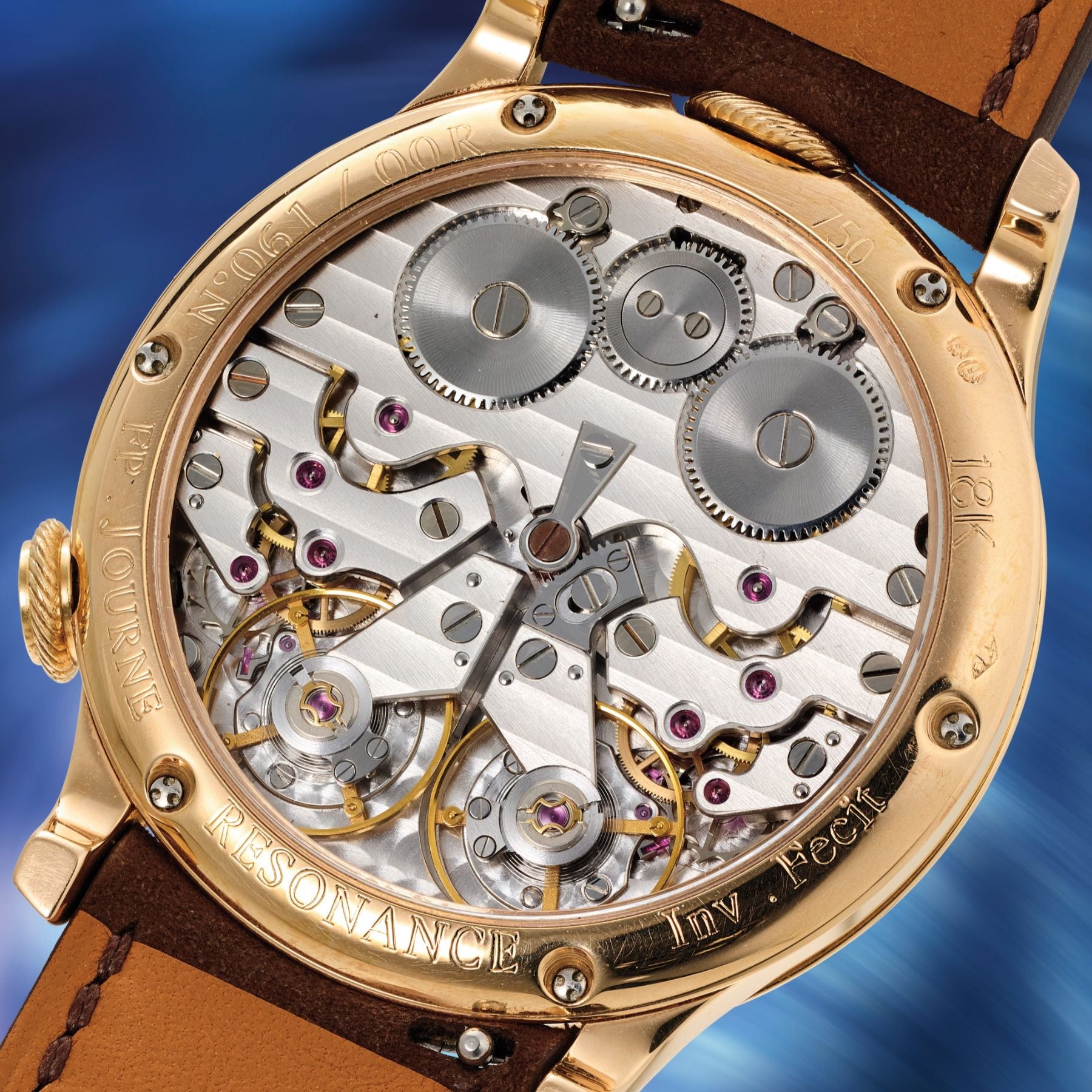
Lot 33: A 2000 F.P. Journe Chronomètre à Résonance “Pre-Souscription” in 18k pink gold with white gold dial and shallow caseback engravings, numbered 061/00R, included in The New York Watch Auction XV. Estimate: USD $600,000–1,200,000
While we have the watch turned over, look at the pink gold caseback around the sapphire. The case number, 061/00R, is engraved there in fine, shallow strokes, a feature of the early cases Journe had engraved in-house. The 00 tells you the case was ordered in 2000. The 061 is where it gets interesting.
Journe had reserved numbers 001/00R through 020/00R for his original Tourbillon subscribers, giving each the chance to buy a Résonance with the same number as their Tourbillon. Yet according to Phillips’ research, the batch that included 061/00R was ordered before the cases for those subscribers. That’s what “Pre-Souscription” means here.
Marked Proto
Seen from the front, the 2000 Octa Réserve de Marche prototype (Lot 108) already looks familiar. The hours and minutes sit off to the right, the large date is high on the dial, and the power-reserve hand sweeps across the gold on the left. The main dial has a fine grain that catches the light, while the silver-toned time display is brighter. It’s a layout that would carry into the production watch.
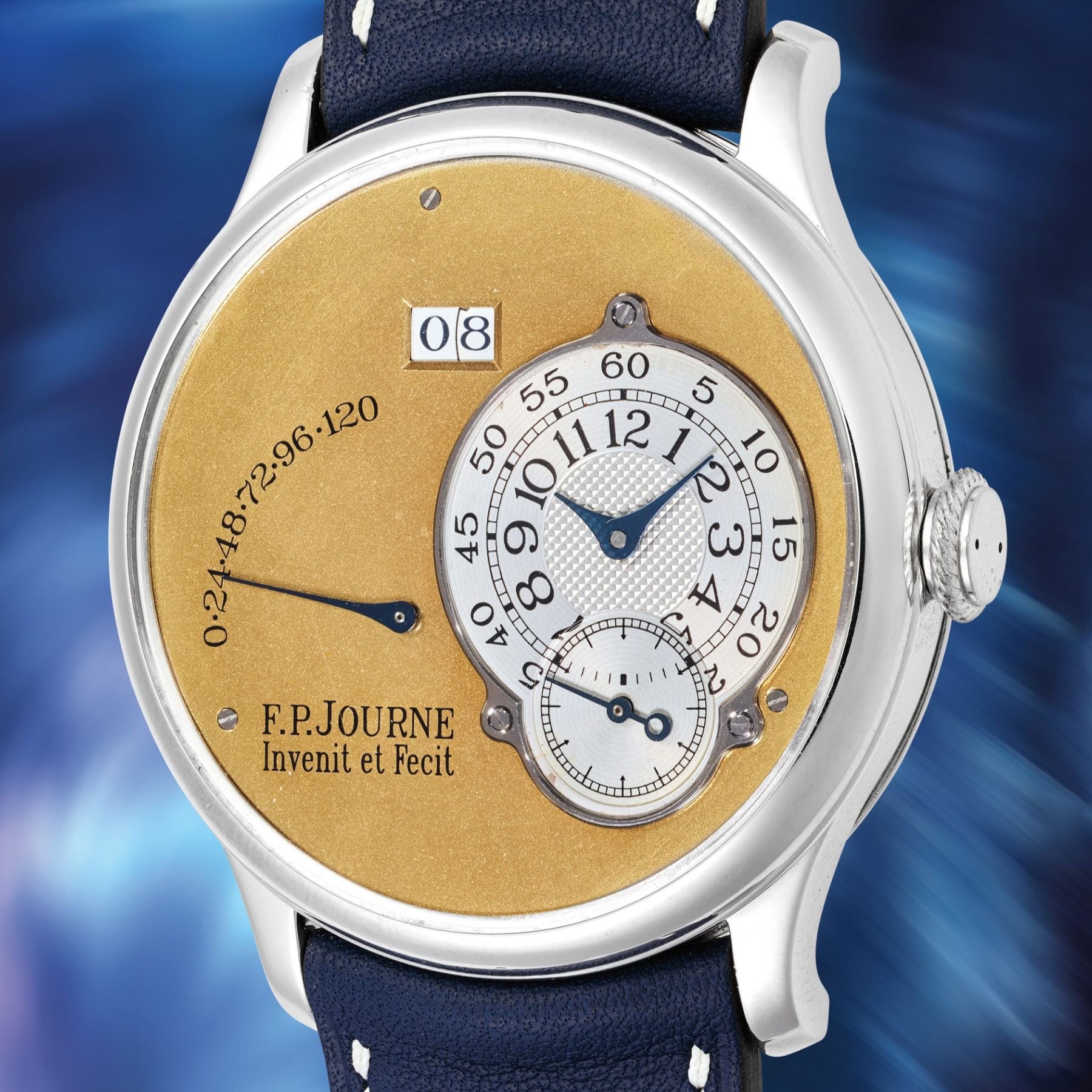
Lot 108: A 2000 F.P. Journe Octa Réserve de Marche prototype in platinum, numbered “Proto/00A,” with gold dial and brass movement featuring straight Côtes de Genève, included in The New York Watch Auction XV. Estimate: In excess of USD $500,000
Look where the small-seconds register meets the hour track and you can make out parts of the 5 and 7. Both numerals were omitted on the prototype dial photographed at the Basel watch fair in 2000. Journe brought three Réserve de Marche prototypes to the fair. He later fitted this watch and one of the other two with production dials and replaced their date discs before giving them to two Swiss friends and advisers who served on the company’s board.
Turn the watch over and look along the caseback rim of the 38mm platinum case. “No. Proto / 00A” is engraved there. Journe added the word “Proto” when he prepared the two watches for the board members.
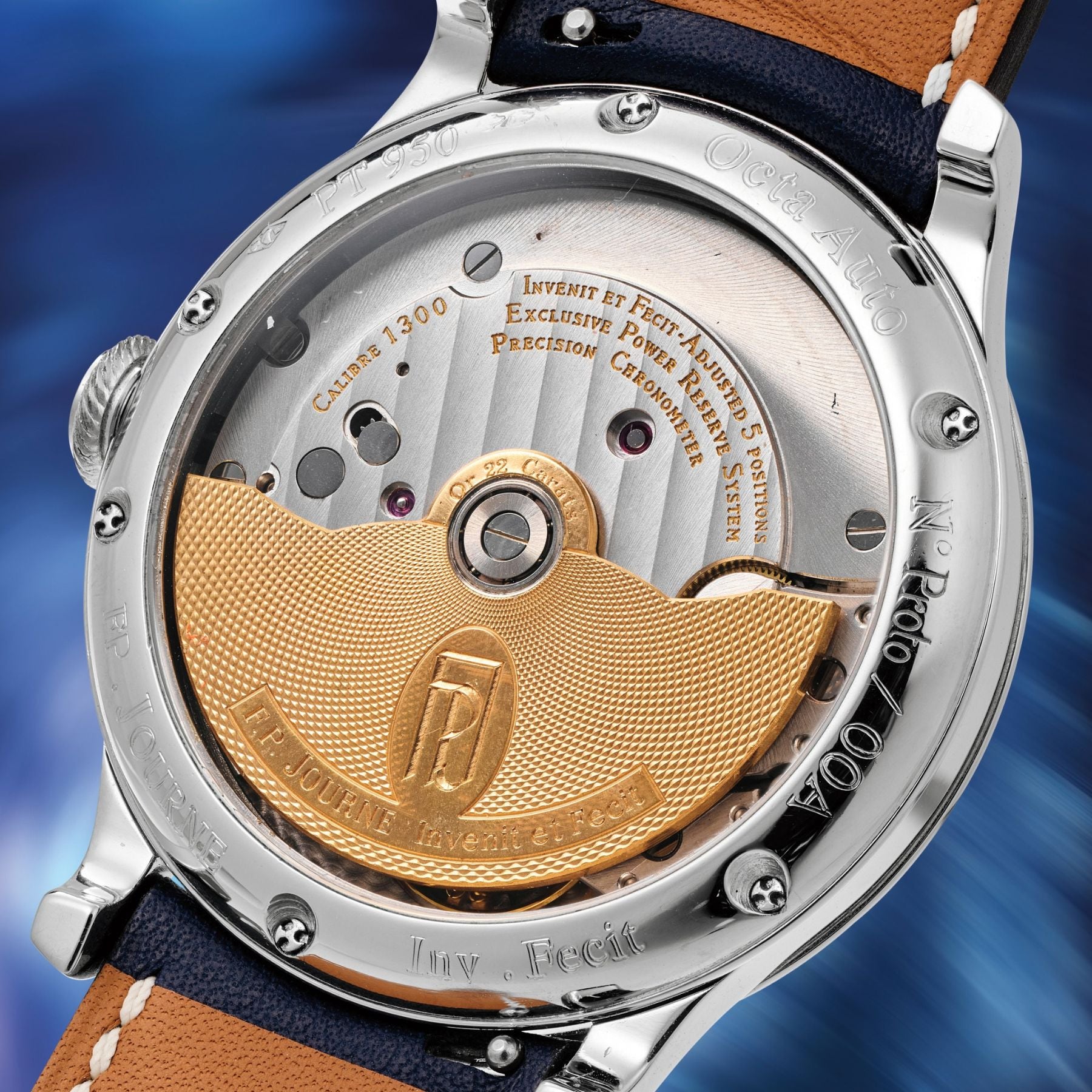
Lot 108: A 2000 F.P. Journe Octa Réserve de Marche prototype in platinum, numbered “Proto/00A,” with gold dial and brass movement featuring straight Côtes de Genève, included in The New York Watch Auction XV. Estimate: In excess of USD $500,000
Through the sapphire display back, you can see straight Côtes de Genève running across the rhodium-plated brass bridges. Journe carried that finish into the first batch of production Réserve de Marche watches, then switched to circular Geneva stripes because he preferred the way they looked.
Straight Geneva Stripes
Our Octa story moves from Basel to Zermatt. On July 10, 2002, the retailer Schindler sold the Octa Chronographe, case No. 031-02C, offered here as Lot 109. The original guarantee card still accompanies the watch and bears the date and the shop’s stamp. Just two years after Journe showed his automatic prototypes at the Basel fair, a customer could buy an Octa with a flyback chronograph.
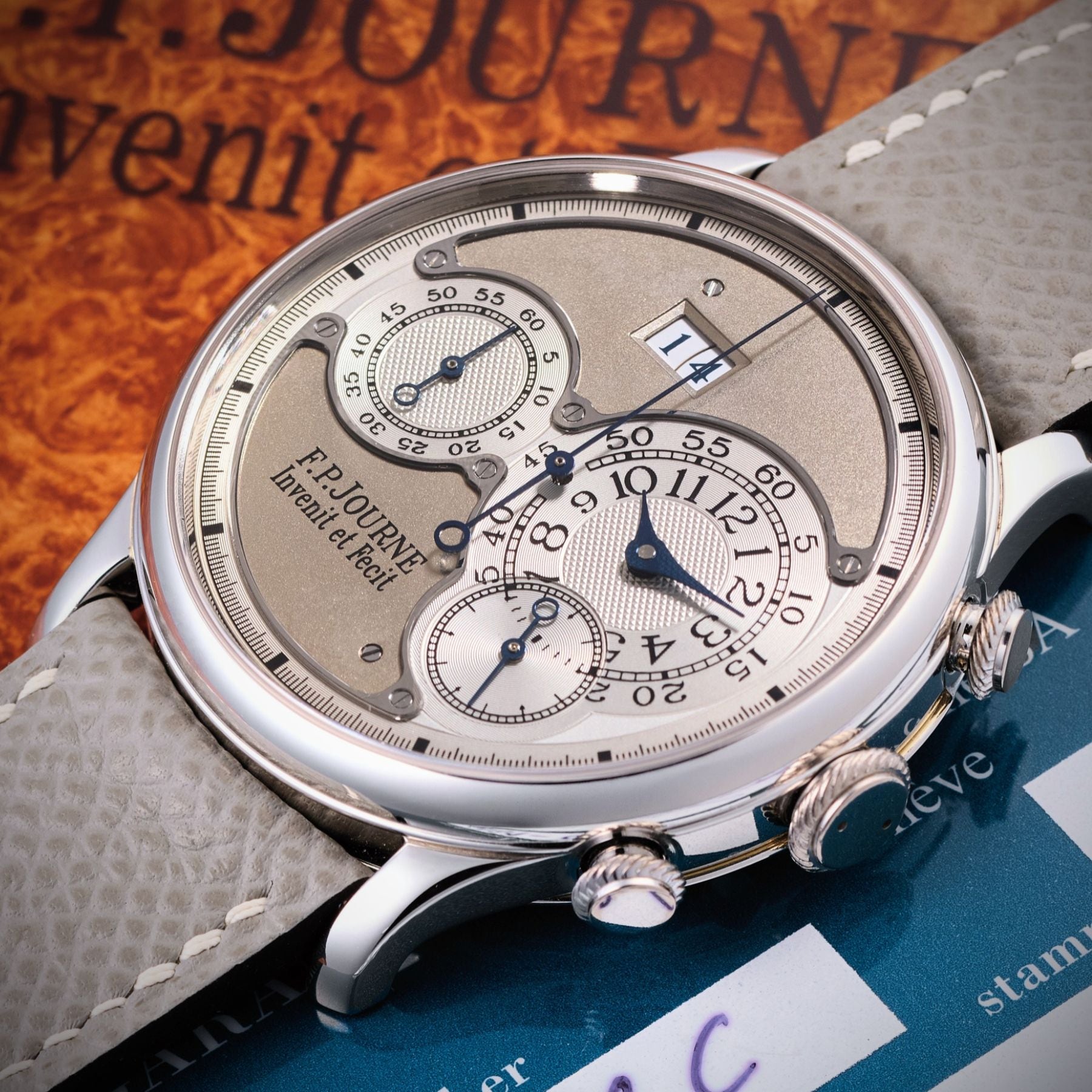
Lot 109: A circa 2002 F.P. Journe Octa Chronographe in platinum with white gold dial and brass movement featuring straight Côtes de Genève, included in The New York Watch Auction XV. Estimate: USD $200,000–400,000
What connects this Chronographe to the 2000 Octa Réserve de Marche prototype is the finish on the movement. Both have straight Geneva stripes across their brass bridges. Circular Geneva stripes went on to become standard on the Octa. Phillips estimates that only about ten early Octa Chronographes received the straight finish.
A Style Emerges
We know what F.P. Journe became, which makes it easy to look back at these watches as though everything that followed was inevitable. For the people buying them at the time, they were new timepieces from a young company. They were already reaching collectors while Journe was still refining the way he wanted his watches to look.
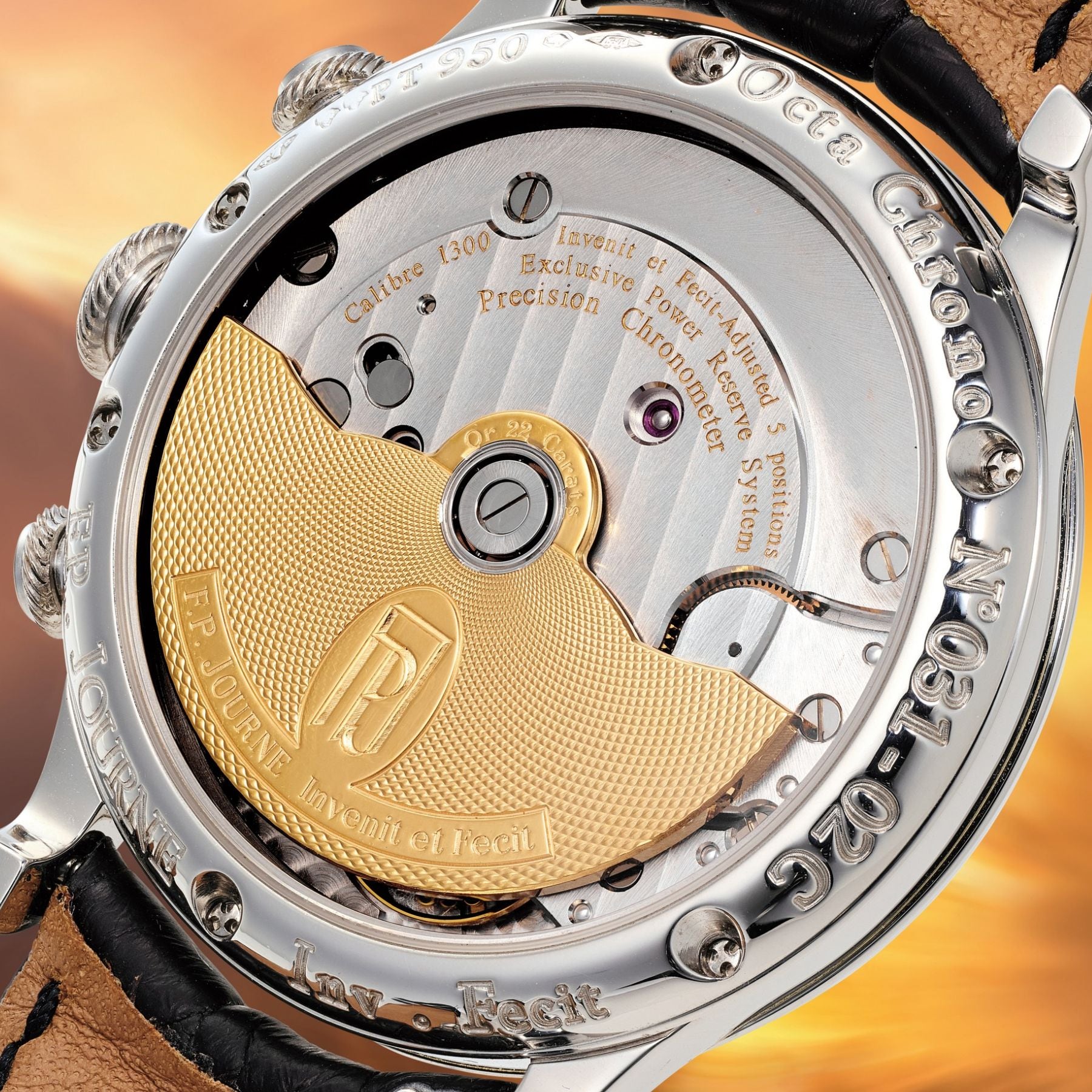
Lot 109: A circa 2002 F.P. Journe Octa Chronographe in platinum with white gold dial and brass movement featuring straight Côtes de Genève, included in The New York Watch Auction XV. Estimate: USD $200,000–400,000
That’s part of the enjoyment of spending time with these six. A closer look can place a watch in a particular batch or generation, and sometimes the sequence turns out to be less tidy than the serial numbers suggest. You can also trace a choice from one creation to the next and see what Journe carried forward. The details collectors pore over today were decisions he was making as his watches went out into the world. And we get to see his signature taking shape.
You can learn more, place a bid, and view the full catalog for The New York Watch Auction XV here.