Article | Claude Monet Joan Mitchell Auction New York November 2026
Monet and Mitchell: Alike in Difference
Claude Monet’s swan song, Joan Mitchell’s pivot, and the shared insights of two crucial masterworks.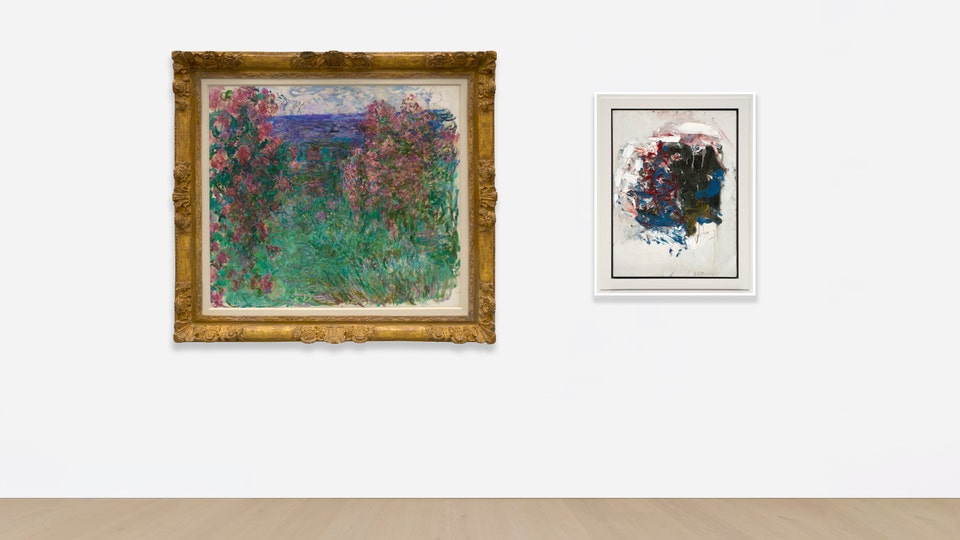
Right: CLAUDE MONET, La Maison dans les roses, 1925. Modern & Contemporary Art Evening Sale, New York.
Left: JOAN MITCHELL, Composition, 1965. Modern & Contemporary Art: Morning Session, New York.
Offered across Phillips’ upcoming Evening Sale and Morning Session in New York, works by Claude Monet and Joan Mitchell present a familiar area for comparison and consideration. These two artists — different in nationality, generation, and approach — shared a love for the same geography and a relentless pursuit of the boundaries of painting as an art form. This intriguing paradox has long been part of art world discourse, and in 2023 reached new heights in the exhibition Monet – Mitchell at Fondation Louis Vuitton. By hanging Claude Monet’s late Giverny works alongside Mitchell’s grand-scale canvases created in France, the exhibition foregrounded a historical continuity that critics and fellow artists had begun discussing as early as the 1950s. Then, as Monet’s critical revival was at its apex, Mitchell took part in exhibitions that compared the late artist’s work to the Abstract Expressionist movement of which Mitchell was a defining figure. Such comparisons deepened upon Mitchell’s relocation to France in 1959, and her later move to Vétheuil, near the home Monet once occupied. The exhibition didn’t treat Mitchell as a grand heir to Impressionism, nor did it argue Monet to be a progenitor of Abstract Expressionism, but it illuminated how both painters used their experience of landscape as a catalyst for profound invention — for Monet, the sensation of his beloved garden, and for Mitchell, the nuanced feeling of memory.
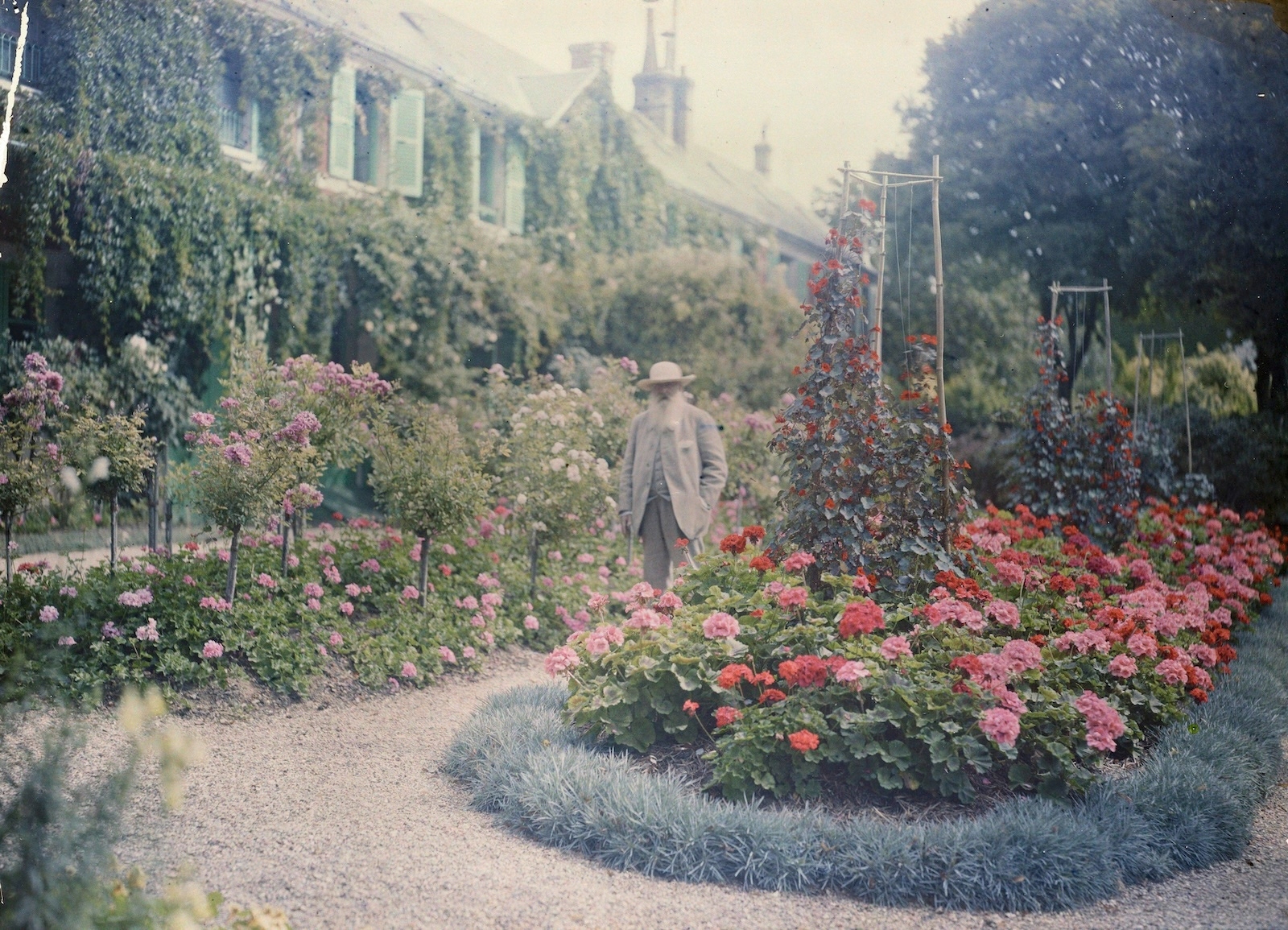
Claude Monet in his rose garden at Giverny, 1921.
Paris, Musée d'Orsay. Image: © Musée d'Orsay, Dist. GrandPalaisRmn / Alexis Brandt
Comparing Monet’s La Maison dans les roses (1925) and Mitchell’s Composition (1965) reveals the oblique structural resonance between the two. It also exemplifies the decisive conceptual rupture within what Clement Greenberg described as a lineage of “all-over” painting. Greenberg — observing that traditional Western easel painting was uniquely defined by its social function to hang on a wall, subordinating the decorative to the dramatic — argued that modernism in each art form advanced itself by self-critically isolating what was most unique and inherent to its respective medium. For him, the reduction of painting to a decentralized, flat, and polyphonic surface finds no greater early example than Monet’s final decade. Greenberg’s argument that Monet lays the groundwork for postwar abstraction does echo Mitchell’s own sentiments on the artist — she once explained, “I like late Monet, but not early” — though she later resisted the comparison, objecting less to its logic than to what she saw as the gendered implication that her work was somehow derivative.

Joan Mitchell © Marion Kalter. All rights reserved 2026 / Bridgeman Images
“I paint from remembered landscapes that I carry with me—and remembered feelings of them, which of course become transformed. I could certainly never mirror nature. I would like more to paint what it leaves me with.”
—Joan Mitchell
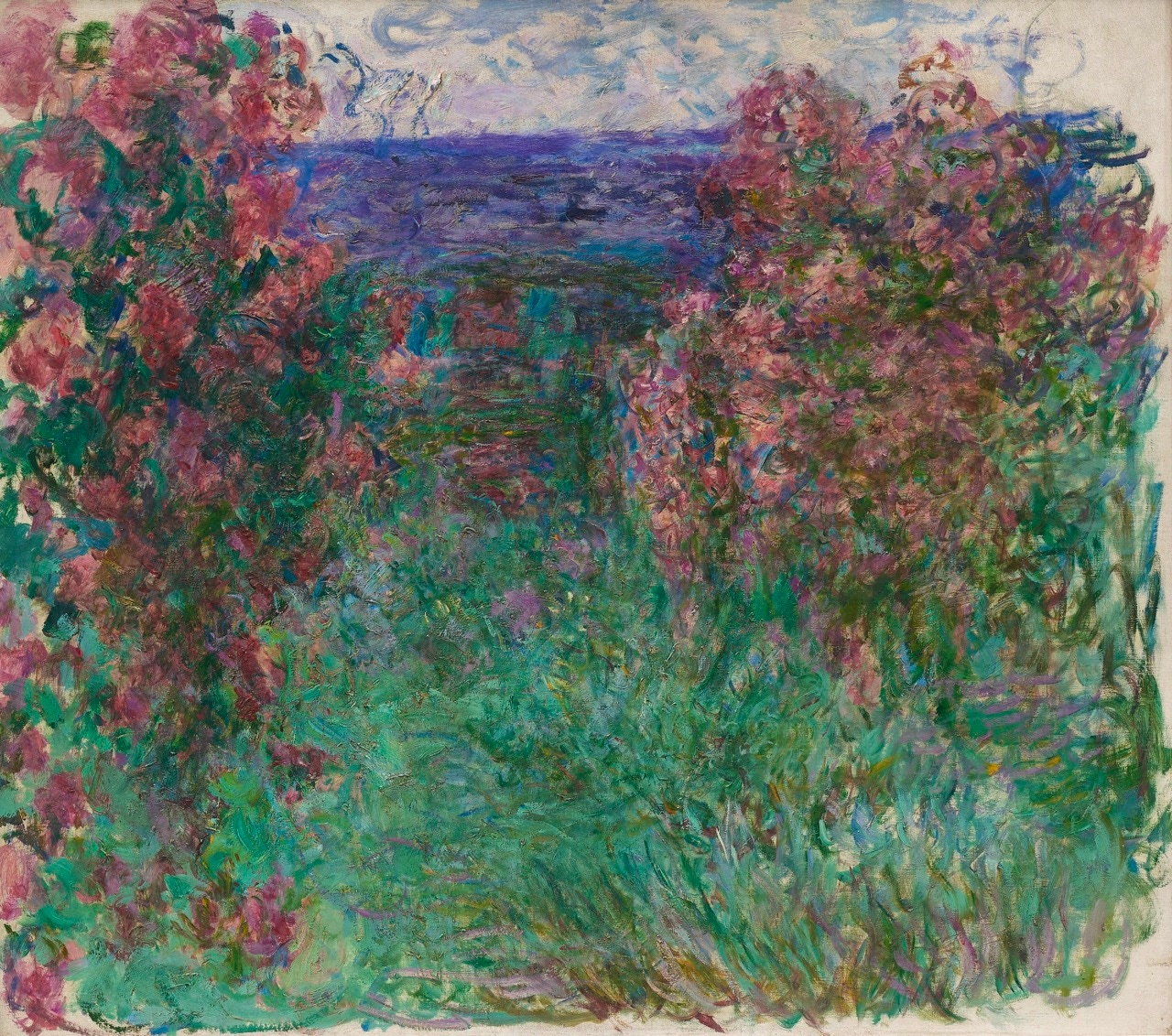
CLAUDE MONET, La Maison dans les roses, 1925. Modern & Contemporary Art Evening Sale, New York.
Nonetheless, Greenberg’s concept of an “all-over” painting is perhaps fully realized in this late Monet work, which art historian Daniel Wildenstein termed Monet’s “swan song” and a farewell to his beloved home and rose garden. Painted at Giverny during the summer of 1925, La Maison dans les roses stands among the final canvases Monet completed before his death in 1926. As the first and largest work of his second Maisons series, the work carries immense art historical importance, echoed by its cousins from the broader series being held in such notable collections as the Albertina, Thyssen-Bornemisza, Stedelijk, and Marmottan. The painting traces the fortunes of Monet’s failing and recovering vision following cataract surgeries, pushing the motif of his house framed by rich flora to the brink of the visible and redefining the art of painting along the way. As easy as it is to see how the central, expressive brushstrokes of Mitchell’s Composition can be seen to relate to the dense, interwoven brushstrokes saturating every square inch of La Maison dans les roses’ surface, it is just as important to understand that Mitchell arrived there through her own path.
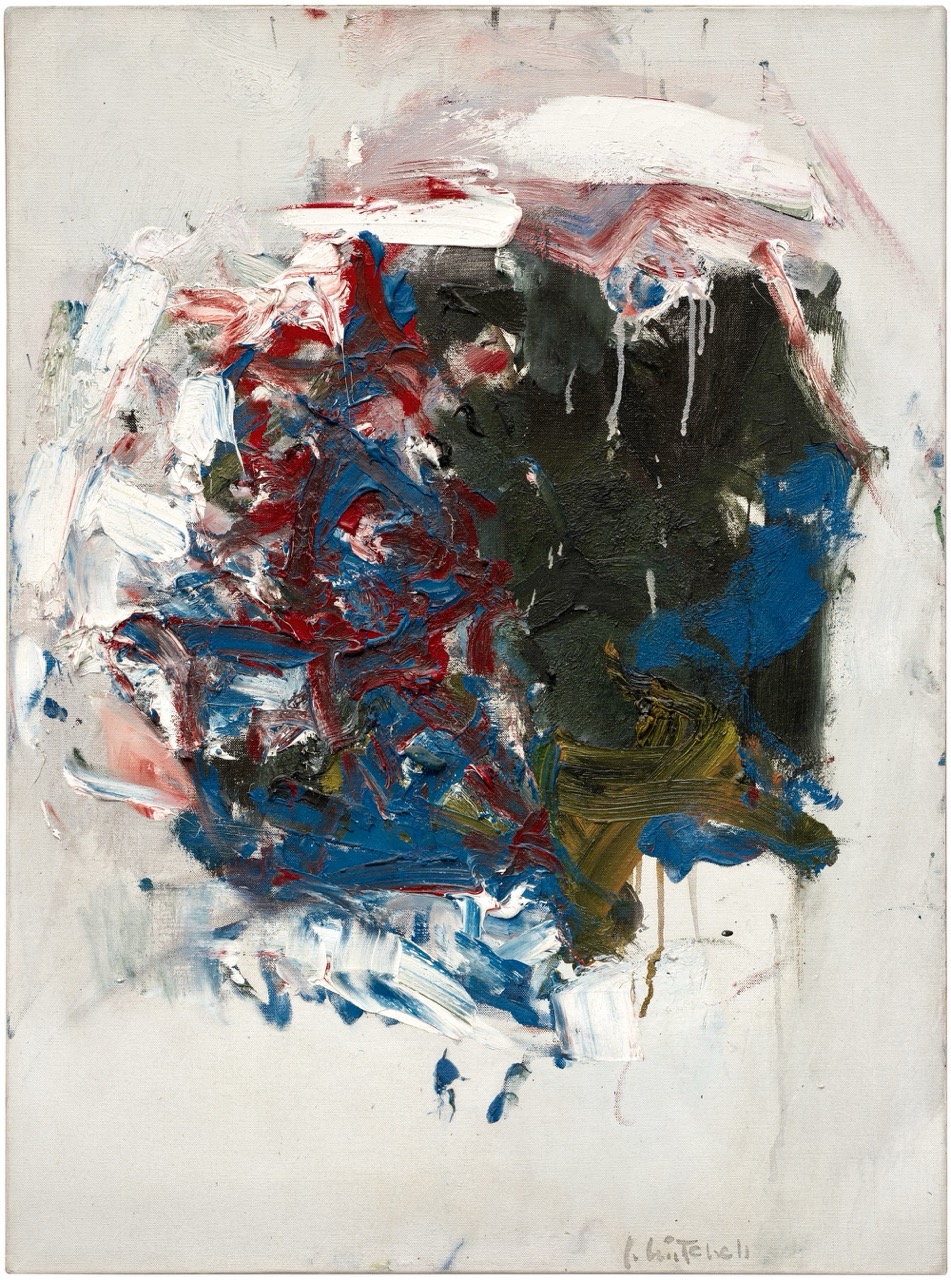
JOAN MITCHELL, Composition, 1965. Modern & Contemporary Art: Morning Session, New York.
Exemplifying her landmark “Black Paintings” of the early 1960s, which marked a deliberate departure from the seamless fields of paint in her earlier works toward central masses of heavy, impasto paint, Composition sees Mitchell move beyond lyrical colorism to grapple with raw emotional states and heavy materiality. Yet the senses of both Monet and Mitchell were flooded with visions of a changing France when each artist executed their respective work forty years apart. Like Monet near the end of his life, Mitchell produced this work during a transformative period: in her case, following her permanent relocation to France in 1959, but predating her move to Vétheuil near the house where Monet once lived. And like the Monet, Composition is also significant within the context of her body of work, having been featured in her crucial posthumous solo exhibition at Robert Miller Gallery in 2002. It draws us in with tactile strokes of crimson, deep olive, and saturated blue clustered at the center of the canvas against an atmospheric misty white ground, which can almost be seen as intentionally defying Greenberg’s rhetoric of “all-over” painting. Yet still, the canvas eliminates illusionistic depth and rejects any narrative hierarchy. Seeing these two works together, we come to understand that such a modern decentralization in painting can accommodate both Monet’s immersive color fields and Mitchell’s own physical and emotional immediacy. It’s not that one follows the other — it’s that each lifts the other in historical context.

