Article | Art And The Digital Avery Singer Emma Webster Auction New York November 2026
Where the Digital Meets the Physical
What works by Avery Singer and Emma Webster tell us about painting today.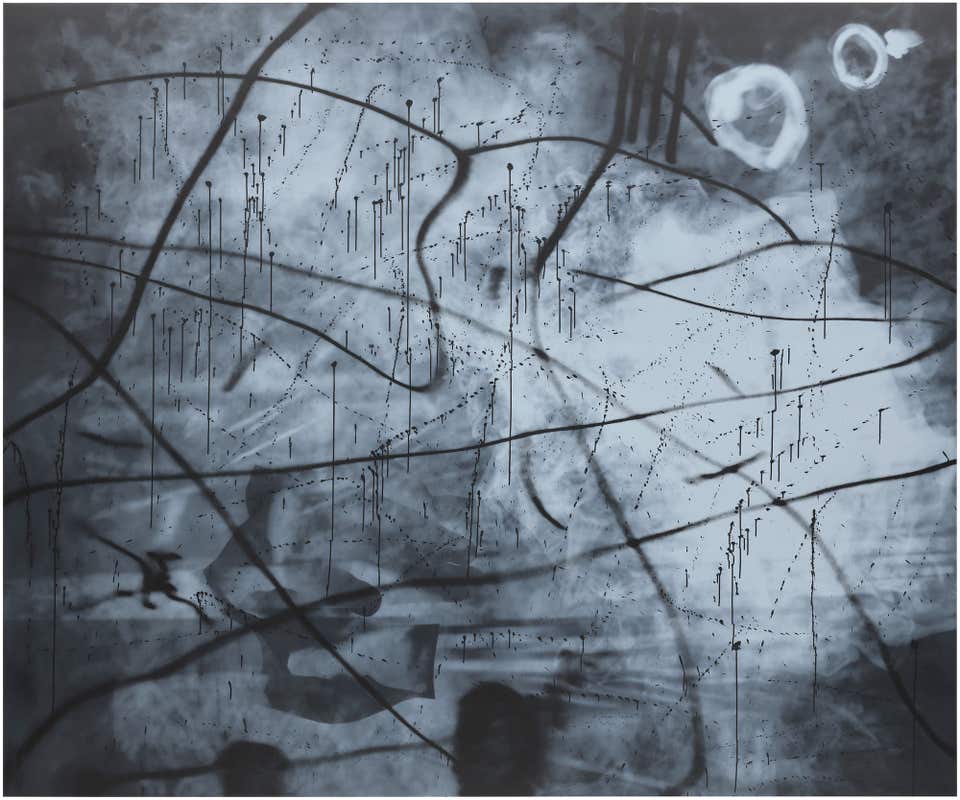
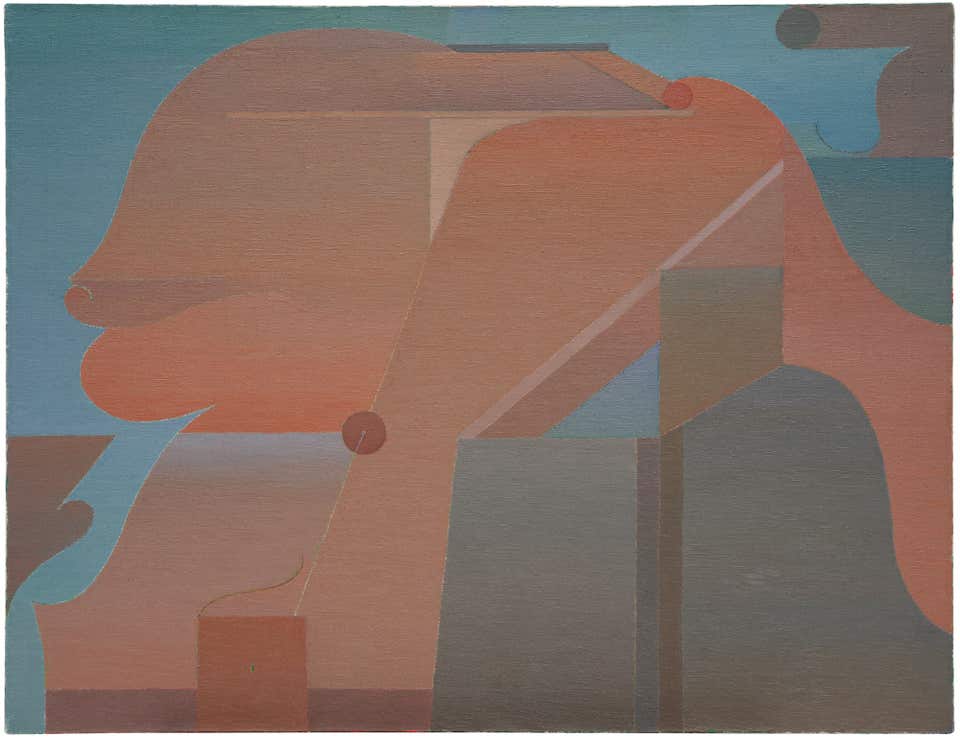
AVERY SINGER, JUUL Smoke, 2021. Modern & Contemporary Art Evening Sale, New York.
Spend some time investigating works by Avery Singer and Emma Webster and it becomes clear how inseparable digital processes are from their practices, even though their works are distinct from each other in both method and appearance. Born in 1987 and 1989 respectively, these artists came of age alongside a proliferation of visual technologies, placing them among a new wave of artists who directly engage with the ubiquitous presence of the digital. Yet for them, these tools perhaps mirror how forward-thinking painters a century ago viewed the photograph: as just one more instrument to be harnessed in the service of painting. Now that we’re living in an era when a persuasive image can be summoned from a sentence — a fact both Singer and Webster has spoken about — this distinction feels worth lingering over.
Two works on offer at Phillips New York this November — Singer’s JUUL Smoke (2021) in the Evening Sale and Webster’s Narcissus (2020) in the Afternoon Session — offer such an opportunity. Both works involved digital tools in their creation, but both are ultimately paintings made in the traditional sense. Crucially, both address a contemporary crisis in painting and find new ways to investigate the medium at a time when so much of visual culture has become virtual.
AVERY SINGER, JUUL Smoke, 2021. Modern & Contemporary Art Evening Sale, New York.
In JUUL Smoke, Avery Singer distills a web of cultural references into a near-abstract image dominated by a churning field of gray vapor, with two pale smoke rings drifting toward the upper right, and a hand and shirt cuff low in the center. First shown at the Institute of Contemporary Art, Miami in 2023 as part of a wave of institutional exhibitions that followed Singer’s participation in the 2019 Venice Biennale, JUUL Smoke was created by projecting a three-dimensional model designed with Daz 3D onto a ten-foot-wide black-gessoed canvas. She executed the visual motifs by airbrushing acrylic paint over liquid rubber masking that was applied and then removed. This process left behind negative spaces that resemble marks while eliminating traditional brushwork — part of Singer’s broader effort to strip away the physical trace of the artist.
“I am not really interested in using paint brushes, and never have been, so I guess I am trying to figure out how to make a painting without that methodology.” —Avery Singer
Singer has often spoken about the gradual obsolescence of painting as an art form, noting that Albert Oehlen’s Computer Paintings series was the first body of work that showed her just how powerful the medium of painting could be today. This conceptual power takes on personal resonance in JUUL Smoke, which was presented as part of a narrative loosely built around the September 11 attacks in the Miami exhibition. Singer, raised a few blocks from the World Trade Center, looked at the finished canvas and recognized the dust cloud from her memory. “I’d unconsciously painted it,” she remarked.
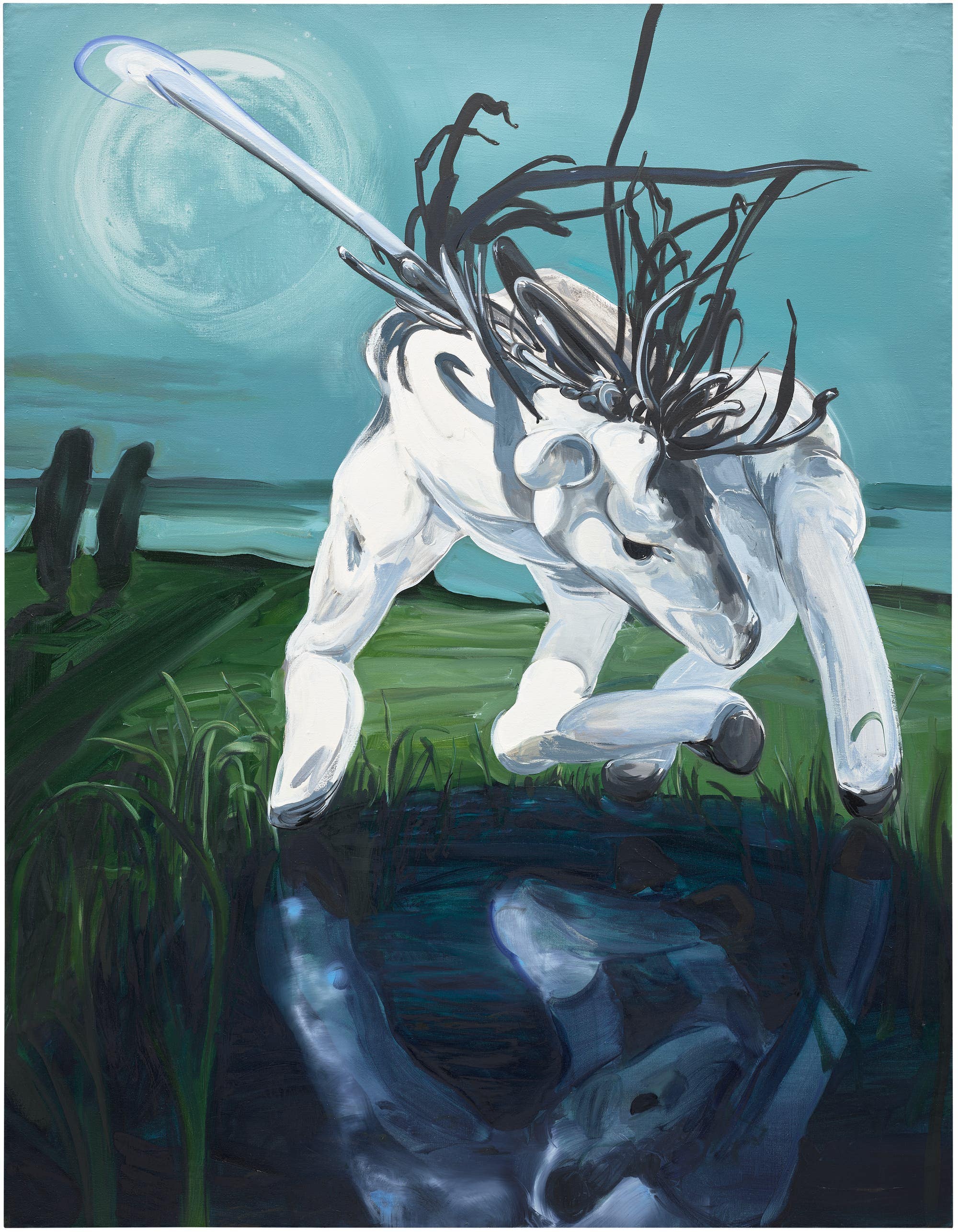
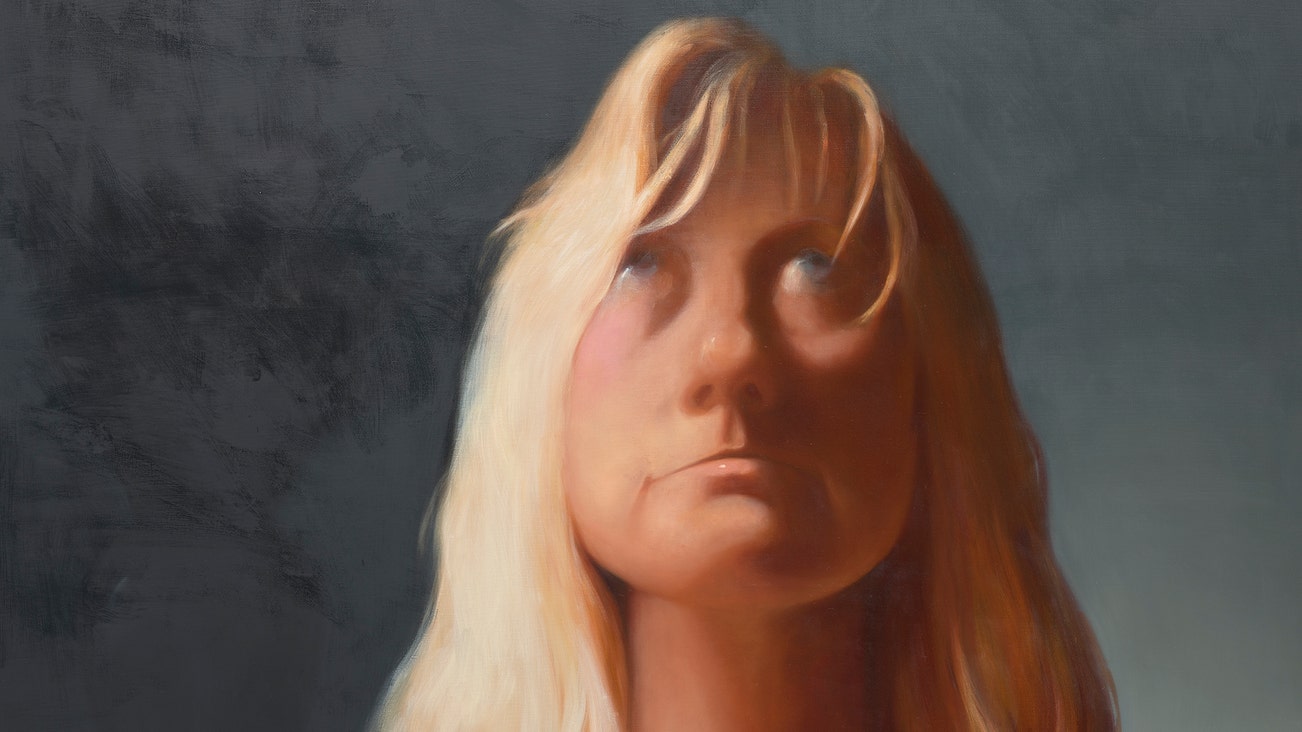
EMMA WEBSTER, Narcissus, 2020. Modern & Contemporary Art: Afternoon Session, New York.
Emma Webster approaches the canvas from a different direction. She begins with hand-drawn sketches, watercolors, or small sculptures in clay and papier-mâché that she scans into Blender and arranges into dioramas she can walk through in virtual reality. Webster explores her dioramas for weeks before committing to a single perspective, and it is only at that point that she projects the scene onto a surface for painting. In a sense, this process mirrors a traditional landscape painter’s site visit, lending an authority to Webster’s fantastical scenes that makes them feel so gripping and real. This is clearly seen in Narcissus, which casts a stag-like creature as Ovid’s hunter, contorting itself to study its own reflection in still blue water beneath a full moon. The artist has noted that landscape painting flourished at the height of the Industrial Revolution as an escape from the proliferation of machines, and that painting still asks where we might go if we could. “I think the way we see nature is always mediated through our own desires,” she has said. Narcissus makes that point twice over — in a creature that cannot look away from itself, and in a landscape born of the artist’s imagination.
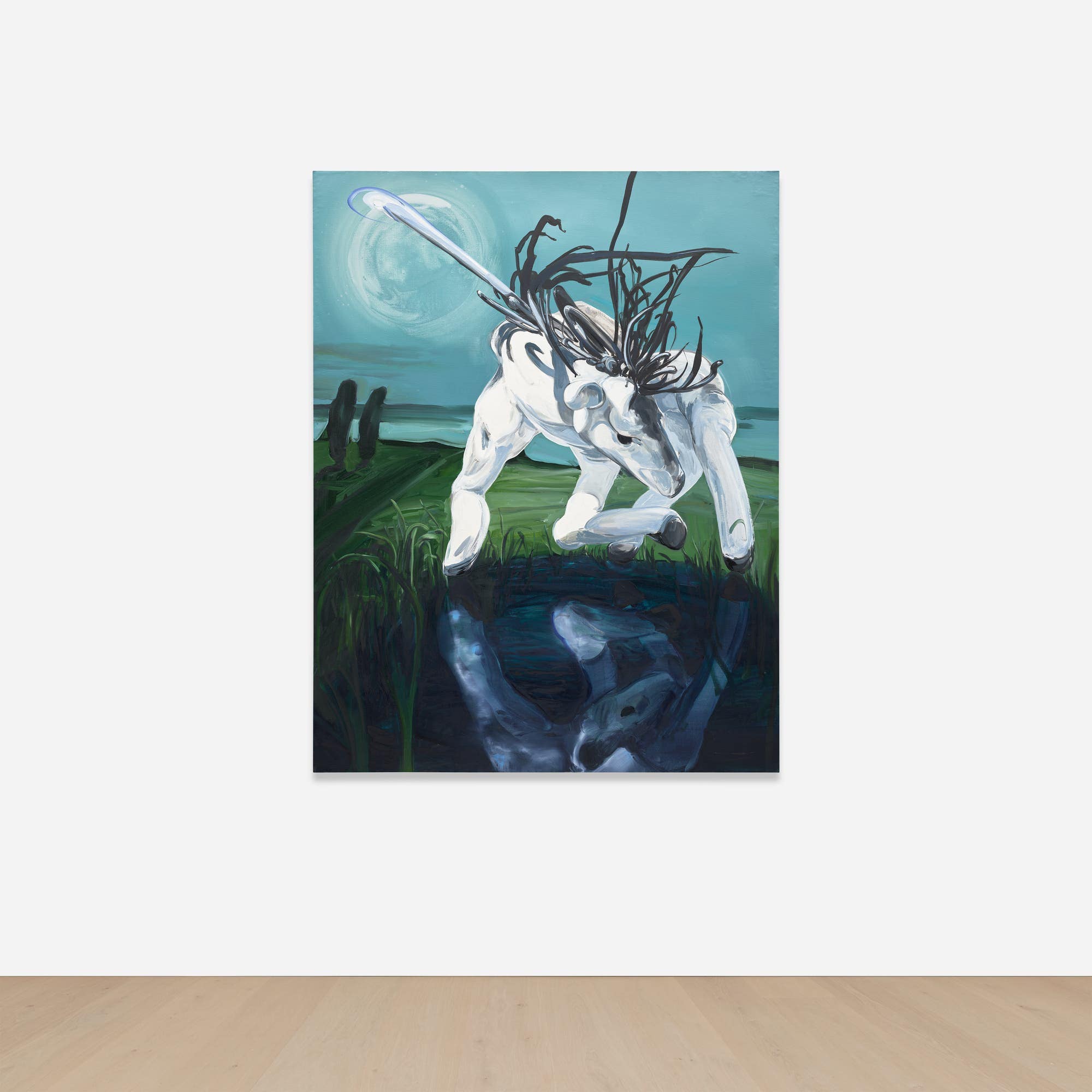
EMMA WEBSTER, Narcissus, 2020. Modern & Contemporary Art: Afternoon Session, New York.
Several years into the age of AI-generated imagery, it is tempting to consider how these works fit into a broader cultural dialogue that has now reached virtually every artist’s studio. Singer, for one, has discussed our current moment as already “post-AI,” a point where automated technology is so deeply embedded into daily reality that it no longer functions as a standalone phenomenon or novelty. That these works were made so recently highlights the pace of this shift — they are ultra-contemporary but predate this landscape entirely. Still, as both artists have underscored in recent public commentary, artistic agency and individual vision continue to be the driving forces in their works, though they are each approach new technologies with open minds.
Emma Webster, in conversation with Craig Gould, references Gilles Deleuze’s remark that “machines are social before they’re technical.” She explains: “Let’s not dismiss an entire thing just because we think that painting is somehow just about the hand. The human body is also a computer and a system that can be hacked.” Singer has also discussed AI extensively — including the questions of authorship it raises — remarking that it is just as easy for humans to steal an artist’s work as it is for machines. However, for her, it is often AI’s malfunctions that prove most compelling. As she noted in an interview with Hauser & Wirth: “There was a workflow I made, and the AI was just hallucinating, and I had no idea why. Instead of doing what I had prompted it to do, it was just making granular blue and purple images. The breakdown that happens in AI is the most interesting thing to me. It’s not really optimization that I’m interested in.”
For as much as some may speak of new technology’s propensity to diminish physical art-making, it doesn’t seem to have slowed down either of these artists in the slightest. In fact, if there is a limit to how the digital can inform the medium of painting, it is easy to see how these artists are primed to find it — possibly becoming generationally important artists along the way.