Article | Pocket Watches Clocks Singing Birds Phillips Hong Kong Watch Auction Xxi Nov 2025
Pocket Watches, Clocks, and Objets d'Art at the Phillips Hong Kong Watch Auction: XXI
An exploration of objects that marry precision and beauty, tracing the evolution of craftsmanship across continents and eras.
The PHILLIPS Hong Kong Watch Auction: XXI takes place on 21-23 November 2025, at our West Kowloon headquarters. The auction includes more than 300 of the world's finest watches – and though we are loath to boast, we truly think it's one of the best catalogues we've ever put together. We'll be highlighting a number of the most interesting lots and stories featured in the sale, including all the timepieces presented below.
The pocket watches, clocks, automata, and objets d’art featured in the Phillips Hong Kong Watch Auction: XXI trace more than two centuries of horological imagination, moving from the enamel ateliers of 18th-century Geneva to the Art Deco workshops of Cartier and the experimental electronic division of Patek Philippe.
These pieces demonstrate how watchmakers, casemakers, enamellers, and automaton specialists responded to shifting tastes across Europe, China, and beyond, blending technical innovation with decorative ambition.
Lot 820: A 1975 Unique Patek Philippe Ref. 866/54 Pocket Watch in 18k Yellow Gold with 'Lord Rivers and his friends – J.L. Agasse' Miniature Enamel Painting by Suzanne Rohr
Estimate: HKD $1,000,000 - 2,000,000
This Patek Philippe pocket watch carries a stunning miniature painting by Suzanne Rohr, one of the true giants of 20th-century enamel art. Rohr mastered every technique, but collectors know her best for her cloisonné and miniature enamel work. She began working with Patek Philippe in 1967 and remained for nearly 50 years, producing a total of barely more than 100 pieces.
That scarcity, paired with her technical control and painterly touch, helped define her legacy. The Patek Philippe Museum holds 26 of her works, a quarter of everything she ever made.
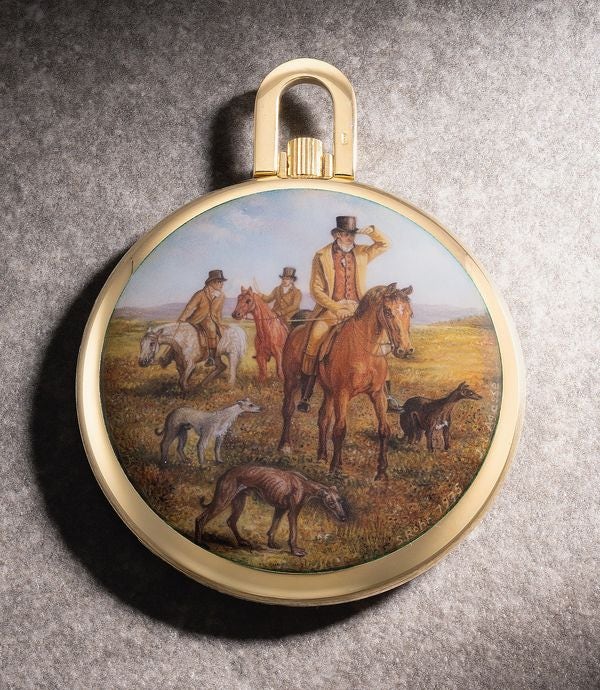
Lot 820: A 1975 Unique Patek Philippe Ref. 866/54 Pocket Watch in 18k Yellow Gold with 'Lord Rivers and his friends – J.L. Agasse' Miniature Enamel Painting by Suzanne Rohr that's included in the Phillips Hong Kong Watch Auction: XXI. Estimate: HKD $1,000,000 - 2,000,000
This example dates to 1975 and shows Rohr at full strength in the first decade of her career. Her signature is located at the lower right edge of the caseback enamel, which recreates “Lord Rivers and his Friends” by Jacques-Laurent Agasse, an early-19th-century painter renowned for his almost unsettling fidelity to horses, hounds, and pastoral details. The subject comes with its own layered history. Lord Rivers, born George Pitt, was a London aristocrat with ties to the Prince of Wales. He met Agasse in Geneva in the 1790s and brought him to England, commissioning scenes of his stables and hunting dogs. Those commissions helped cement Agasse’s reputation as one of the leading animal painters of his time.
The watch offered here has been with its current owner for nearly two decades and was recently removed from its factory service packaging. It comes with its Extract from the Archives and remains in superb condition. Pieces like this blend art, patronage, and watchmaking in a way few objects manage to do.
Lot 841: A Circa 2000s Chopard Skeletonized Pocket Watch in Platinum
Estimate: HKD $100,000 - 200,000
Skeletonized watches have a way of stopping you in your tracks.
You get an open view of the mechanics, every wheel and lever working in plain sight, framed by hand-finished bridges and plates. Sapphire casebacks made that experience more common in modern wristwatches, but the idea dates back much further to pocket watches, where artisans treated the movement itself as a form of sculpture.
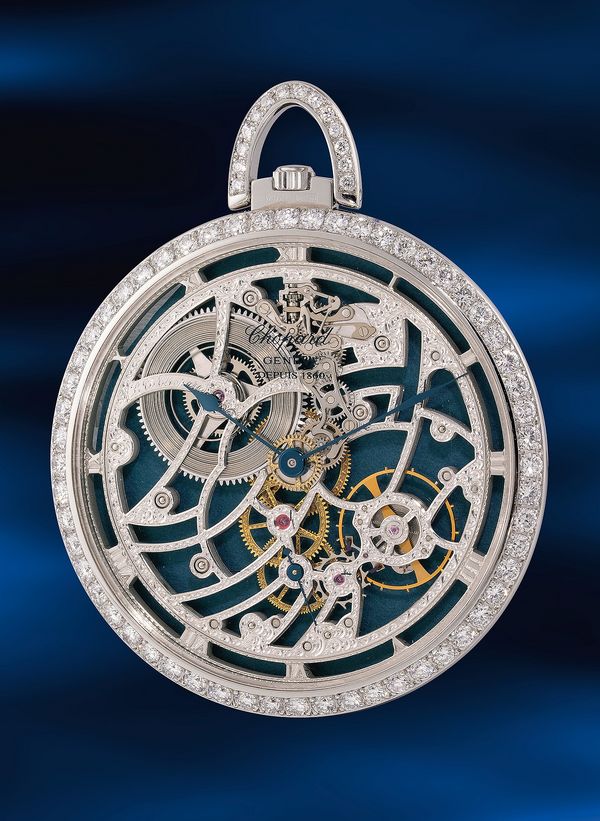
Lot 841: A Circa 2000s Chopard Skeletonized Pocket Watch in Platinum that's included in the Phillips Hong Kong Watch Auction: XXI. Estimate: HKD $100,000 - 200,000
Chopard leaned into that tradition with this platinum pocket watch. It’s built around a fully openworked movement, its bridges and plates engraved with flowing patterns that give the whole piece a light, airy rhythm. A ring of diamonds along the bezel and bow pushes it firmly into jewelry territory, yet nothing about it feels excessive. The heat-blued hands float over the dial, and a small-seconds register anchors the display at six.
At 47mm, the case still feels refined, with crisp hallmarks and a clear case number that reveals how well it has been maintained. It’s an elegant piece of high craft, and one that will bring a touch of drama to any collection.
Lot 855: A Circa 1996 Unique Piaget Répétition à Minutes à Carillon Pocket Watch in 18k Yellow Gold with Emeralds and Diamonds
Estimate: HKD $700,000 - 1,400,000
The 1997 handover of Hong Kong marked a turning point not only in global politics but also in the story of a city that had grown from a small port into one of the world’s most influential financial centers. Hong Kong has for decades been a major force in Swiss watch collecting, and few companies understood that relationship better than Piaget.
To honor the ceremonial handover, Piaget created a single, extraordinary pocket watch – part high complication, part high jewelry, and entirely unlike anything else the brand has ever produced.
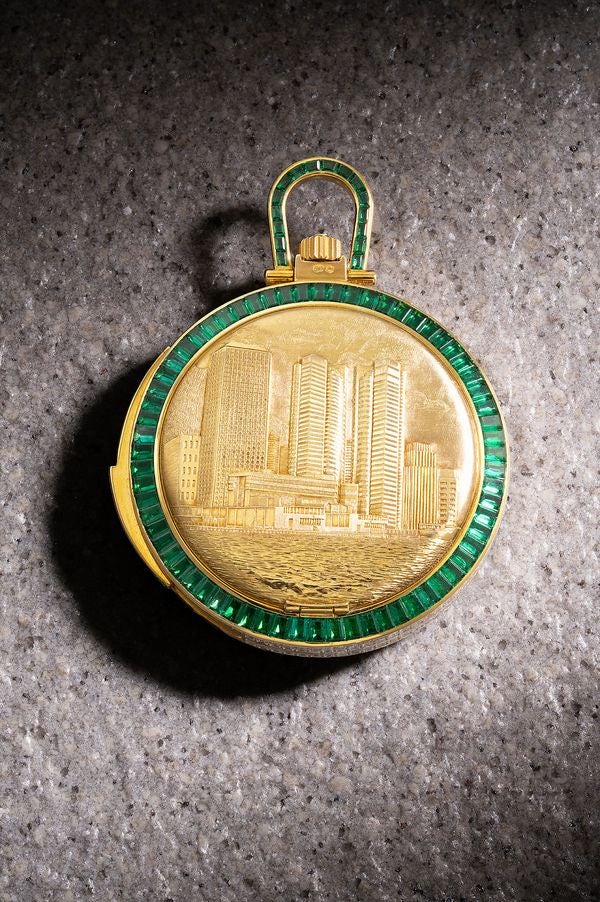
Lot 855: A Circa 1996 Unique Piaget Répétition à Minutes à Carillon Pocket Watch in 18k Yellow Gold with Emeralds and Diamonds that's included in the Phillips Hong Kong Watch Auction: XXI. Estimate: HKD $700,000 - 1,400,000
From the front, the watch presents a diamond-set spectacle. Baguette-cut diamonds wrap around the bezel and bow, framing an engraved yellow-gold dragon. In Chinese culture, the dragon symbolizes strength, prosperity, and benevolence, and the execution here reflects that status with striking depth and detail.
Flip the watch over, and the tone shifts. The back displays an engraved scene of Hong Kong's iconic Victoria Harbour from the 1990s, complete with Jardine House, the General Post Office, Exchange Square, and the old Central Pier. Baguette-cut emeralds surround the scene, echoing the green shimmer of the harbor itself. Emeralds and diamonds continue alongside the caseband, with the minute-repeater slide set entirely in emeralds. In total, the case carries 246 baguette diamonds weighing 22.6 carats and 89 baguette emeralds totaling 8.83 carats, along with a diamond-set crown.
Opening the hunter-style case reveals an 18k yellow-gold dial with a guilloché center, surrounded by 60 baguette diamonds, emerald hour markers, brilliant-cut stones, and mother-of-pearl detailing. The movement beneath matches the ambition of the exterior. Based on an early 20th-century grand complication calibre, Piaget restored and rebuilt it into a carillon minute repeater – a rare configuration that utilizes three hammers and gongs to sound the low hours, quadruple-note quarters, and high minutes. Even the chain is a work of art, crafted from 18k yellow gold and set with emeralds and diamonds, anchored by a rock-crystal and onyx base.
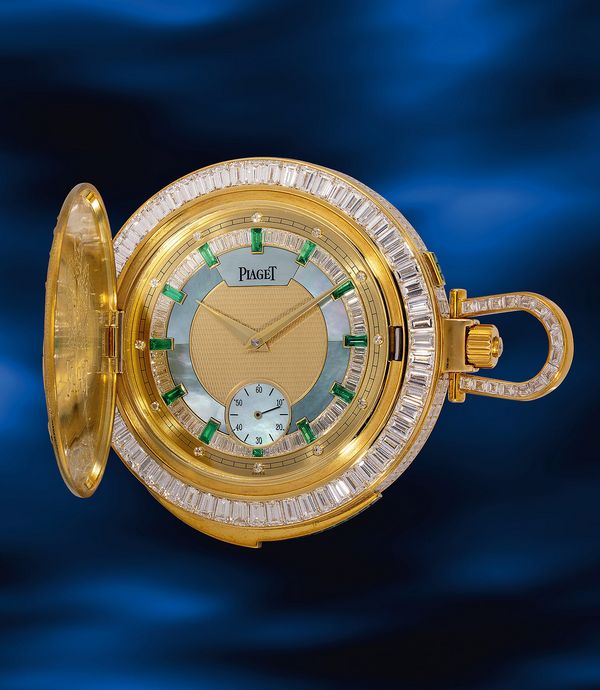
Lot 855: A Circa 1996 Unique Piaget Répétition à Minutes à Carillon Pocket Watch in 18k Yellow Gold with Emeralds and Diamonds that's included in the Phillips Hong Kong Watch Auction: XXI. Estimate: HKD $700,000 - 1,400,000
Piaget first presented the watch at the 1996 SIHH fair in Geneva with a public price of CHF 1,700,000. The engraved covers that honor Hong Kong were later commissioned by the original owner, making the piece even more personal to the moment it commemorates.
Offered with all accessories and its 1998 purchase invoice, the watch stands as a singular creation – part historical document, part mechanical achievement, and part unmatched expression of haute joaillerie.
Lot 889: A 1995 Audemars Piguet Star Wheel Ref. 25743BA.OO.0000XX.01 Pocket Watch in 18k Yellow Gold
Estimate: HKD $150,000 - 300,000
Audemars Piguet brought the Star Wheel to life in 1991, reviving a 17th-century wandering-hours display and turning it into one of the most memorable complications of the neo-vintage period.
Three sapphire disks carry the hours. They rotate on a central carousel, and the active hour sweeps the minute arc at twelve.
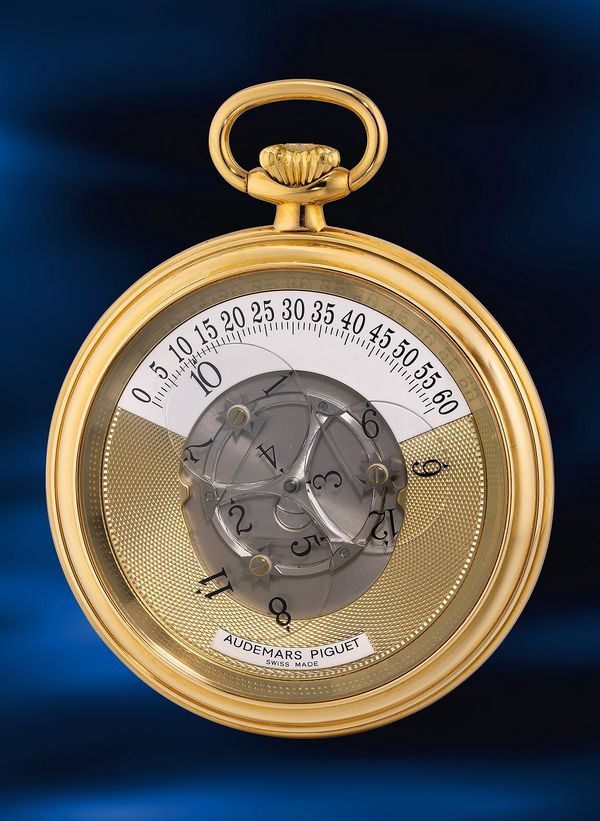
Lot 889: A 1995 Audemars Piguet Star Wheel Ref. 25743BA.OO.0000XX.01 Pocket Watch in 18k Yellow Gold that's included in the Phillips Hong Kong Watch Auction: XXI. Estimate: HKD $150,000 - 300,000
You rarely see this display on a pocket watch, which makes this 18k yellow gold example stand out. The lower dial features a crisp guilloché pattern, adding depth to the watch, set against a clean white minute track. Above it, the sapphire disks drift across the dial with almost no visual weight, so the hours seem to float.
This piece is in excellent condition, complete with its original presentation box. It blends mechanical imagination with a restrained, elegant profile, showcasing Audemars Piguet at its most inventive.
Lot 890: A Circa 1998 Unique Parmigiani Fleurier Meccanica II Pocket Watch in 18k Yellow Gold with Diamond-Set Bezel
Estimate: HKD $450,000 - 900,000
The Parmigiani Fleurier Meccanica II Pocket Watch is one of Michel Parmigiani’s most ambitious creations – a unique perpetual-calendar, minute-repeating pocket watch that took him an entire year to complete. At first glance, the watch makes its intent unmistakable: nearly 26 carats of baguette diamonds frame a fully openworked display, turning a technical achievement into a visual statement.
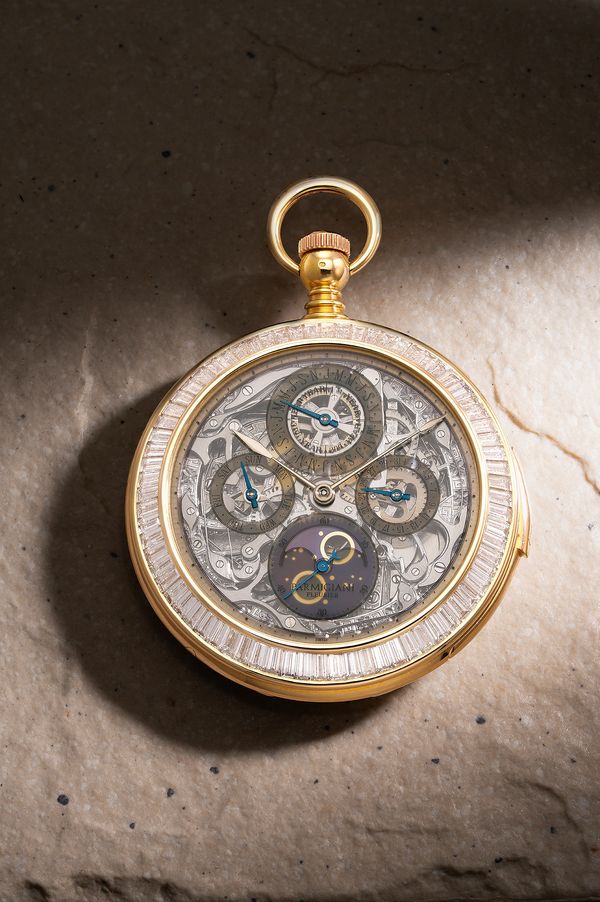
Lot 890: A Circa 1998 Unique Parmigiani Fleurier Meccanica II Pocket Watch in 18k Yellow Gold with Diamond-Set Bezel that's included in the Phillips Hong Kong Watch Auction: XXI. Estimate: HKD $450,000 - 900,000
The dial is crafted from crystal glass, with frosted zones marking the hours and slim javelin hands sweeping across the surface. Every element was shaped by hand to achieve a sense of balance and restraint. Parmigiani once described the project as “a school of life,” chasing absolute precision with equal measures of discipline and creativity.
Geometry drives the design language of the Meccanica II. Bridges, plates, and structural components follow strict lines and mirrored patterns, building a rhythm that feels architectural. Openwork engraving covers the LeCoultre ébauche movement, and the pocket-watch cover features a floral motif that anchors the entire aesthetic composition. From that center point, a maze of precise lines radiates outward, resembling a hybrid of French garden geometry and traditional Chinese patterning, which lends the engraving surprising depth.
The enamel work adds another layer of refinement. A translucent metal-oxide enamel in light blue was applied through multiple stages to achieve a saturated, luminous finish. It’s the kind of enamel rarely attempted and even more rarely perfected.
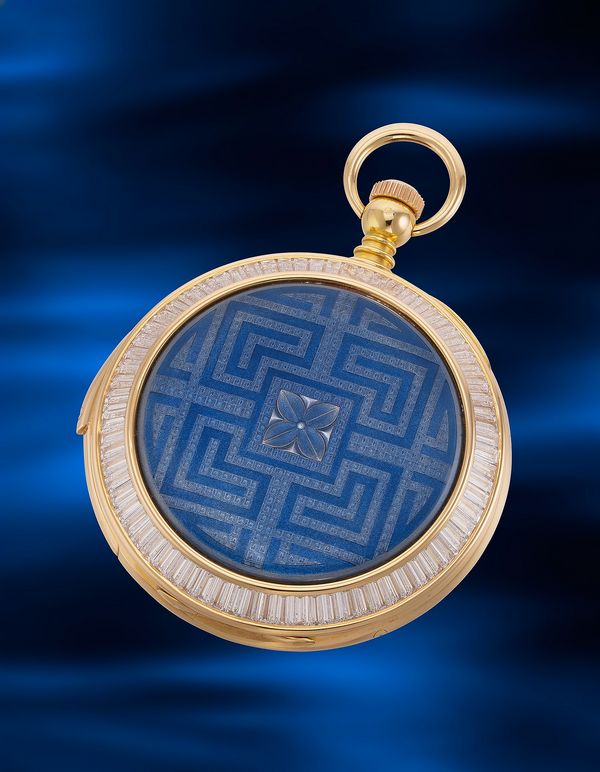
Lot 890: A Circa 1998 Unique Parmigiani Fleurier Meccanica II Pocket Watch in 18k Yellow Gold with Diamond-Set Bezel that's included in the Phillips Hong Kong Watch Auction: XXI. Estimate: HKD $450,000 - 900,000
Kept in pristine condition for more than 20 years, the Meccanica II remains a singular object in Parmigiani’s decades-long body of work. According to our research, no example has ever appeared publicly until now.
For a collector who values both mechanical ambition and the highest forms of decorative art, this is a rare chance to acquire one of Michel Parmigiani’s most personal masterpieces.
Lot 891: A Circa 2005 Patek Philippe Ref. 972/1J-001 Pocket Watch in 18k Yellow Gold
Estimate: HKD $100,000 - 200,000
Wristwatches rule the modern collecting world, but that wasn’t always the case.
Pocket watches once defined status and taste, and while they’ve slipped out of everyday use, a few makers still treat them with the respect they deserve. Patek Philippe sits at the top of that short list, keeping the craft alive through its Rare Handcrafts collection and a steady, thoughtful output of traditional pieces.
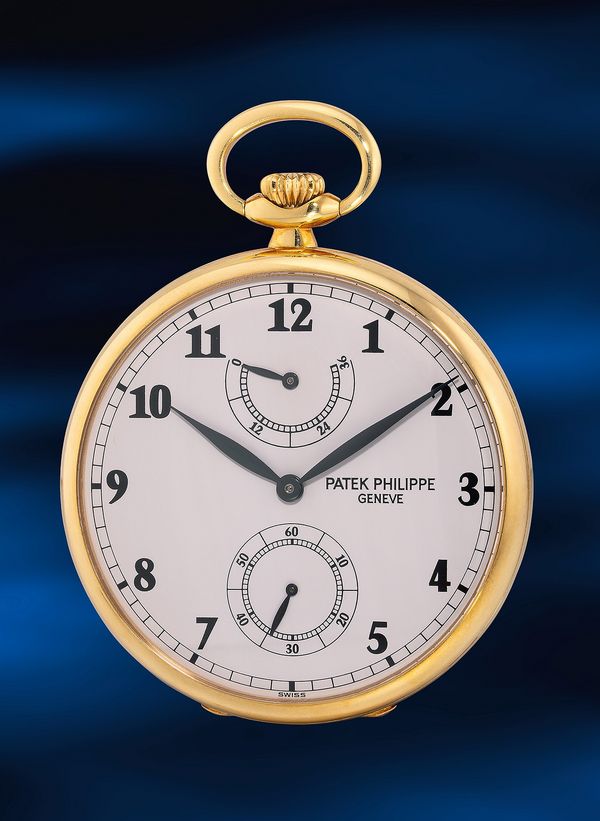
Lot 891: A Circa 2005 Patek Philippe Ref. 972/1J-001 Pocket Watch in 18k Yellow Gold that's included in the Phillips Hong Kong Watch Auction: XXI. Estimate: HKD $100,000 - 200,000
The present Ref. 972 is a clear example of their dedication. It keeps things functional with a power-reserve indicator and leans into classic design with a white porcelain dial and sharp black numerals. The look is simple, crisp, and rooted in the language of early Patek Philippe pocket watches.
Introduced in 1995, the reference is hardly ever seen at auction. This example comes fresh to the market and shows excellent preservation throughout.
Lot 892: A 1908 Patek Philippe Chronometro Gondolo 24-Hour Pocket Watch in 18k Pink Gold
Estimate: HKD $60,000 - 100,000
Few watch clubs have a story as colorful as Brazil’s “Gondolo Gang,” the group of devoted Patek Philippe collectors known for their wide-brimmed hats stamped with “PATEK” and their shared love of great watches, wine, and cigars.
At its peak, the club counted around 180 members and helped define one of the earliest and most successful “club watch” concepts: the Chronometro Gondolo.
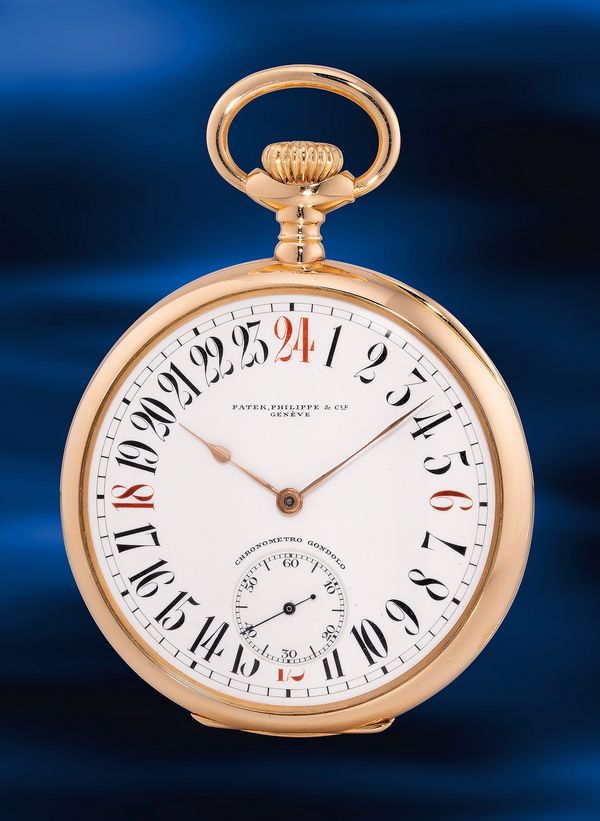
Lot 892: A 1908 Patek Philippe Chronometro Gondolo 24-Hour Pocket Watch in 18k Pink Gold that's included in the Phillips Hong Kong Watch Auction: XXI. Estimate: HKD $60,000 - 100,000
The name comes from Gondolo & Labouriau, Patek Philippe’s retailer in Rio de Janeiro from 1872 to 1927. Together, they created a sales model that felt radical for the time. Club members bought an exclusive pocket watch through a lottery-style installment plan. The watch cost 740 francs, broken down into 74 weekly payments of 10 francs each. Each week, one member won their watch outright, while later winners paid progressively less for it. Everyone eventually received a watch, usually at a better price than retail, and the format built a loyal, almost cult-like following around the brand.
This 18k pink gold 24-hour Chronometro Gondolo pocket watch stands out for its dial. The enamel is exceptionally well-preserved, and the red accents at 6, 12, 18, and 24 make it one of the rarest versions of the model.
Research indicates that there are approximately a dozen known examples with this configuration. After spending the last 20 years in a private collection, it now returns to the market with an Extract from the Archives confirming a 1908 manufacture date.
Lot 893: A Circa 1998 Cartier Mysterieux '150th Anniversaire Collection' Privées de Cartier Pocket Watch in 18k White Gold
Estimate: HKD $100,000 - 200,000
Cartier marked its 150th anniversary in 1997 with a wave of limited editions that sent collectors into a frenzy. The Maison touched nearly every beloved line, from the Tank à Guichet to the Pasha and the Basculante. Each piece carried a special, intertwined guilloché pattern, along with the "L♡C 1847–1997" signature, that defined the “I Love Cartier” series.
The celebration wouldn’t have felt complete without a nod to Maurice Coüet’s Mysterieux Modèle A, the mystery clock that debuted in 1912 and helped cement Cartier’s reputation for mechanical theatre. For the anniversary, Cartier produced three pocket watch versions in 18k white, yellow, and pink gold, all of which appear in this catalogue.
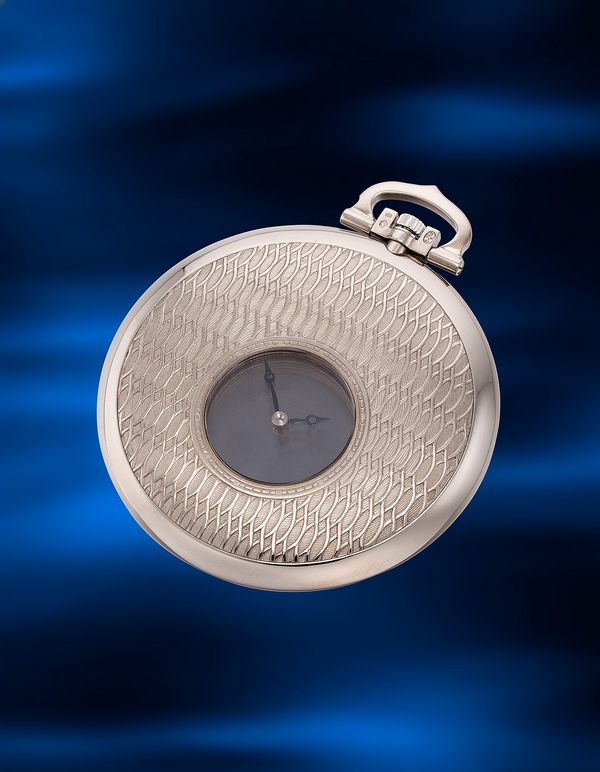
Lot 893: A Circa 1998 Cartier Mysterieux '150th Anniversaire Collection' Privées de Cartier Pocket Watch in 18k White Gold that's included in the Phillips Hong Kong Watch Auction: XXI. Estimate: HKD $100,000 - 200,000
This white gold example stands out for its number alone. It is stamped '150 of 150,' indicating that it is the final piece made for the series. The case carries sharp guilloché work, and the bow hides a neat C-shaped emblem. Inside, the familiar mystery display does its work. The hands appear to float, driven by two transparent discs and a concealed gear train.
The watch comes with a rarely seen wooden presentation box bearing the anniversary crest, along with its original certificate. It is a compact slice of Cartier magic and one of the most charming interpretations of the mystery clock ever produced.
Lot 894: A Circa 1998 Cartier Mysterieux '150th Anniversaire Collection' Privées de Cartier Pocket Watch in 18k Pink Gold
Estimate: HKD $100,000 - 200,000
Like its white-gold sibling seen above, this 18k pink-gold anniversary Mysterieux is numbered 150 of 150, marking it as the final example produced in its metal. The three pieces in this catalogue share an added bit of charm: the original owner purchased all of them on the same day, 16 November 1998.
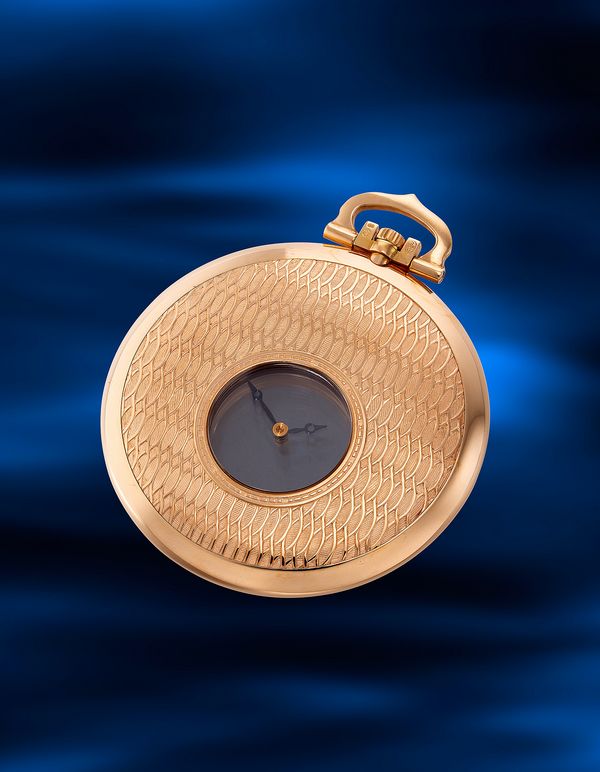
Lot 894: A Circa 1998 Cartier Mysterieux '150th Anniversaire Collection' Privées de Cartier Pocket Watch in 18k Pink Gold that's included in the Phillips Hong Kong Watch Auction: XXI. Estimate: HKD $100,000 - 200,000
The watch carries the signature elements of the “I love Cartier” series, including the intertwined 150th-anniversary guilloché motif and the "L♡C 1847–1997" crest. The bow incorporates a subtle C-shaped emblem that ties the design together. Inside, the classic mystery display performs its magic. The hands seem to hover in open space, driven by two transparent discs and a hidden gear train – an idea that traces back to Maurice Coüet’s original 1912 creation for Cartier.
This example comes with its wooden anniversary presentation box bearing the L♡C logo, as well as its original certificate. It’s a beautifully preserved piece and a striking example of Cartier’s enduring fascination with illusion and craft.
Lot 895: A Circa 1998 Cartier Mysterieux '150th Anniversaire Collection' Privées de Cartier Pocket Watch in 18k Yellow Gold
Estimate: HKD $100,000 - 200,000
The 18k yellow-gold Mysterieux completes the trio, rounding out the full 150th-anniversary set from the Collection Privées de Cartier. Like the white- and pink-gold versions described above, it is numbered 150 of 150, the final example in its metal. Together, the series played with three symbolic numbers: three for the Maison’s historic boutiques in Paris, London, and New York; 150 for the anniversary being celebrated; and 1847 for Cartier’s founding year.
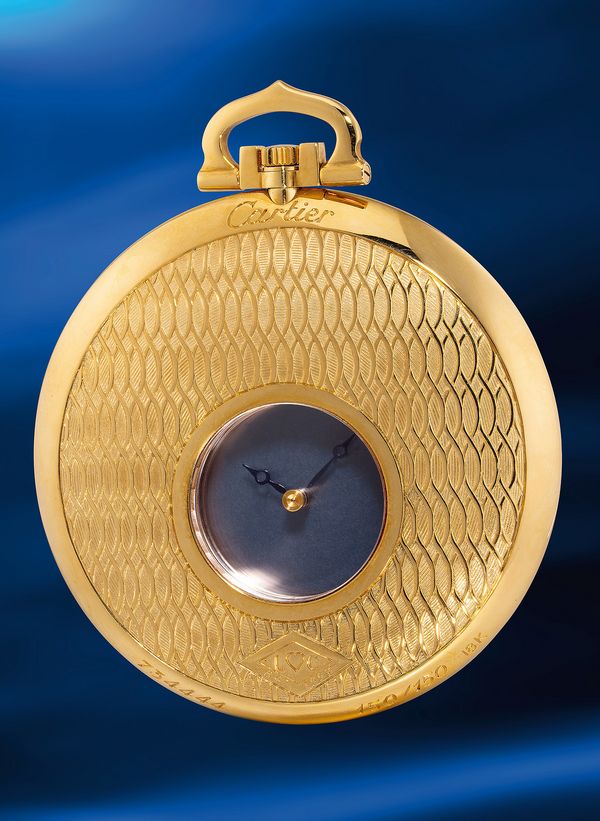
Lot 895: A Circa 1998 Cartier Mysterieux '150th Anniversaire Collection' Privées de Cartier Pocket Watch in 18k Yellow Gold that's included in the Phillips Hong Kong Watch Auction: XXI. Estimate: HKD $100,000 - 200,000
The watch carries the same refined touches that define the collection. The guilloché pattern draws from Cartier’s jewelry heritage, while the "L♡C 1847–1997" crest ties the design back to the anniversary. Despite its historic references, the motif still feels fresh – a testament to the Maison’s ability to reinterpret its past without feeling locked in by it.
As with the other two examples, the mystery display brings the piece to life. The hands drift across the dial in apparent suspension, powered by transparent discs and a hidden gear train.
Lot 896: A Circa 1980s Piaget Coin Watch Ref. 900 in 18k Yellow Gold
Estimate: HKD $80,000 - 160,000
Coin watches have always had a certain charm.
The idea is simple: split a coin, hollow it out, and hide a mechanical movement inside. Sometimes the slimmer half becomes the dial, sometimes the thicker half forms the case, and occasionally a second coin is added as a companion piece. The result is a blend of mechanical ingenuity and subtle showmanship.
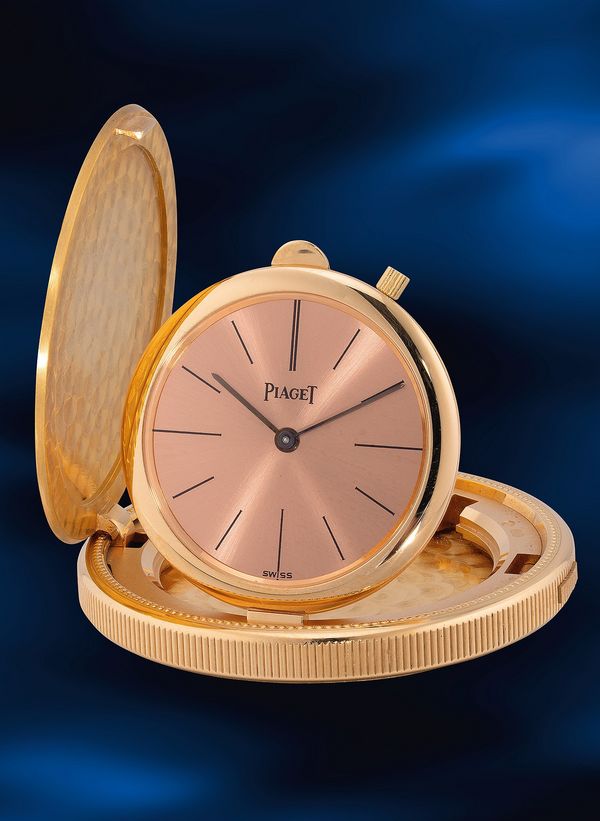
Lot 896: A Circa 1980s Piaget Coin Watch Ref. 900 in 18k Yellow Gold that's included in the Phillips Hong Kong Watch Auction: XXI. Estimate: HKD $80,000 - 160,000
This Piaget example leans into that tradition with real finesse. An 1894 20-dollar gold coin forms the case, opening to reveal an ultra-thin movement from Piaget's famed ultra-thin calibre 9P family. The watch has been kept in excellent condition, and the concealed dial still delivers that little moment of surprise for which Piaget became known during the mid-century era of slim, elegant design.
It also comes with a matching 1881 10-dollar gold coin fitted as a pendant, completing the set.
Lot 943: A 1920 Patek Philippe Tourbillon Pocket Watch in 18k Yellow Gold, Awarded First Prize at the 1924 Geneva Astronomical Observatory
Estimate: HKD $800,000 - 1,600,000
Precision timekeeping didn’t become a competitive sport by accident.
After Britain’s Longitude Act of 1714 set out a reward for a reliable method to determine a ship’s longitude, Observatory testing grew into one of the great proving grounds of horology. John Harrison’s H4 demonstrated to the world what was possible in the 18th century, and by the 19th century, Observatories in Neuchâtel, Geneva, and Kew were conducting formal timing trials. Their “Bulletins de marche” became badges of honor for the best movements. That spirit survives today in the Swiss COSC tests, but the golden era of Observatory competitions remains unmatched.
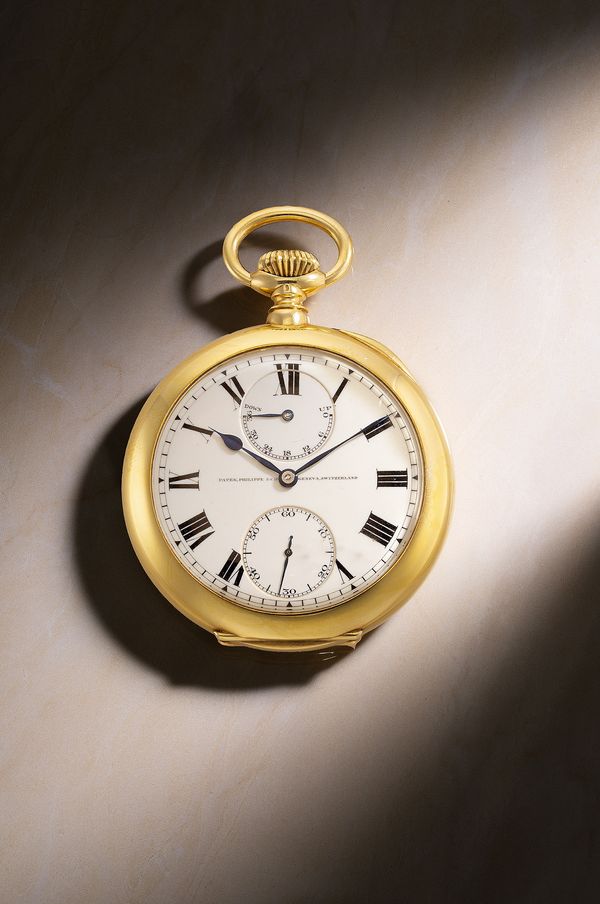
Lot 943: A 1920 Patek Philippe Tourbillon Pocket Watch in 18k Yellow Gold, Awarded First Prize at the 1924 Geneva Astronomical Observatory that's included in the Phillips Hong Kong Watch Auction: XXI. Estimate: HKD $800,000 - 1,600,000
For serious collectors, a First Prize watch from that period ranks among the most meaningful objects you can own. Patek Philippe understood this better than most. The firm began building tourbillons in the 1860s, relying heavily on the workshop of A. Pellaton-Favre in Le Locle. Pellaton-Favre produced the majority of Patek’s early tourbillon regulators – approximately 80, according to current research – and passed both the craft and the obsession for precision to his son, James C. Pellaton.
James Pellaton became one of the defining tourbillon makers of the early 20th century. He apprenticed under his father, later served as director of the Le Locle watchmaking school, and trained a generation of specialists. His tourbillon carriages are immediately recognizable once you know the signature, and the present watch proudly displays it.
Movement No. 197’585 is one of Pellaton’s masterpieces. This one-minute tourbillon with up/down indicator earned First Prize at the Geneva Observatory in 1924 in Category B, scoring 815 points. Outwardly, the watch keeps a classic, understated pocket-watch profile. Inside, it’s a technical showpiece: a large 21-ligne movement, a Guillaume balance, a Breguet balance spring, and the kind of meticulous finishing reserved for Patek Philippe’s “Extra”-quality Observatory-trial movements. Very few watches were granted that double “Extra” designation.
Another name tied to this watch is J. Golay-Audemars, the master adjuster responsible for preparing the movement for competition. His work, paired with Pellaton’s construction, helps explain why this example performed at the highest level. The enamel dial adds its own charm – a double-sunk amber tone sometimes referred to as “Venetian tint,” reminiscent of Willis-made dials admired by English collectors.
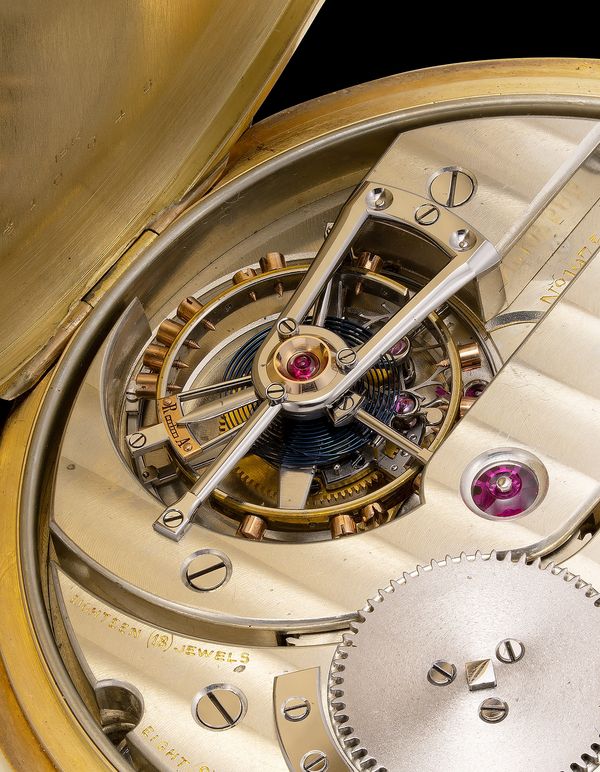
Lot 943: A 1920 Patek Philippe Tourbillon Pocket Watch in 18k Yellow Gold, Awarded First Prize at the 1924 Geneva Astronomical Observatory that's included in the Phillips Hong Kong Watch Auction: XXI. Estimate: HKD $800,000 - 1,600,000
The up/down indicator makes the watch even more unusual. Only one other Patek Philippe tourbillon pocket watch with this feature is known: No. 174720, made for famed patron James Ward Packard. That watch also used a Pellaton carriage, but on a smaller 19-ligne movement. With its 21-ligne calibre, the present example ranks among the largest and most impressive tourbillon regulators Patek Philippe ever produced.
This watch has spent nearly 26 years tucked away in a private collection and remains exceptionally well-preserved. In the broader sweep of Patek Philippe’s tourbillon history – roughly 100 pieces produced in the period – examples like this hardly ever surface. It’s a rare chance to own a true competition-grade movement from one of the greatest chapters in precision watchmaking.
Lot 944: A Circa 1900 Dent Grand Complication Pocket Watch in 18k Yellow Gold
Estimate: HKD $320,000 - 640,000
At the turn of the 20th century, British watchmaking stood at its peak.
From the late Victorian era through the Edwardian years, the country’s best workshops produced some of the most sophisticated and beautiful timepieces of the time. This Dent Grande Complication pocket watch sits squarely in that tradition, packing a minute repeater, split-seconds chronograph, and perpetual calendar with moon-phase into an 18k yellow-gold hunter case.
Edward J. Dent founded his firm in 1814, and it quickly became a name tied to precision during Britain’s period of rapid expansion. Dent chronometers sailed with the Royal Navy and accompanied explorers across the globe. In 1852, the company built the Standard Clock at the Royal Observatory in Greenwich – the reference for GMT and a symbol of British timekeeping authority well into the 20th century.
Dent also constructed the Great Clock of the Palace of Westminster, known everywhere as Big Ben.
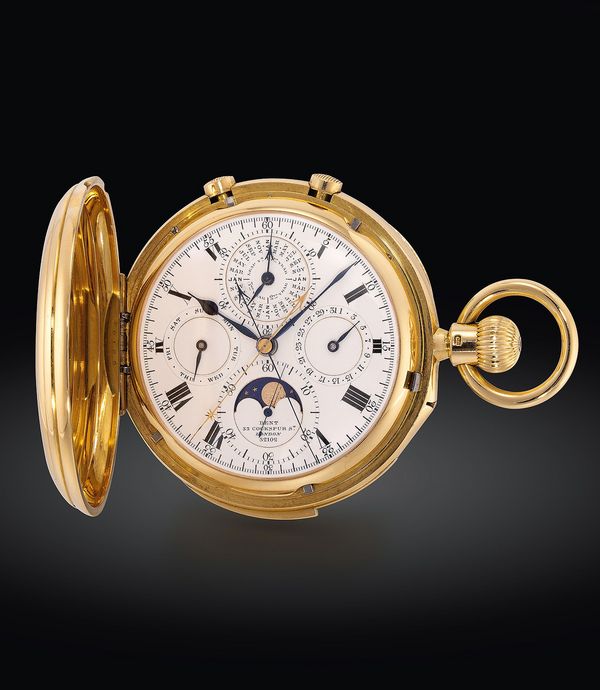
Lot 944: A Circa 1900 Dent Grand Complication Pocket Watch in 18k Yellow Gold that's included in the Phillips Hong Kong Watch Auction: XXI. Estimate: HKD $320,000 - 640,000
Those achievements earned the firm Royal Warrants from Queen Victoria, Prince Albert, and their successors, as well as commissions from the Russian imperial family and Emperor Meiji of Japan. By 1900, Dent’s headquarters at 33 Cockspur Street had become a hallmark of British horological prestige. That address appears both on the dial of this watch and engraved on the movement, alongside the title “Watchmaker to the Queen.”
London hallmarks date the case to 1900. A slide at six o'clock engages the minute repeater, which chimes the hours, quarters, and minutes on a pair of gongs. Split-second timing is achieved through twin pushers positioned at eleven and one o'clock, which feed a 60-minute counter at twelve o'clock that also houses the leap-year and month indicators. The white enamel dial is the work of Frederick Willis, one of the most respected dialmakers of his era. Roman numerals frame sub-dials that display the day, month, date, running seconds, moon-phase, and the lunar cycle. Willis signed the piece, as he did only for his most serious commissions.
This Dent Grande Complication hasn’t been seen publicly since its last auction appearance in 1989. Well-preserved and rich in historical significance, it captures the inventive, highly technical spirit that defined British watchmaking at its peak.
Lot 1007: A Circa 1820 Ilbery Pocket Watch in 18k Yellow Gold with 'King Arthur and Emmeline' Enamel Painting by V. Dupont Pinx
Estimate: HKD $640,000 - 1,280,000
William Ilbery ranks among the great British watchmakers of the late 18th and early 19th centuries.
Active in London from around 1780 until his death in 1839, he built a reputation for refined workmanship and an international outlook. Although based in England, he maintained close ties with workshops abroad and became best known for the lavish gold enamel watches he produced for the Chinese market. These pieces often featured miniature paintings of exceptional quality, typically floral or domestic scenes, while mythological subjects were less common. For his finest cases, Ilbery turned to Geneva’s top enamel painters, including Jean-Louis Richter and Jean-François-Victor Dupont.
This pocket watch showcases why his work became so highly sought after. The spring-loaded caseback reveals a vivid enamel scene of King Arthur and Emmeline, attributed to Dupont. Emmeline holds a mirror belonging to her attendant Matilda, reflecting Arthur’s face – an image inspired by an engraving published in 1787 by P. W. Tomkins. The bezels are decorated with red, white, and blue champlevé enamel in a crisp geometric pattern that frames the miniature painting with real presence.
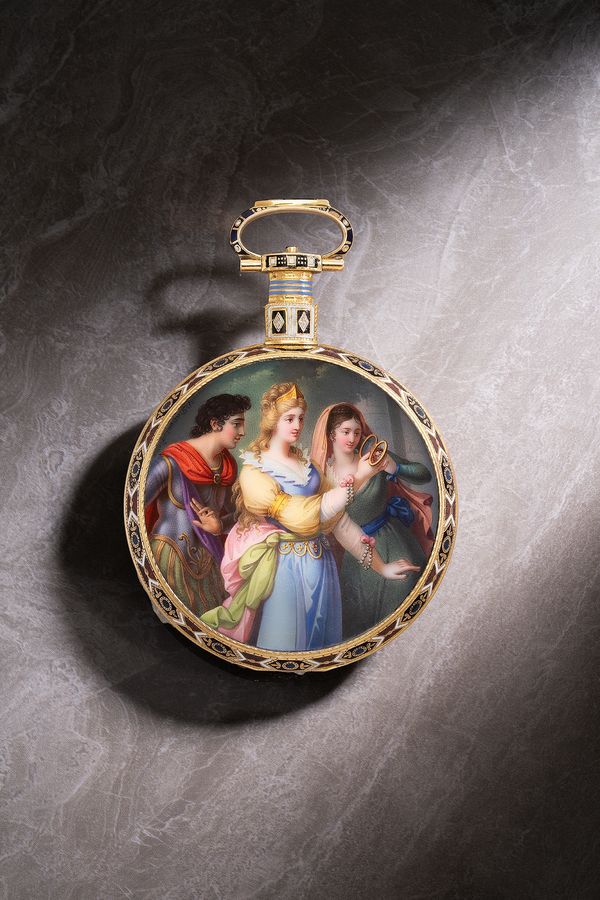
Lot 1007: A Circa 1820 Ilbery Pocket Watch in 18k Yellow Gold with 'King Arthur and Emmeline' Enamel Painting by V. Dupont Pinx that's included in the Phillips Hong Kong Watch Auction: XXI. Estimate: HKD $640,000 - 1,280,000
Dupont deserves a closer look. Born in 1785, he became one of the standout enamel artists of his era, known for his paintings on enamel, porcelain, and ivory. His style blended the influence of the Genevan school with a romantic, colorful sensibility shaped by the artistic currents of the French Restoration. His compositions often used pared-back backgrounds to push the figures forward, giving his scenes an immediate, animated quality that appealed strongly to collectors in China. Dupont mixed his own enamels to achieve bold reds, blues, and a distinct shade of purple, and he mastered techniques like pointillé for faces, which required the use of delicate one-bristle brushwork. He signed many of his pieces, exhibited widely between 1822 and 1843, and was even represented in modern museum collections, including the former Musée d’Horlogerie et d’Emaillerie in Geneva.
The watch itself is built with the elegance you expect from Ilbery. The gold cuvette is engraved, sprung, and mounted directly to the movement ring. The white enamel dial features Roman numerals, accompanied by outer minute and quarter-second tracks, and is paired with gold spade hands that suit the period. Inside is a 49mm gilt-brass “Chinese” calibre with five jewels, a free-standing barrel, a duplex escapement, and a five-arm steel balance with a flat balance spring and diamond endstone. The entire piece measures 59mm in diameter.
This watch stands out not only for the quality of its enamel but also for its rare mythological theme. Well-preserved and visually striking, it represents the height of Ilbery’s production for China and remains as compelling to collectors today as it was in the 19th century.
Lot 1008: A Pair of Circa 1860s Edouard Juvet Pocket Watches in 18k Yellow Gold with Enamel Paintings
Estimate: HKD $320,000 - 640,000
This lot brings together a rare surviving pair of pocket watches by Edouard Juvet, one of the standout Fleurier makers of the 19th century. Juvet built his reputation in the Swiss Jura, where he mastered the art of enamel decoration for the Chinese market – a market that couldn’t get enough of these brightly colored, lavishly finished pieces.
While pairs of watches are often linked to an aesthetic preference for symmetry, their original purpose was pragmatic. One served as a spare at a time when repairs could take years between China and Switzerland. The paired-image tradition later evolved into the “specular” compositions popularized by Bovet and embraced by collectors across Asia.
Demand in China surged during the mid-19th century, and Juvet’s watches became fast sellers in Shanghai before spreading to Saigon and Tianjin. As his son Léon later wrote, they were “selling like salt,” a telling snapshot of how strong the appetite for European craftsmanship already was.
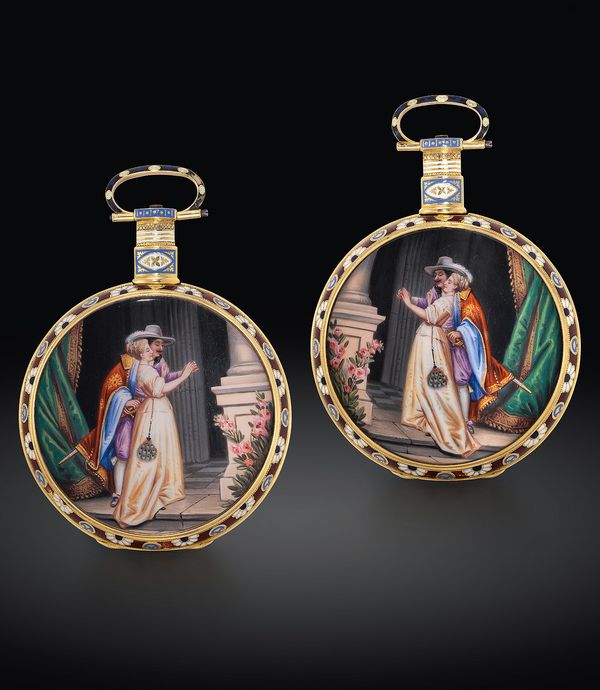
Lot 1008: A Pair of Circa 1860s Edouard Juvet Pocket Watches in 18k Yellow Gold with Enamel Paintings that's included in the Phillips Hong Kong Watch Auction: XXI. Estimate: HKD $320,000 - 640,000
The casebacks of both watches show why Juvet’s work resonated so deeply. Each carries a vivid enamel scene of a courting couple – a musketeer and a lady holding a peacock fan – painted in rich tones that remain remarkably bright to this day. The enamel is applied over fine engraving, adding texture and depth to the images. The bezels, pendants, and bows are decorated with half-flowers in blue and white set over translucent red enamel, framed by engine-turned patterns that were a signature of Fleurier’s finest ateliers.
Inside, each watch houses a key-wound Juvet movement with floral engraving and a gold cuvette decorated with stars and ribbons. The white enamel dials use bold Roman numerals for the hours and Arabic numerals for the quarter-minutes, all laid out with the clarity that defined Swiss export watches of the period.
The pair remains in excellent condition and is housed in its original leather presentation box. For collectors who appreciate the intersection of decorative art, mechanical craft, and cross-cultural history, these Juvet watches offer a rare and compelling glimpse into the golden age of Fleurier production.
Lot 1011: A Circa 1820 Swiss-Made Quarter-Repeating Pocket Watch in 18k Pink Gold with 'Hector’s Departure' Enamel Painting Attributed to J. L. Richter
Estimate: HKD $240,000 - 480,000
This quarter-repeating pocket watch, designed for the Chinese market, showcases just how refined Fleurier-style decoration had become at its peak. The bezel uses a rope-twist pattern set with alternating half-pearls and translucent red enamel laid over a flinqué ground, creating a surface that shifts beautifully in the light. The caseband continues the theme with clusters of half-pearls framed by deep blue enamel.
Open the hinged gold cuvette, and the decoration becomes even more expressive. A basket of flowers – painted in red, yellow, and dark blue enamel – sits against a bright azure background, executed with the crispness you see only on top-tier export pieces. The pendant and bow carry their own enamel and pearl details, tying the whole composition together.
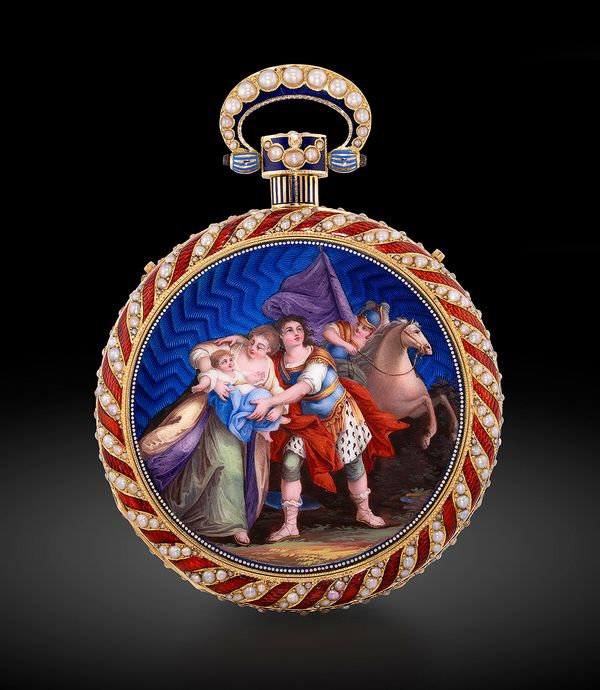
Lot 1011: A Circa 1820 Swiss-Made Quarter Repeating Pocket Watch in 18k Pink Gold with 'Hector’s Departure' Enamel Painting Attributed to J. L. Richter that's included in the Phillips Hong Kong Watch Auction: XXI. Estimate: HKD $240,000 - 480,000
The white enamel dial features Roman numerals with an outer minute track and Arabic quarter-markers, complemented by blued-steel lozenge hands that fit the period style. Inside sits a 46.8mm gilt-brass movement with six jewels, floral engraving, a free-standing barrel, and a cylinder escapement. A gold three-arm balance and blued flat spring complete the setup. Pressing the pendant activates the quarter-repeater, which strikes cleanly on demand.
The caseback elevates the watch from a decorative object to a narrative work of art. It carries a vivid enamel painting of “Hector’s Departure,” inspired by the scene in the Iliad where Hector bids farewell to his family before returning to war.
Well-preserved and rich in both artistry and storytelling, this quarter-repeater exemplifies the exceptional craftsmanship of 19th-century Switzerland, specifically designed for the Chinese market.
Lot 1012: A Circa 1830 Swiss-Made Pocket Watch in Silver-Gilt with Pearl Setting and 'Bouquets de Chine' Enamel Painting
Estimate: HKD $80,000 - 160,000
Flowers hold deep meaning in Chinese culture. Their forms, colors, and scents convey values that permeate poetry, painting, and everyday life. The lotus stands for purity. The chrysanthemum signals perseverance. The plum blossom reflects integrity. At the top sits the peony, its bold petals and rich colors making it the “Queen of Flowers,” and a symbol of wealth, status, and happiness. Families displayed floral paintings for good fortune, and merchants used them to invite success.
That symbolism made flowers a natural subject for the European miniature enamel painters who supplied luxury watches to China’s elite. A single bloom could signal refinement, prosperity, or imperial favor.
This Swiss-made example illustrates that tradition at its finest. The enamel panel carries a vivid summer blossom set against a bright green background, painted with exceptional depth and clarity.
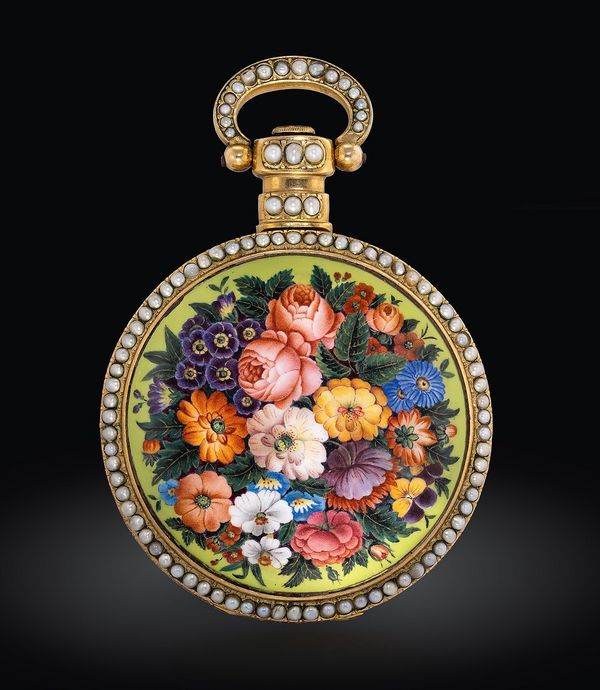
Lot 1012: A Circa 1830 Swiss-Made Pocket Watch in Silver-Gilt with Pearl Setting and 'Bouquets de Chine' Enamel Painting that's included in the Phillips Hong Kong Watch Auction: XXI. Estimate: HKD $80,000 - 160,000
The watch is housed in a silver-gilt Empire-style case featuring large half-pearls on the bezel, pendant, and bow. A sprung cuvette protects the movement, while the caseband uses a fluted design that gives the watch a clear architectural profile. Inside, the movement stands out for its unusual mirror polish. It features a duplex Jacot escapement with heat-blued screws throughout and exhibits the meticulous finishing that characterized top-level Swiss production in the early 19th century. The internal numbers remain sharp, a sign of long, careful preservation.
Held in the same collection for more than 30 years, the watch remains an important example of how Swiss craftsmanship and Chinese aesthetics came together.
Lot 1038: A Circa 1991 Breguet Perpetuelle Ref. 1890 Pocket Watch in 18k Yellow Gold
Estimate: HKD $160,000 - 240,000
Breguet introduced a modern take on its original Souscription series in 1991 to commemorate more than two centuries of continuous history. Limited to 300 pairs, each set included a Ref. 3430 perpetual calendar minute-repeating wristwatch and a 62mm perpétuelle pocket watch produced in platinum, pink, white, or yellow gold. The pocket watch, known as the Ref. 1890, took direct inspiration from Abraham-Louis Breguet’s late-18th-century perpétuelle watches. The most famous of those early self-winding watches is the No. 5, sold in 1794 and now a highlight of the Breguet Museum in Paris.
At the time, Breguet was still a small-scale operation under Investcorp, producing fewer than 4,000 watches a year. The Ref. 1890 project was entrusted to Michel Parmigiani, whose restoration of a 19th-century Breguet Sympathique – complete with a pocket watch that could be wound and set by the clock – had established him among the few watchmakers capable of handling such work.
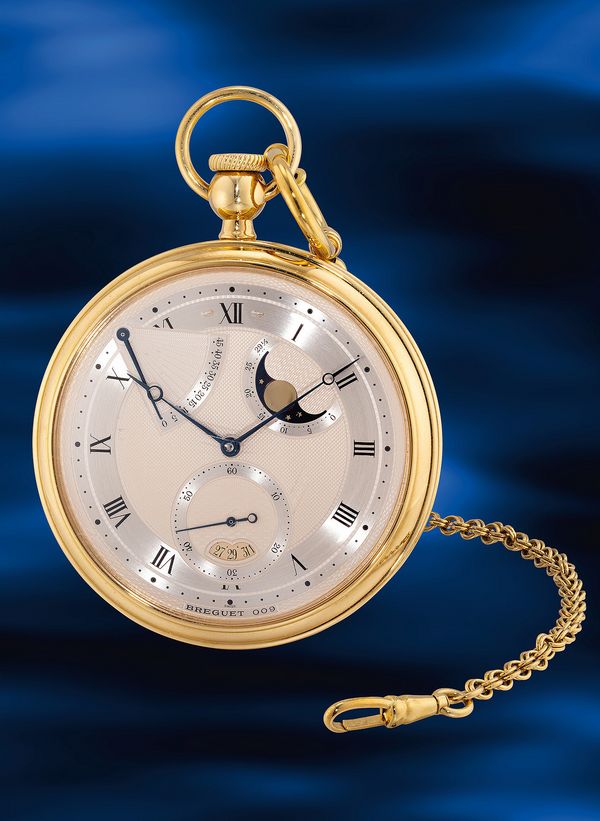
Lot 1038: A Circa 1991 Breguet Perpetuelle Ref. 1890 Pocket Watch in 18k Yellow Gold that's included in the Phillips Hong Kong Watch Auction: XXI. Estimate: HKD $160,000 - 240,000
Although often described as a replica, the Ref. 1890 is better understood as a modern reinterpretation. It keeps the hallmark hammer-winding system of the original perpétuelle watches but forgoes the minute repeater and adds contemporary refinements. The platinum delta-shaped rotor, running on sapphire rollers and linked to a curved steel arm, is as technically clever as it is sculptural. A sprung bumper system and "pare-chute" shock absorbers on both pivots reinforce the mechanical symmetry, paying tribute to classic Breguet ideas.
The large 62mm case allows the movement to breathe, providing a full view of the architecture and finishing. This 18k yellow-gold example is numbered 9 out of 300 and comes with its matching chain. Exceptionally well-preserved, it stands as one of the most thoughtful modern homages to Abraham-Louis Breguet’s foundational work.
Lot 1039: A Circa 1930 Cartier Minute-Repeating Pocket Watch in 18k Yellow Gold
Estimate: HKD $160,000 - 310,000
The European Watch and Clock Company (EWC) was founded in the 1920s as a partnership between Cartier and Edmund Jaeger (of Jaeger-LeCoultre), whose workshop in Le Sentier was already renowned for its inventive, high-quality movements.
Cartier continued to work with other makers, but many of its finest 20th-century creations featured EWC movements built within the LeCoultre factory.
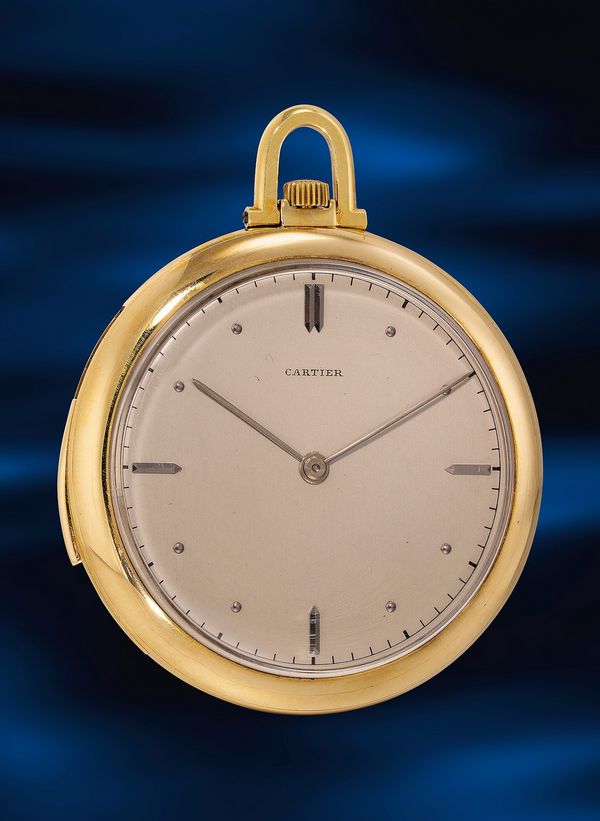
Lot 1039: A Circa 1930 Cartier Minute-Repeating Pocket Watch in 18k Yellow Gold that's included in the Phillips Hong Kong Watch Auction: XXI. Estimate: HKD $160,000 - 310,000
Cartier’s reputation for glamour and design was already firmly established. Founded in Paris in 1847, the Maison became a destination for royalty and influential clients, and its watches reflected that same mix of elegance and precision.
Before partnering with Jaeger, Cartier often turned to Geneva makers like Patek Philippe and Audemars Piguet for movements. Those relationships continued for special orders, yet the core of Cartier’s production in the following decades relied on EWC. The movements were made to a very high standard, and watches from the 1930s through the 1950s that house them remain some of the most coveted vintage Cartier watches.
This example dates to around 1930 and uses an EWC manual-wind movement with a minute repeater that chimes with a clear, even tone. The 18k yellow gold case exhibits a bright mirror polish with only light age-related marks. The design language is pure Art Deco, clean and understated, and the overall condition is impressive for a watch approaching its centennial.
Lot 1040: A Circa 2007 Rolex Cellini Ref. 3612 Coin Watch in 18k Yellow Gold
Estimate: HKD $60,000 - 120,000
Rolex is best-known for its tool watches, but the brand's catalogue has always been wider than most people realize.
Among the rarest pieces the company ever produced is a small series of coin watches, and the Ref. 3612 belongs to that elusive family. This example is housed inside a 20-dollar gold coin from 1897, capturing the spirit of the Cellini line, Rolex’s tribute to the 16th-century goldsmith Benvenuto Cellini.
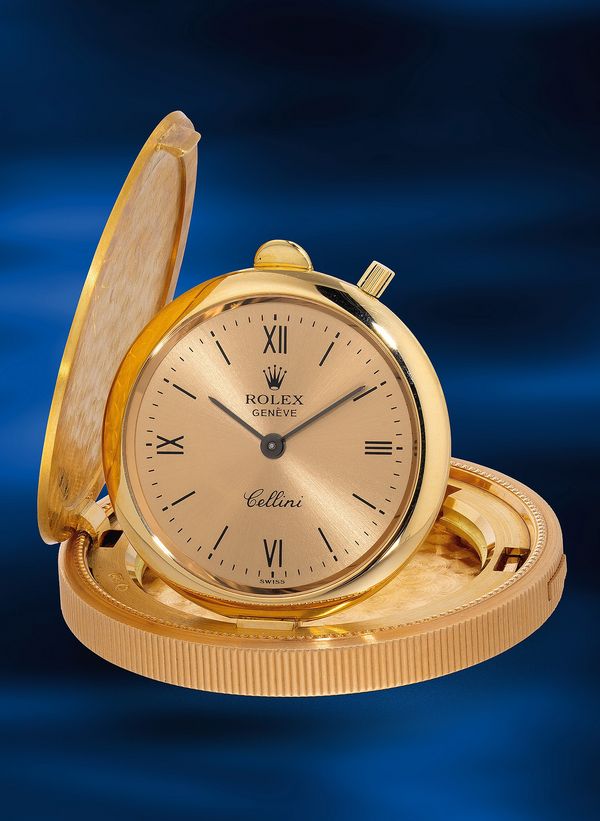
Lot 1040: A Circa 2007 Cellini Ref. 3612 Coin Watch in 18k Yellow Gold that's included in the Phillips Hong Kong Watch Auction: XXI. Estimate: HKD $60,000 - 120,000
A small button, hidden in the reeded caseband, opens the case with a simple press, revealing the dial. The interior walls of the coin show hand-applied perlage, a thoughtful touch that adds to the sense of craft once the watch is opened.
The piece is in well-preserved condition and comes with all its original accessories. For collectors of both watches and numismatics, it is an unusual and appealing crossover that rarely appears on the market.
Lot 1086: A Circa 1899 Swiss-Made One-Minute Tourbillon Pocket Watch in 18k Yellow Gold, Retailed by S. Smith & Son
Estimate: HKD $320,000 - 640,000
From the 17th century onward, Britain set the pace in horological innovation, producing the world’s most precise timekeepers.
That legacy stretched well into the 19th century, and the present one-minute tourbillon pocket watch stands squarely in the national tradition. It is highlighted in influential books, including Watches by Cecil Clutton and George Daniels, and Das Tourbillon by Reinhard Meis.
It is the first tourbillon pocket watch signed by S. Smith and Son, and the only one fitted with a detent escapement. All other known S. Smith and Son tourbillons use lever escapements.
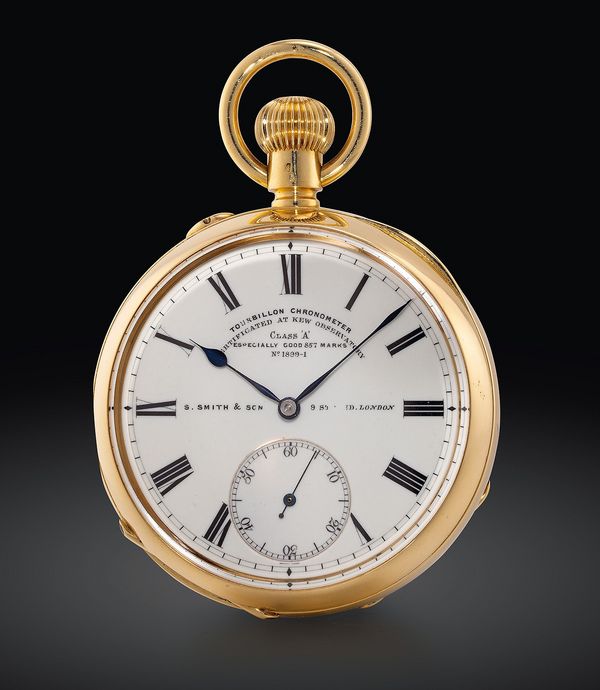
Lot 1086: A Circa 1899 Swiss-Made One-Minute Tourbillon Pocket Watch in 18k Yellow Gold Retailed by S. Smith & Son that's included in the Phillips Hong Kong Watch Auction: XXI. Estimate: HKD $320,000 - 640,000
The dial originates from Frederick Willis, whose enamel work was the pinnacle of period British dialmaking. His white enamel dials with Roman numerals were favored by top makers for their clarity and quality, and this example shows that standard well.
The movement was made by Albert Pellaton Favre, one of the defining tourbillon specialists of his era. His constructions won major prizes at Kew and at the Geneva and Neuchâtel Observatories, and he collaborated with notable companies such as Henchoz Frères, Golay Fils, Paul Ditisheim, Girard-Perregaux, and Patek Philippe.
This tourbillon, completed around 1899, was sent twice to the National Physical Laboratory at Teddington, a suburb of London. Its first trial in 1894 earned 88.8 points, and a second test in 1899 achieved 85.7 points. A Statement of Examination from February 1953 confirms the later submission.
London's Baume and Co. commissioned this tourbillon, along with five others tested at Kew between 1891 and 1902, entering it in trials under their own name and number. It was later sold to S. Smith and Sons, who signed the barrel bridge and cuvette and ordered the Willis dial before offering it for sale.
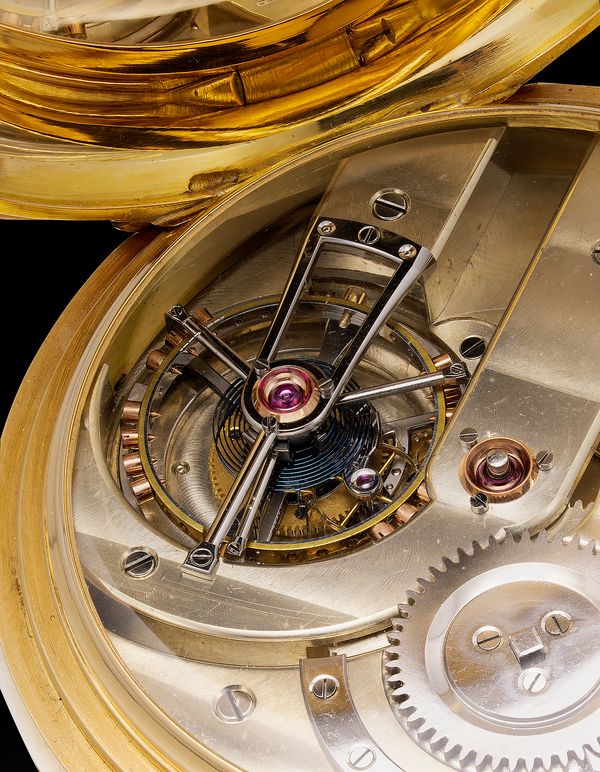
Lot 1086: A Circa 1899 Swiss-Made One-Minute Tourbillon Pocket Watch in 18k Yellow Gold Retailed by S. Smith & Son that's included in the Phillips Hong Kong Watch Auction: XXI. Estimate: HKD $320,000 - 640,000
The watch has survived in exceptional condition and comes with its original S. Smith and Sons leather presentation box.
It represents the heights of late 19th-century British watchmaking, a period when the country produced some of the most technically ambitious and beautifully finished watches in the world.
Lot 1087: A Circa 1851 J.R. Losada Grande and Petite Sonnerie Pocket Watch in 18k Yellow Gold
Estimate: HKD $80,000 - 160,000
José Rodríguez (J.R.) Losada built his reputation as one of the most accomplished Spanish watchmakers working in London during the mid-19th century.
His watches were admired not only in Britain but also across Spain and Latin America, where his name carried significant weight among clients.
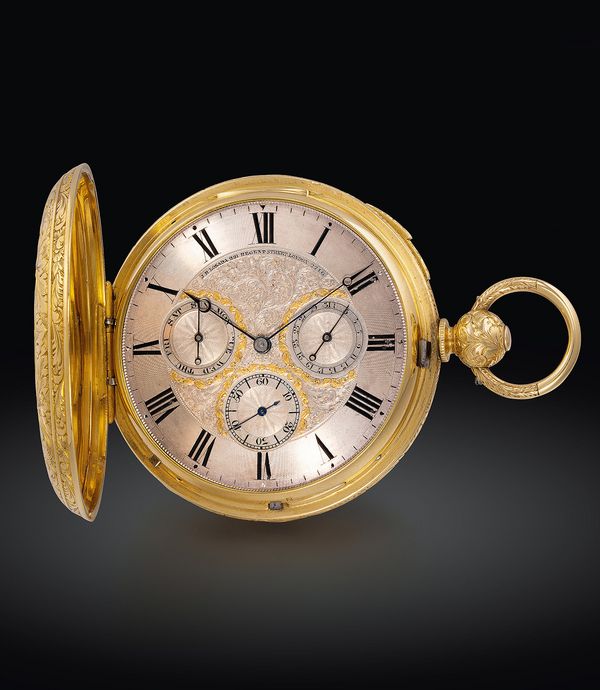
Lot 1087: A Circa 1851 J.R. Losada Grande and Petite Sonnerie Pocket Watch in 18k Yellow Gold that's included in the Phillips Hong Kong Watch Auction: XXI. Estimate: HKD $80,000 - 160,000
This example shows why. It is a London-made watch tailored for the Spanish-speaking market, pairing an elaborate case and dial with a sophisticated two-train movement. The repeating mechanism and movement are fully jeweled in screwed settings, and the silver dial is accented with gold around the subsidiary calendar and seconds displays. The 18-carat case is richly engraved with scrolling floral motifs on the covers, band, cuvette, pendant, and bow, a decorative style that found particular favor in South America during the period. London hallmarks date this piece to 1851, and the case carries the maker's mark of Gustavus Huguenin, who registered his initials in 1842.
The cuvette identifies the original owner as one Luciano de Murrieta, a Peruvian-born Spaniard whose life took him from military service during Spain's First Carlist War, to exile in London, and finally to a central role in the development of Spain's Rioja wine region.
Encouraged and financed by the general Baldomero Espartero, Murrieta founded his winery in 1852 and introduced the Bordeaux method of barrel-aging to Spain. His early vintages were exported to markets such as Mexico and Cuba, making his wines among the first fine Riojas to be exported internationally. He was later granted the title Marqués de Murrieta.
More than 170 years on, the watch remains in impressive condition. As a blend of London craft, Spanish patronage, and the personal history of one of Rioja’s foundational figures, it is a compelling and rare pocket watch.
Lot 1090: A Circa 1925 Cartier Travel Dress Watch in Onyx, Gold, and Enamel
Estimate: HKD $64,000 - 128,000
The 1920s produced some of the most refined objects in watchmaking, from slim evening wristwatches to compact travel clocks carried by men who valued style as much as punctuality.
A well-chosen dress watch or travel clock signaled taste, confidence, and a certain appetite for experience, all of which helped define the Roaring '20s.
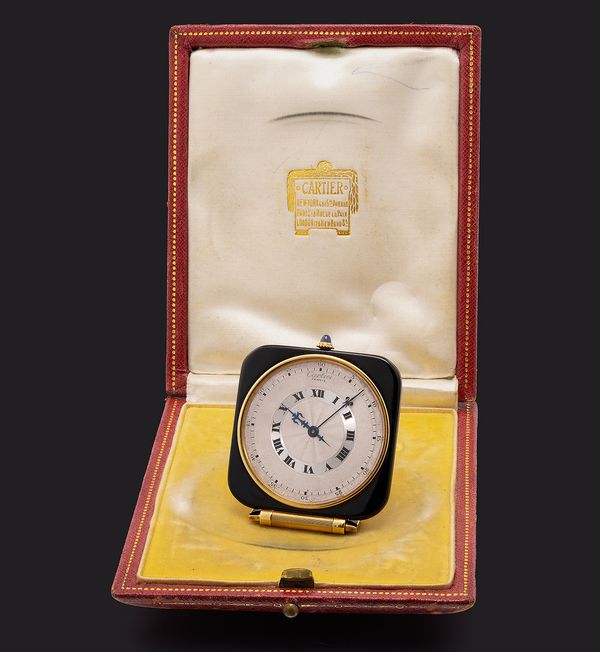
Lot 1090: A Circa 1925 Cartier Travel Dress Watch in Onyx, Gold, and Enamel that's included in the Phillips Hong Kong Watch Auction: XXI. Estimate: HKD $64,000 - 128,000
This small onyx travel dress watch from Cartier perfectly captures the spirit of the era.
It features a smooth profile with rounded edges, is slim enough to sit comfortably in the hand, and was designed with real versatility in mind. A gold-reeded, hinged pendant, shaped as a black enamel angled trefoil, folds out to form a stand, transforming the watch into a discreet travel companion. The guilloché dial, signed Cartier Paris, carries a silver hour ring with Roman numerals and a pair of heat-blued steel hands shaped in an oriental style. The caseback reveals an elegant black inlaid gold arabesque motif, and the bow bears a sharp French eagle hallmark.
The watch is accompanied by a red Cartier presentation box. It has remained out of the public eye for the last 28 years. As an object, it evokes a time when travel was glamorous, and even the smallest accessories were crafted with great care. It is a charming, beautifully preserved example of Cartier’s design sensibility during one of the most stylish decades of the 20th century.
Lot 1091: A Circa 1800 Swiss-Made 'Musique Aiguilles' Quarter-Repeating Pocket Watch in 18k Yellow Gold with Enamel Painting
Estimate: HKD $200,000 - 400,000
This watch pairs an extraordinarily ornate Empire-style case with a dial that keeps things deliberately simple. The white enamel surface features short, broad Roman numerals and a central seconds display. The contrast with the case is immediate. The gold cuvette carries a basket of polychrome enamel flowers set against powder blue enamel and is inscribed “Musique Aiguilles,” confirming that this is indeed a musical watch.
Inside the cuvette sits the casemaker’s mark, I.E., in a diamond cartouche, and the engraved case number. The caseband continues the decorative program with opaque blue enamel punctuated by translucent red ovals, green enamel foliage, and alternating pearls. The rims feature green and red enamel geometric patterns, and the bezels, pendant, and bow are all set with pearls.
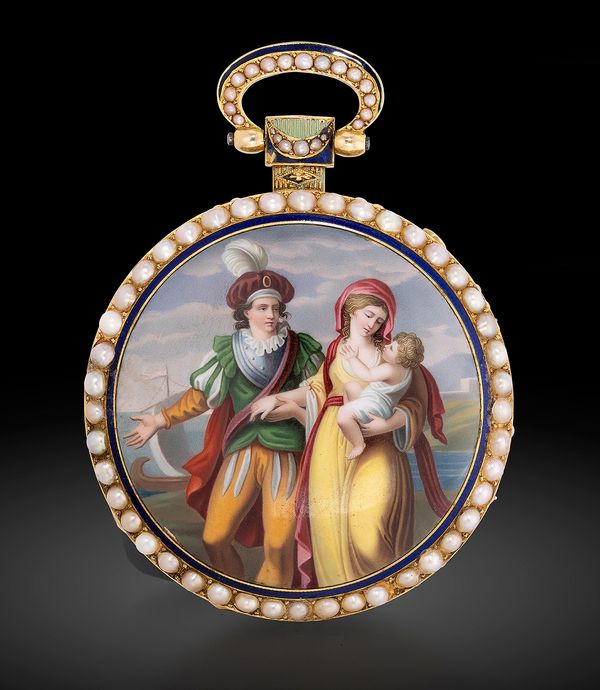
Lot 1091: A Circa 1800 Swiss-Made 'Musique Aiguilles' Quarter-Repeating Pocket Watch in 18k Yellow Gold with Enamel Painting that's included in the Phillips Hong Kong Watch Auction: XXI. Estimate: HKD $200,000 - 400,000
Empire-style watches often involved collaborations with Geneva’s top enamel painters, including François Dupont, Jean Louis Richter, Dufaux, L’Evesque, Roux, and Lissignol. Floral themes were common, many inspired by Chinese porcelain, but this example carries a full narrative scene. The back panel shows a woman holding a child beside a man who appears ready to depart by ship. His feathered hat and richly colored clothing hint at a noble or explorer figure, while she wears robes of yellow and red. The composition evokes Tuscan paintings from the 19th century and earlier, drawing clear inspiration from Renaissance works of art.
The enamel quality is outstanding. The colors are balanced, and the surface is finished to a high polish. As with most Geneva work of the period, the panel is unsigned. (Only three artists – Jean-François Soiron, Jean Louis Richter, and Jean-François Victor Dupont – signed consistently.) The present miniature enamel painting aligns most closely with Dupont’s style. His compositions focus heavily on the foreground, with figures filling out most of the space and only minimal background detail. The proportions, gestures, and sense of movement point to his hand, and the facial work suggests the use of the rare pointillé technique executed with a single bristle brush.
Under the decorated cuvette, the movement remains in remarkable condition for a watch of this age. It uses a gilt cylinder escapement with a three-arm balance and a pinned disc musical mechanism. The plates and barrels are engraved with foliate scrolls, enhancing their visual appeal.
Lot 1092: A Circa 1810 Ilbery Pocket Watch in 18k Yellow Gold with Enamel Painting Attributed to Jean-Louis Richter
Estimate: HKD $200,000 - 400,000
William Ilbery, active from the late 18th century into the 1830s, occupies a central place in the history of export watchmaking.
Often described as the father of the Montre Chinoise calibre, he became one of the most important makers supplying watches to the Chinese market at a time when Britain dominated trade in the region. Ilbery worked closely with leading Swiss artisans for both movements and enamel decoration, creating pieces that blended English craftsmanship with Genevan artistry.
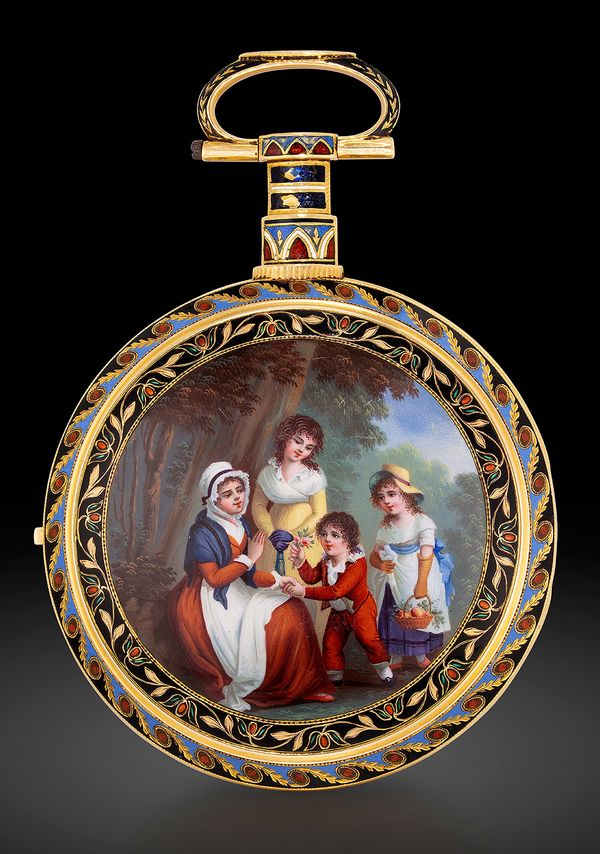
Lot 1092: A Circa 1810 Ilbery Pocket Watch in 18k Yellow Gold with Enamel Painting Attributed to Jean-Louis Richter that's included in the Phillips Hong Kong Watch Auction: XXI. Estimate: HKD $200,000 - 400,000
Between approximately 1790 and 1830, Ilbery collaborated with miniature enamel painters such as Dupont, Jean Louis Richter, and Lissignol. His cases often featured scenes drawn from classical mythology, allegorical themes, or Alpine landscapes. Portraits appear far less often, which makes any surviving example especially interesting.
The present watch dates to circa 1810 and represents Ilbery’s work at a high level. Measuring 55.8mm, it follows the Empire-style and bears a crowned leopard’s head hallmark. It has remained in private hands for 28 years. The watch uses a double case: an outer enamelled case that lifts away to reveal a gold inner watch with an engraved fusée-and-chain duplex escapement. The enamel caseback, attributed to Jean Louis Richter, depicts a pair of women and children sitting leisurely in a garden.
The outer case is framed by a pattern of lozenges and florets in black, blue, and red enamel, which lends the watch a strong presence. As a combination of British construction, Genevan miniature enamel work, and early 19th-century export taste, it stands as a striking and well-preserved Ilbery creation.
Lot 1093: A Circa 1830 Voumard Pocket Watch in 18k Yellow Gold with 'Bouquets de Chine' Enamel Painting
Estimate: HKD $80,000 - 120,000
In Chinese culture, the peony carries a special weight.
Known as the Queen of Flowers, it symbolizes wealth, prosperity, and good fortune. Its full blooms and vivid colors made it a favorite subject in classical art and poetry, often linked to feminine beauty and romantic love.
Peonies were used in wedding imagery to bring blessings to a new marriage and were also believed to attract positive energy and ward off misfortune. For this reason, the flower became a natural motif for luxury objects destined for the Chinese market.
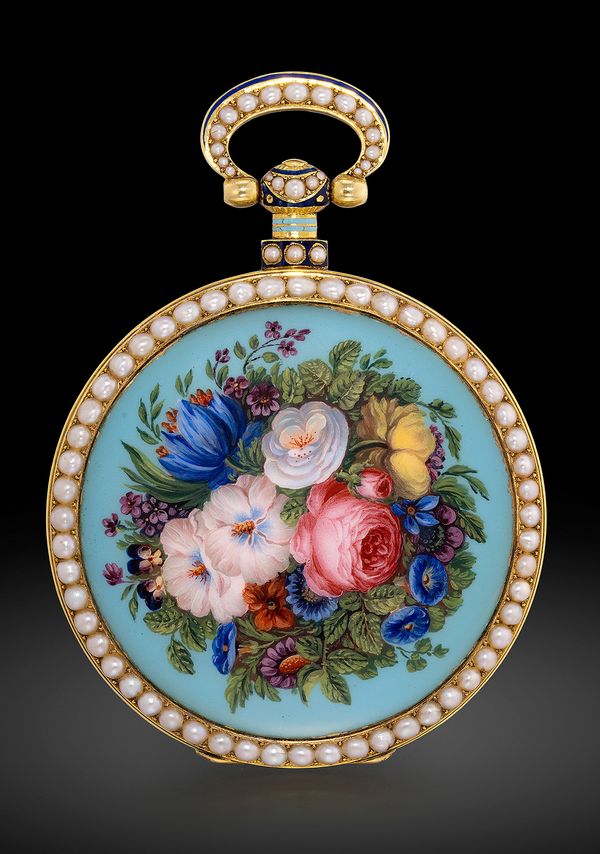
Lot 1093: A Circa 1830 Voumard Pocket Watch in 18k Yellow Gold with 'Bouquets de Chine' Enamel Painting that's included in the Phillips Hong Kong Watch Auction: XXI. Estimate: HKD $80,000 - 120,000
This 18k yellow gold watch by Voumard of Le Locle is a rare example from that tradition. While many export watches of the period were cased in silver-gilt, this piece is fully marked as 18k gold inside the case. The watch follows the Empire-style, featuring large half-pearls set into the bezel, pendant, and bow, as well as a sprung gold cuvette that protects the movement. The caseband features turquoise and deep blue enamel accents that complement the overall design.
The gilt movement is richly engraved and features a jeweled escapement at its center, set with a blue chaton. The Voumard signature appears alongside the movement number, which is repeated inside the case and cuvette with sharp, well-preserved stamping.
Kept in the same collection for over 30 years, this pocket watch is an impressive and well-preserved example of early Swiss work made for the Chinese market.
Lot 1095: A Circa 1830s Bovet Gilt-Silver Pocket Watch with 'Bouquets de Chine' Enamel Painting
Estimate: HKD $64,000 - 128,000
Flowers carry deep meaning in Chinese culture. Each bloom expresses a particular virtue. The lotus stands for purity, the chrysanthemum for perseverance, and the plum blossom for integrity.
This Bovet pocket watch, signed 播喴 for the Chinese market, and shaped in the Empire-style, features a bright floral enamel composition to celebrate those themes.
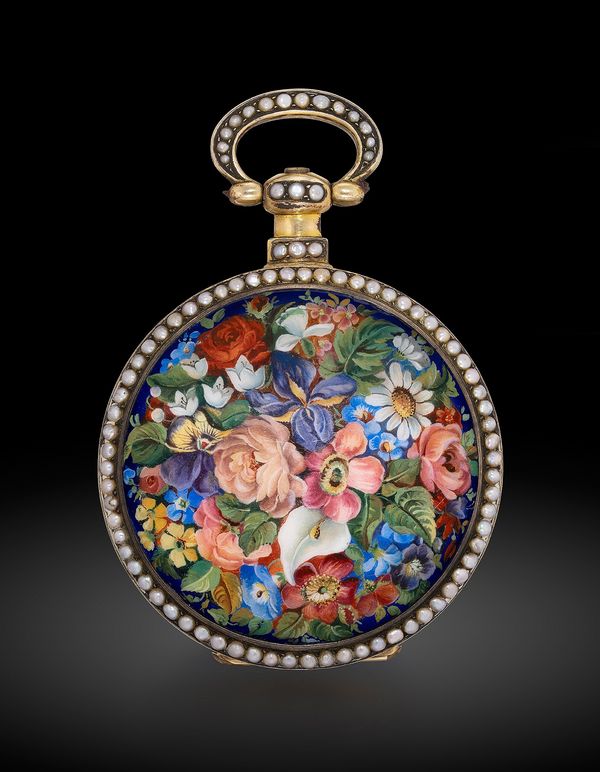
Lot 1095: A Circa 1830s Bovet Gilt-Silver Pocket Watch with 'Bouquets de Chine' Enamel Painting that's included in the Phillips Hong Kong Watch Auction: XXI. Estimate: HKD $64,000 - 128,000
Inside, the watch features a Jacot duplex escapement, also known as the Chinese duplex.
The system was introduced around 1830 by Charles-Édouard Jacot, who moved between La Chaux-de-Fonds and New York and became known for his inventive work on escapements. His version of the duplex created a jumping seconds display that appealed to buyers in China and gave the impression of regulator-like precision.
Jacot’s creativity carried over into his American career, where he secured 12 patents to improve watch construction, including designs for the star wheel duplex.
Lot 1096: A Circa 1830s Edouard Juvet Gilt-Silver Pocket Watch with Enamel Painting Attributed to Pierre-Amédée Champod
Estimate: HKD $40,000 - 80,000
This Empire-style pocket watch, likely the work of Pierre Amédée Champod, centers on a striking enamel scene of Indian hunters facing down a tiger from the back of an elephant.
The image is rendered in vivid polychrome enamel and reflects the Qing-dynasty fascination with exotic animals and far-flung settings. Measuring 57mm and numbered 293, the watch dates to the 1830s and survives in exceptional condition.
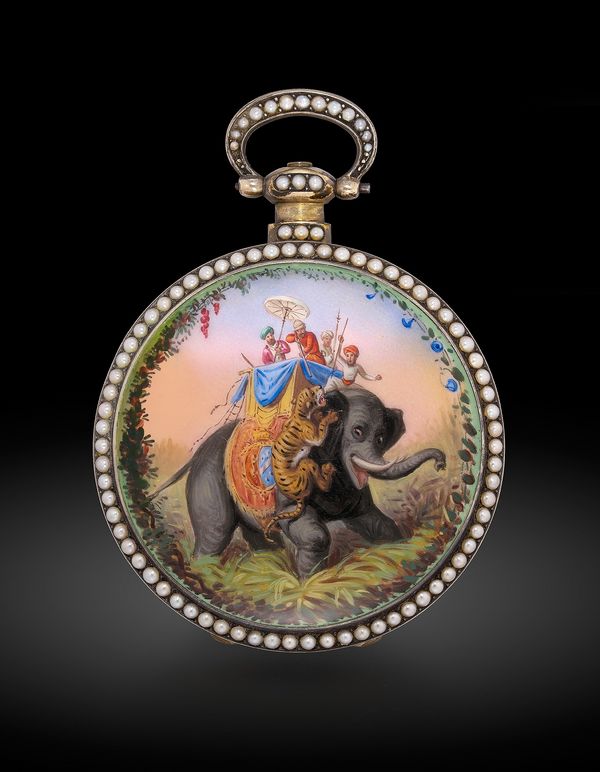
Lot 1096: A Circa 1830s Edouard Juvet Gilt-Silver Pocket Watch with Enamel Painting Attributed to Pierre-Amédée Champod that's included in the Phillips Hong Kong Watch Auction: XXI. Estimate: HKD $40,000 - 80,000
The piece comes from the Juvet family, one of the leading makers supplying enamel watches to China in the mid-19th century. Edouard Juvet founded the firm in Fleurier in 1842 and later established branches in Shanghai, Tianjin, and Saigon. Their success was such that the company registered a Chinese trademark, You Wei 有喴, in 1873. Alongside Bovet, Juvet became a dominant name in the Chinese export trade.
Behind the gold cuvette sits a high-grade duplex movement. The duplex escapement was first imagined by Robert Hooke around 1700 and later refined by Dutertre, Leroy, and Thomas Tyrer, who patented its mature form in 1782. This example features engraved plates and bridges, as well as a five-armed polished steel balance with a ruby endstone, demonstrating the level of finish expected by Chinese buyers at the time.
More than a century and a half later, the watch remains remarkably well-preserved.
Lot 1006: A Circa 1925 Unique Cartier Desk Clock with Strut, “Laque Burgauté” Panel, Agate, Mother-of-Pearl, Gold, Enamel, Sapphire Cabochons, and Diamonds
Estimate: HKD $200,000 - 400,000
Cartier spent much of the 19th century drawing on the mythology of the Far East.
Dragons, phoenixes, and chimeras appeared consistently across its creations, but as the 20th century approached, a different current swept through Europe. Literature and opera, including works like Madama Butterfly, fueled a new fascination with Chinese and Japanese culture. By the early 1900s, Cartier had embraced these influences and began shaping an entire Chinoiserie universe.
The Maison lifted visual language from Chinese culture and craft, translating lacquer, jade, and enamel details from everyday objects into luxurious Art Deco forms. These motifs found their way into large clocks as well as small objects, such as vanity cases, scent bottles, and lipsticks.
Cartier was especially drawn to the effects of light, much like China's shadow theatre traditions. Through iridescent panels and sculpted surfaces, the Maison transformed those concepts into jewelry and decorative art.
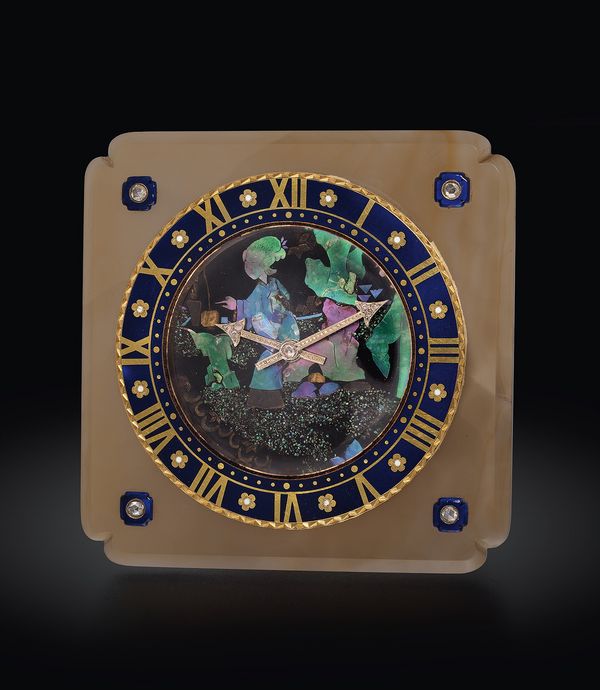
Lot 1006: A Circa 1925 Unique Cartier Desk Clock with Strut, “Laque Burgauté” Panel, Agate, Mother-of-Pearl, Gold, Enamel, Sapphire Cabochons, and Diamonds that's included in the Phillips Hong Kong Watch Auction: XXI. Estimate: HKD $200,000 - 400,000
One of the most refined techniques Cartier employed was laque burgauté, a method of inlaying tinted mother-of-pearl into black lacquer. The technique, known as lo tien in China and aogai in Japan, appeared as early as the Ming dynasty and flourished through the Qing period before spreading across the Ryukyu Islands and into Japan.
The mother-of-pearl, often tinted green or purple, is set beneath layers of lacquer that are then polished smooth with pumice to achieve a flawless, shimmering finish. The panel on this Cartier desk clock shows an elegant woman seated in an oriental garden, her hand raised in a calm, thoughtful gesture. A vase and teacup sit before her, creating a quiet nocturnal scene rendered with grace.
The clock itself is framed with four Japanese corners, the classic coin japonaise profile, and carved from translucent agate with a soft pink hue. Each corner holds a sapphire cabochon set with a single diamond. The chapter ring features gold and blue enamel, with each Roman numeral set off by a gold sakura blossom. The hands, made in platinum and set with diamonds, taper to a fine arrow point that echoes the line of the figure’s hand in the panel.
The strut retains sharp “European Watch and Clock Co. Inc., France” engravings, and the case is stamped "Cartier N.Y.," indicating that this example was likely sold through Cartier's Manhattan flagship. Well-preserved and rich in detail, it's a beautiful illustration of Cartier’s early 20th-century cultural dialogue with Asia and its mastery of Chinoiserie design.
Lot 1013: A Circa 2008 Jaeger-LeCoultre Marqueterie 'Gustav Klimt' Atmos Clock
Estimate: HKD $780,000 - 1,560,000
In 1928, engineer Jean Léon Reutter created a clock that could run almost entirely on air.
Jaeger-LeCoultre brought the concept into production in the 1930s, and the so-called Atmos quickly became a horological icon. Powered by tiny shifts in ambient temperature, the Atmos eventually earned the nickname “the President’s Clock” and became the official diplomatic gift of the Swiss Confederation.
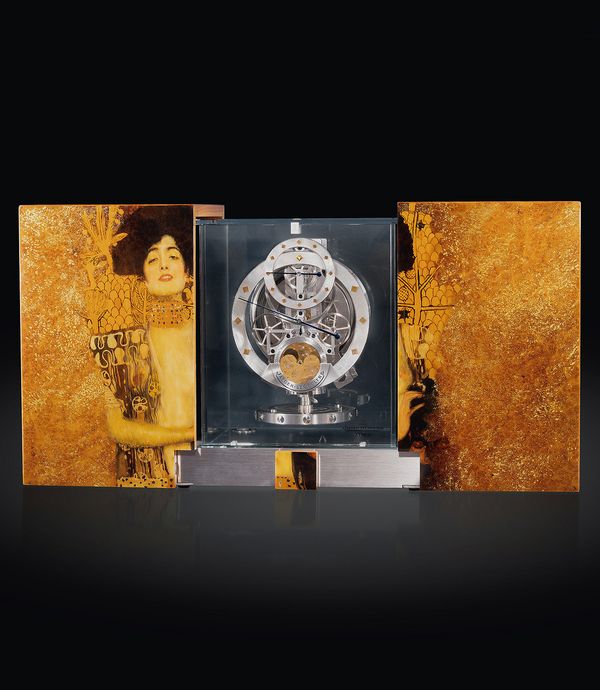
Lot 1013: A Circa 2008 Jaeger-LeCoultre Marqueterie 'Gustav Klimt' Atmos Clock that's included in the Phillips Hong Kong Watch Auction: XXI. Estimate: HKD $780,000 - 1,560,000
For the Atmos’s 80th anniversary in 2008, Jaeger-LeCoultre unveiled one of its most ambitious creations at the SIHH fair in Geneva. The Atmos Marqueterie Gustav Klimt, limited to 10 pieces, elevated the model from technical curiosity to a full-blown work of art. The cabinet recreates Gustav Klimt’s "Judith I" (1901), a portrait of the biblical Judith holding the head of Holofernes. Klimt painted the figure using his signature mix of gold, mosaic patterning, and bold ornament. His muse and close friend, Adele Bloch-Bauer, served as the model.
French marquetry artist Jérôme Boutteçon translated Klimt’s shimmering surface into wood and gold, using more than 1,200 fragments of rare woods, including amboyna burl, lemonwood, satinwood, and tulipwood, many of which were then finished with thin layers of gold leaf. The result has the same depth and glow as Klimt’s original, rendered entirely through marquetry.
A concealed button opens the cabinet, revealing the Atmos mechanism protected by rhodium-plated crystal glass. The mother-of-pearl dial features a regulator layout, with the hours at 12 o'clock, and the central minutes, months, and moon-phase at 6 o'clock. Fine decorative touches include a cushion-cut yellow sapphire at the 60-minute mark, petrified wood hour markers set into the mother-of-pearl ring, and a golden diamond-set moon.
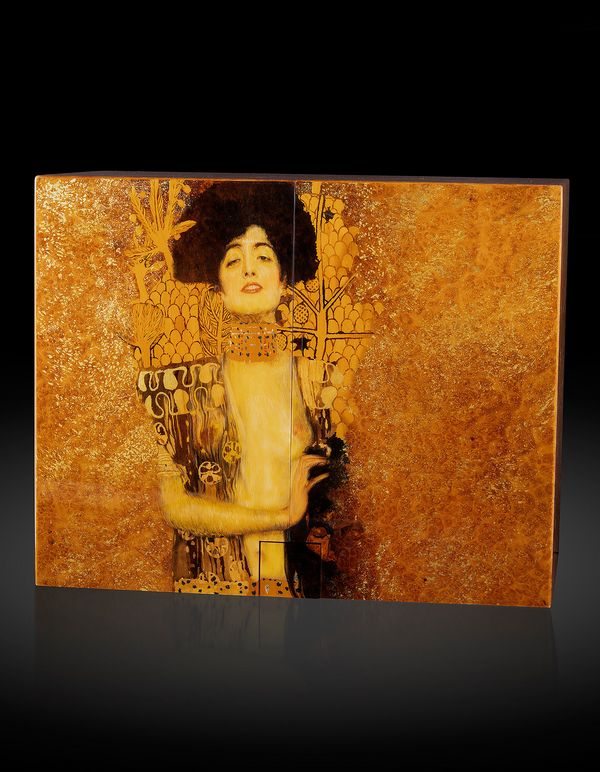
Lot 1013: A Circa 2008 Jaeger-LeCoultre Marqueterie 'Gustav Klimt' Atmos Clock that's included in the Phillips Hong Kong Watch Auction: XXI. Estimate: HKD $780,000 - 1,560,000
Inside is the Jaeger-LeCoultre calibre 582, whose slow breathing rhythm defines the Atmos. A sealed capsule of gases expands and contracts in response to small temperature changes, winding the mainspring in a nearly continuous cycle. The moon-phase display is exceptionally precise, drifting only a single day every 3,821 years.
Number six of 10, this Atmos Marqueterie Gustav Klimt is in outstanding condition. It's one of the most memorable and striking examples of Jaeger-LeCoultre’s ability to merge horology, decorative art, and technical ingenuity into a single object.
Lot 1046: A Circa 1967 Patek Philippe Square-Shaped Gilt-Brass Solar Clock Ref. 928
Estimate: HKD $60,000 - 120,000
Patek Philippe founded its Electronic Division in 1948, with the goal of developing photoelectric and electronic timekeeping technologies.
By 1955, the company had already demonstrated a new solar-powered photoelectric clock at the World Symposium, signaling its serious investment in the emerging field.
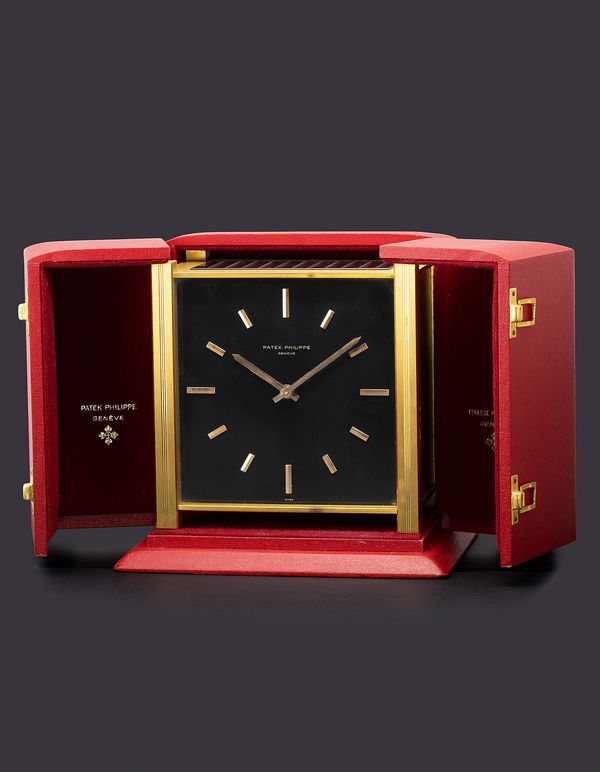
Lot 1046: A Circa 1967 Patek Philippe Square-Shaped Gilt-Brass Solar Clock Ref. 928 that's included in the Phillips Hong Kong Watch Auction: XXI. Estimate: HKD $60,000 - 120,000
This table clock, dating to circa 1967, embodies the spirit of Patek's period experimentation in a refined, Art Deco-inspired design. A large solar panel sits atop the gilt-brass case, powering the movement, while a secondary battery system serves as a backup. The dial is a deep, rich black that brings a strong visual contrast to the warm tone of the case.
Research indicates that only 31 examples of these solar clocks were made across nine variations. This clock is offered by the family of its original owner and comes with a Patek Philippe red presentation box. It was originally sold in the late 1960s by Guillermin & Mollet, a well-known Patek Philippe agent in Paris.
With its blend of technical ambition and elegant design, it is a distinctive object that would sit comfortably on a desk or in a living room, enhancing the space with both history and presence.
Lot 1088: A Circa 1925 Cartier Desk Clock in Gold, Enamel, Rubies, Diamond-Set Rock Crystal with Strut and Kingfisher Feather Dial
Estimate: HKD $160,000 - 320,000
Cartier’s clocks have always reflected the design vocabulary of their time, moving from the curves of the Belle Époque to the sharp geometry of Art Deco. The 1920s and 1930s were a high point, when new materials and Asian influences reshaped Cartier’s output, turning even small desk pieces into works of modern design.
This rock crystal desk clock, dating to circa 1925, is a lovely example that, at first glance, appears to be one of Cartier's many special creations with Maurice Coüet; however, it actually takes things much further by incorporating an exceptionally rare craft.
The dial is decorated in Tian-Tsui, a Chinese technique that uses the iridescent blue feathers of the kingfisher bird as inlay. For 2,000 years, Chinese artisans applied these feathers to screens, jewelry, and fine objects; the feathers were prized for their vivid, electric blue hue, which enamel could not replicate.
The work required extreme skill and precision, and Cartier was one of the few European houses capable of incorporating the technique at its Paris workshops.
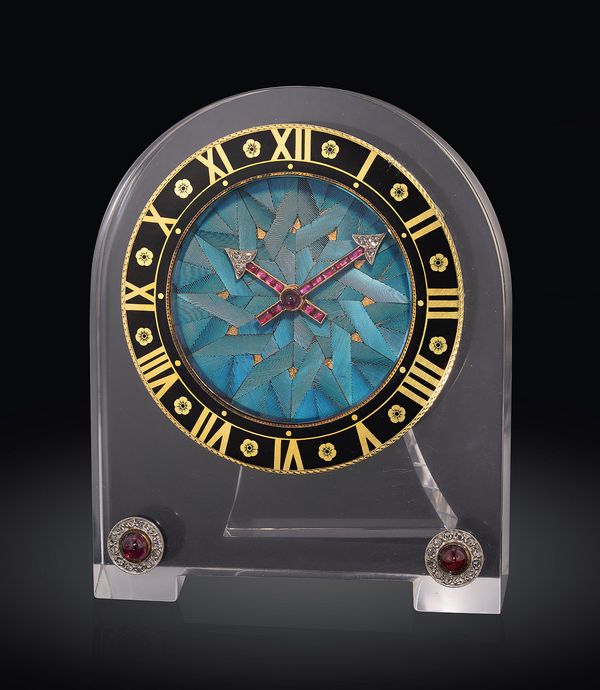
Lot 1088: A Circa 1925 Cartier Desk Clock in Gold, Enamel, Rubies, Diamond-Set Rock Crystal with Strut and Kingfisher Feather Dial that's included in the Phillips Hong Kong Watch Auction: XXI. Estimate: HKD $160,000 - 320,000
Here, the artist uses the natural linear pattern of the feathers to form a radiating star motif, accented with gold. Diamond-set arrow hands, also set with rubies for enhanced visibility, sit above a black enamel chapter ring with gold Roman numerals and floral details. The rock crystal support surround is shaped in a soft arch and anchored by ruby cabochons and rose-cut diamonds.
Having last appeared on the auction market 33 years ago, the clock remains beautifully preserved. The kingfisher feather dial, in particular, retains its rare and luminous appeal, making this an especially compelling example of Cartier’s early 20th-century craftsmanship.
Lot 1089: A Circa 1920 Cartier Desk Clock in Onyx, Yellow gold, and Diamonds with Guilloché Peach Enamel Dial
Estimate: HKD $80,000 - 160,000
The Art Deco years produced some of Cartier’s most distinctive clocks.
Many pieces from the 1920s and 1930s featured a square shape, often combining materials such as onyx, nephrite jade, enamel, and precious stones. The present example fits neatly into that tradition.
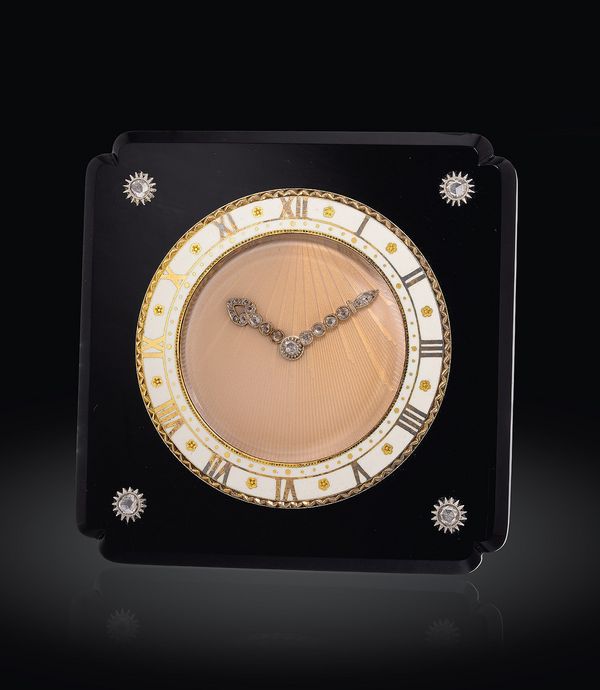
Lot 1089: A Circa 1920 Cartier Desk Clock in Onyx, Yellow gold, and Diamonds with Guilloché Peach Enamel Dial that's included in the Phillips Hong Kong Watch Auction: XXI. Estimate: HKD $80,000 - 160,000
The clock uses a square black onyx frame with chevron corners and rose-cut diamond sunburst accents. The enamel chapter ring features gold Roman numerals set against small gold floral motifs. The dial features pale peach guilloché enamel, providing a warm contrast to the deep black frame. The hands, set with rose-cut diamonds, add an elegant Art Deco touch. Although the piece is unsigned on the front and dial, every detail aligns with Cartier’s design language from the period.
Equipped with an eight-day movement and preserved in excellent condition for a clock more than 100 years old, it has a subtle presence that suits a fireplace mantel or an office desk.
Lot 1120: A 1965 Possibly Unique Patek Philippe 'Bridge Cards' Solar Dome Clock Ref. 725 in Gilt-Brass and Leather
Estimate: HKD $500,000 - 1,000,000
Patek Philippe first introduced its famous Dome Clock in the 1950s, and it quickly became one of the firm's most recognizable creations.
Early examples used a cylindrical body topped with a rounded dome and were powered by a mechanical movement fed by a solar panel. Light entered through the panel and charged an internal storage unit, which then wound the manual calibre 17’250.
It was an elegant fusion of traditional watchmaking and forward-looking technology.
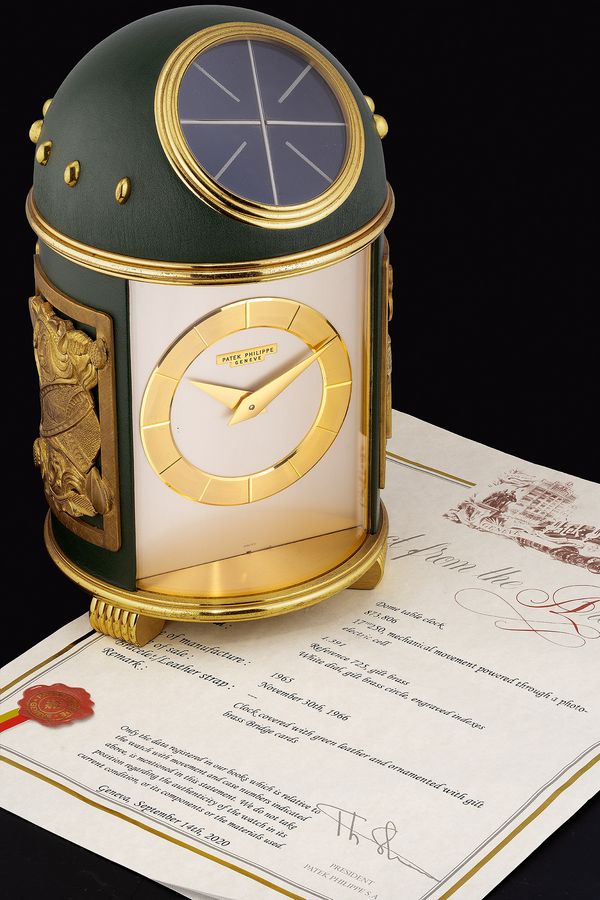
Lot 1120: A 1965 Possibly Unique Patek Philippe 'Bridge Cards' Solar Dome Clock Ref. 725 in Gilt-Brass and Leather that's included in the Phillips Hong Kong Watch Auction: XXI. Estimate: HKD $500,000 - 1,000,000
That innovation originated from Patek Philippe’s Electronic Division, which was founded in 1948 to explore photoelectric, electronic, and even nuclear timekeeping. The division produced the very first solar-powered clocks and secured a Swiss patent for photoelectric cell technology. The concept relied on a rechargeable accumulator that stored energy and assisted in winding the mainspring. Once the system reached full tension, the cells diverted their effort to charging the accumulator, creating a light-powered cycle that feed the movement.
This gilt-brass dome clock, dating from 1965, is an especially rare example. Instead of cloisonné enamel, the exterior is finished in green leather, a detail confirmed by the Extract from the Archives. The decoration follows a bridge card game theme, with each of the four panels representing one of the four suits: hearts, diamonds, spades, and clubs. Vintage leather-finished dome clocks, such as the present example, are among the scarcest dome-clock variants ever produced by Patek Philippe, with only a small number having resurfaced publicly.
Lot 1009: A Circa 1810 Possibly Unique Georges Rémond & Compagnie Singing-Bird Box in Gold with Miniature Enamel, Engine-Turned Panels, Centre Seconds Watch, and Musical Mechanism
Estimate: HKD $400,000 - 800,000
Singing-bird boxes first appeared around 1750 and quickly became prized objects of entertainment and status.
These small automata relied on a wind-up mechanism that channelled air through bellows to animate a tiny bird, which would rise, turn, flap its wings, wag its tail, and sing. Whether housed in a birdcage or a small decorative box, the principle was the same: a blend of mechanics, artistry, and theatre.
Jean Georges Rémond, born in Germany in 1752 and established in Geneva by 1783, became one of the leading makers of luxurious singing-bird boxes, jewelry, clocks, and automata.
His firm, Jean Georges Rémond & Company, ranked alongside the best-known workshops in Europe, including Rochat Frères, Frédéric Leschot, and Jaquet Droz.
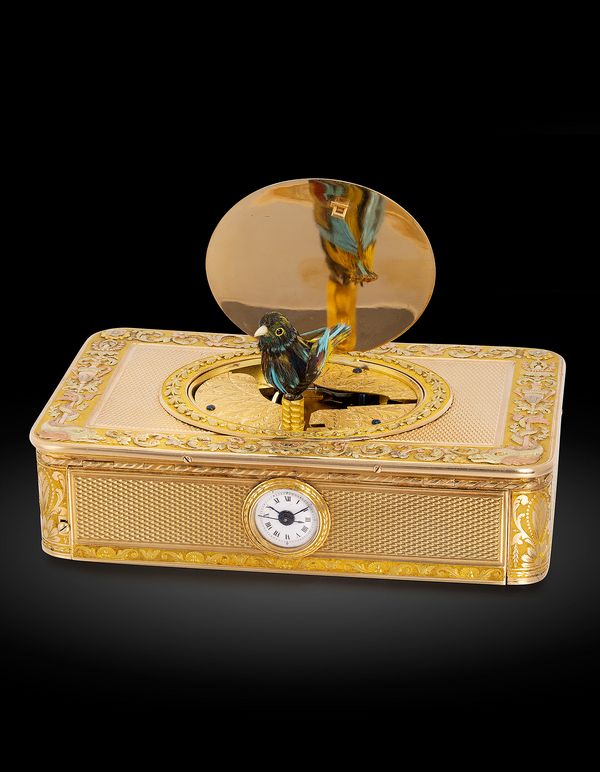
Lot 1009: A Circa 1810 Possibly Unique Georges Rémond & Compagnie Singing-Bird Box in Gold with Miniature Enamel, Engine-Turned Panels, Centre Seconds Watch, and Musical Mechanism that's included in the Phillips Hong Kong Watch Auction: XXI. Estimate: HKD $400,000 - 800,000
The present singing-bird box demonstrates the level of craftsmanship that made his work so sought after. The pink-gold panels are engine-turned, with the top panel engraved in contrasting shades of gold, creating depth through a mixture of engraved patterns and decorations. The sides feature chased and engraved floral decoration, all crisp and consistent.
At the center of the cover lid sits a beautifully preserved enamel miniature painting attributed to Jean Abraham Lissignol, known for his figure painting and for decorating snuff boxes and watch cases for Rémond. The scene shows a young nobleman bidding farewell to a woman who appears to be his sibling. The detail and color remain vivid, framed by raised floral work on the yellow bezel.
The front-facing panel contains a watch with a white enamel dial, Roman numerals, and a sweeping seconds hand. This panel is hinged, and upon opening, it reveals the winding arbors for the watch, the bird, and the musical movement. Another hinged panel on the side houses the winding key.
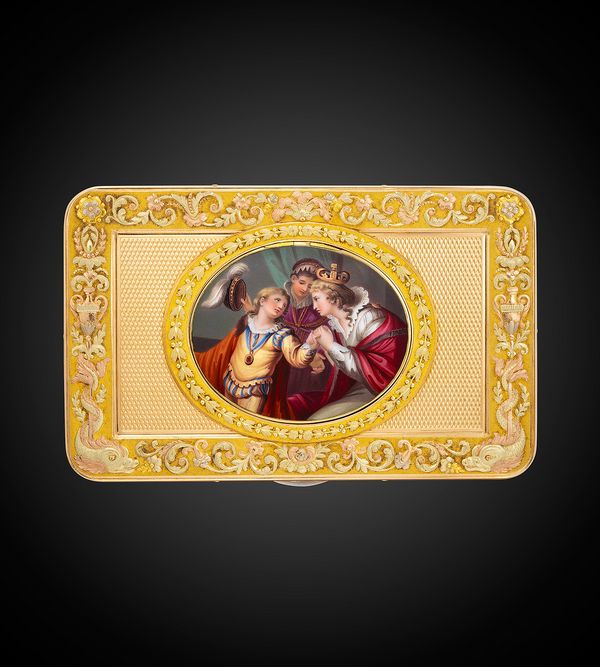
Lot 1009: A Circa 1810 Possibly Unique Georges Rémond & Compagnie Singing-Bird Box in Gold with Miniature Enamel, Engine-Turned Panels, Centre Seconds Watch, and Musical Mechanism that's included in the Phillips Hong Kong Watch Auction: XXI. Estimate: HKD $400,000 - 800,000
Once the musical movement is wound, a slide on the back opens the top-center aperture and raises up the singing bird.
The bird turns, flaps, swivels, and sings with striking realism before disappearing again when the power runs down. This movement is attributed to Frères Rochat, a trio of brothers who perfected many of the most naturalistic singing-bird mechanisms made in Geneva between 1800 and 1835. Their designs improved motion through complex cam arrangements and strengthened the sound through piston-rod refinements.
The mechanism here includes a gilt-brass fusée-and-chain, polished steel levers, blued screws, eight cams, and circular bellows. The musical system utilizes a pin barrel with two banks of eight tuned teeth, whereas the watch movement employs a going barrel and cylinder escapement.
The box is remarkably well-preserved and carries notable provenance. It belonged to Caroline, Lady Clonbrock, granddaughter of the fourth Duke of Marlborough, and was a gift from her uncle, the fifth Duke. It remained in the family until its first appearance at auction in 1993 and has not been altered since.
Rémond’s casemaker’s mark is still clear inside the case and within the key compartment. The piece also retains its original red leather presentation box and key.
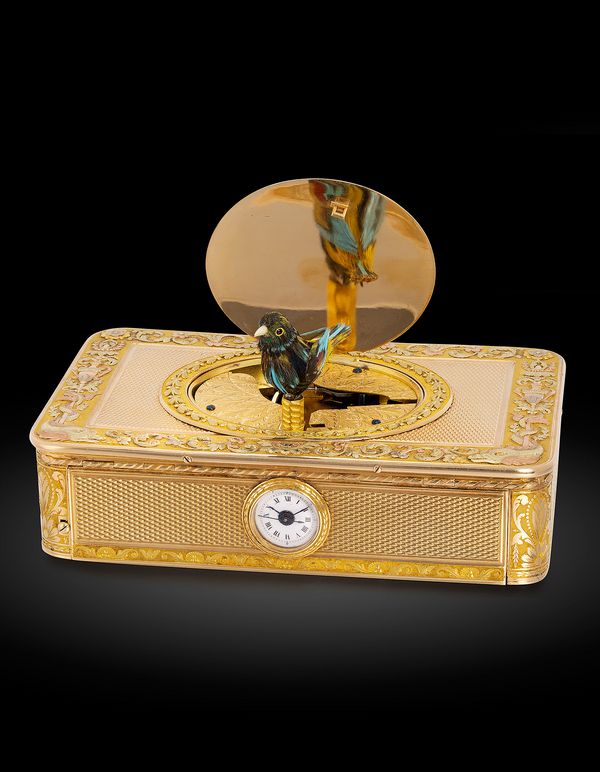
Lot 1009: A Circa 1810 Possibly Unique Georges Rémond & Compagnie Singing-Bird Box in Gold with Miniature Enamel, Engine-Turned Panels, Centre Seconds Watch, and Musical Mechanism that's included in the Phillips Hong Kong Watch Auction: XXI. Estimate: HKD $400,000 - 800,000
Singing-bird boxes by Rémond can be found in the Imperial Palace in Beijing and in major museums, including the Patek Philippe Museum in Geneva.
This is a top-tier, museum-quality singing-bird box – and one of the finest preserved examples of its kind.
Lot 1010: A Circa 1825 Frères Rochat 'The Duke of Sussex' Singing Bird Cage Clock
Estimate: HKD $480,000 - 960,000
This magnificent singing birdcage once belonged to His Royal Highness Augustus Frederick, Duke of Sussex, the sixth son of King George III.
Sold at auction on 4 July 1843, for 41 guineas – roughly two years of wages for an average British laborer at the time – it ranked as the fourth most expensive item among 137 lots from the Duke’s renowned clock and watch collection.
His holdings included major works by Joseph Knibb, Thomas Tompion, John Arnold, Thomas Mudge, and Breguet. Royal provenance is confirmed by the filigree panels engraved with the Royal Garter motto “Honi Soit Qui Mal Y Pense,” crowned and centered with the Duke’s monogram: “AF.”
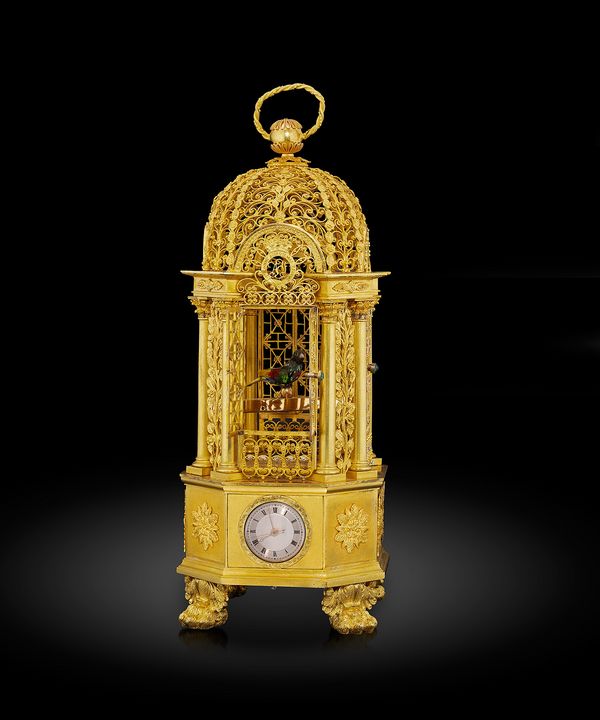
Lot 1010: A Circa 1825 Frères Rochat 'The Duke of Sussex' Singing Bird Cage Clock that's included in the Phillips Hong Kong Watch Auction: XXI. Estimate: HKD $480,000 - 960,000
Singing birdcages were among the most enchanting mechanical objects of the early 19th century.
These automata paired decorative craft with complex clockwork, animating a small bird that sang, turned, flapped its wings, and moved with surprising realism. Produced during a period of intense fascination with nature and technology, they served both as curiosities and as markers of luxury.
This example was made with exceptional care. The filigree case mimics the form of a small temple or cage, topped with a rope twist handle and supported by four pairs of Corinthian columns. Arches frame filigree panels around the dome. The front and rear doors, along with the octagonal base, are finished with matte panels and foliate mounts in mixed gilding.
Behind the hinged front cover lies the clock dial, a silvered chapter ring featuring Roman numerals, an engine-turned center, and gold hour and minute hands, accompanied by a sweeping seconds hand. Winding squares for the going and striking trains sit above, with hand-setting and regulation squares tucked to the right.
The movement uses a cylinder escapement with two going barrels. The quarter-strike sounds on a single gong, while the bird mechanism is powered by a fusée-and-chain with circular bellows. A lever on the left side enables the bird to either sing or remain silent on the hour, while a lever on the right makes the bird sing on demand.
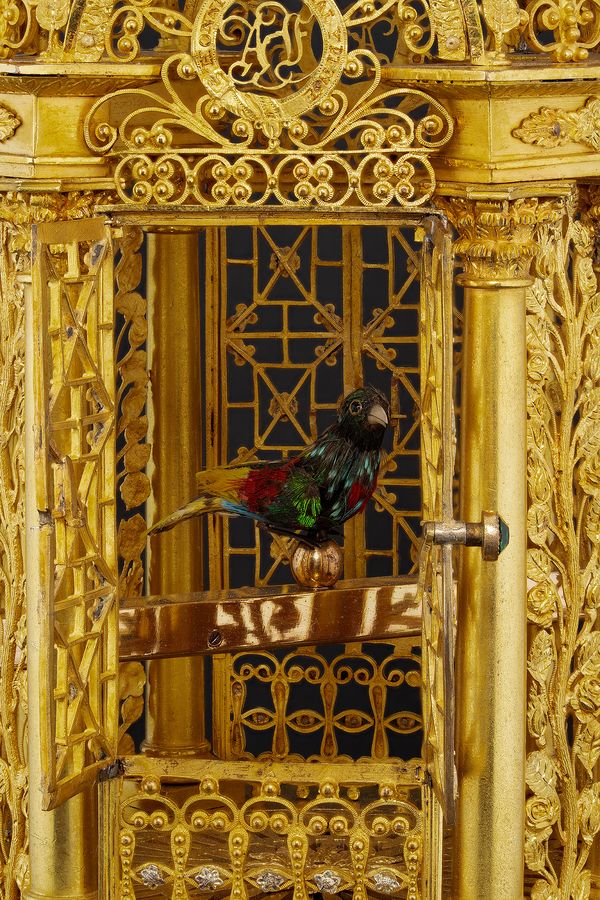
Lot 1010: A Circa 1825 Frères Rochat 'The Duke of Sussex' Singing Bird Cage Clock that's included in the Phillips Hong Kong Watch Auction: XXI. Estimate: HKD $480,000 - 960,000
When activated, the doors open to reveal a brightly colored bird that sings four melodies and moves in five coordinated ways: tail flicks, wing beats, beak opening, head rotation, and a gentle side-to-side motion. It is one of the most animated bird examples seen in singing-bird cages of this type.
The maker’s punch “FR” identifies the workshops of Frères Rochat – François Elisée, Frédérick, and Samuel Henri – who trained in Le Brassus and became leading specialists in singing-bird mechanisms. They supplied movements to major automata makers, including Jaquet Droz and Leschot.
A second punch mark appears on the movement, but its exact origin remains uncertain. The letter “M” may correspond to the Swiss watchmaker Milleret, who is listed in an 1843 sale catalogue as having produced several of the Duke’s timepieces.
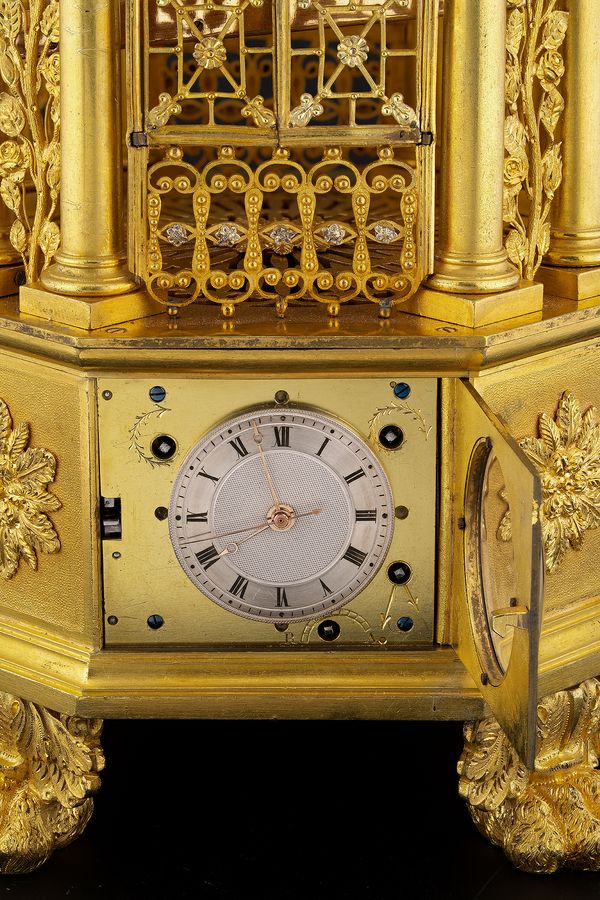
Lot 1010: A Circa 1825 Frères Rochat 'The Duke of Sussex' Singing Bird Cage Clock that's included in the Phillips Hong Kong Watch Auction: XXI. Estimate: HKD $480,000 - 960,000
The cage remains in exceptional condition. The engravings are sharp, the bird’s colors are bright, and the mechanism performs cleanly and audibly.
It last appeared at an international auction in 2000 and has remained untouched ever since. With its royal provenance, outstanding preservation, and superb automaton work, this is an extremely rare opportunity to acquire a masterful early 19th-century mechanical singing-bird cage clock.
Lot 1094: A Pair of Circa 1780 Watts Gilt Metal Glass Scent Flask with Watches, Fusée-and-Chain Verge Movements, Paste-Set Hinged Bezels, and Enamel Paintings
Estimate: HKD $80,000 - 160,000
In the second half of the 18th century, Switzerland entered a period of strong economic and artistic growth.
Geneva emerged as a center for luxury watchmaking and enamel decorative arts, producing imaginative, often picturesque pieces that blended ornament with function. Clients could choose from an almost endless array of decorative accessories fitted with watch movements: cane knobs, lorgnettes, snuff boxes, seals, scent bottles, and much more.
These objects reflected the technical sophistication of the workshops of the time and a taste for refinement shaped by the Enlightenment.
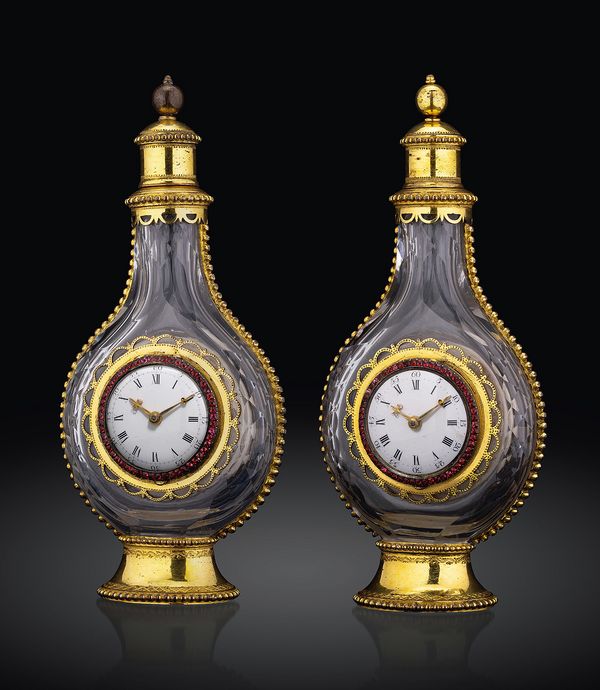
Lot 1094: A Pair of Circa 1780 Watts Gilt Metal Glass Scent Flask with Watches, Fusée-and-Chain Verge Movements, Paste-Set Hinged Bezels, and Enamel Paintings that's included in the Phillips Hong Kong Watch Auction: XXI. Estimate: HKD $80,000 - 160,000
The same atmosphere extended to Georgian England, where London watch- and clock-makers responded to the demand for fashionable, multi-purpose objects.
This pair of gilt-metal and faceted-glass scent-flask watches is a well-preserved example of that trend. Each piece uses a dimensional repoussé base decorated with floral and scroll motifs, gilt-metal beading around the bezel, and threaded screw caps. The glass bodies have a deep, rich shine, and both watches feature paste-set bezels imitating rubies. Paste work – carefully cut and polished artificial stones set in metal – was widely used in Georgian jewelry and first appeared at the French court in the early 18th century.
The reverse of each flask carries a painted miniature enamel scene of a young woman with two children gathering fruit in a pastoral landscape. The compositions mirror each other, suggesting the pair was conceived together. The figures are rendered with soft colors and meticulous attention to detail in expression and clothing. The bucolic setting evokes the romantic rural themes favored by François Boucher and Jean-Honoré Fragonard, whose paintings helped shape the Rococo style that was embraced by the European aristocracy in the late 18th century.
Behind the hinged enamel backs are the winding holes for the movements. Each flask contains a chain-and-fuseé verge escapement in gilt-brass, a mechanism designed to provide constant torque. The white enamel dials are simple by comparison, with Roman numerals for the hours, Arabic numerals for the minutes, and gilt beetle-and-poker hands.
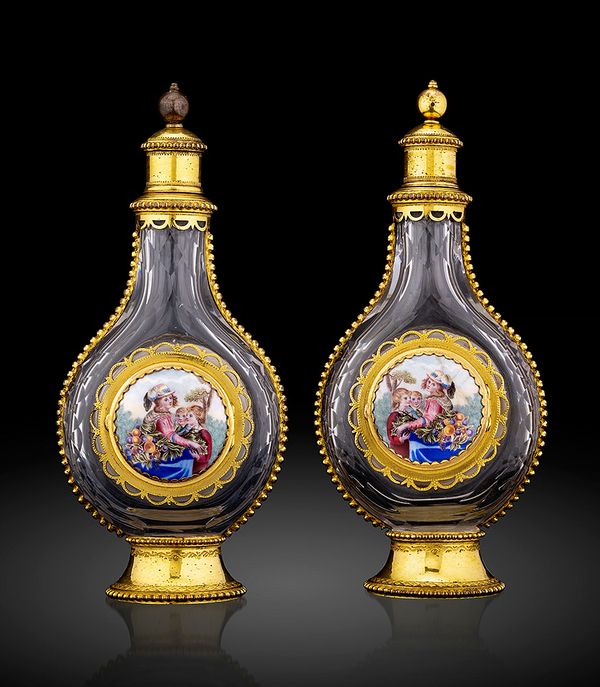
Lot 1094: A Pair of Circa 1780 Watts Gilt Metal Glass Scent Flask with Watches, Fusée-and-Chain Verge Movements, Paste-Set Hinged Bezels, and Enamel Paintings that's included in the Phillips Hong Kong Watch Auction: XXI. Estimate: HKD $80,000 - 160,000
These flasks served as both functional perfume/scent containers and luxury accessories that signaled taste and social standing.
Their mix of miniature enamel painting, gilt metalwork, faceted glass, and mechanical watchmaking captures the elegance and ingenuity of 18th-century craft.
You can view the complete Phillips Hong Kong Watch Auction: XXI auction catalogue here.