文章 | Stillness And Movement In The Art Of Magdalene Odundo Design Auction London November 2026
Stillness and Movement in the Art of Magdalene Odundo
Isabella Smith, author of 'Lucie Rie' (2022), explores the artist's remarkable practice.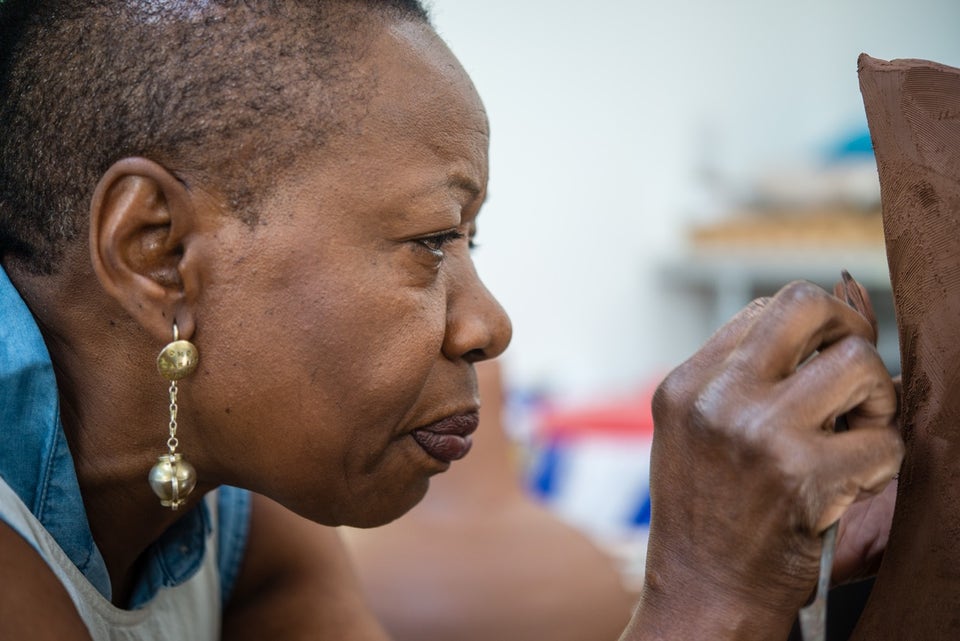
Magdalene Odundo at work in a process that she describes as ‘a rhythmic dance around the pot.’ Image: © Ben Boswell 2016. Artwork: © Magdalene Odundo
‘The human body is a vessel that contains ourselves, our being human.’
—Magdalene Odundo
In 1974, Magdalene Odundo travelled from England, where she was studying ceramics, to the Nigerian city of Suleja. She was there to spend the summer learning from the renowned Ladi Kwali and the other potters of the Abuja Pottery Training Centre. Here she witnessed the Gbari handbuilding method in action. This was mostly practiced by women potters, who — rather than using a potter’s wheel — pinched a ball of clay into a bowl-like form, then added and smoothed coils of clay onto it, building upwards to create a spherical waterpot. As the women worked, they would rotate the vessel while walking backwards around it. Not sharing a common language, Odundo learnt through watching, studying the movements she would later describe as ‘a rhythmic dance around the pot.’i
It was to be a formative experience in more ways than one. After the summer ended, the Kenyan-born student returned to England and began making pots inspired by the technique and forms she had witnessed. But as her work developed during the late 1970s and into the 1980s, those distinctive movements she had seen — that rhythmic gesture of hand building while walking backwards — played into other interests she had developed. Odundo was still learning through looking, absorbing art and objects from a vast array of cultures: from ancient Greek, Roman and Egyptian pots, to 20th century burnished blackware from the San Ildefonso Pueblo in New Mexico, to the modernist sculpture of Henry Moore and Barbara Hepworth, and more.
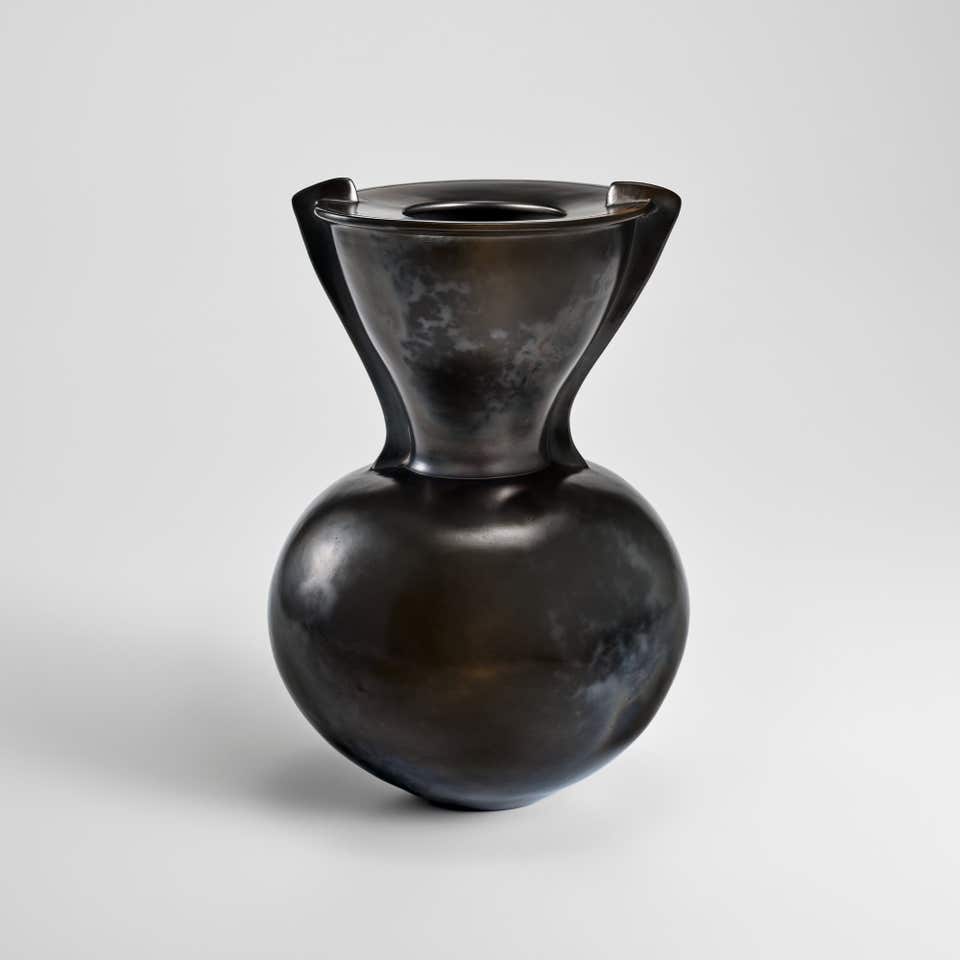
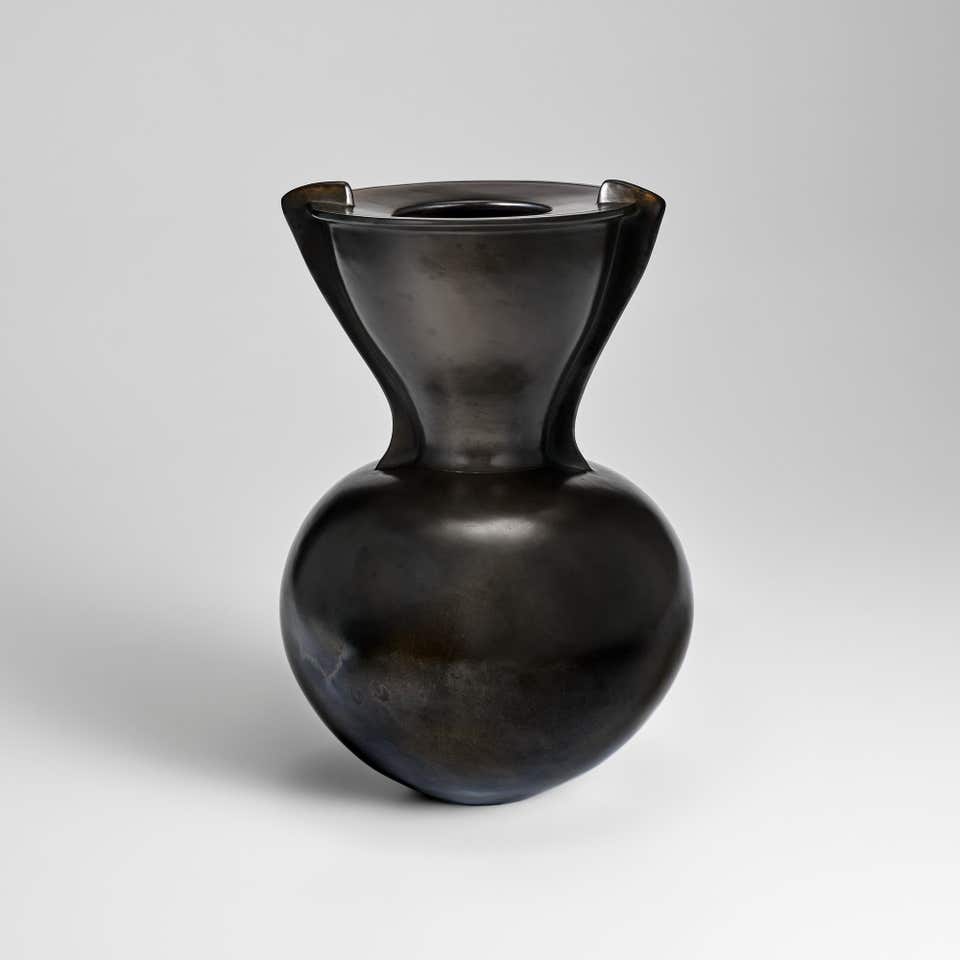
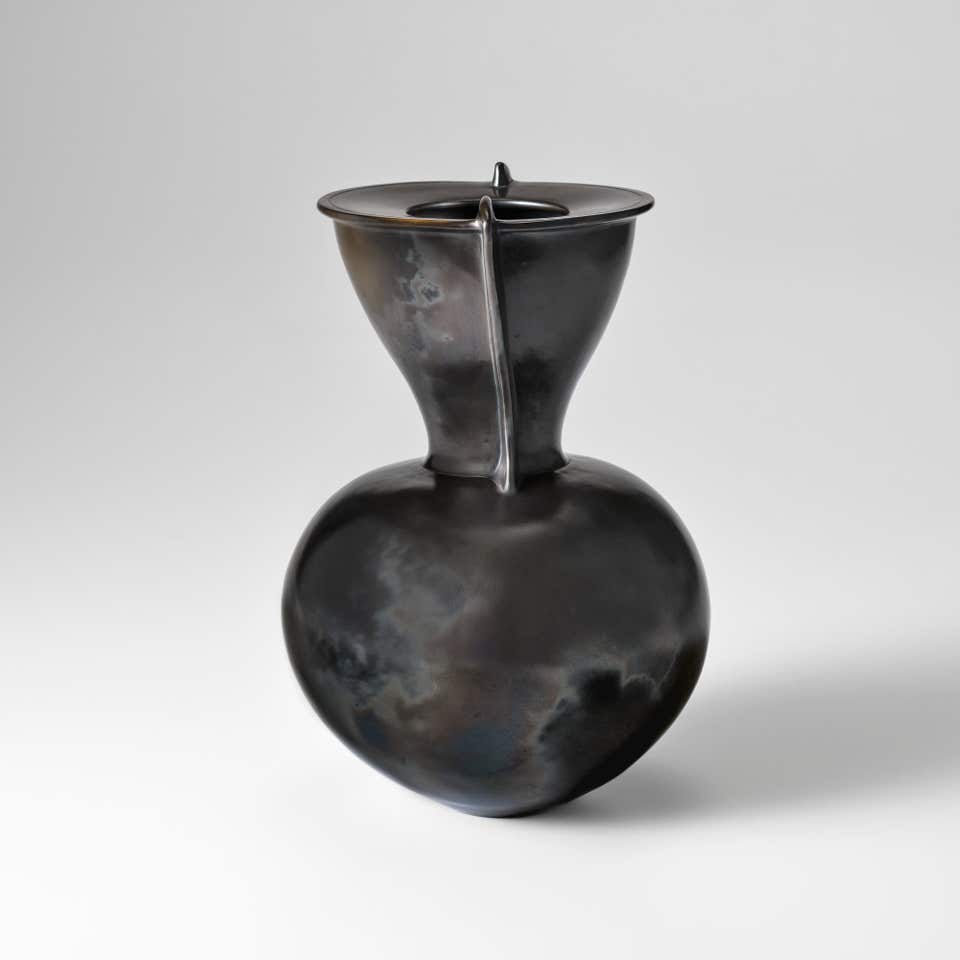
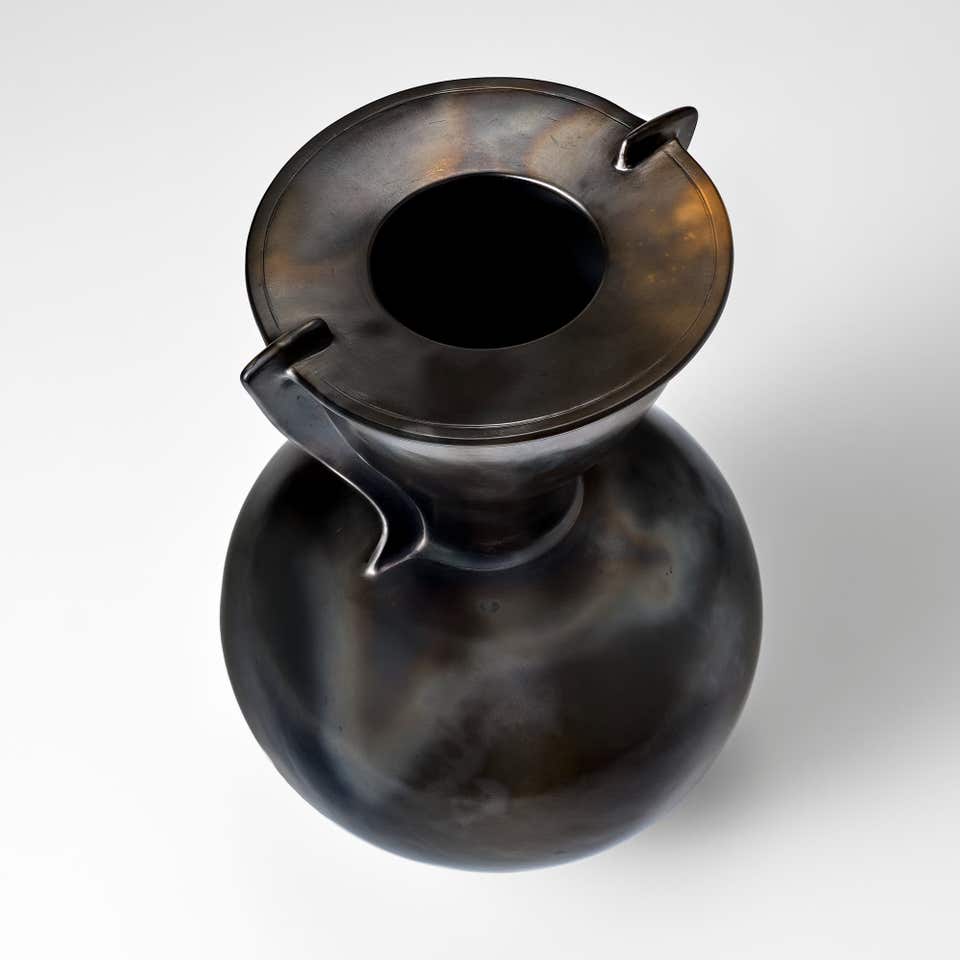
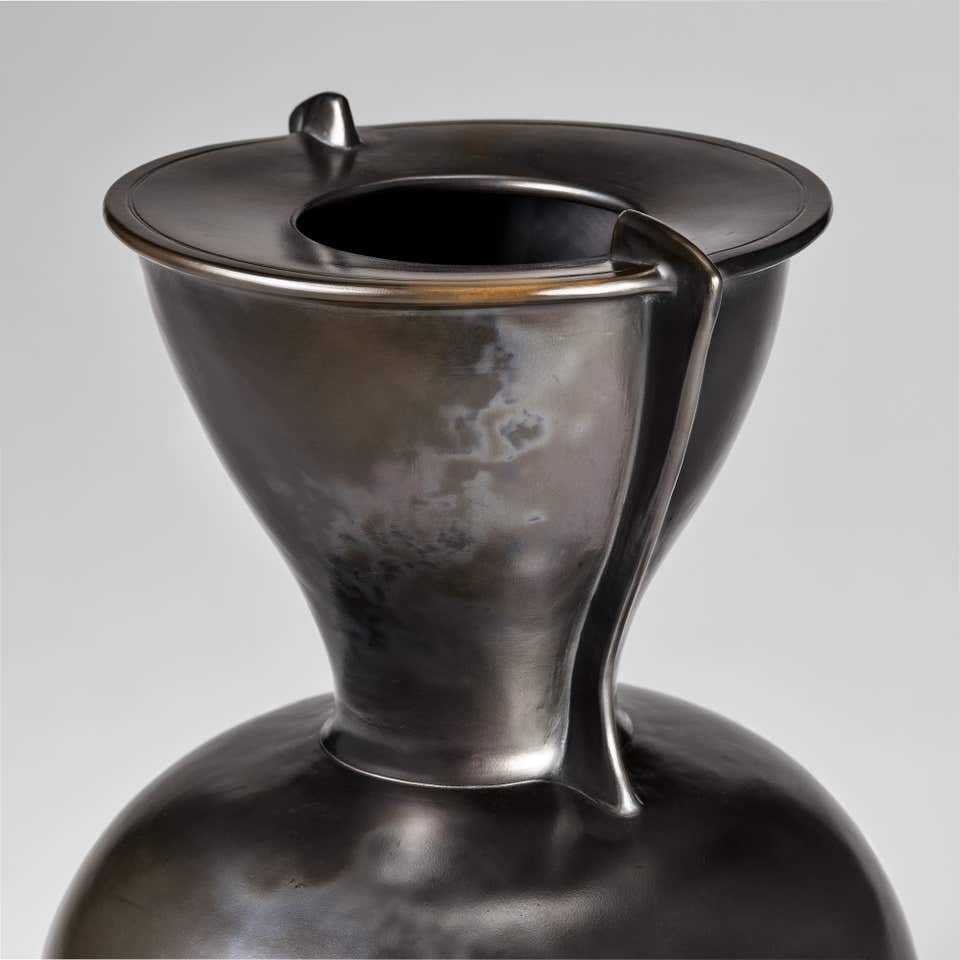
In the late 1970s, while working as an educator at The Commonwealth Institute in London, she was struck by one aspect of its art collection. These were 16th century portraits of English women whose bodies were encased by rigid corsets — their enclosed waists the inverted point of a triangle, tiny below extravagant ruffs and collars. To Odundo, these Elizabethan women appeared like vessels. A decade later, she began making pieces that would echo these exaggerated silhouettes.
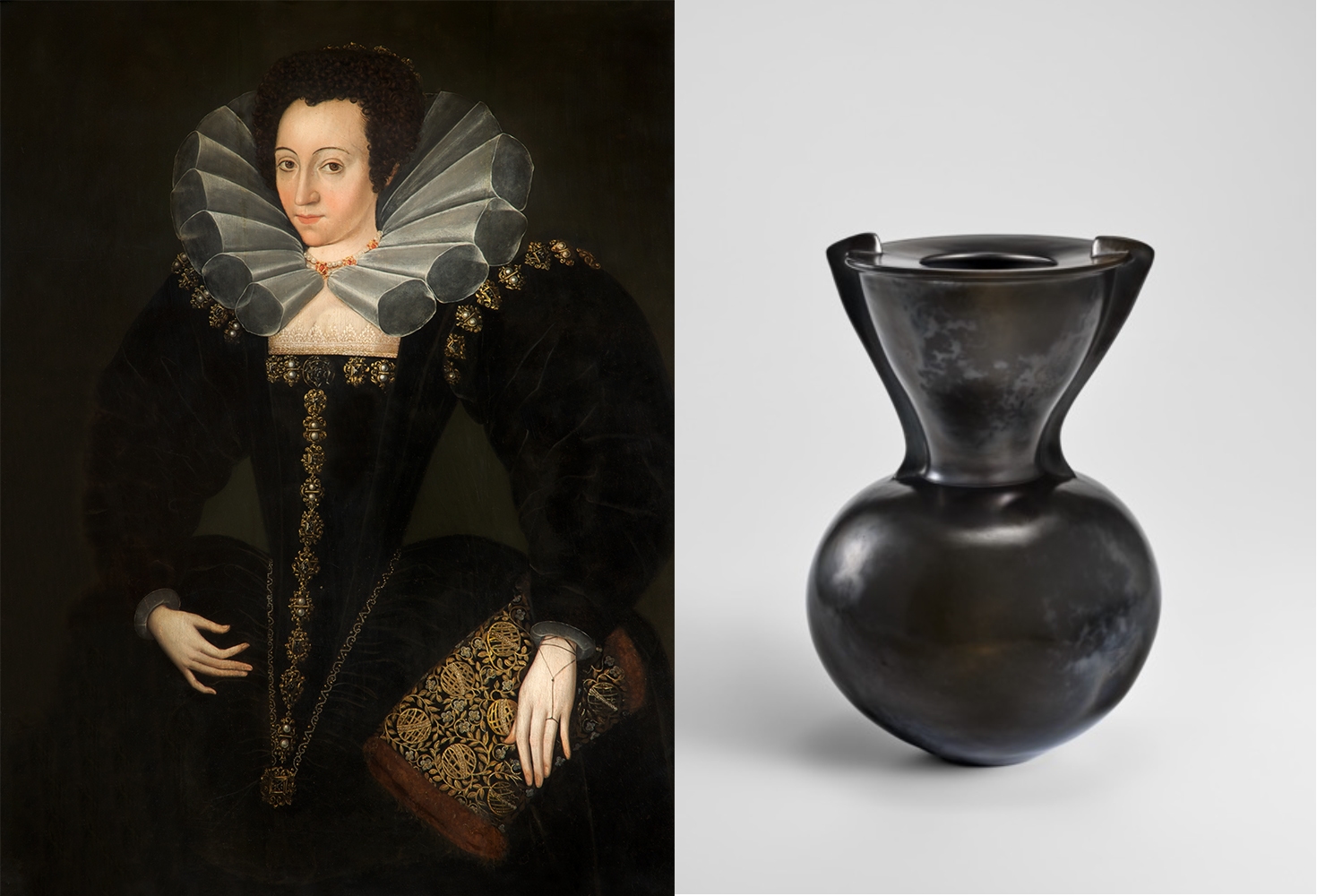
A 16th century portrait of an English woman titled Portrait of a Lady in Court Dress, whose ‘wasp waist’ served as one of the inspirations for the present vessel by Odundo. Image: Salford Museum & Art Gallery
This untitled vessel from 1987 is one such work. Its lower body is round, a faint echo perhaps of her earlier fascination with Gbari waterpots. Its middle is narrow, as narrow as what the Victorians called a ‘wasp waist’. Above, it gently widens outwards before meeting a flat rim that semi-encloses its mouth. Winged lobes on either side flare out like sleeves or arms held against the body.
Much has been made of the anthropomorphic language we use to describe vessels: we speak of their foot, body, bellies; their shoulders, neck, mouth, lip. For Odundo, the discussion of such language is unusually apt. The body-like nature of her pots is clear; some have necks that curve like some strange creature’s; others have bumps that suggest nipples, or the vertebrae of a spine; others still have swollen bellies that recall pregnancy. Most prevalent of all is the narrow waist that suggests that of a woman. They often convey a sense of mood or characters. Some appear sensual, others ferocious, as if rearing back to strike; others suggest a jaw jutted stubbornly forward. Some, like this untitled vessel, seem at rest, if perhaps a touch formal.
In an interview between Odundo and Ben Okri, the poet commented: ‘Your work is still.’ Odundo replied: ‘Yes, but they are just on tip toe and have momentarily stopped. They are staying still for just that moment. If you turn them or walk to the other side, they will continue dancing for you. I hope it is like watching a dancer do a pirouette. That moment of rest and of taking a breath is the stance I am trying to capture.’ii The 1987 vessel speaks of a woman’s body that is poised, upright, self-contained.
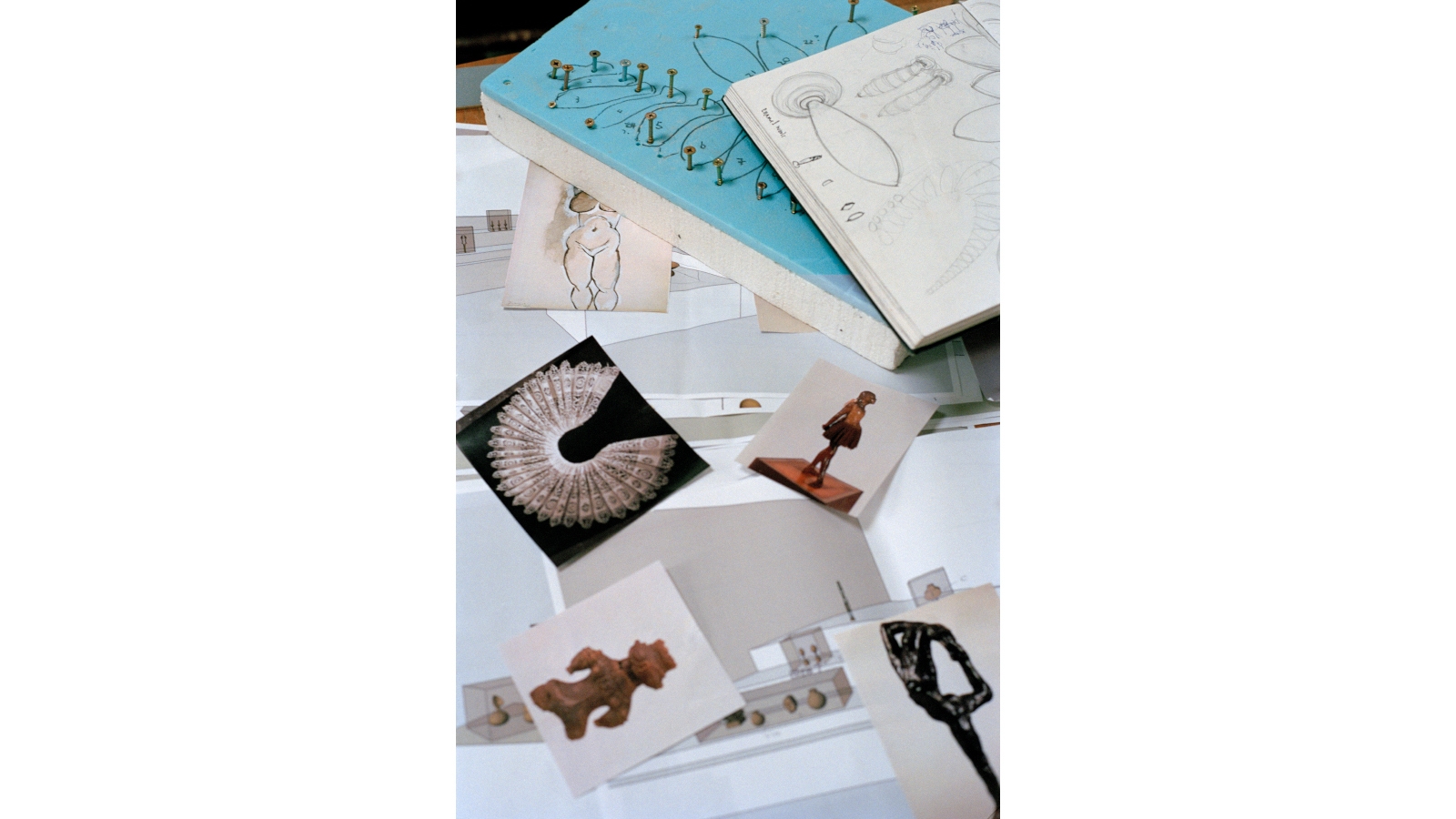
Odundo conducting research for her exhibition Magdalene Odundo: The Journey of Things at the Hepworth Wakefield. Image: © Sophie Green. Artwork: © Magdalene Odundo
In 2019, the Hepworth Wakefield held a landmark exhibition titled Magdalene Odundo: The Journey of Things. Here the potter was invited to share the incredible diversity of interests and influences that have inspired her across her five-decade career. Among the exhibits was Portrait of a Lady in Court Dress (c.1590), an English oil painting by an unknown artist, and a pair of iron stays — frighteningly rigid corsets intended to correct improper posture – from roughly the same time and place. Nearby was Edgar Degas’ Little Dancer Aged Fourteen (1880–81), his sculpture of a young student the French artist observed at the Paris Opera Ballet dance school; Degas famously loved to draw dancers. Her bronze figure is encased in a light corset, a skirt of real fabric adding balance to her silhouette. Nearby, another of Odundo’s vessels from 1987 — this one in a bright orange terracotta — was the sibling of Phillips’ example, only a little more exaggerated in its narrow waist and flared shoulders. The connection to the female form was clear.
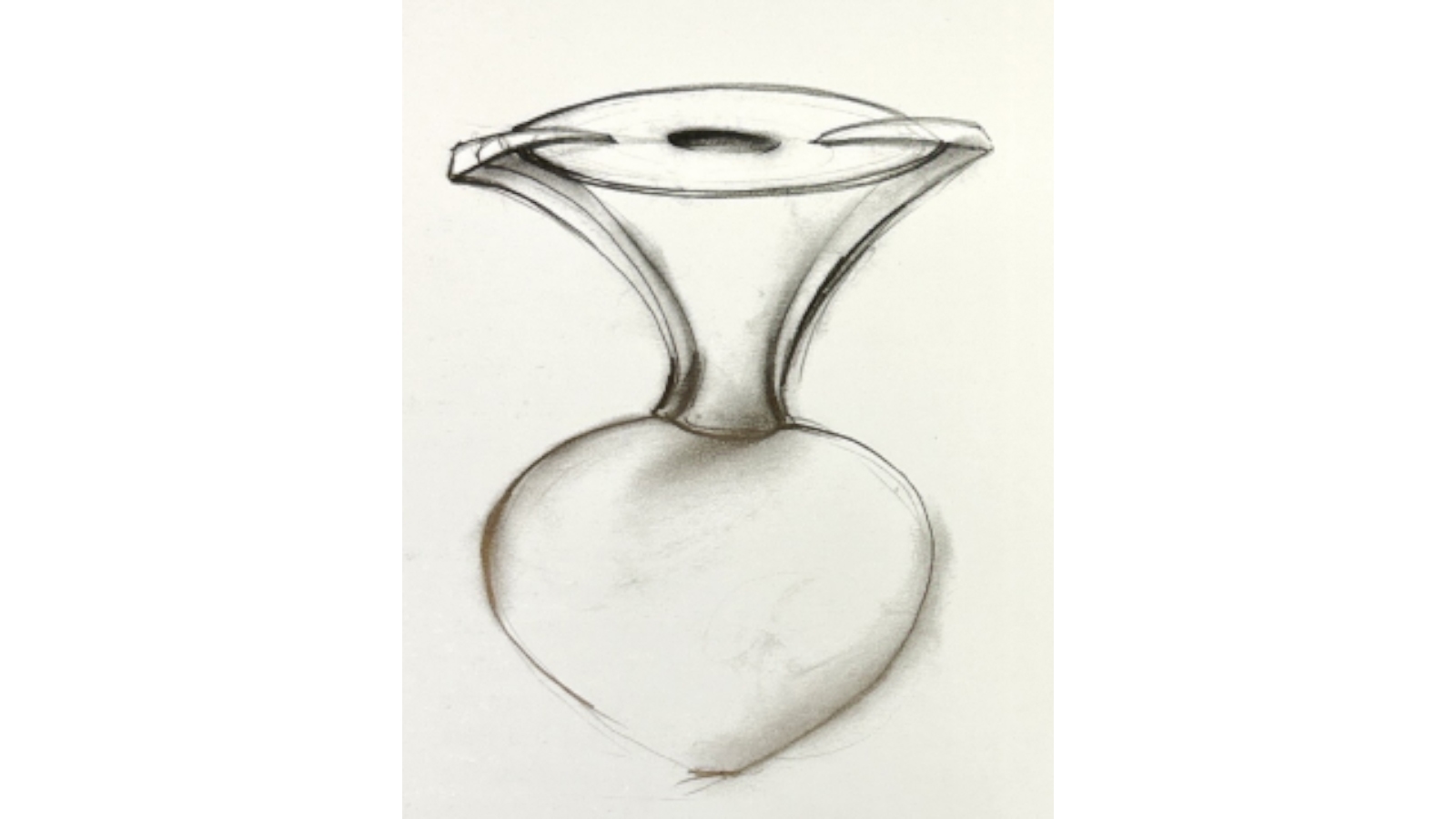
Odundo’s sketch of the present ‘Untitled’ vessel. Artwork: © Magdalene Odundo.
As an MA student in the early 1980s, she had often attended rehearsals at the Royal Ballet School, where she, like Degas, sketched dancers. Drawing remains important to Odundo, who sketches both ideas for pots and, through life drawing sessions, the human body. She has said that such drawing underpins her work in clay — that observing how people hold themselves, how their bodies move, how they appear in repose — ‘gives humanity to the work’.iii Life drawing remains central to how ideas for vessels evolve. In Odundo’s work above all others, the two arts combine. ‘The human body is a vessel that contains ourselves, our being human,’ Odundo has said. ‘As artists and makers of things, when we are sculpting, modelling or forming figures or containers, we are echoing the vessel that is us as human containers of mind and body.’iv
i Magdalene Odundo, ‘Pots with Structure and Purpose: A Chance Encounter, a Potter by Chance’ in Ceramic Art (Princeton and Edinburgh: Princeton University Press, 2023
ii ‘Roots and Resonances’, Magdalene Odundo and Ben Okri, Magdalene Odundo: The Journey of Things, exh. cat., Hepworth Wakefield, 2019
iii Magdalene Odundo, quoted in Ashley Thorpe, ‘Intimate Humanity’, Ceramic Review, Nov/Dec 2011
iv Untitled essay, Andrew Bonacina, Magdalene Odundo: The Journey of Things, exh. cat., Hepworth Wakefield, 201