文章 | November 2026 Specialist Picks Design London Auction
Specialist Picks: Design London
The London team returns with all their favorites from the upcoming sale.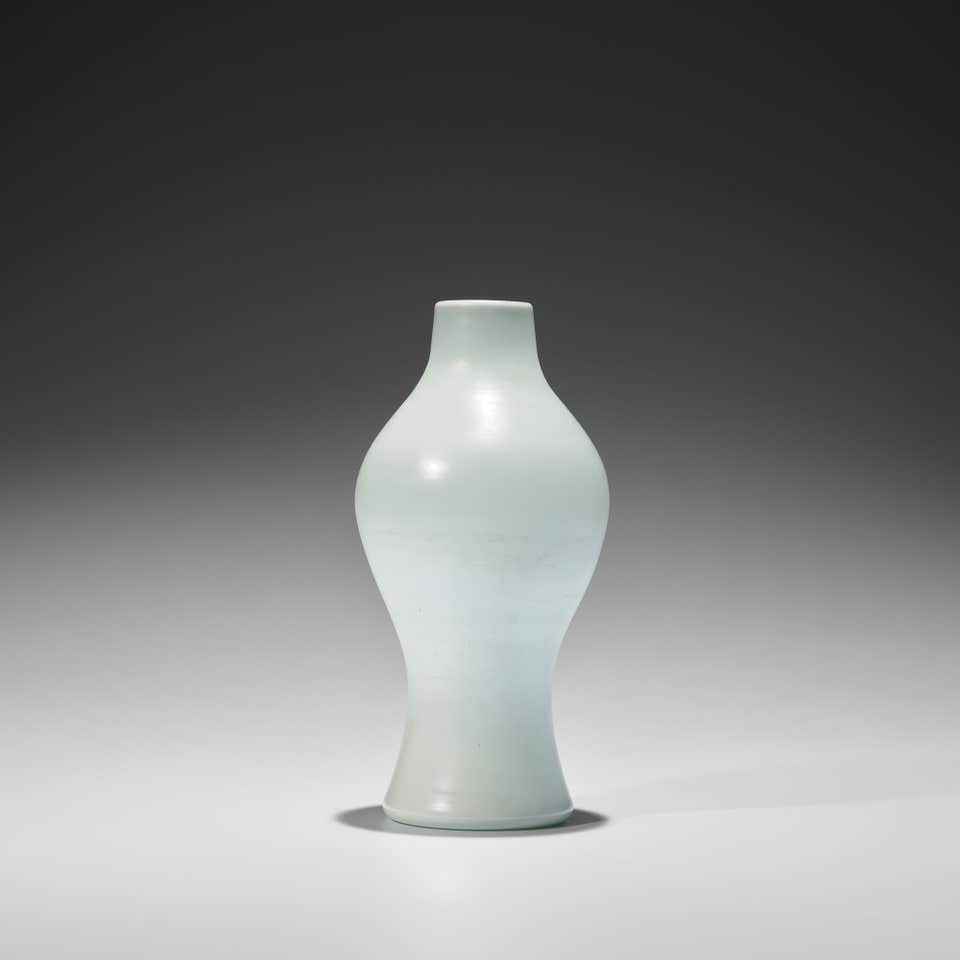
CARLO SCARPA, Rare vase, 1936. Design, London.
Carlo Scarpa
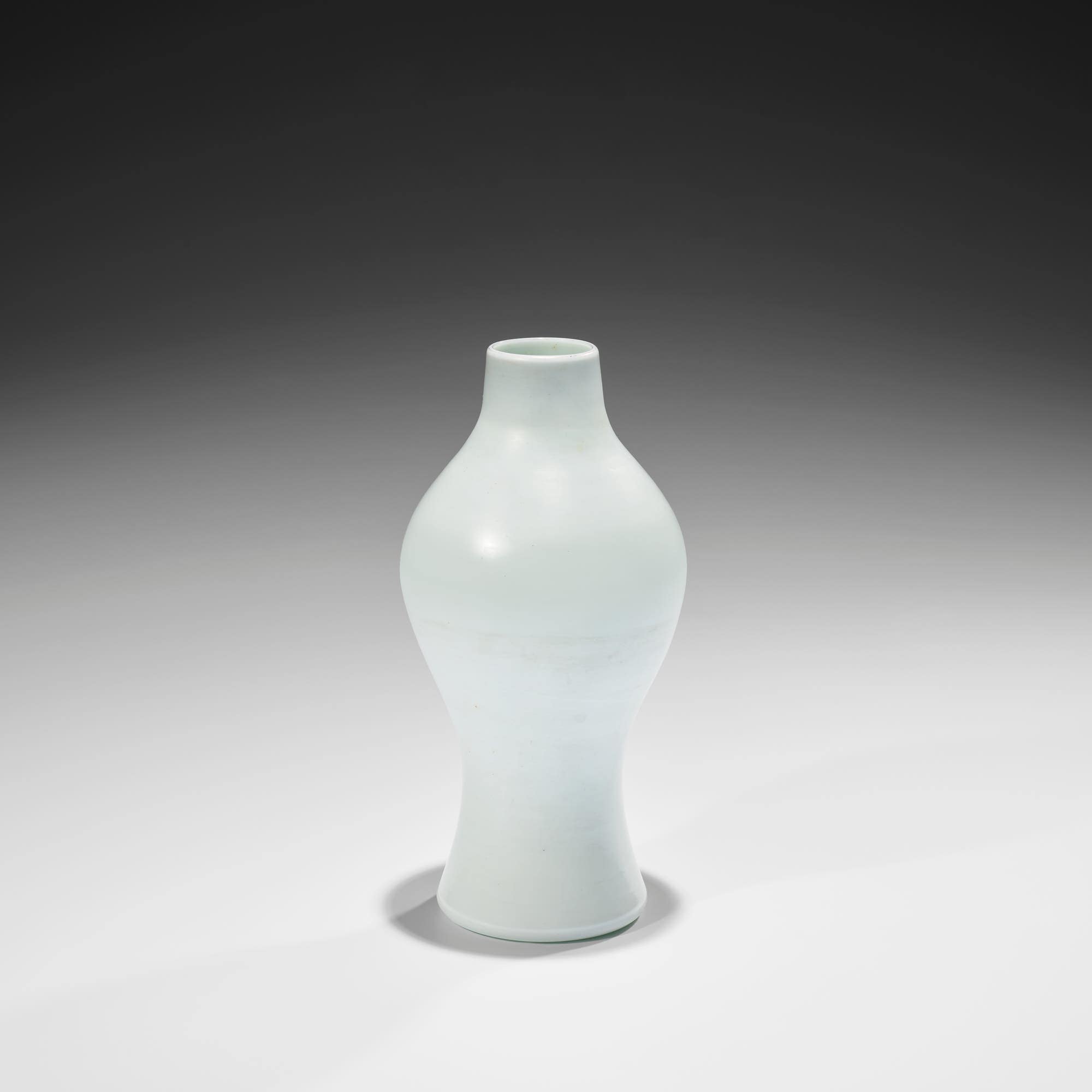
CARLO SCARPA, Rare vase, 1936. Design, London.
Domenico Raimondo, Deputy Chairman, Europe and Senior International Specialist, Design
This vase captures my attention through the singular harmony of its form, colour, and unusual materiality. In its apparent simplicity lies an object of remarkable sophistication and elegance, profoundly Scarpian in its essence.
Its highly iridescent surface lends the object an extraordinary depth, evoking the delicate, opalescent lustre of mother-of-pearl. Light interacts with the surface to produce a subtle and ever-changing play of reflections, revealing nuances of colour that seem almost immaterial and evanescent. The result is breathtaking: a form that feels less defined than suggested, as though its contours are the firm yet quiet expression of an idea rather than the assertion of a solid volume.
Its colour, too, is elusive. It emerges not as a singular, fixed hue, but as a delicate phenomenon of light, refracted and dispersed into the faintest gradations of colour. These nuances appear almost as whispers, barely perceptible yet profoundly affecting.
GEORGE NAKASHIMA
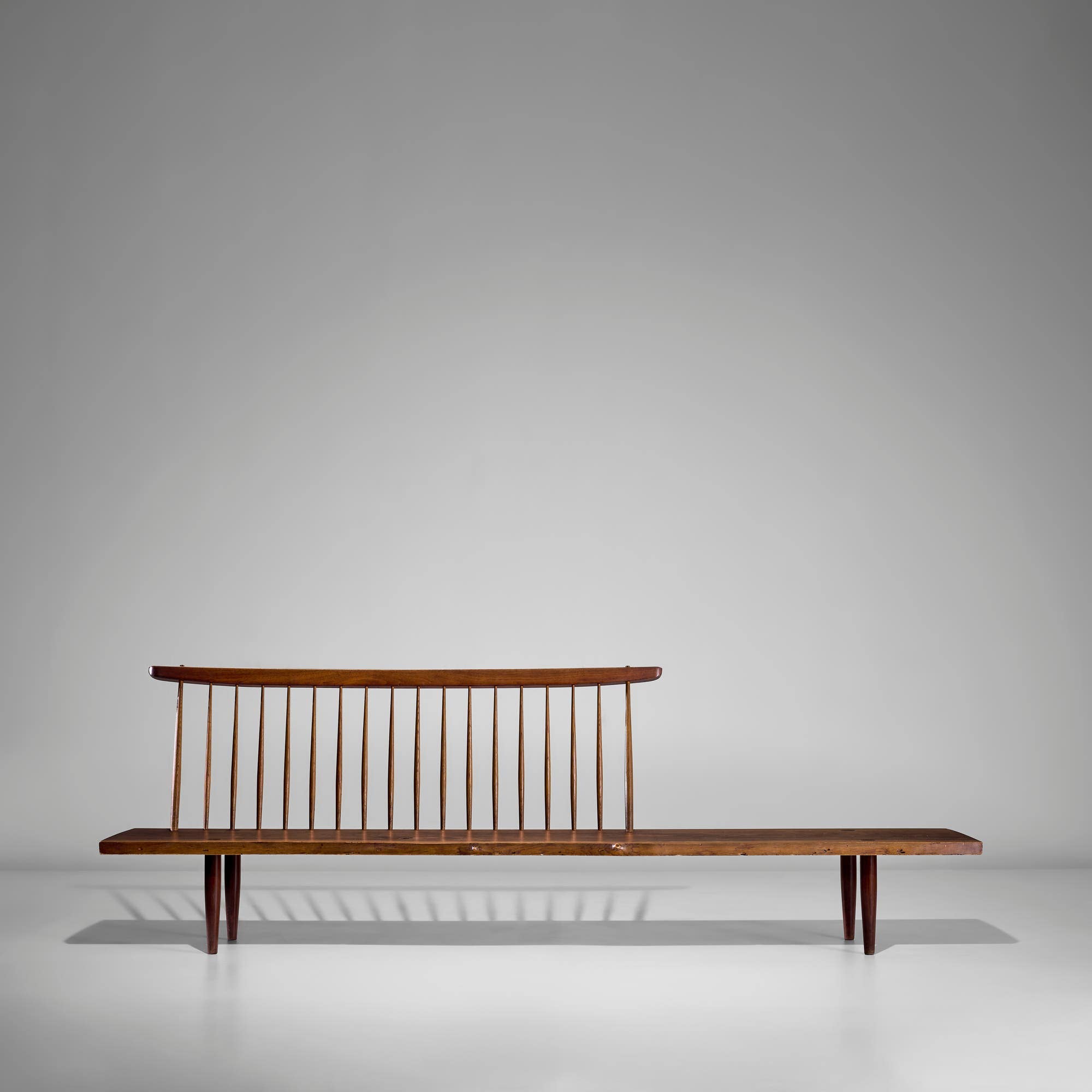
GEORGE NAKASHIMA, Early 'Conoid' bench, 1958. Design, London.
Madalena Horta E Costa, Specialist, Design
I’ve always been drawn to George Nakashima’s work, particularly the way his training as an architect informs his approach to furniture. His designs bring together Japanese woodworking traditions, American vernacular forms, and other influences, distilled into a language entirely his own.
This bench, commissioned by Beverly and Melvin Pollock of Pittsburgh in 1958, is among the very first iterations of what would later become the ‘Conoid’ bench. The Nakashima studio confirmed that Marion Nakashima recorded the commission as a Bench with Back, before the new design acquired its name. Whilst the idea was clearly already formed, the ‘Conoid’ series was only introduced in 1960, in celebration of the completion of Nakashima’s Conoid Studio, named after its distinctive roof geometry, derived from a section of a cone.
The bench combines a long, freeform edge, American black walnut slab seat with tapered legs and a sculptural back, its slender hickory spindles creating a rhythmic interplay of solid mass, linear structure and open space. The back stops short of the full length of the seat, an unexpected play on proportion that lends the composition a particular sense of balance. This deliberate asymmetry reflects the architectural thinking behind Nakashima’s approach to furniture. Insect holes remain visible in the walnut, traces of the tree’s life before it became furniture. Nakashima understood wood both as a structural material and as something with a history worth preserving.
I would love to live with this bench: I can imagine all three of my children perched atop it, putting on their shoes on a hectic school morning. A little everyday chaos made better by great design.
Magdalene Odundo
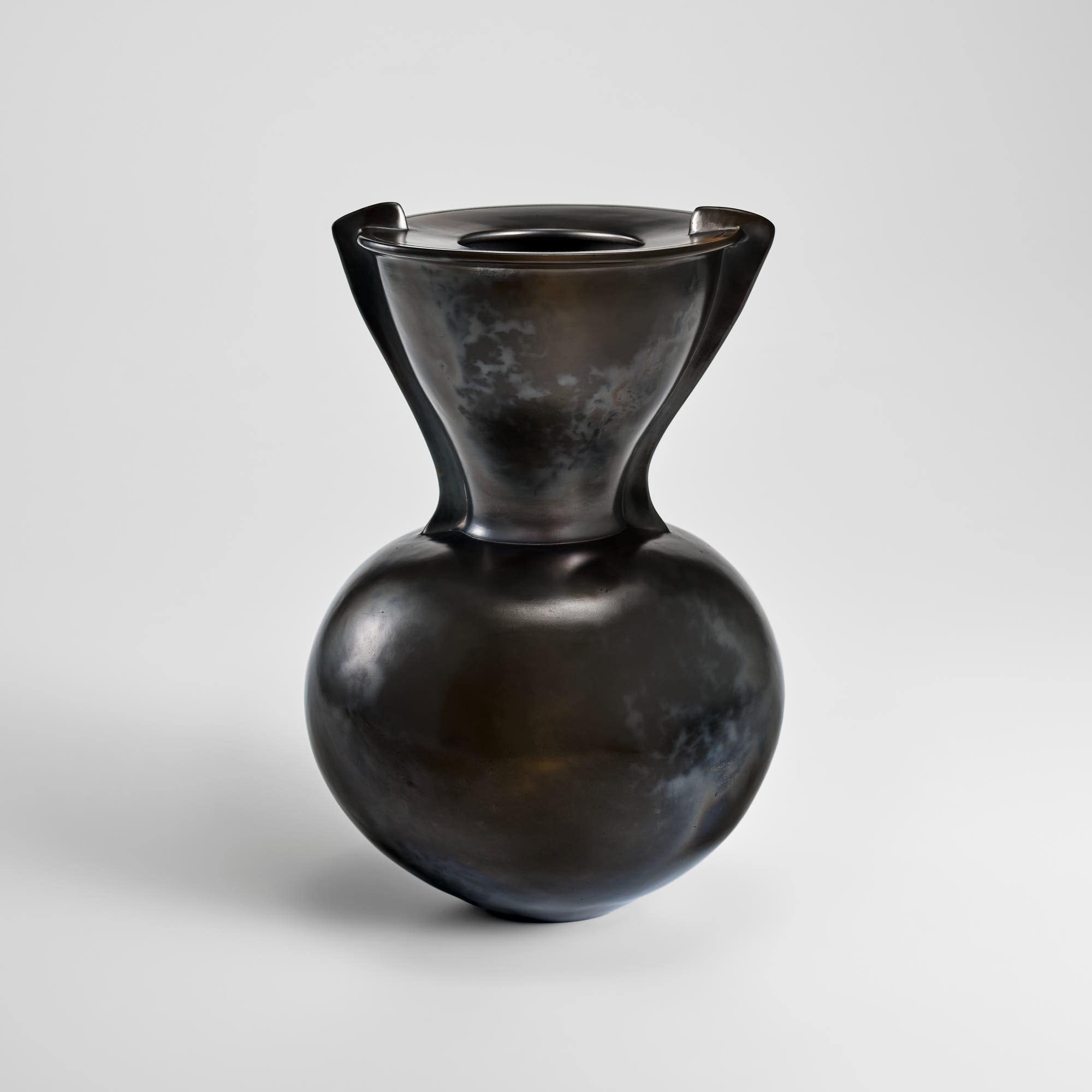
MAGDALENE ODUNDO, 'Untitled', 1987. Design, London.
Antonia King, Head of Sale, Design
What I love about this perfectly balanced vessel, with its corseted anthropomorphic silhouette, is that it is imbued with life, not only in its physical, visual similarity to the human form but in its uniquely expressive energy. Poised in a moment of controlled stillness, hands-on-waist, we’re invited to move around the vessel and enter a dance with it, allowing it to reveal its form and astonishingly radiant and smooth, skin-like surface from every angle. This humble material has been pushed to its limits through a meticulously controlled and time-consuming process of hand-building from coils of clay with exquisite flashes of iridescence flickering across the almost metallic surface, the result of the alchemy and happenstance of the firing process. So many references and dualities; ancient and modern, tangible, and conceptual, are distilled into the creation of Odundo’s vessels, transforming the clay into something far beyond being a pot. I find ‘Untitled’ utterly captivating in its presence and timeless beauty.
Christopher Dresser
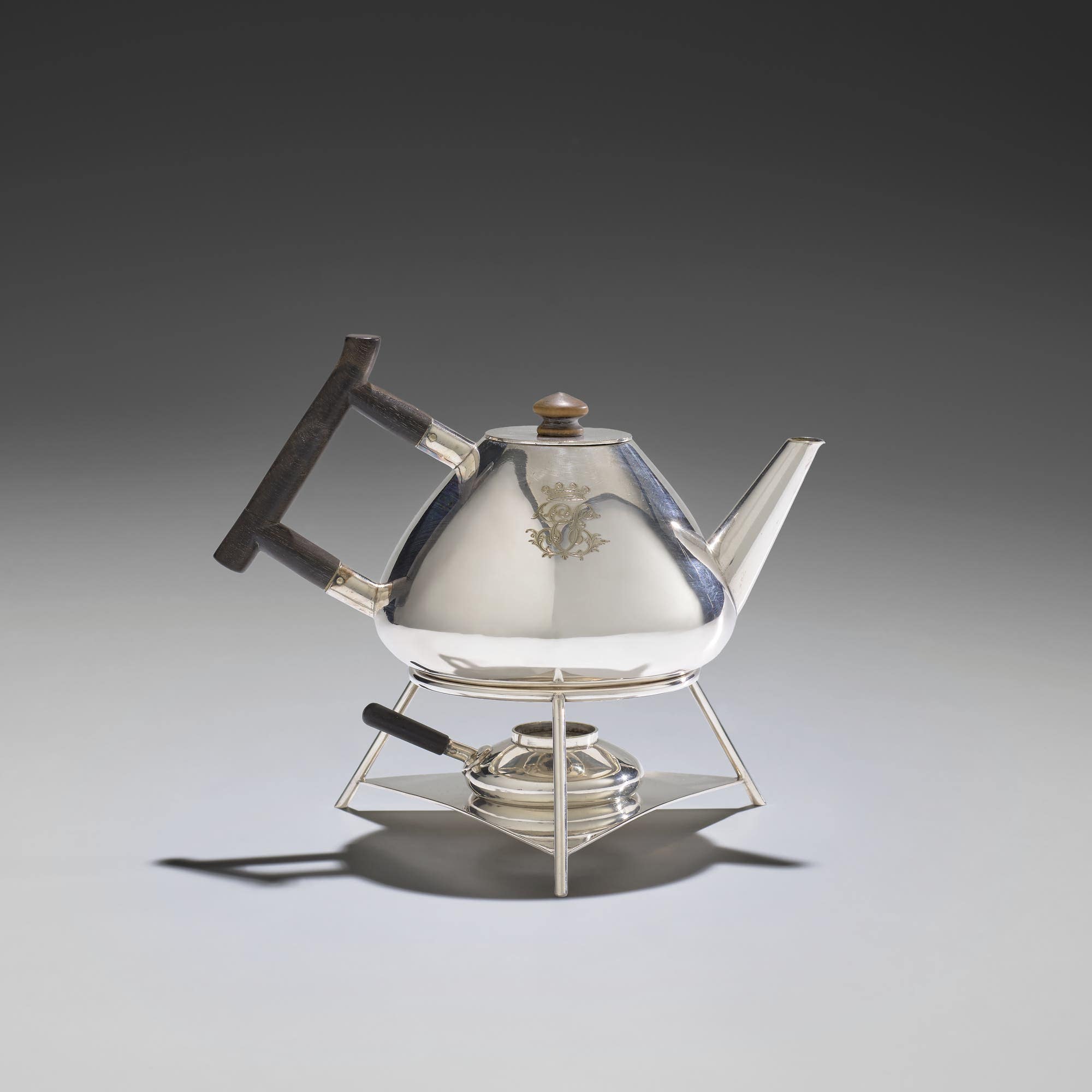
CHRISTOPHER DRESSER, Tea kettle on stand, 1878. Design, London.
Carlotta Pintucci, Senior Cataloguer, Assistant to Deputy Chairman Design, Europe
To me, Christopher Dresser’s 1878 Tea Kettle is one of his most radical and breathtaking creations. Designed a full four decades before the Bauhaus, it feels almost impossibly modern. What I find so captivating is how Dresser completely rejected the overly ornate, heavy decoration of the Victorian era. Instead, he looked at nature through a scientific lens, stripping organic forms down to their geometric essence. You can see that brilliant logic in every element: the body, the handle, the spout and the stand. He didn’t try to hide how the kettle was constructed; he made those clean, structural relationships the actual focus of the design. It elevates an everyday object into a striking sculpture. It’s a beautiful reminder that real elegance comes from purpose and simplicity, proving just how far ahead of his time Dresser truly was.
Donald Judd
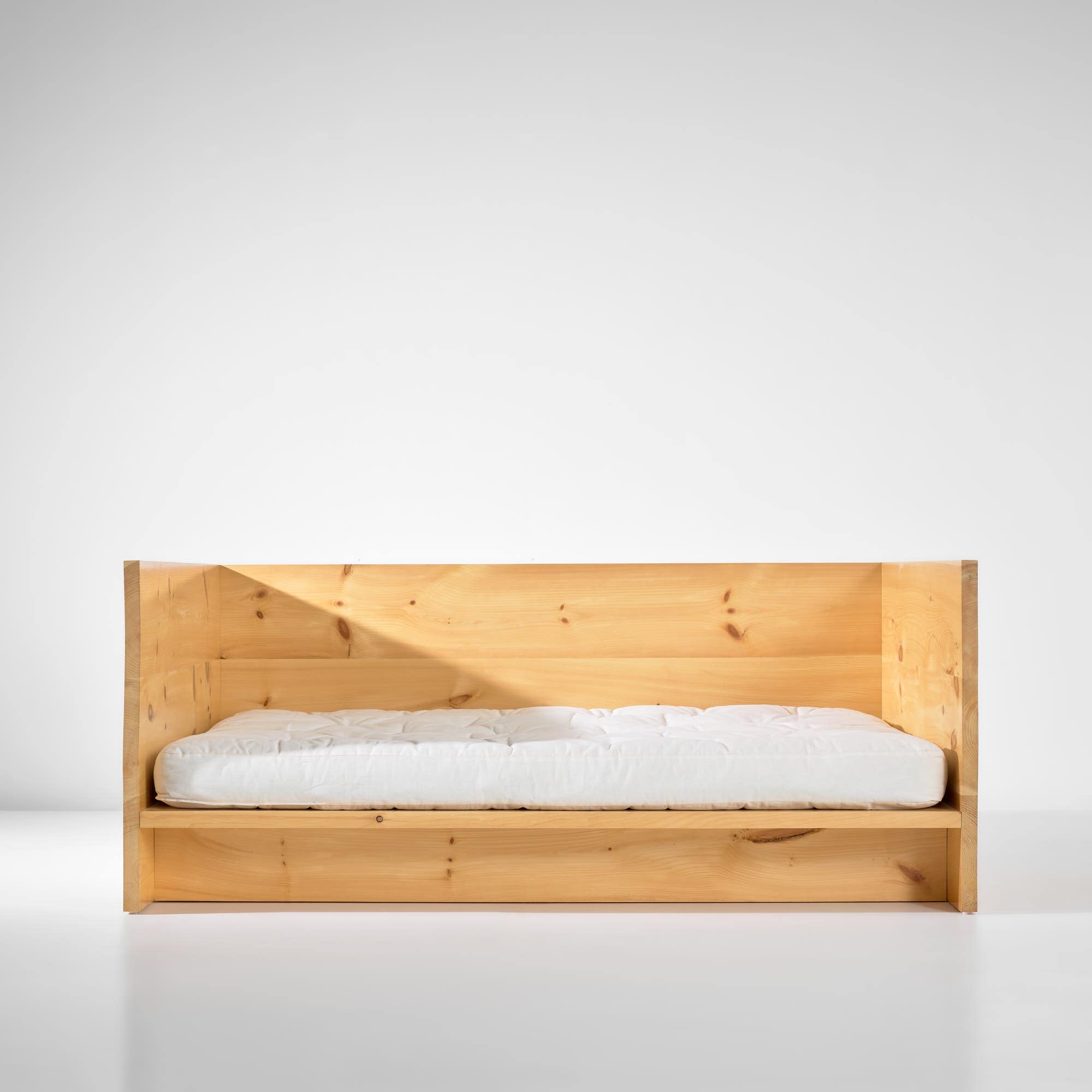
DONALD JUDD, ‘Library Bed 15’, designed 1979, produced 2008. Design, London.
Kaela Aalto, Cataloguer, Design
I personally love Donald Judd’s ‘Library Bed 15’ because it was designed with a specific purpose in mind: to provide its user with a comfortable place to immerse themselves in a good book. This piece was designed in 1979 for the library of Judd's residence and studio in Marfa, Texas. At the time he purchased the property, he simply could not find any furniture that was, in his eyes, “pleasurable to look at, fairly available, and moderate in price.” Judd specifically needed a piece of furniture for his library, which is home to the artist’s personal collection of over 13,000 books that range in topics from ancient Greece to 19th century philosophy. The library bed served as the perfect intervention into the space as a purely functional object that allows its user to lose themselves in the book at hand. It suggests that the library is not merely a passing place, but one in which to make yourself comfortable and even sleep. Even when brought outside of the Marfa library, the minimalist principles that underscore the design of this bed allow it to be perfectly placed in any environment. Judd's ‘Library Bed 15’ presents a unique opportunity to not merely live with an artwork by one of minimalism's most important artists, but to allow Judd's pioneering principles to influence your interior world as you engage with this bed daily. Implicit in its design is Judd's signature sculptural language distilled into a discreet domestic object. Created in pine, the simple double bed was made with utilitarian purpose and geometric purity; there is not a superfluous element nor any hint of ornamentation. Just as Judd intended his minimalist sculptures to give the viewer an awareness of the gallery space around them, so too does his bed reveal more about the space it inhabits than it does about itself. It is ultimately an invitation to rest and to take in the beauty around you, whether it be a massive library or an art-filled room.
Flavio Poli
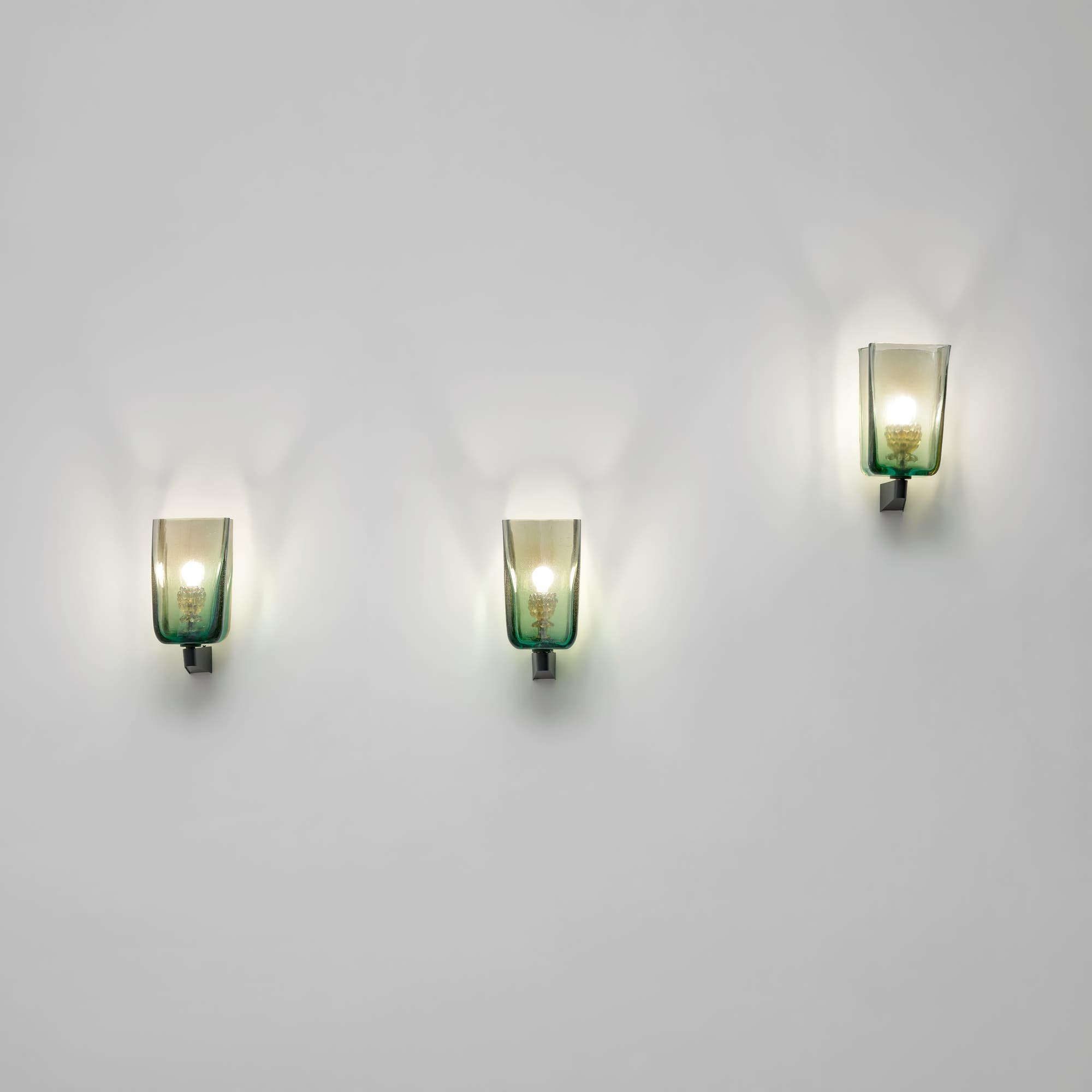
FLAVIO POLI, Set of three wall lights, model no. 1250, from the Hotel Concordia, Cortina d'Ampezzo, circa 1955. Design, London.
Poppy Miles, Intern, Design
In 1923, Ernest Hemingway wrote ‘Out of Season’. The short story became the first example of his ‘iceberg principle’: the idea that a narrative’s full meaning is not explicitly stated. What is left unsaid can be as important as what is written. Why bring this up? Well, within the story, Hemingway mentions the Hotel Concordia, which, standing at the heart of Cortina d’Ampezzo, was the very hotel where these wall lights once hung.
Cortina, famed ‘Queen of the Dolomites’, underwent a dramatic transformation during the twentieth century, from Nazi occupation in World War II to luxury travel resort following the 1956 Winter Olympics. Produced under Flavio Poli’s artistic direction at Seguso Vetri d’Arte, the present lights were part of the hotel’s refurbishment following its prosperity due to the Games. They feature a single flower encased by rectangular shades of iridato sommerso glass, a technique in which layers of coloured glass are framed within a transparent outer layer, creating the illusion that blue-green hues are suspended within the glass. What truly fascinated me about these lights lies not in the moment of their creation but in their history within Hotel Concordia. I was intrigued by the world they once illuminated, the conversations and encounters that unfolded around them: writers seeking solitude among the Dolomites, families finding warm refuge after a long day on the slopes, and famous faces, including Hemingway, Ettore Sottsass and Fernanda Pivano, all of whom signed the hotel’s guest book. Their provenance connects them to a hotel that has now disappeared, they exist as tangible fragments of a world that might otherwise be lost. Made to be lived with rather than simply observed, these wall lights carry a story that extends beyond their physicality. Perhaps this is what makes a design so special, and what allows it to stand the test of time. Poli’s lights preserve the Concordia’s past, but their story continues as they inhabit new spaces and gather new meanings. Like Hemingway’s iceberg, there will always be more beneath the surface.