13✱︎Ж︎
Zhang Xiaogang
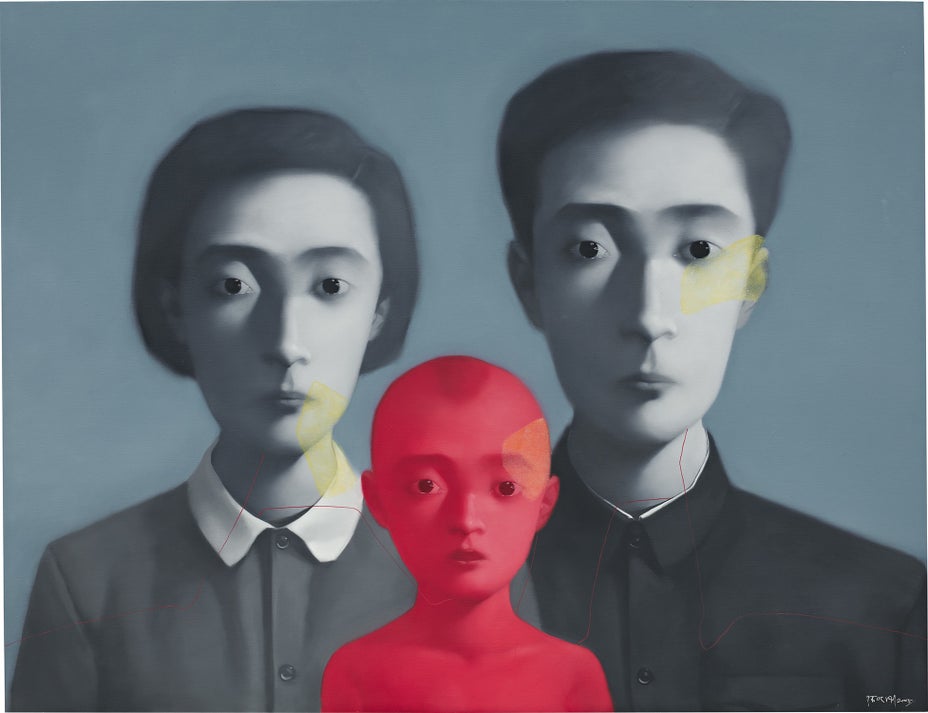
Bloodline Series: Big Family No.3
Full-Cataloguing
(Zhang Xiaogang, quoted in Zhang Wenjia, “Interview with Zhang Xiaogang”, March 2019)
Internationally celebrated as one of the greatest living Chinese artists, Zhang Xiaogang’s era-defining Bloodline series is considered an integral part of contemporary Chinese art, encapsulating the psychological disposition of an entire generation. After the collapse of the Maoist era, Zhang was accepted to the Sichuan Academy of Fine Arts where he not only received formal training in oil painting but was also exposed to impressions of Western art where his earliest artistic influences beyond Socialist Realism included Jean-François Millet and Vincent Van Gogh. After graduating in 1982, Zhang joined a group of young avant-garde artists who sought to develop new artistic languages for a nation in transition, as China underwent profound changes in the country’s political, societal and cultural environment. The defining political events of 1989, however ‘pulled [Zhang] back into reality, awakened from [his] dreams’, and his own outlook and art practice rapidly altered. (Zhang Xiaogang quoted in J. Fineberg and G. G. Xu, Zhang Xiaogang: Disquieting Memories, London: Phaidon, 2015, p. 59).
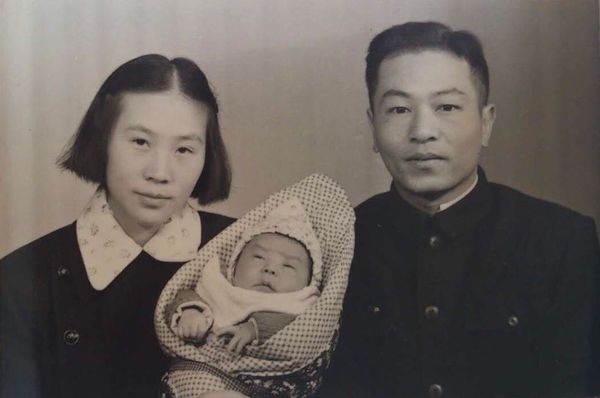
Zhang Xiaogang's elder brother with their parents, on the occasion of his 100th Day Celebration
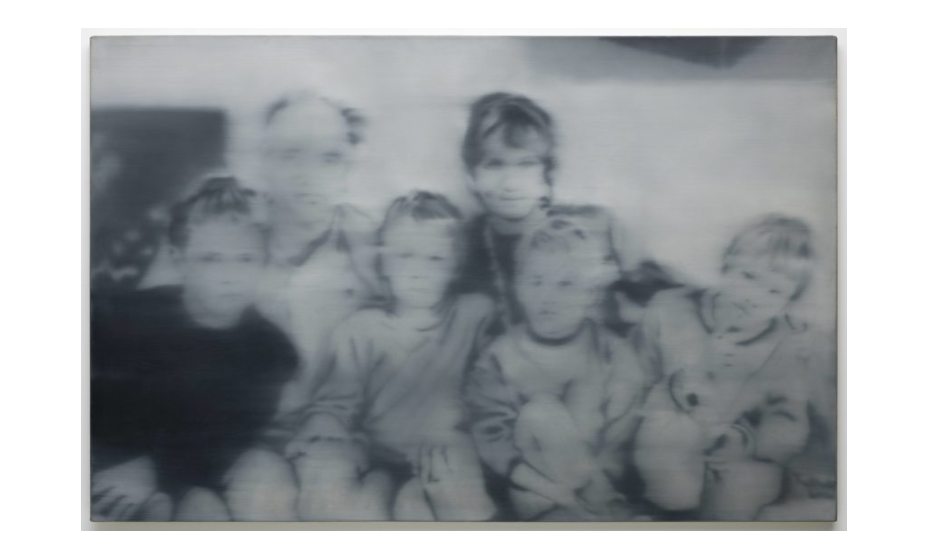
Gerhard Richter
Familie Ruhnau (The Ruhnau Family), 1968
The Doris and Donald Fisher Collection at the San Francisco Museum of Modern Art
Upon his return from an informative trip to Germany in 1992 where Zhang fully immersed himself into the Western art world, he stumbled across intriguing formal family photographs from the Cultural Revolution featuring stiff poses and detached facial expressions. Influenced by how visual artist Gerhard Richter ‘looked at photos and saw their history and meaning’, manipulating the medium to explore memories, Zhang commenced his Bloodline series in 1993 to visually negotiate the conflicts of group versus identity and document the scarred past of his previous generations. (Zhang Xiaogang, quoted in ‘Zhang Xiaogang: In Conversation’, Phillips, 15 May 2018, online). Executed in 2005, twelve years after completing the first of his highly sought-after Bloodline canvases, the present painting perfectly showcases Zhang’s now instantly identifiable aesthetic and matured technical mastery.
Hovering between a seemingly realistic portrayal and a dreamlike illusion, Bloodline Series: Big Family No.3 depicts two adults and a child staring solemnly ahead toward the viewer but not directly at them, as if their presence has not been registered. Vivid lighting effects illuminate the subjects against a flat background that is deliberately reminiscent of carefully retouched black-and-white family photographs from the 1950s and 1960s. Although the group is situated together, confined within the parameters of the large rectangular canvas, they stand rigidly with vacant stares that emotionally isolate them from each other as well as from themselves. They are connected, however, via barely perceptible crimson bloodline threads that link the child to his parents behind him. Ingeniously borrowing from Mexican painter Frida Khalo’s use of red lines to unite figures, such as the explicitly exposed veins in The Two Fridas (1939), Zhang’s ‘bloodlines’ in comparison are more elusive in meaning, alluding to both the familial relations between the protagonists as well as the troubling 'chains that restrain them in the darkness' (Hirayoshi Yukihiro, Avant-garde China: Twenty Years Of Chinese Contemporary Art, Osaka: National Museum of Art, 2008).
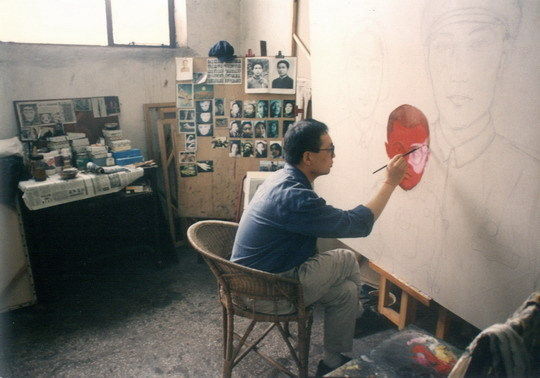
Zhang Xiaogang In Studio, 1994
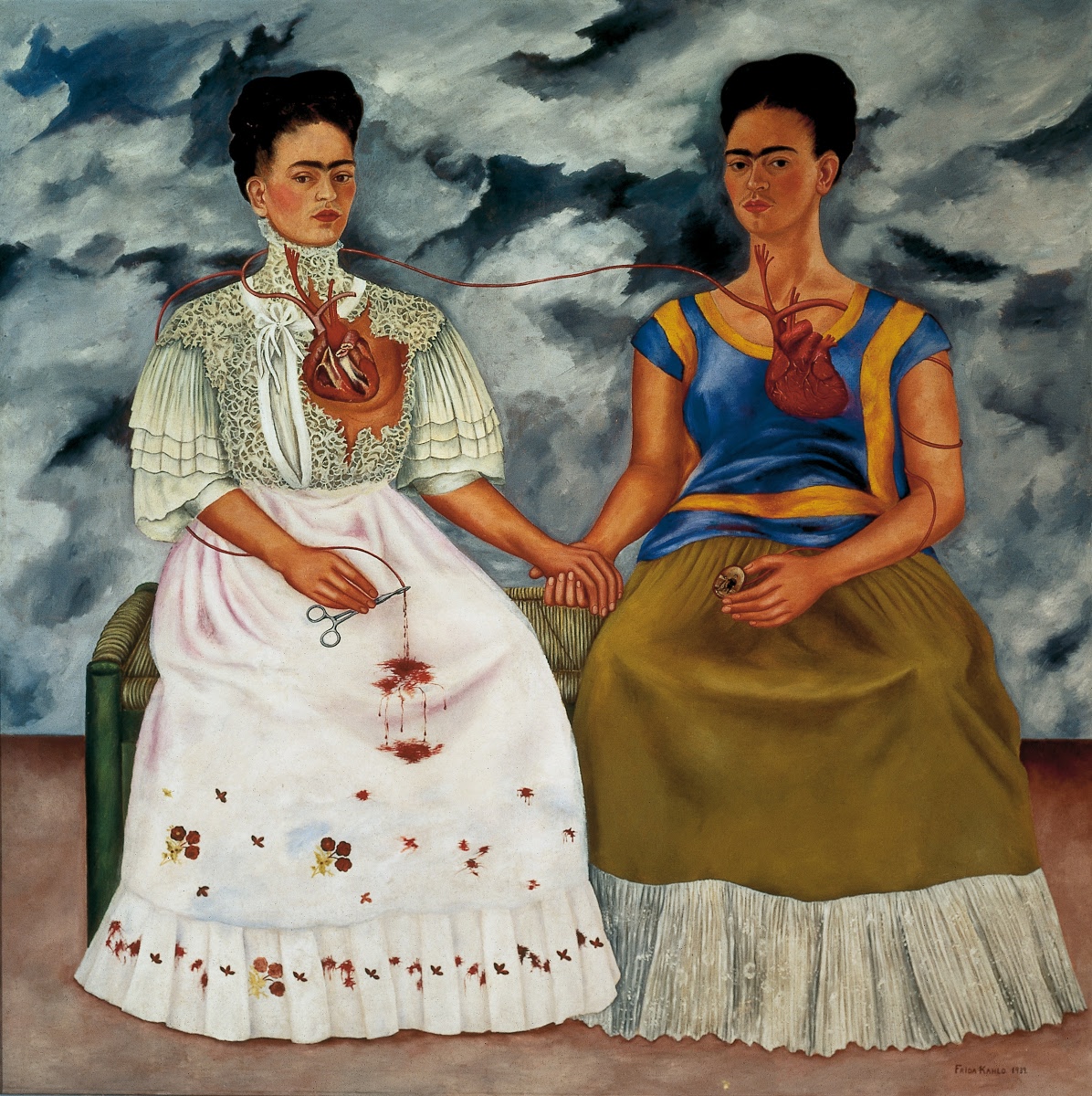
Frida Kahlo
The Two Fridas, 1939
Collection of the Museo de Arte Moderno, Mexico City
The Bloodline Series: Big Family No.3 trio curiously share the same androgynous facial features of an oblong-shaped head, pointed nose, and arched brows. The central child, however, is rendered in a pronounced shade of brilliant red that starkly contrasts the grey-scale pair behind. Harkening back to Zhang's first exploration of the motif, Genesis Number One, The Birth of a Republic (1992), the inclusion of a glum, red-child in Zhang's works has come to be considered an important trait that symbolises the ‘"Second-generation Reds," the product of new China’ (Zhang Xiaogang, quoted in Zhang Wenjia, “Interview with Zhang Xiaogang”, March 2019), who have been born into an era of political tension and uncertainty. The only other distinguishing marks present in Bloodline Series: Big Family No.3 are the yellow translucent patches of light overlaid on each character’s face that like birthmarks or watermarks, appear either disfiguring or decorative. Otherwise depicted with a retouched aesthetic, achieved through a ‘rigorous painting process’ of applying ‘thin layers one after another, repeatedly’ (Zhang Xiaogang, quoted in Huang Z., ‘Experience, Identity and Judgement, Interview with Zhang Xiaogang’, Gallery, no.5-6, 1996. Cited in J. Chang T.Z., ed., Umbilical Cord of History: Paintings by Zhang Xiaogang, Hong Kong: Hanart TZ Gallery, 2004, p. 60), the painted faces are uncannily similar and thus immediately interchangeable. In exploring the notion of identity in relation to the Chinese culture of collectivism, as embodied in the present work, Zhang confronts the viewer with a strikingly archetypal face from a turbulent time of historical suffering.
Throughout the evolution of his famed 'Bloodline' series, we see the artist turning away from his early expressionist brushstrokes and surrealist affinities, instead opting for a highly graphic, almost sculptural treatment of his figures in the creation of compositions that are devoid of identity and narrative. In his mature Big Families, painted from 2000 onwards, Zhang’s desire to let his images speak for themselves is cemented. Having struck the essence of his subjects, his paintings reveal what reality is concealed in the imaginary - thus making the invisible, visible.
From the early showcasings of his Bloodline works at the 1994 São Paulo Biennial and the 1995 Venice Biennale, Zhang has only grown to garner increasing international attention and critical acclaim for the series. Inviting his viewers to fill the void within each image with their own experiences and reflection, Zhang’s legendary oeuvre succeeds in encapsulating the artist’s intimate familial memories, as well as giving voice to the collective dreams and psychological unrest of an estranged generation.
Zhang Xiaogang
Chinese | 1958Relying on memory and inspired by family portraits from the Chinese Cultural Revolution, Zhang Xiaogang creates surreal, subtle artworks that explore the notion of identity in relation to the Chinese culture of collectivism. Using a muted, greyscale palette, Xiaogang repeatedly depicts a series of unnervingly similar figures, often dressed in identical Mao suits, to create an endless genealogy of imagined forebears and progenitors. Their somber, melancholy gazes are interrupted only by thin red bloodlines intimating familial links as well as occasional pale splotches of color resembling birthmarks.
Xiaogang investigates how to express individual histories within the strict confines of a formula. His sitters, while appearing muted and compliant, are given physical exaggerations: oversized heads, tiny hands and long noses. These distortions imply stifled emotions and give a complex psychological dimension to the artist's work.