56
Rolex
Ref. 1803
Day-Date
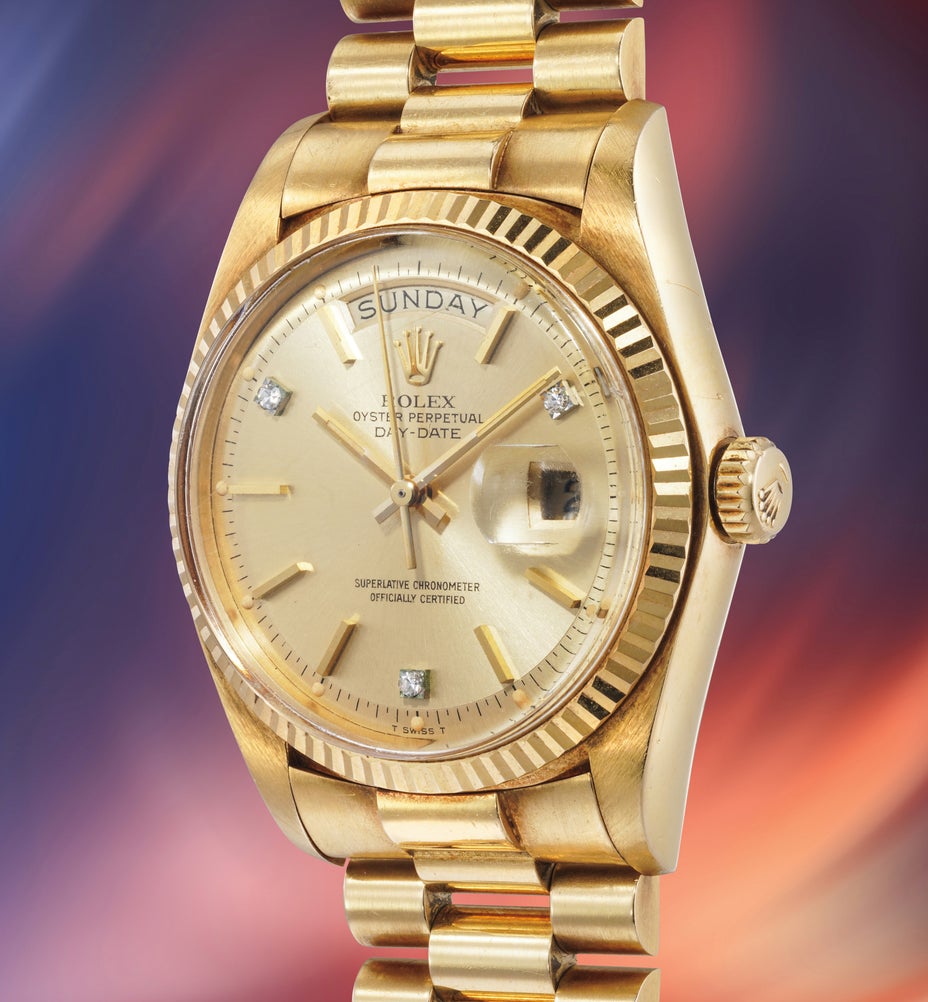
A surprising, delightful and extremely uncommon yellow gold calendar wristwatch with center seconds, diamonds-set numerals at 2, 6 and 10, and bracelet
Full-Cataloguing
- Automatic, center seconds, day, date
- Incredibly rare dial configuration with diamond-set hour markers at 2, 6 and 10 o’clock
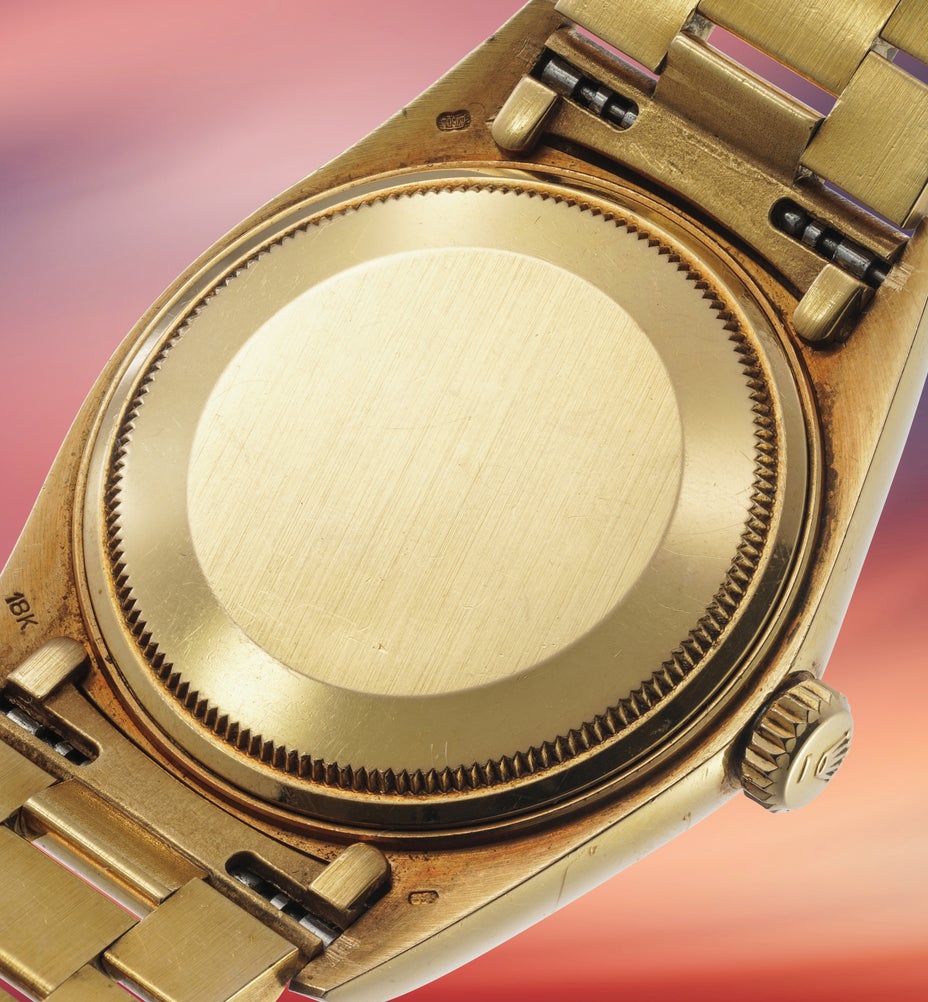
- Extremely well-preserved, possibly unpolished condition
The Day-Date is an incredibly vast canvas upon which Rolex experimented with a wide variety of options ranging from the standard silvered dial to lacquered Stella dials and hardstone dials. The variety is such that even the most jaded collector can be, still today—more than half a century after the introduction of the model—surprised by a configuration which they were unaware of.
Such is the case for this extremely uncommon example.
Gem-set numeral variants of the Day-Date are considered among the most luxurious in production at the time, and a plethora of options is known: from the “standard” square markers combined with baguettes at 6 and 9, to full baguette hour markers with square minute markers, and everything in between.
However, despite our best research efforts, it appears that the configuration sported in this watch has never to date appeared on the auction market: its soleil champagne dial features diamond markers at 2, 6 and 10 o’clock, and batons for the remaining positions.
Beyond the rarity and potential uniqueness of the configuration, it imparts the watch with very different aesthetics from what is commonly seen on the model. The “Y” configuration of the numerals is supremely symmetrical (while most, if not all, other gem-set numeral versions are inherently unbalanced due to the lack of a numeral at 3 o’clock) and it comes as a minor shock—and major surprise—to the eye of the seasoned Day-Date collector.
The supremely attractive condition of the watch is the final icing on this superb horological cake.
Rolex
Swiss | 1905Founded in 1905 England by Hans Wilsdorf and Alfred Davis as Wilsdorf & Davis, it soon became known as the Rolex Watch Company in 1915, moving its headquarters to Geneva in 1919. Like no other company, the success of the wristwatch can be attributed to many of Rolex's innovations that made them one of the most respected and well-known of all luxury brands. These innovations include their famous "Oyster" case — the world's first water resistant and dustproof watch case, invented in 1926 — and their "Perpetual" — the first reliable self-winding movement for wristwatches launched in 1933. They would form the foundation for Rolex's Datejust and Day-Date, respectively introduced in 1945 and 1956, but also importantly for their sports watches, such as the Explorer, Submariner and GMT-Master launched in the mid-1950s.
One of its most famous models is the Cosmograph Daytona. Launched in 1963, these chronographs are without any doubt amongst the most iconic and coveted of all collectible wristwatches. Other key collectible models include their most complicated vintage watches, including references 8171 and 6062 with triple calendar and moon phase, "Jean Claude Killy" triple date chronograph models and the Submariner, including early "big-crown" models and military-issued variants.