80
Rolex
Day-Date
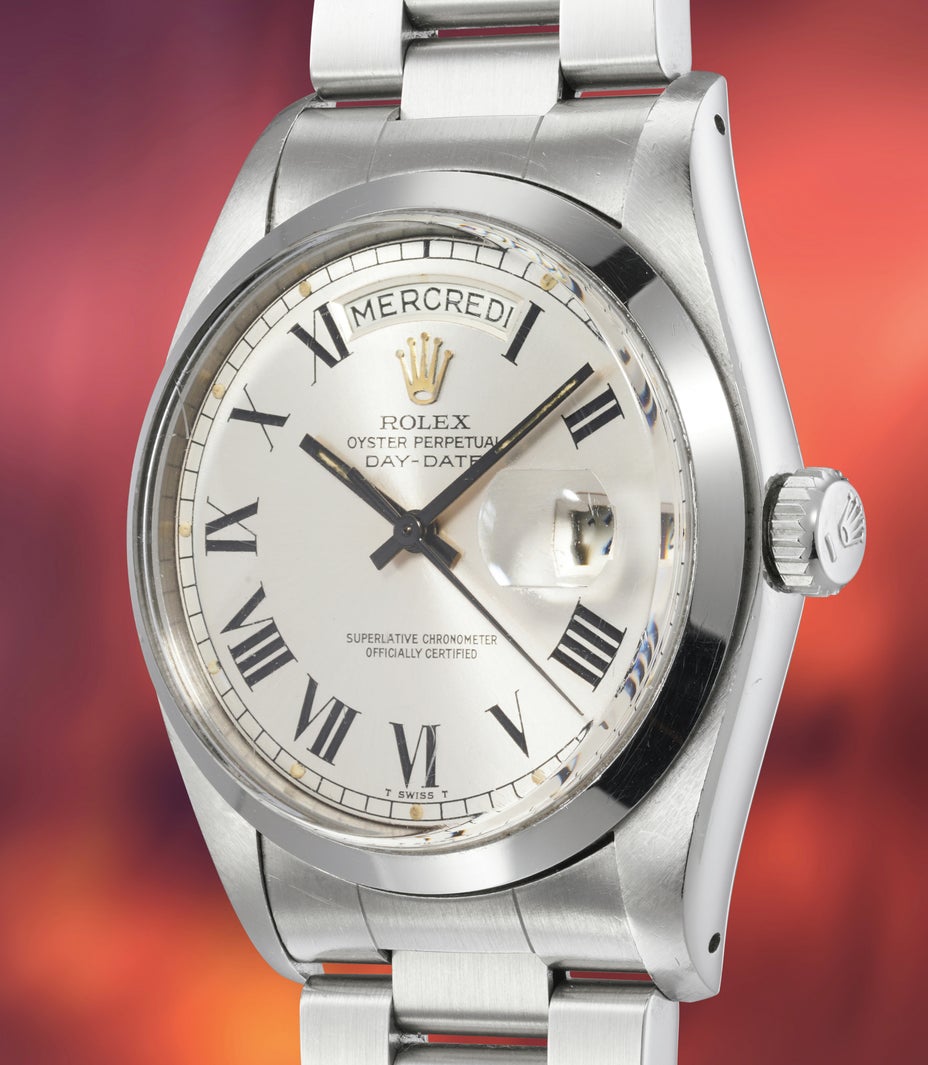
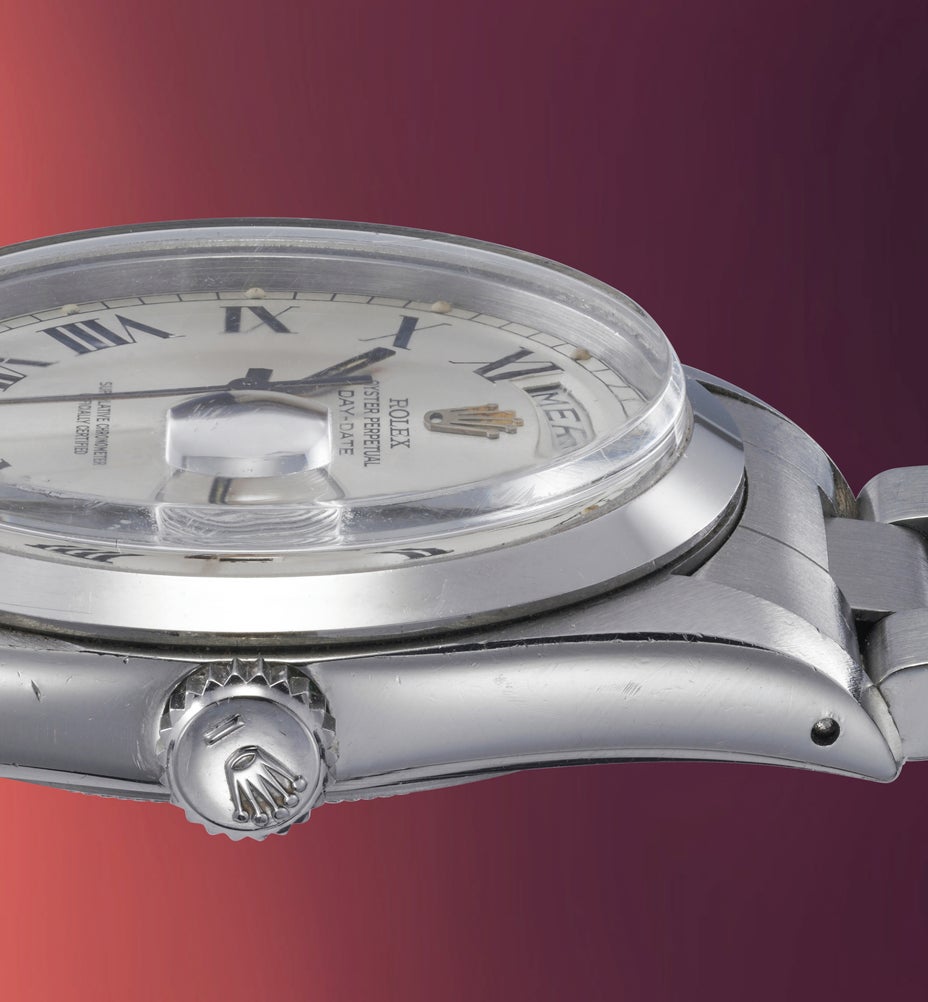
An outstandingly rare and historically interesting stainless steel prototype calendar wristwatch with center seconds and bracelet
Full-Cataloguing
- The present watch is one of a handful known prototypes of the Day-Date model, cased in stainless steel
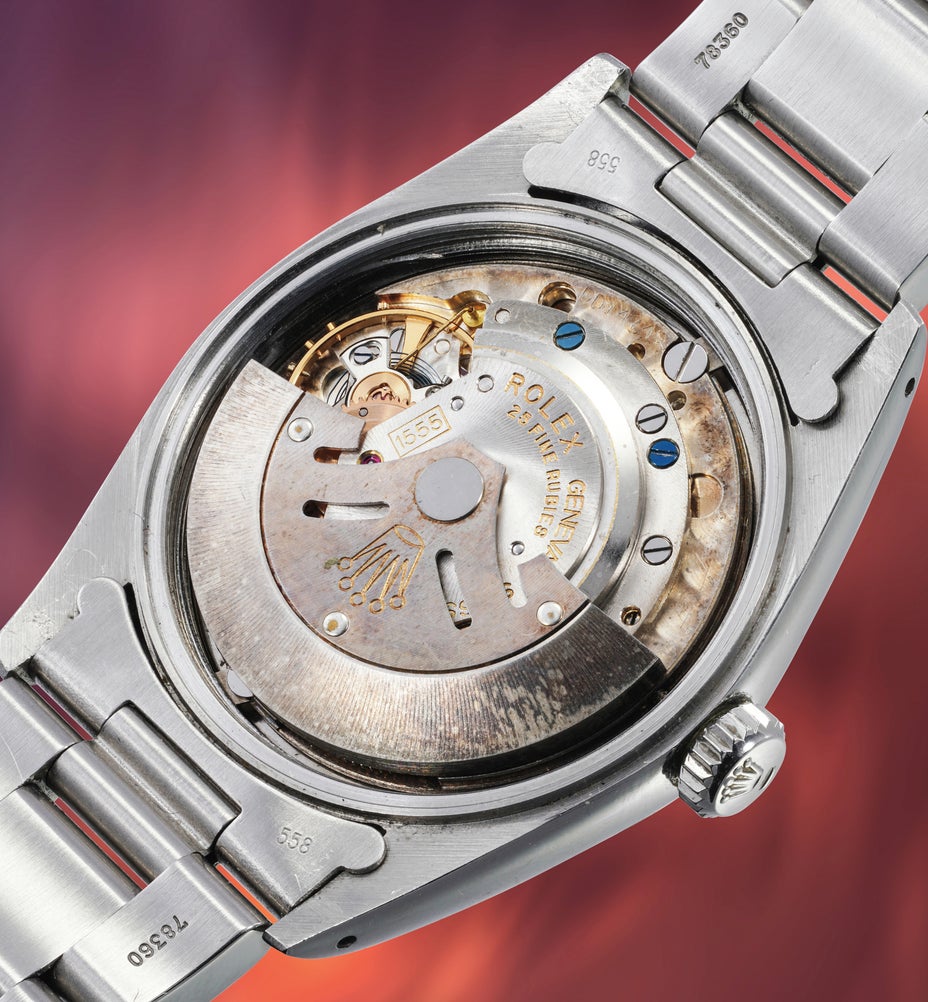
- These prototypes (which bear no serial nor case number) were originally gifted to Rolex’s watchmakers at the end of their career and they all have the same Roman numerals dial style
The Day-Date was, at the time of its launch, somewhat of an exception for Rolex. The company had carved out a name as the world’s foremost supplier of technical timepieces. However, in 1957 the Day-Date was introduced, and it would go on to become one of the most easily recognizable luxury wristwatches on the planet. In order to underline the exclusivity of the model, Rolex decided to produce the Day-Date exclusively in precious metals; this “ban” on steel Day-Date models in fact remains in effect to this very day.
As with every rule, however, there are exceptions—including the “no steel Day-Date” one. As it turns out, an extraordinarily small number of prototype or scholarship pieces were in fact produced in stainless steel. One example (movement no. 0004547) is illustrated in John Goldberger’s Rolex “bible,” 1000 Superlative Rolex Watches. Two more were sold by Phillips in 2018 (no. 0005073) and in 2019 (no. DD411420). This fourth example (no. DD14749), previously unknown to the market, completes the set of known stainless steel Day-Date prototypes.
All four of these prototype examples—and indeed, as one would expect from Rolex prototypes, they bear no serial or case numbers—were originally gifted to Rolex watchmakers at the end of their careers, and they all feature the same Roman numeral dial style.
In a world where rarity is one of the most prized qualities in a collectible timepiece—and where sports watches dominate demand thanks to their undeniable wearability—the present watch unquestionably deserves the coveted “grail” status.
Rolex
Swiss | 1905Founded in 1905 England by Hans Wilsdorf and Alfred Davis as Wilsdorf & Davis, it soon became known as the Rolex Watch Company in 1915, moving its headquarters to Geneva in 1919. Like no other company, the success of the wristwatch can be attributed to many of Rolex's innovations that made them one of the most respected and well-known of all luxury brands. These innovations include their famous "Oyster" case — the world's first water resistant and dustproof watch case, invented in 1926 — and their "Perpetual" — the first reliable self-winding movement for wristwatches launched in 1933. They would form the foundation for Rolex's Datejust and Day-Date, respectively introduced in 1945 and 1956, but also importantly for their sports watches, such as the Explorer, Submariner and GMT-Master launched in the mid-1950s.
One of its most famous models is the Cosmograph Daytona. Launched in 1963, these chronographs are without any doubt amongst the most iconic and coveted of all collectible wristwatches. Other key collectible models include their most complicated vintage watches, including references 8171 and 6062 with triple calendar and moon phase, "Jean Claude Killy" triple date chronograph models and the Submariner, including early "big-crown" models and military-issued variants.