

US import tariffs: Non-US origin lots in this sale (including watches and timepieces with Swiss-made or non-US made movements) will be subject to special tariffs upon import to the USA, currently ranging from 10% to 39% on the total invoice price (hammer price plus buyer’s premium). Buyers are responsible for paying any applicable tariffs, duties, taxes and charges when importing their purchased lots. Due to the evolving nature of international trade regulations, we recommend clients consult with their local customs office or advisor for up-to-date information on the applicable tariffs.
27
Rolex
Ref. 971
Prince Brancard
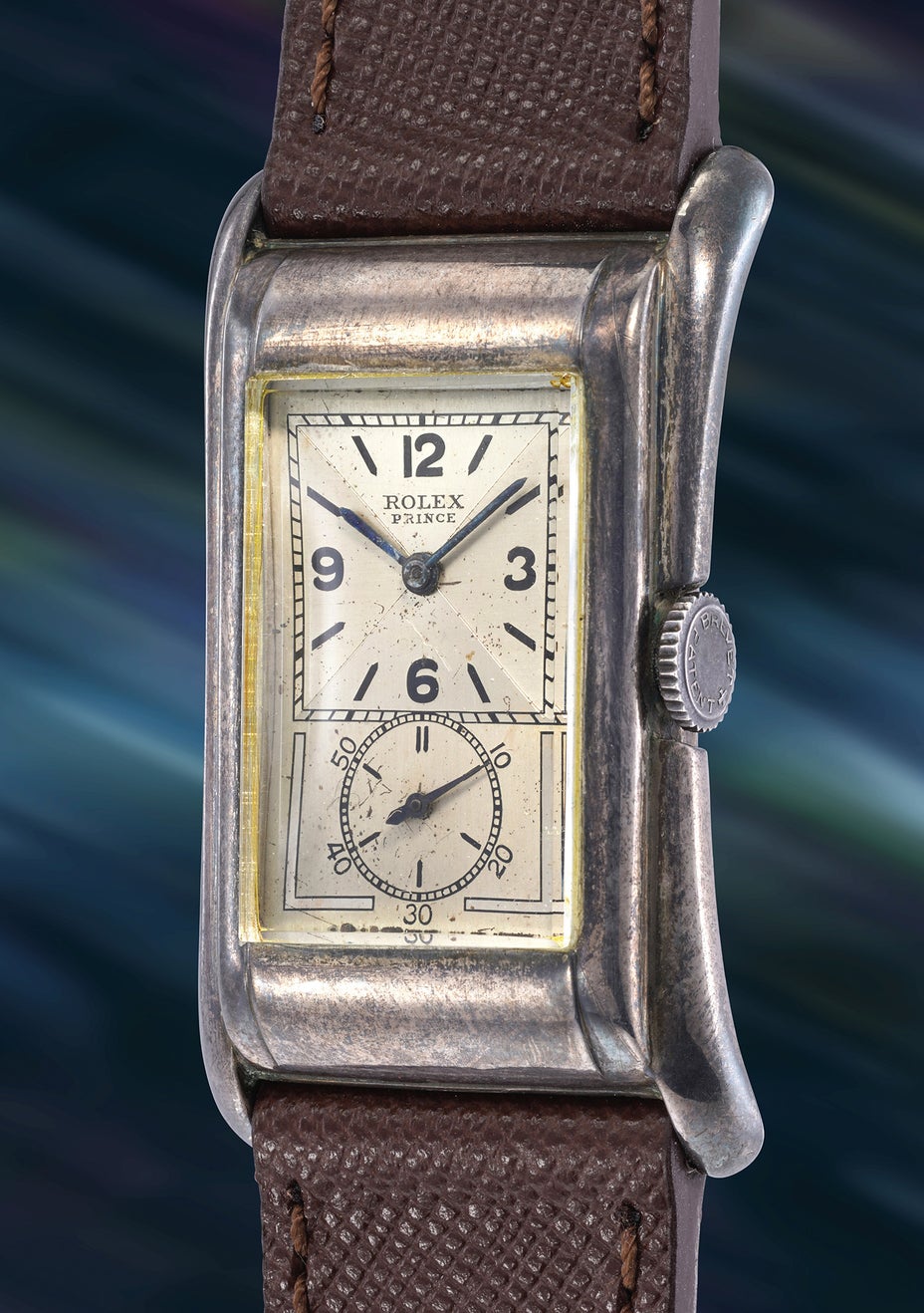
An unusual and delightful silver rectangular wristwatch with three-tone dial, chronometer certificate and presentation box
- Estimate
- CHF10,000 - 20,000€10,800 - 21,600$12,600 - 25,100
CHF10,795
Lot Details
- Manufacturer
- Rolex
- Year
- Circa 1930
- Reference No
- 971
- Case No
- 05'995
- Model Name
- Prince Brancard
- Material
- 925 Silver
- Calibre
- Manual, jeweled
- Bracelet/Strap
- Leather
- Clasp/Buckle
- Silver Rolex pin buckle
- Dimensions
- 35.5mm Length, 23.5mm Width
- Signed
- Case, dial, movement and buckle signed
- Accessories
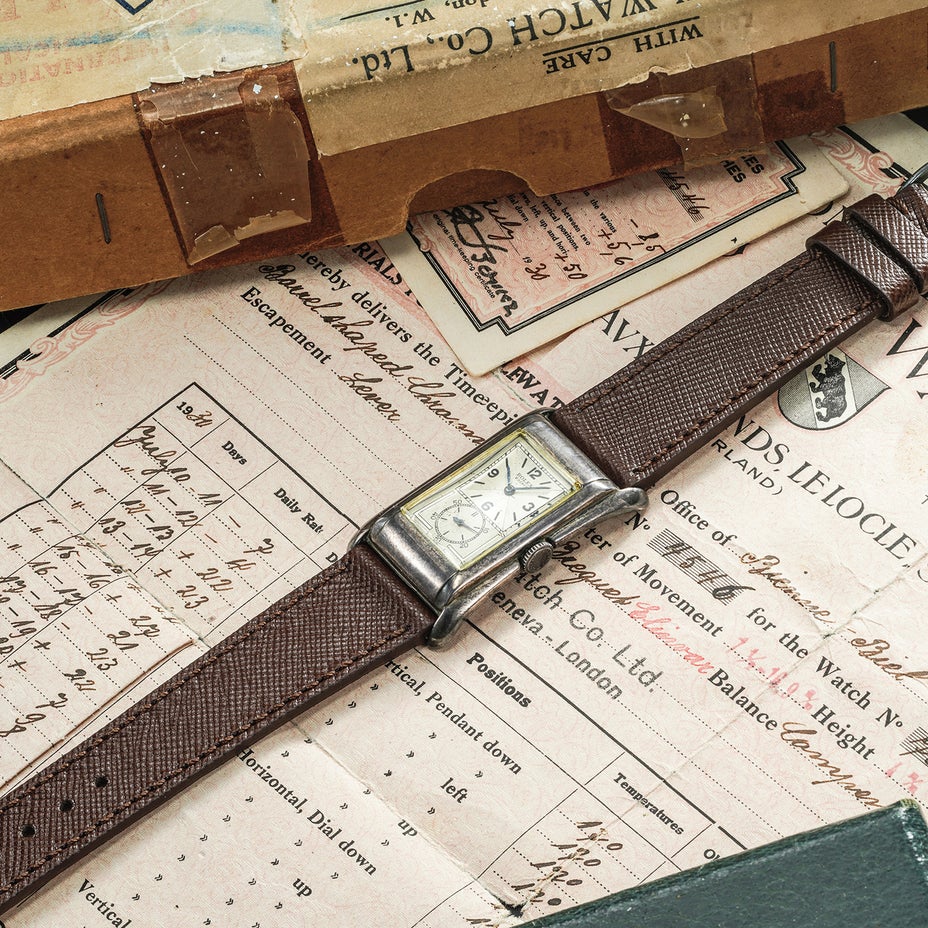
- Accompanied by Rolex Chronometer certificate dated July 26, 1930, presentation box and outer packaging.
Specialist
Full-Cataloguing
Catalogue Essay
Originally released to the market in 1928, the Rolex Prince, or "Doctor’s Watch", was an unbelievably accurate wristwatch. Often fitted with a chronometer movement, the model featured a subsidiary seconds register below the hours and minutes section of the dial, enabling a doctor to time pulses and respiration, hence its moniker. Rolex capitalized on this concept during the period, marketing the watch to professionals in the medical industry. The watch absolutely captures the zeitgeist of the 1920s, with its elegant, stepped case and deco-style dial composition.
Prince watches generally feature two different case styles: the soft, curved model with flared sides, such as the present watch, is known as the Brancard. The sharp, angled and rectangular model, is known as the Classic. While Prince watches were cased in a variety of metals, such as 9K gold or white gold or platinum, the present examples appears to be an extremely uncommon silver specimen – with the 925 titulation stamped to the inside of the caseback and repeated inside the case at 12. An intellectual curiosity comes from the Swan French import mark (the swan) present on the watch – which lacks titulation. This is because French government did not request such detail, and as long as the alloy was at least 800/1000 silver, it could be swan-stamped when importing the artifact.
Prince watches were fitted with a variety of dials. In this instance, the watch bears a superbly well executed three-tone dial featuring vertically and horizontally brushed elements coupled with mirror polished details.
Prince watches generally feature two different case styles: the soft, curved model with flared sides, such as the present watch, is known as the Brancard. The sharp, angled and rectangular model, is known as the Classic. While Prince watches were cased in a variety of metals, such as 9K gold or white gold or platinum, the present examples appears to be an extremely uncommon silver specimen – with the 925 titulation stamped to the inside of the caseback and repeated inside the case at 12. An intellectual curiosity comes from the Swan French import mark (the swan) present on the watch – which lacks titulation. This is because French government did not request such detail, and as long as the alloy was at least 800/1000 silver, it could be swan-stamped when importing the artifact.
Prince watches were fitted with a variety of dials. In this instance, the watch bears a superbly well executed three-tone dial featuring vertically and horizontally brushed elements coupled with mirror polished details.
Rolex
Swiss | 1905Founded in 1905 England by Hans Wilsdorf and Alfred Davis as Wilsdorf & Davis, it soon became known as the Rolex Watch Company in 1915, moving its headquarters to Geneva in 1919. Like no other company, the success of the wristwatch can be attributed to many of Rolex's innovations that made them one of the most respected and well-known of all luxury brands. These innovations include their famous "Oyster" case — the world's first water resistant and dustproof watch case, invented in 1926 — and their "Perpetual" — the first reliable self-winding movement for wristwatches launched in 1933. They would form the foundation for Rolex's Datejust and Day-Date, respectively introduced in 1945 and 1956, but also importantly for their sports watches, such as the Explorer, Submariner and GMT-Master launched in the mid-1950s.One of its most famous models is the Cosmograph Daytona. Launched in 1963, these chronographs are without any doubt amongst the most iconic and coveted of all collectible wristwatches. Other key collectible models include their most complicated vintage watches, including references 8171 and 6062 with triple calendar and moon phase, "Jean Claude Killy" triple date chronograph models and the Submariner, including early "big-crown" models and military-issued variants.
Browse Maker