801
Rolex
Ref. 6350, inside case back stamped IV.53
Explorer
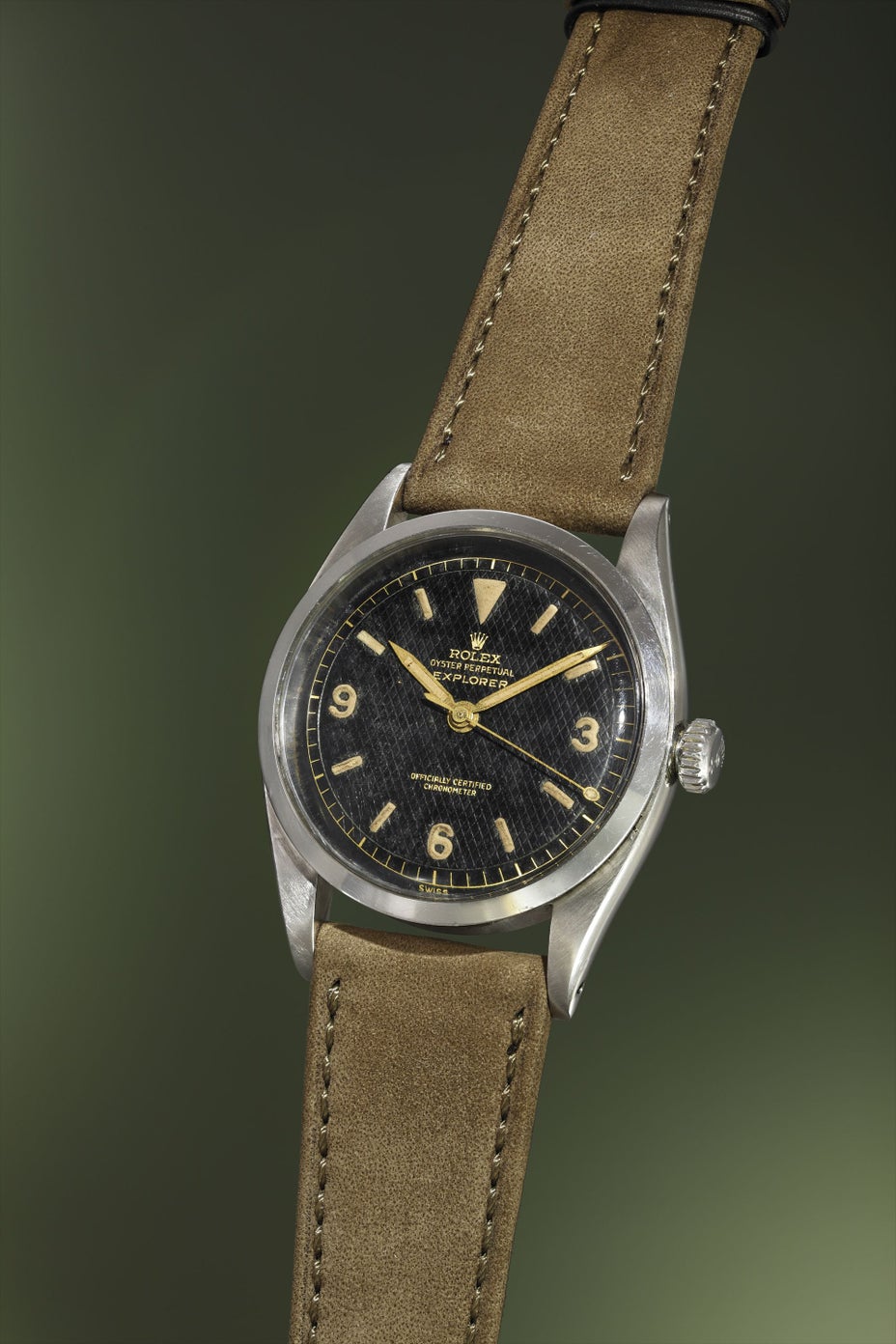
A superb, very rare and highly attractive stainless steel wristwatch with sweep center seconds and ‘explorer’ honeycomb dial
Full-Cataloguing
The key objective in creating the Explorer was dial legibility. Radium was thus applied to the dial, with the iconic '3-6-9' numerals clearly recognizable even from far away. Unlike reference 6150, which bore ‘Precision’, reference 6350 was marked ‘Officially Certified Chronometer’, confirming the movement had been subject to stricter timing tests.
Following Sir Edmund Hillary and Tenzing Norgay’s conquering of Mount Everest on 29 May 1953, the Explorer immediately rose to popularity. Rolex was one of the sponsors of the expedition, and supplied Oyster watches to the duo. While Rolex already registered the 'Explorer' patent on January 26, 1953, the name was officially adopted after Hillary and Norgay reached the peak of Everest.
John Goldberger's Opinion
The example presented in these pages, fitted with an attractive black honeycomb dial with radium '3-6-9' Arabic numerals, is really quite stunning. It is the most delightful aspect of this watch.
The ‘Swiss’ dial is correct, and all the luminous material is original to the watch. The ‘Explorer’ dial also features a gilt chapter ring, which we see on early tool watches. The numerals have aged to a warm orange tone, and the gilt lettering and chapter ring is incredibly vibrant.
The case has been preserved in excellent condition, with full proportions, sharp finishes to the top of the lugs and crisp edges. The watch still retains its original Brevet crown.
Rolex
Swiss | 1905Founded in 1905 England by Hans Wilsdorf and Alfred Davis as Wilsdorf & Davis, it soon became known as the Rolex Watch Company in 1915, moving its headquarters to Geneva in 1919. Like no other company, the success of the wristwatch can be attributed to many of Rolex's innovations that made them one of the most respected and well-known of all luxury brands. These innovations include their famous "Oyster" case — the world's first water resistant and dustproof watch case, invented in 1926 — and their "Perpetual" — the first reliable self-winding movement for wristwatches launched in 1933. They would form the foundation for Rolex's Datejust and Day-Date, respectively introduced in 1945 and 1956, but also importantly for their sports watches, such as the Explorer, Submariner and GMT-Master launched in the mid-1950s.
One of its most famous models is the Cosmograph Daytona. Launched in 1963, these chronographs are without any doubt amongst the most iconic and coveted of all collectible wristwatches. Other key collectible models include their most complicated vintage watches, including references 8171 and 6062 with triple calendar and moon phase, "Jean Claude Killy" triple date chronograph models and the Submariner, including early "big-crown" models and military-issued variants.