96Σ︎
Patek Philippe
Ref. 3970E
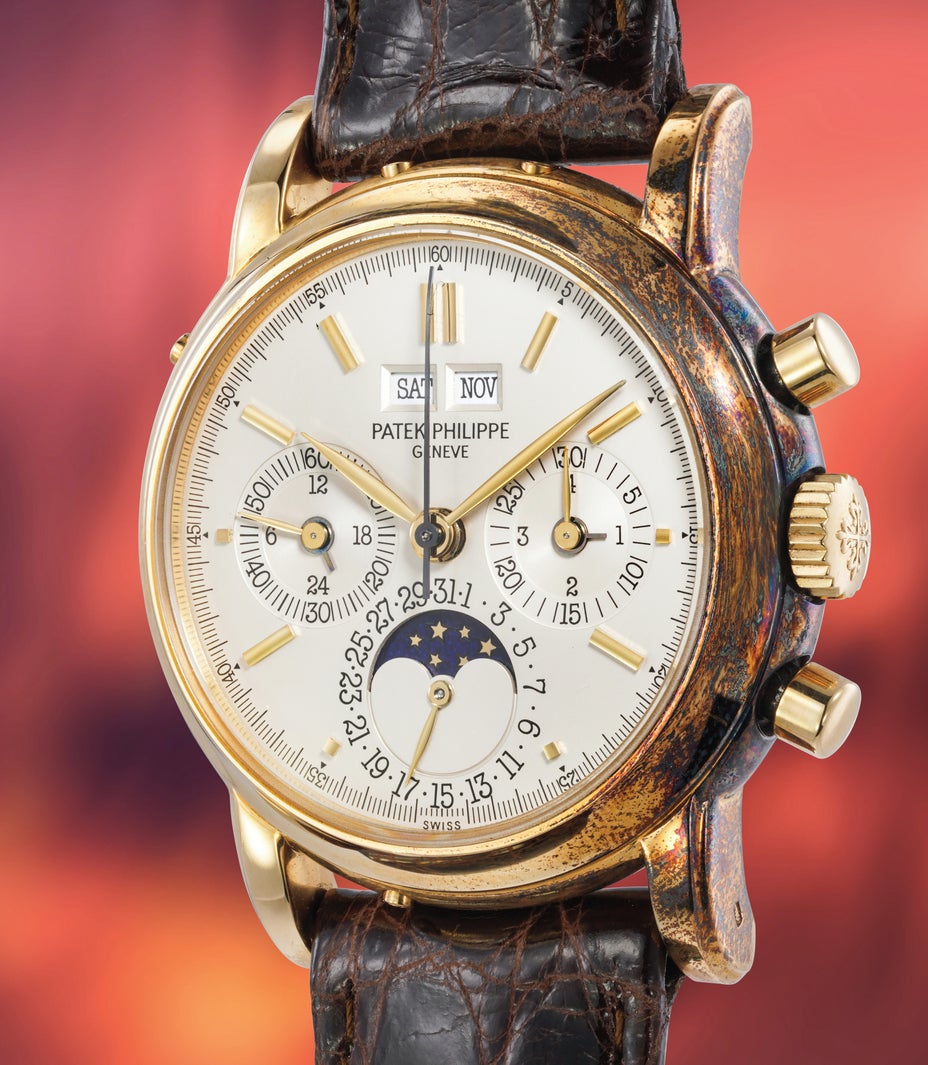
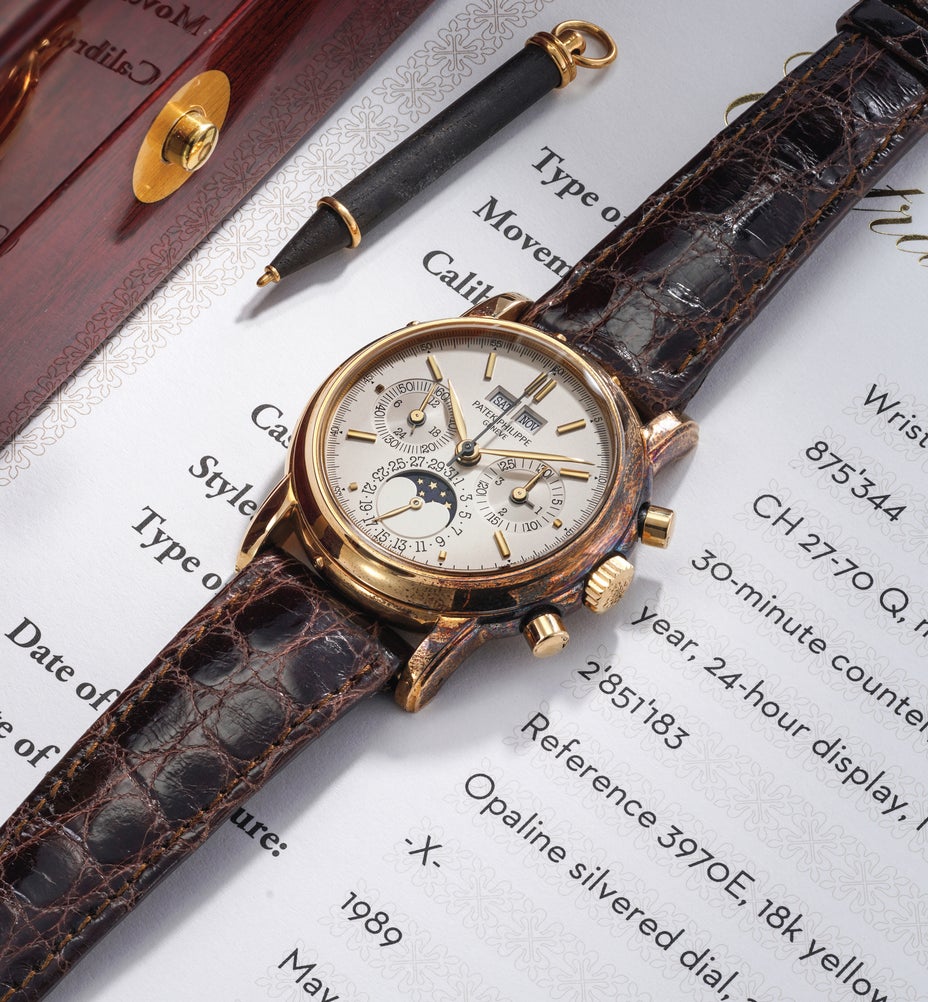
A highly rare and exceptionally well-preserved yellow gold " 2nd series" perpetual calendar chronograph wristwatch with moonphases, 24-hour, leap year indication and box
Full-Cataloguing
- Perpetual calendar chronograph
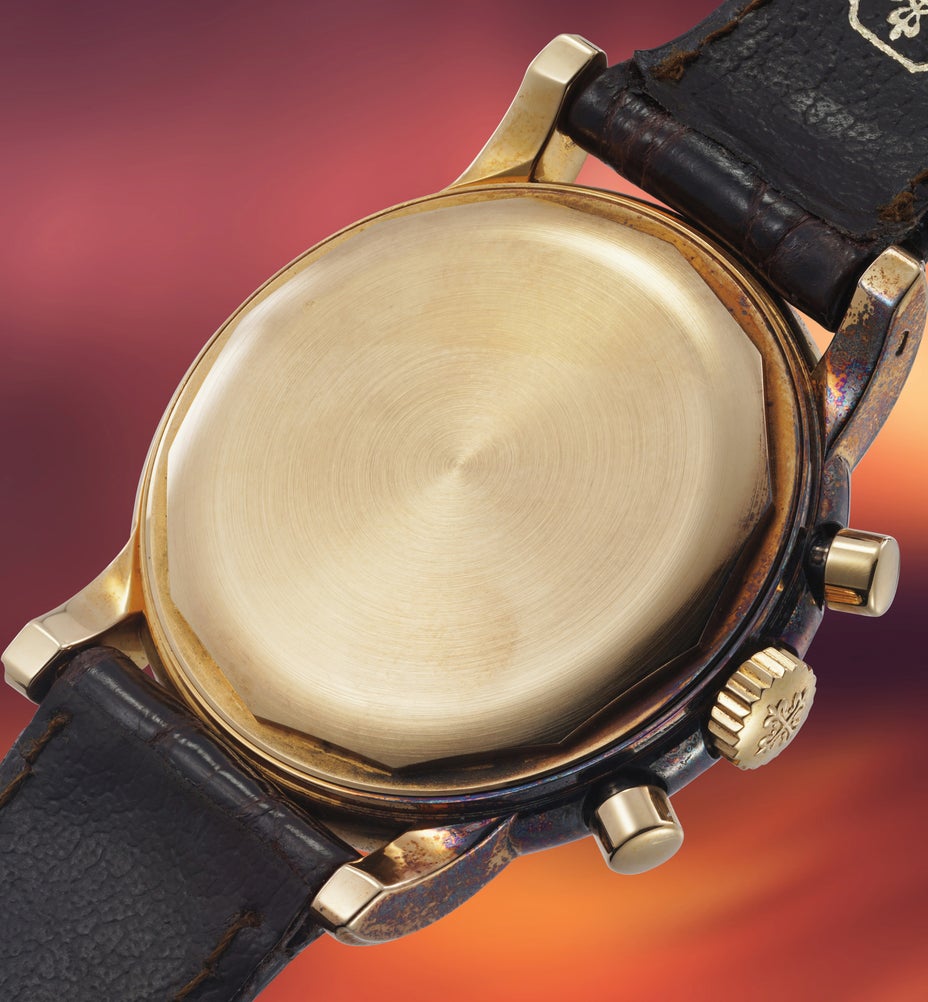
- Part of the coveted second series with screw down caseback
- Appealing oxydation to the case demonstrating the watch has been hardly ever worn
Introduced in 1986 as the successor to the revered Patek Philippe reference 2499, the reference 3970 marked a clear shift in Patek Philippe’s perpetual calendar chronograph lineage. While the overall spirit of earlier references such as the Patek Philippe references 1518 and 2499 remained intact, the mechanics moved forward. For the first time, the model stepped away from the Valjoux-based calibres of its predecessors, adopting a heavily reworked Lemania ébauche as its base.
The layout remained reassuringly familiar, though the watch introduced a few practical additions—most notably a leap-year indication and a 24-hour display, both new to the lineage at the time.
Produced for nearly twenty years, the reference 3970 appeared in yellow, pink, and white gold, as well as platinum. Over that period, it evolved through four distinct series.
The first series (1986–1988) was fitted with a snap-back case and feuille hands and was produced exclusively in yellow gold. Production is believed to have been around 100 examples.
The second series (1987–1990)—to which the present watch belongs—introduced a screw-down caseback engraved “E – Étanche,” while retaining the feuille hands. It was available across all four metals, with approximately 450 examples produced in total.
The third series (1989–1995) saw the addition of a sapphire display back, baton hands, and faceted indexes, giving the watch a slightly more contemporary appearance.
The fourth and final series (1994–2004) continued largely unchanged in appearance, though with updated movement and case numbers. Toward the end of production, a deployant clasp was also introduced.
The present example is a second-series watch from 1989, produced toward the end of that configuration and just prior to the introduction of the sapphire caseback.
Patek Philippe
Swiss | 1839Since its founding in 1839, this famous Geneva-based firm has been surprising its clientele with superbly crafted timepieces fitted with watchmaking's most prestigious complications. Traditional and conservative designs are found across Patek Philippe's watches made throughout their history — the utmost in understated elegance.
Well-known for the Graves Supercomplication — a highly complicated pocket watch that was the world’s most complicated watch for 50 years — this family-owned brand has earned a reputation of excellence around the world. Patek's complicated vintage watches hold the highest number of world records for results achieved at auction compared with any other brand. For collectors, key models include the reference 1518, the world's first serially produced perpetual calendar chronograph, and its successor, the reference 2499. Other famous models include perpetual calendars such as the ref. 1526, ref. 3448 and 3450, chronographs such as the reference 130, 530 and 1463, as well as reference 1436 and 1563 split seconds chronographs. Patek is also well-known for their classically styled, time-only "Calatrava" dress watches, and the "Nautilus," an iconic luxury sports watch first introduced in 1976 as the reference 3700 that is still in production today.