232
Patek Philippe
Ref. 701
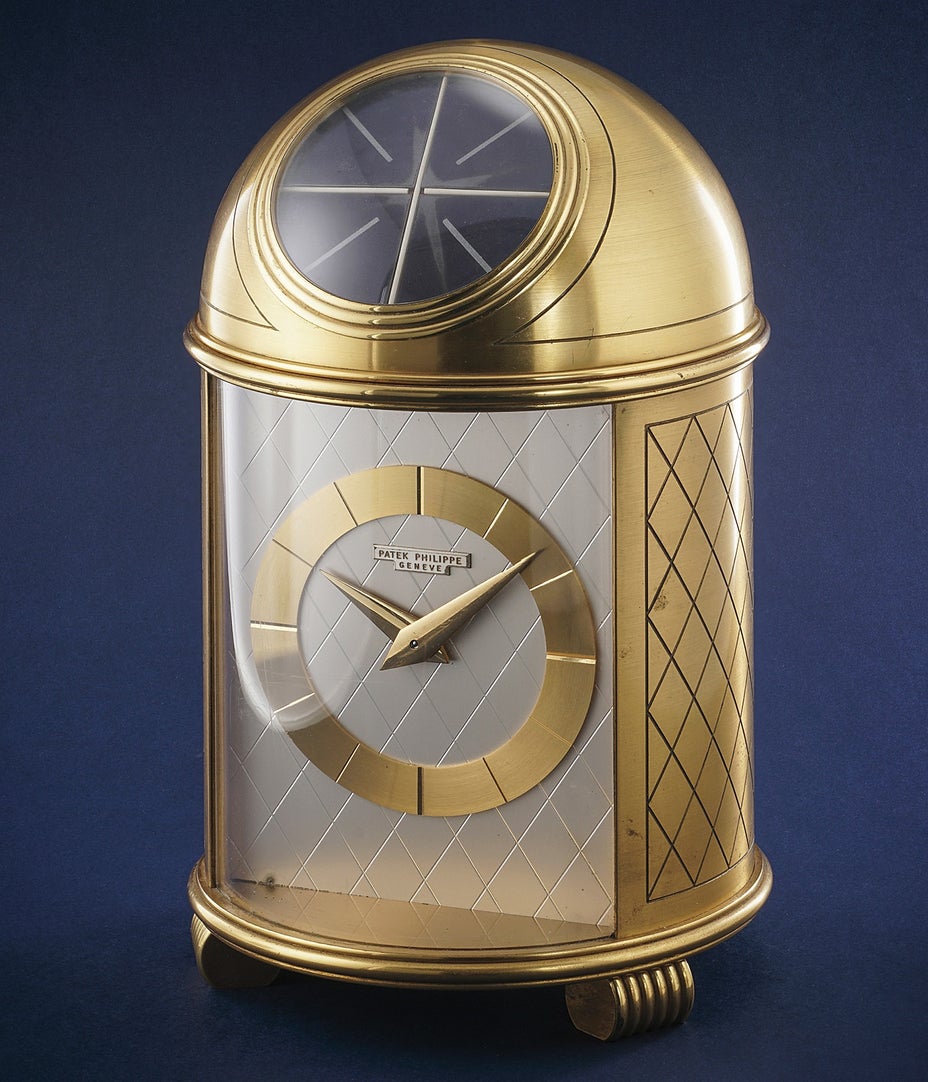
A fine and rare engraved gilt brass solar powered dome clock
Full-Cataloguing
Housing the Patek Philippe manual caliber 17-250, a small rotatable solar panel on the top of the dome supplies energy to a storage device within, which in turn transmits energy to power the mechanical movement.
In 1948 Patek Philippe opened its Electronic Division with the goal of exploring photoelectric, electronic, and nuclear timekeeping. The department is responsible for the creation of the groundbreaking solar clock, the first of its kind. A Swiss patent was awarded to Patek Philippe for clocks fitted with photo-electric cells. Patek Philippe's idea for a light-powered horological mechanism was to introduce additional electronic storage – an accumulator that provides the energy to wind the spring. The photoelectric cells can either store their energy electronically in the accumulator, or mechanically by winding the spring. When the mechanism is fully wound, the cells switch over to charge the accumulator.
The gilt brass case of the present model has been intricately and painstakingly hand engraved with an “engraved lozenges” motif giving the clock a charismatic sophistication.
Patek Philippe
Swiss | 1839Since its founding in 1839, this famous Geneva-based firm has been surprising its clientele with superbly crafted timepieces fitted with watchmaking's most prestigious complications. Traditional and conservative designs are found across Patek Philippe's watches made throughout their history — the utmost in understated elegance.
Well-known for the Graves Supercomplication — a highly complicated pocket watch that was the world’s most complicated watch for 50 years — this family-owned brand has earned a reputation of excellence around the world. Patek's complicated vintage watches hold the highest number of world records for results achieved at auction compared with any other brand. For collectors, key models include the reference 1518, the world's first serially produced perpetual calendar chronograph, and its successor, the reference 2499. Other famous models include perpetual calendars such as the ref. 1526, ref. 3448 and 3450, chronographs such as the reference 130, 530 and 1463, as well as reference 1436 and 1563 split seconds chronographs. Patek is also well-known for their classically styled, time-only "Calatrava" dress watches, and the "Nautilus," an iconic luxury sports watch first introduced in 1976 as the reference 3700 that is still in production today.