
25
Pablo Picasso
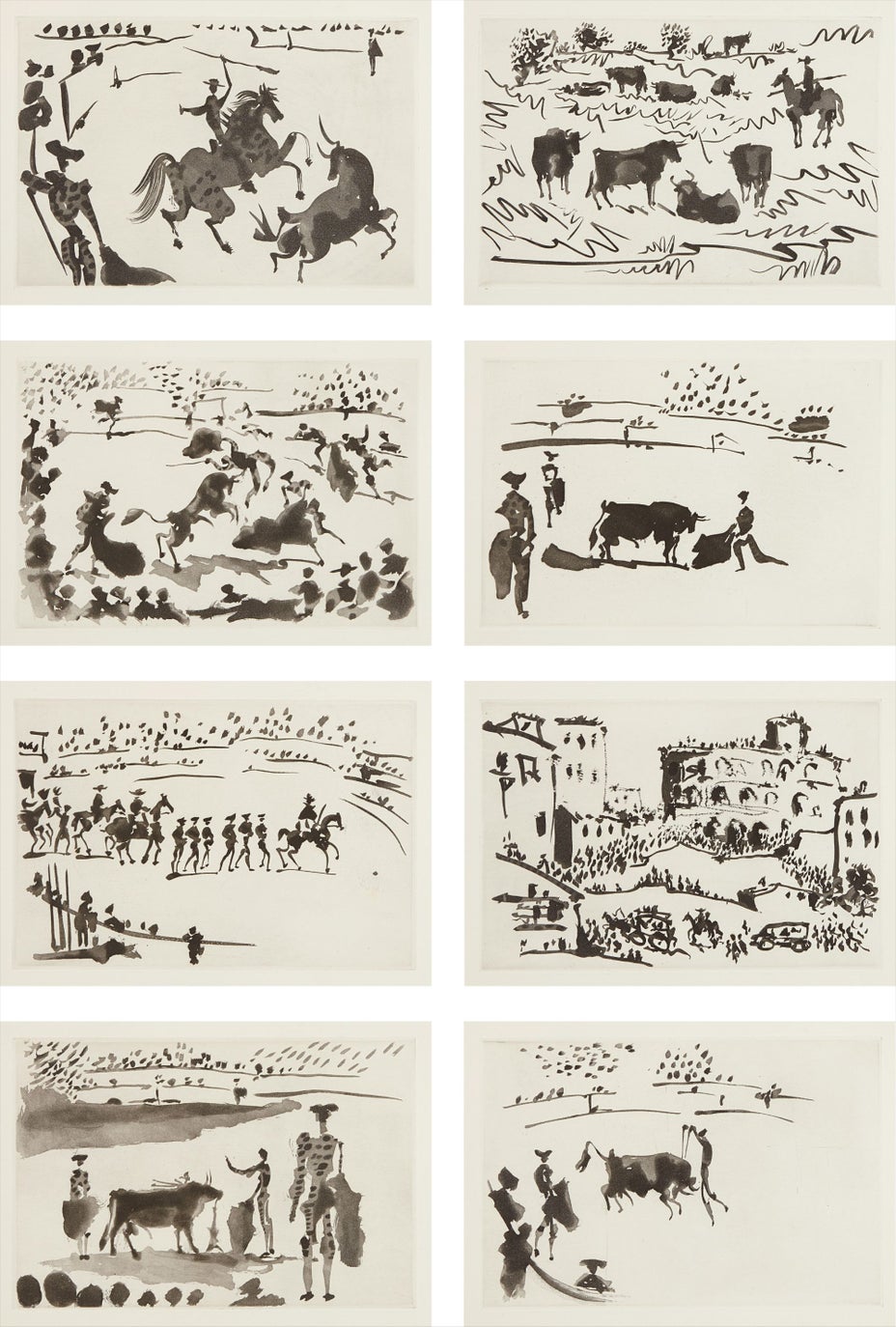
La Tauromaquia
- Estimate
- $30,000 - 40,000
$37,500
Lot Details
The complete set of 26 aquatints, on Guarro paper with Bull's Head watermark designed by the artist, with full margins, with text by José Delgado (Pepe Illo), loose and the prints in paper folders, with title page, table of contents, text in Spanish and justification,
1959
20 1/2 x 14 3/4 in. (52.1 x 37.5 cm)
unsigned, copy 188 (from the total edition of 263), printed by Atelier Lacourière, Paris (aquatints) and Talleres de Jaume Pla, Barcelona (drypoints), published by Gustavo Gili: Ediciones de la Cometa, Barcelona, all contained in original parchment-covered boards with drypoint on the cover and the title in gilt on the spine, within the yellow cloth-covered slipcase.
Specialist
Full-Cataloguing
Catalogue Essay
This book was commissioned by Gustavo Gili, Senior, in 1927, for the collection of bibliophile books he published under the name of 'Ediciones de la Cometa'. Picasso alludes to this in the drypoint he made for the cover because it shows a kite; cometa in Spanish means kite. Picasso made a few prints for the book and then the wars in Spain and elsewhere put an end to the project. In 1956 Gustavo Gili, Junior, reminded Picasso of the book. In the spring of 1957, at Cannes, several days after the Easter corrida that the artist had attended at Arles, he started work again. Using a brush, he painted on the copperplates directly, creating a sort of 'stenogram' of light and shade, which is the modern equivalent of Goya's Tauromaquia of 1815. Picasso's 26 aquatints accompany the text written by the famous torero, Pepe Illo, his manual, which was published in 1796, was the first handbook for toreros and aficionados. Patrick Cramer Pablo Picasso, The Illustrated Books, 1983, p. 252.
Provenance
Literature
Pablo Picasso
Spanish | B. 1881 D. 1973One of the most dominant and influential artists of the 20th century, Pablo Picasso was a master of endless reinvention. While significantly contributing to the movements of Surrealism, Neoclassicism and Expressionism, he is best known for pioneering the groundbreaking movement of Cubism alongside fellow artist Georges Braque in the 1910s. In his practice, he drew on African and Iberian visual culture as well as the developments in the fast-changing world around him.Throughout his long and prolific career, the Spanish-born artist consistently pushed the boundaries of art to new extremes. Picasso's oeuvre is famously characterized by a radical diversity of styles, ranging from his early forays in Cubism to his Classical Period and his later more gestural expressionist work, and a diverse array of media including printmaking, drawing, ceramics and sculpture as well as theater sets and costumes designs.
Browse Artist