35Ο︎◆︎
Jenny Holzer
Red Yellow Looming
Estimate
£250,000–350,000‡︎
Sold For
£435,000
double-sided electronic signs with red and amber diodes, in 13 parts
each 13.3 x 276.9 x 10.2 cm (5 1/4 x 109 x 4 in.)
overall approx. 363.2 x 276.9 x 132.1 cm (142 7/8 x 109 x 52 in.)
overall approx. 363.2 x 276.9 x 132.1 cm (142 7/8 x 109 x 52 in.)
Executed in 2004.
Full-Cataloguing
The guiding light of Holzer’s practice is to make ‘the big issues in culture intelligible as public art’ (James Danzinger, ‘American Graffiti’, The Sunday Times Magazine, London, 4 December 1988, p. 5). Danzinger’s comment accurately surmises the guiding force of Holzer’s praxis, of which Red Yellow Looming is a paradigmatic example. A focus on the linguistic that is at once astute and incisive has consistently been Holzer’s modum operandi. Beginning as slogans on various ephemera such as posters, the artist’s works have become increasingly durable and monumental as she turned her attention towards mass media; and by freely appropriating texts from mass culture, Holzer examines, and prompts us to examine, the most pressing issues of our time. As Diane Waldman notes, ‘[Holzer’s works] seem permanent and totemic, no matter how swiftly her messages flash on and off the boards’ (Diane Waldman, ‘The Language of Signs’, Jenny Holzer, New York, 1989, p. 13). In a reversal of Marshall McLuhan’s famous pronouncement, Holzer transforms the message into medium.
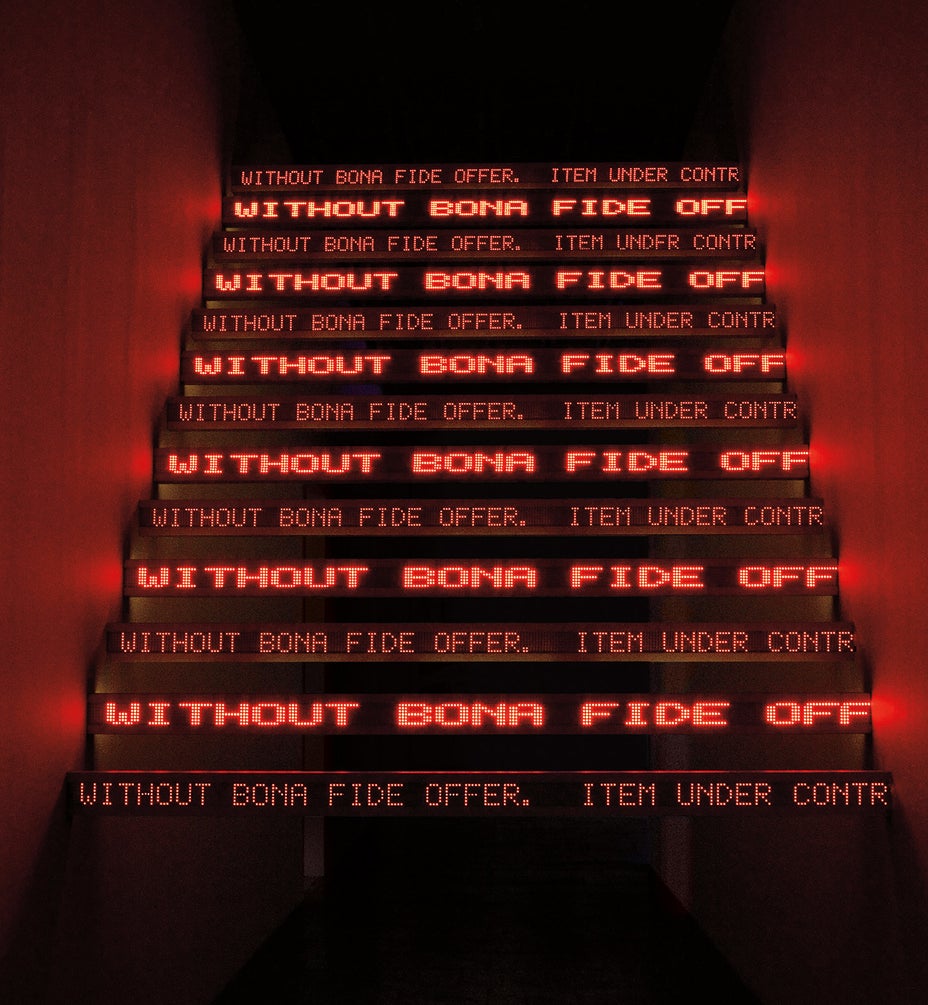
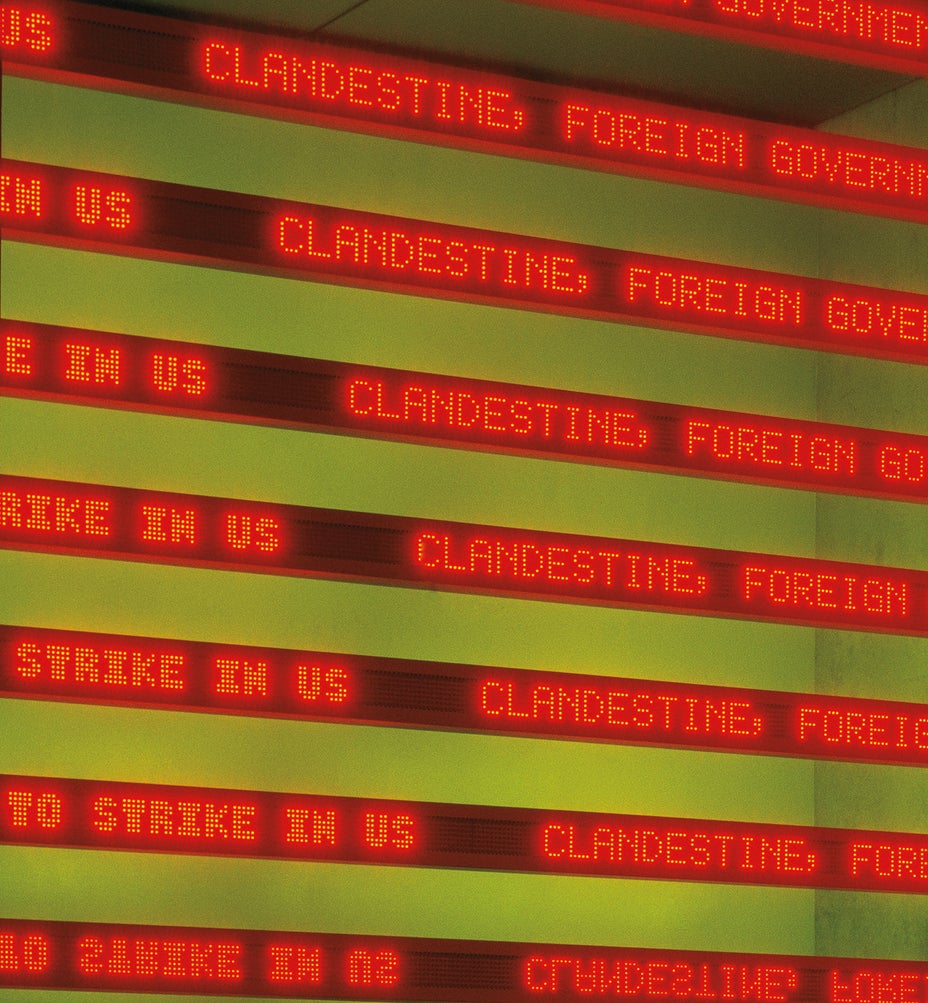
Red Yellow Looming, 2004, is a potently triumphant realisation of this. The work’s genesis was prompted by the events of 11 September and the 2003 invasion of Iraq. Dissatisfied with what she saw as gaps of information provided by press coverage, Holzer decided to address these lacunae herself by utilising declassified wording in governmental archive that had been released under the Freedom of Information Act and redacted to varying degrees. The 13 LED tickers which comprise Red Yellow Looming bathe the surrounding space with a striking red glow, and signify an unapologetically honest call to think critically about our social and human conscience. Through their internal redacted logic these documents dance between the harrowing and the poetic as they repeat across the screens. Repetition paradoxically blunts and intensifies simultaneously – an enigma which Andy Warhol famously explored with his Disaster silkscreens. Yet Holzer eschews the need for graphic violence, and successfully achieves her aims with text alone.
Holzer’s work shares affinities with the conceptual, language-based art of her predecessors such as Joseph Kosuth and Art & Language. Yet where Kosuth and Art & Language insisted on an output that was insistently cerebral and deliberately impenetrable to anyone outside a small circle of cognoscenti, Holzer capitalises on language as a common denominator in interpersonal communication, acting as the Rosetta Stone to text-based art. The centrality of location to creating the meaning of Holzer’s works means that her work can also claim the seminal work of 1960s Minimalists such as Dan Flavin in her genealogy of influence. Blurring the boundaries between poetry, installation and advertising, Holzer’s practice occupies a unique place in the world of contemporary art.
Holzer’s LED philosophies can be seen on both sides of the Atlantic, historically occupying both the iconic billboard spaces of Times Square in New York City and Piccadilly Circus in London. Her projections have illuminated the façades of the Berlin Reichstag and the Louvre Pyramid in Paris. Outside the public sphere, Holzer has had solo exhibitions at some of the most prestigious venues within the institutional domain. For her 1989-90 retrospective at the Solomon R. Guggenheim Museum in New York, Holzer created a site-specific LED sign that wound its way around the parapet of the museum’s renowned rotunda. The artist was awarded the Golden Lion at the 1990 Venice Biennale, where she was the first woman to represent the United States, and featured in the eighth edition of the quinquennial survey documenta.
Using the intersection of message, medium and the public arena to identify and comment upon contradictions and extreme situations in society in the most neutral voice and in a laconic but sincere style Holzer attributes to her Midwestern background. ‘Midwesteners are impatient with things that are too elaborate or too silly. They want to get things done so they do it in the most expeditious way – expeditious as in fast and right’ (Bruce Ferguson, ‘Wordsmith: An Interview with Jenny Holzer by Bruce Ferguson’, Jenny Holzer: Signs, exh. cat., Des Moines Art Center, Des Moines, 1971, p. 66).
Red Yellow Looming, 2004, is a potently triumphant realisation of this. The work’s genesis was prompted by the events of 11 September and the 2003 invasion of Iraq. Dissatisfied with what she saw as gaps of information provided by press coverage, Holzer decided to address these lacunae herself by utilising declassified wording in governmental archive that had been released under the Freedom of Information Act and redacted to varying degrees. The 13 LED tickers which comprise Red Yellow Looming bathe the surrounding space with a striking red glow, and signify an unapologetically honest call to think critically about our social and human conscience. Through their internal redacted logic these documents dance between the harrowing and the poetic as they repeat across the screens. Repetition paradoxically blunts and intensifies simultaneously – an enigma which Andy Warhol famously explored with his Disaster silkscreens. Yet Holzer eschews the need for graphic violence, and successfully achieves her aims with text alone.
Holzer’s work shares affinities with the conceptual, language-based art of her predecessors such as Joseph Kosuth and Art & Language. Yet where Kosuth and Art & Language insisted on an output that was insistently cerebral and deliberately impenetrable to anyone outside a small circle of cognoscenti, Holzer capitalises on language as a common denominator in interpersonal communication, acting as the Rosetta Stone to text-based art. The centrality of location to creating the meaning of Holzer’s works means that her work can also claim the seminal work of 1960s Minimalists such as Dan Flavin in her genealogy of influence. Blurring the boundaries between poetry, installation and advertising, Holzer’s practice occupies a unique place in the world of contemporary art.
Holzer’s LED philosophies can be seen on both sides of the Atlantic, historically occupying both the iconic billboard spaces of Times Square in New York City and Piccadilly Circus in London. Her projections have illuminated the façades of the Berlin Reichstag and the Louvre Pyramid in Paris. Outside the public sphere, Holzer has had solo exhibitions at some of the most prestigious venues within the institutional domain. For her 1989-90 retrospective at the Solomon R. Guggenheim Museum in New York, Holzer created a site-specific LED sign that wound its way around the parapet of the museum’s renowned rotunda. The artist was awarded the Golden Lion at the 1990 Venice Biennale, where she was the first woman to represent the United States, and featured in the eighth edition of the quinquennial survey documenta.
Using the intersection of message, medium and the public arena to identify and comment upon contradictions and extreme situations in society in the most neutral voice and in a laconic but sincere style Holzer attributes to her Midwestern background. ‘Midwesteners are impatient with things that are too elaborate or too silly. They want to get things done so they do it in the most expeditious way – expeditious as in fast and right’ (Bruce Ferguson, ‘Wordsmith: An Interview with Jenny Holzer by Bruce Ferguson’, Jenny Holzer: Signs, exh. cat., Des Moines Art Center, Des Moines, 1971, p. 66).
Jenny Holzer
American | 1950Jenny Holzer is a Conceptual artist best known for her text-based public art projects. Holzer's work speaks of violence, oppression, sexuality, feminism, power, war and death. Throughout the years, Holzer has employed a variety of media, from a T-shirt to a plaque to an LED sign. Starting in the 1970s with the New York City posters, and continuing through her recent light projections on landscape and architecture, she uses her art as a form of communication and commentary. Holzer's art hangs in important collections around the globe including 7 World Trade Center, the Venice Biennale, the Guggenheim Museums in New York and Bilbao and the Whitney Museum of American Art.