1094
Jaeger-LeCoultre
Atmos Marqueterie “Gustav Klimt”
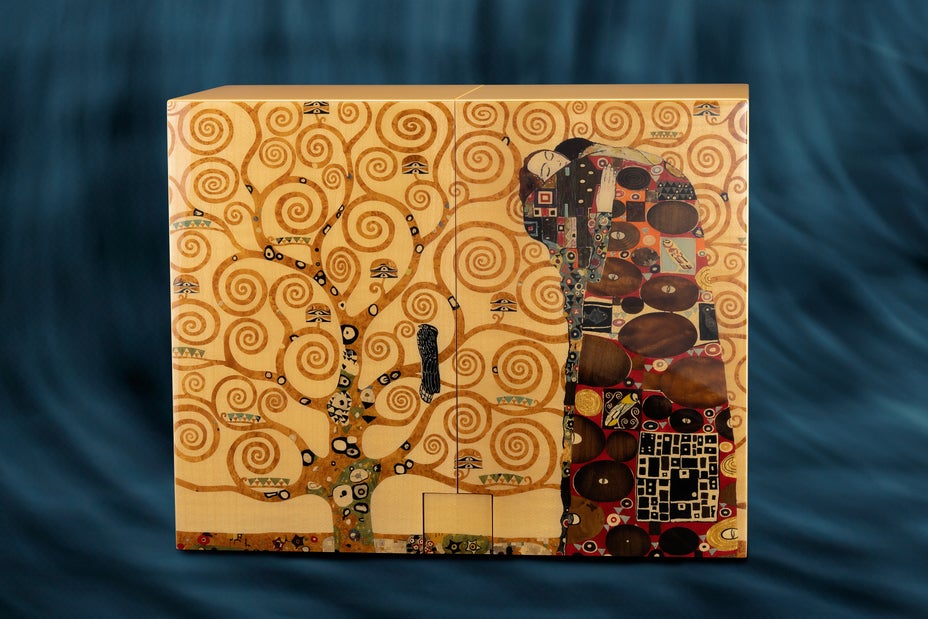
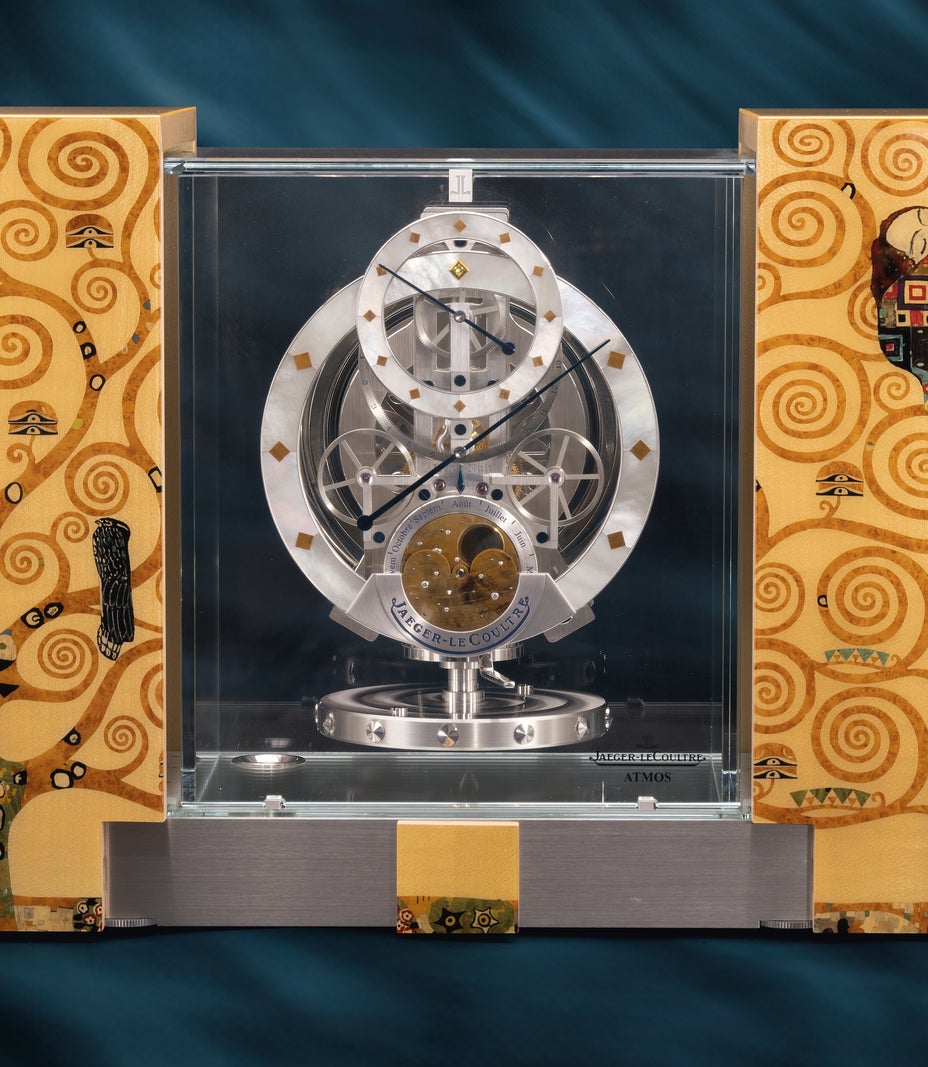
An exceptionally rare and exquisite limited edition wood marquetry, yellow sapphire and diamond-set Atmos clock with wood marquetry reproducing details from “Stoclet Frieze”, a series of mosaics created by Gustav Klimt for the Stoclet Palace, mother-of-pearl regulator-style dial, 24-hour, month indication and moon phases, numbered 10 of a limited edition of 10 pieces
Full-Cataloguing
- Revolutionary clock mechanism running on air
- Limited edition numbered 10 out of 10
- Immaculate condition
In 1928, engineer Jean‑Léon Reutter developed a revolutionary clock mechanism capable of living quite literally “on air.” Placed into production by Jaeger‑LeCoultre in the 1930s, the Atmos quickly became a design icon, running from the smallest variations in atmospheric temperature. Nicknamed the “President’s Clock,” it was long adopted as the official diplomatic gift of the Swiss Confederation.
To commemorate the 80th anniversary of its iconic Atmos clock in 2008, Jaeger-LeCoultre unveiled a limited-edition masterpiece: an Atmos housed within a crystal glass case and a cabinet adorned with exquisite wood marquetry. Inspired by Gustav Klimt’s luminous 1907 portrait of Adele Bloch-Bauer, the piece faithfully reproduced the painting using over 1,200 individual wood veneers—a breathtaking fusion of horology and fine art. This marked the beginning of a lasting tribute, as the brand has since returned to Klimt’s oeuvre, reimagining celebrated works such as The Kiss and Judith in intricate wooden inlay. Phillips was pleased to offer the edition depicting “Judith I” in our Fall 2025 Hong Kong Watch Auction: XXI.
In 2015, the Swiss maison introduces its fifth Atmos homage to Klimt (present example), drawing from his celebrated 1905 mural cycle for Brussels’ Stoclet Palace, a trio of mosaics portraying a standing female figure, the swirling “Tree of Life” – as seen on the left side of the cabinet, and an embracing couple as seen on the right. Where the earlier Atmos “The Waiting” centered on the solitary female, the new edition, aptly named “Fulfillment,” turns its focus to the lovers, capturing their intimate union.
Jaeger-LeCoultre’s artisans have translated this opulent mosaic entirely into the language of wood. Without a single stroke of paint, they’ve rendered Klimt’s luminous palette and intricate detail through a selection of rich veneers such as walnut, Madrona burl, Pau Amarello, and more, each piece meticulously cut and placed by hand.
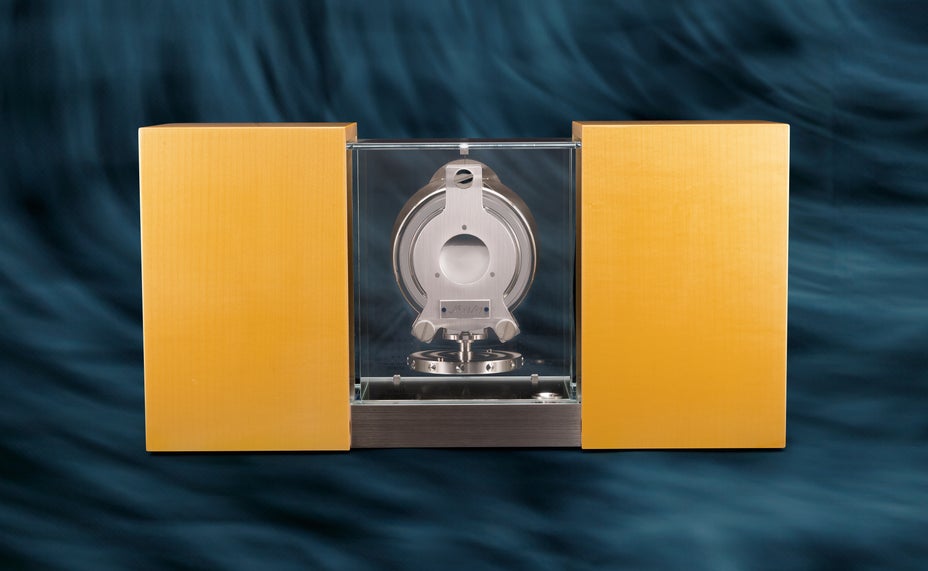
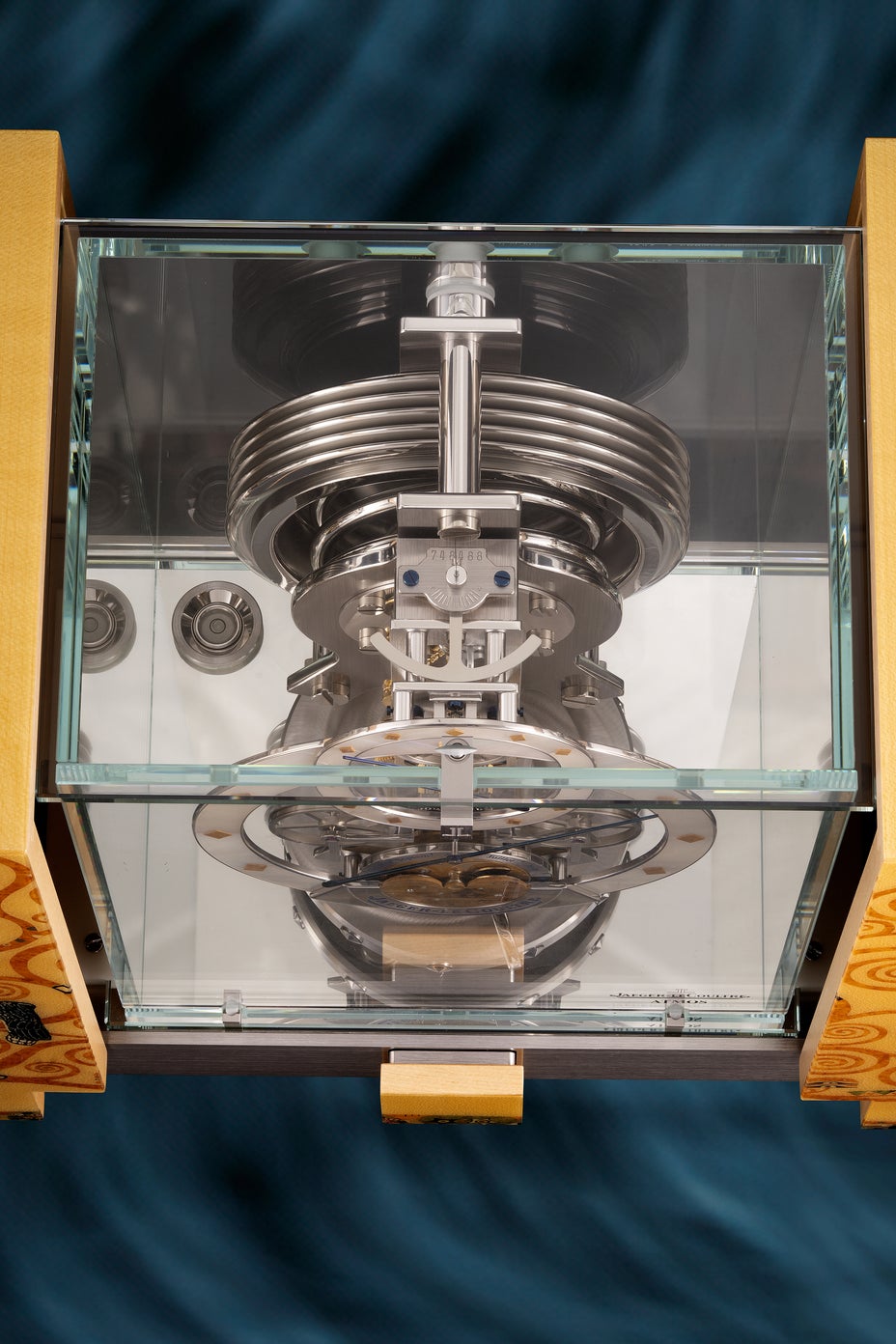
A hidden button opens the cabinet to reveal the Atmos mechanism, safeguarded by rhodium plated crystal glass. The mother of pearl dial adopts a regulator display: hours at 12, the sweeping minutes at center, months and moon phases at 6. Ornamentation is of jewelled sophistication: a cushion cut yellow sapphire at 60 minutes mark, petrified wood indexes enrich the scale on the mother-of-pearl inlay, and a diamond set golden moon graces the lunar aperture. Blue varnished hands provide a refined finishing touch.
At the heart of the clock beats the Jaeger LeCoultre cal. 582, distinguished by its architectural elegance and mechanical poetry. Driven by a hermetically sealed capsule of gases that expand and contract with temperature changes, the mechanism winds the mainspring in a cycle of near perpetual motion. Its moon phases display is astonishingly precise: deviating by only one day in every 3,821 years. More than a timekeeper, this Atmos stands as a portable monument to artisanal devotion, where the warmth of wood meets the golden glow of Klimt’s vision.
Jaeger-LeCoultre
Swiss | 1833Not all companies in the watchmaking field have been able to stand the test of time quite like Jaeger LeCoultre, also known as the "watchmaker's watchmaker." Founded in 1833 by Antoine LeCoultre and originally named LeCoutre, the firm provided watchmaking's top brands, such as Patek Philippe, Vacheron Constantin and Audemars Piguet, the high-grade, unfinished mechanical movements with which they completed their watches.
In the early 1900s, Cartier's watch supplier Edmond Jaeger sought out LeCoultre's help in creating the world's thinnest watches. The collaboration resulted in the creation of Cartier's earliest Tank and Santos watches, all housed with LeCoultre movements. The duo decided to merge in 1937, and the firm officially became the Jaeger-LeCoultre brand by which collectors know and adore it today. Some of the firm's most significant and important timepieces include the Reverso, the Memovox, the Atmos clock and, among modern watches, their Master Complications.