28
George Condo
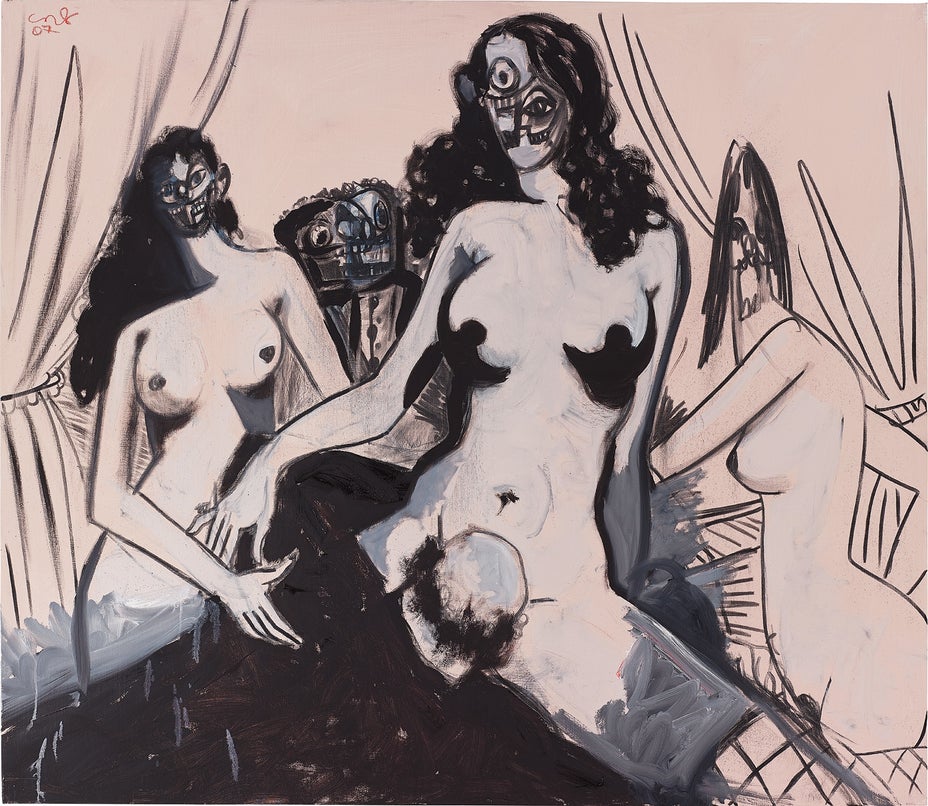
The Monk at the Brothel
Estimate
£400,000–600,000‡︎
signed and dated 'Condo 07' upper left
acrylic and charcoal on canvas
116.8 x 134.6 cm (46 x 53 in.)
Executed in 2007.
Full-Cataloguing
Evincing elements both delicate and strange, rigorous and unbridled, The Monk at the Brothel, 2007, exemplifies George Condo’s captivating collection of ‘drawing paintings’, a series of works that strives to dissolve the perceived boundaries between painting and drawing. Exemplary of the artist’s ability to capture the complexity of human encounters and emotions, the canvas presents three nude women engaging in ambiguously tactile relations, each endowed with a frenetic grimace that ‘goes between a scream and a smile’ (George Condo, quoted in ‘George Condo: Interview’, Time Out, 6 February 2007, online). Following Condo’s significant solo exhibition held at the Wrong Gallery, Tate Modern, London, in 2006, the present work, painted one year later, epitomises the artist's singular and iconic approach to portraiture.
After briefly working at Andy Warhol’s Factory studio in New York, at 23 Condo emerged alongside a new generation of artists including Jean-Michel Basquiat and Keith Haring. He quickly garnered success in the early 1980s, making idiosyncratically facetious imitations of Old Master paintings. Cultivating an irreverent spirit throughout his career, the artist continuously took inspiration from a number of artistic movements and masters. He remarked: ‘The only way for me to feel the difference between every other artist and me is to use every artist to become me’ (George Condo, quoted in Stuart Jeffries, ‘George Condo: “I was delirious. Nearly died”', The Guardian, 10 February 2014, online).
Boasting a dizzyingly tortuous aesthetic, The Monk at the Brothel stems from such amalgamated visual references. Drawing from an art historical tradition of figurative distortion, the composition is redolent of Pablo Picasso’s geometric forms and congruous angles, most strikingly deployed in his Demoiselles d’Avignon, 1907. Touching on the different aesthetic elements that define his self-termed genre of ‘psychological cubism’, Condo conjures an image that marries figuration and abstraction. As such, he has been dubbed the ‘missing link’ connecting the figurative tradition heralded by the likes of Rembrandt and Frans Hals and the abstract and expressive liberties taken by contemporaries such as John Currin and Jenny Saville.
Balancing innocuous acrylic washes and unforgiving charcoal lines, The Monk at the Brothel, replicates its formal dichotomy within the scene it composes, arranging the three women’s bodies in a way that suggests both empowerment and submission. Seized by the viewer’s gaze and the presence of an anonymous onlooker behind the curtains, the three lady protagonists epitomise ‘the sense of the female form prey to the vicissitudes and arbitrary geometry of posing in a constant theme of Condo's unedited female disasters’ (Simon Baker, Painting Reconfigured, London, 2015, pp. 198-199).
Revelling in the sensual nightlife energy made famous by Édouard Manet and Henri de Toulouse-Lautrec, in the present work, Condo’s characters emerge from a distinct nineteenth century décor, fashioned by ornate, theatrical curtains framing each side of the canvas. The viewer is invited into an intimate yet entirely bare scene that straddles comedy and tragedy, investigating the boundaries of psycho-sexual drama. Animated through hectic angles and fragmented bodily contortions, The Monk at the Brothel exudes an arresting charisma, that is at once serene and frenzied.
After briefly working at Andy Warhol’s Factory studio in New York, at 23 Condo emerged alongside a new generation of artists including Jean-Michel Basquiat and Keith Haring. He quickly garnered success in the early 1980s, making idiosyncratically facetious imitations of Old Master paintings. Cultivating an irreverent spirit throughout his career, the artist continuously took inspiration from a number of artistic movements and masters. He remarked: ‘The only way for me to feel the difference between every other artist and me is to use every artist to become me’ (George Condo, quoted in Stuart Jeffries, ‘George Condo: “I was delirious. Nearly died”', The Guardian, 10 February 2014, online).
Boasting a dizzyingly tortuous aesthetic, The Monk at the Brothel stems from such amalgamated visual references. Drawing from an art historical tradition of figurative distortion, the composition is redolent of Pablo Picasso’s geometric forms and congruous angles, most strikingly deployed in his Demoiselles d’Avignon, 1907. Touching on the different aesthetic elements that define his self-termed genre of ‘psychological cubism’, Condo conjures an image that marries figuration and abstraction. As such, he has been dubbed the ‘missing link’ connecting the figurative tradition heralded by the likes of Rembrandt and Frans Hals and the abstract and expressive liberties taken by contemporaries such as John Currin and Jenny Saville.
Balancing innocuous acrylic washes and unforgiving charcoal lines, The Monk at the Brothel, replicates its formal dichotomy within the scene it composes, arranging the three women’s bodies in a way that suggests both empowerment and submission. Seized by the viewer’s gaze and the presence of an anonymous onlooker behind the curtains, the three lady protagonists epitomise ‘the sense of the female form prey to the vicissitudes and arbitrary geometry of posing in a constant theme of Condo's unedited female disasters’ (Simon Baker, Painting Reconfigured, London, 2015, pp. 198-199).
Revelling in the sensual nightlife energy made famous by Édouard Manet and Henri de Toulouse-Lautrec, in the present work, Condo’s characters emerge from a distinct nineteenth century décor, fashioned by ornate, theatrical curtains framing each side of the canvas. The viewer is invited into an intimate yet entirely bare scene that straddles comedy and tragedy, investigating the boundaries of psycho-sexual drama. Animated through hectic angles and fragmented bodily contortions, The Monk at the Brothel exudes an arresting charisma, that is at once serene and frenzied.
George Condo
AmericanPicasso once said, "Good artists borrow, great artists steal." Indeed, American artist George Condo frequently cites Picasso as an explicit source in his contemporary cubist compositions and joyous use of paint. Condo is known for neo-Modernist compositions staked in wit and the grotesque, which draw the eye into a highly imaginary world.
Condo came up in the New York art world at a time when art favored brazen innuendo and shock. Student to Warhol, best friend to Basquiat and collaborator with William S. Burroughs, Condo tracked a different path. He was drawn to the endless inquiries posed by the aesthetics and formal considerations of Caravaggio, Rembrandt and the Old Masters.