271
David Hockney
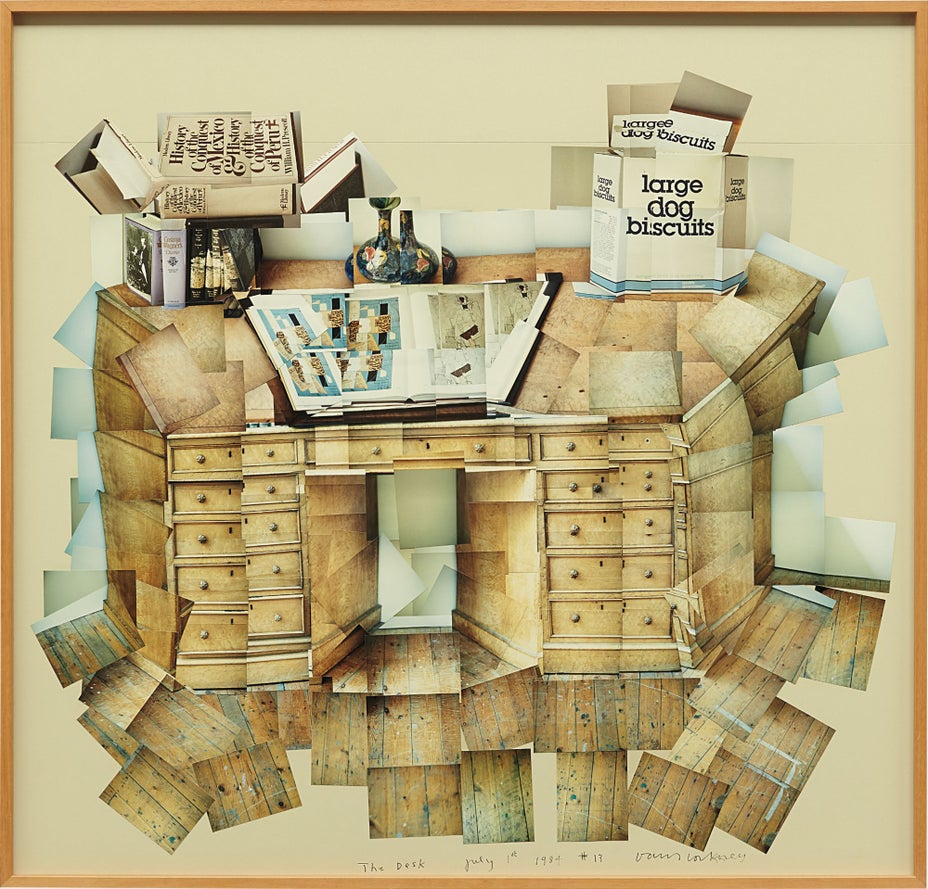
The Desk, July 1st
Full-Cataloguing
The Desk, July 1st, shown in the current lot, is largely recognized as one of Hockney’s most ambitious and important joiners. Taken in 1984, the joiner depicts what at first glance appears to be a work desk, comprised of dozens of individual images that collectively imbue the desk with a deeply three-dimensional feel. By doing so, Hockney blurs the line between photography and sculpture. Similarly, the books and boxes atop the desk are portrayed from multiple angles and in different stages of being opened and utilized, infusing the image with the passage of time and movement.
To further emphasize his intention, sitting atop the desk is a book open to a page depicting Pablo Picasso’s Guitar, 1913, a superb example of Cubism, the style the Spanish artist had founded with his peer Georges Braque. “Many think Cubism is an art of transition, an experiment which is to bring ulterior motives,” Picasso stated in 1923. “Those who think that way have not understood it. Cubism is not either a seed or a fetus, but an art dealing primarily with forms, and when a form is realized it is there to live its own life.” Picasso’s collage of the guitar is comprised of images and shapes culled from different mediums and sources. As such, it eschews a stylistic alliance with any traditional art forms in favor of pioneering a new, hybrid style that draws on the strength of different art forms. By positioning Picasso’s Guitar at the center of his own work, Hockney aligns The Desk, July 1st, with Picasso’s earlier masterpiece, proud to herald his own avant-garde style, breaking conventions and further solidifying his unique contribution to the field of photographs.
David Hockney
British | B. 1937 D. 2026David Hockney is one of the most celebrated artists of the 20th and 21st centuries. With a career spanning over seven decades, Hockney’s practise embraced many mediums including painting, edition-making, and collage, with his more recent digital iPad drawings defining the later part of his career. From semi-abstract representations of domestic life and vibrant still-lifes, to detailed portraits of his closest friends, Hockney’s artworks are nothing short of electric, reflecting the eccentric personality of one of Britain’s greatest artists.
Hockney’s works have been exhibited at the Museum of Modern Art in New York, the Royal Academy of Arts in London and the Van Gogh Museum in Amsterdam, among many other institutions. On the secondary market, his work has sold for more than $90 million.