48
David Hockney
Caribbean Tea Time
Full-Cataloguing
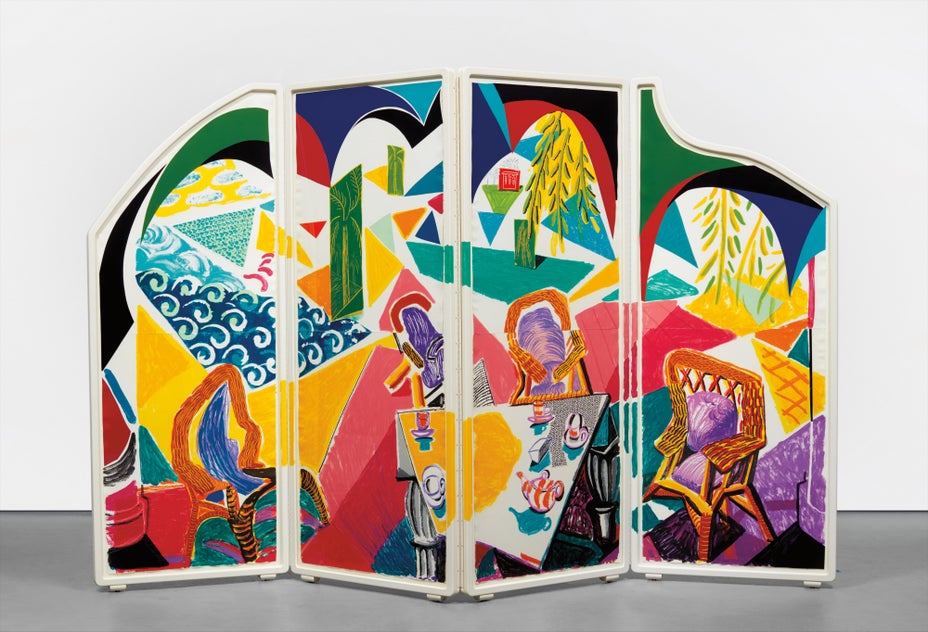
A masterwork by arguably the most influential and accomplished British artist of the 20th century, the leisurely scene of Caribbean Tea Time unfolds to encapsulate the artist’s celebrated use of bright colours akin to the heightened palette of Fauvism. This work depicts a distinct departure from Hockney’s iconic pictures from the 1960s of the backyards and shimmering pools of Los Angeles. In contrast to the bleached desert tones of the artist’s libertine Californian terrains, the present lot embodies the behavior of light and colours specific to the tropical climate of the islands surrounding the Caribbean Sea. Caribbean Tea Time illustrates the lucidity and richness of colors in an equatorial region of the world where light interacts differently with increased humidity in the environment. As such, jewel tones such as the amethyst cushions of the amber wicker chairs, the sapphire body of rippling water, ruby geometric shapes and emerald arches framing the work, add a lushness and playful quality to this scene.
Caribbean Tea Time exemplifies the artist’s devotion to portraying lived experience and his belief that representational painting expresses reality and perception with greater success than photorealist painting or even photography itself. Hockney explains that there is an “attitude to space and time” in his work; he asserts, “time is elastic. And I play with that idea” (David Hockney, “I Like to Live in the Now,” TateShots, December 20, 2016). In Caribbean Tea Time, Hockney illustrates the arms and legs of each wicker chair with an energy and sense of movement suggesting the presence of the space’s occupants without actually rendering human figures. With the implementation of a Cubistic approach to perspective, the artist further breaks from the notion of time as linear and from the restraints of a single vanishing point. In posing a challenge to the accepted narrative of Western art, Hockney utilises “reverse perspective,” a concept elaborated by Pavel Florensky in his 1920 essay of the same title. Hockney agrees with Florensky that the shifting viewpoints and absence of correct perspective of 14th-15th century Russian icons as well as Egyptian and Chinese art was not a mistake but rather a deliberate choice. Caribbean Tea Time thus showcases Hockney’s seamless combination of several perspectives to render a greater fullness and spaciousness in his works than real life.
The mastery of colour and reverse perspective in Caribbean Tea Time attests to David Hockney’s longstanding position as one of the most recognisable and lauded artists in the world who is still active today. The artist has been honoured in his 80th year with a major retrospective presenting his most iconic works from the past six decades of his career. Since February of 2017, this exhibition has travelled from Tate Britain, London, to The Centre Pompidou, Paris, and will complete its yearlong journey at the Metropolitan Museum of Art, New York City.
David Hockney
British | B. 1937 D. 2026David Hockney is one of the most celebrated artists of the 20th and 21st centuries. With a career spanning over seven decades, Hockney’s practise embraced many mediums including painting, edition-making, and collage, with his more recent digital iPad drawings defining the later part of his career. From semi-abstract representations of domestic life and vibrant still-lifes, to detailed portraits of his closest friends, Hockney’s artworks are nothing short of electric, reflecting the eccentric personality of one of Britain’s greatest artists.
Hockney’s works have been exhibited at the Museum of Modern Art in New York, the Royal Academy of Arts in London and the Van Gogh Museum in Amsterdam, among many other institutions. On the secondary market, his work has sold for more than $90 million.