24Ο︎
David Hockney
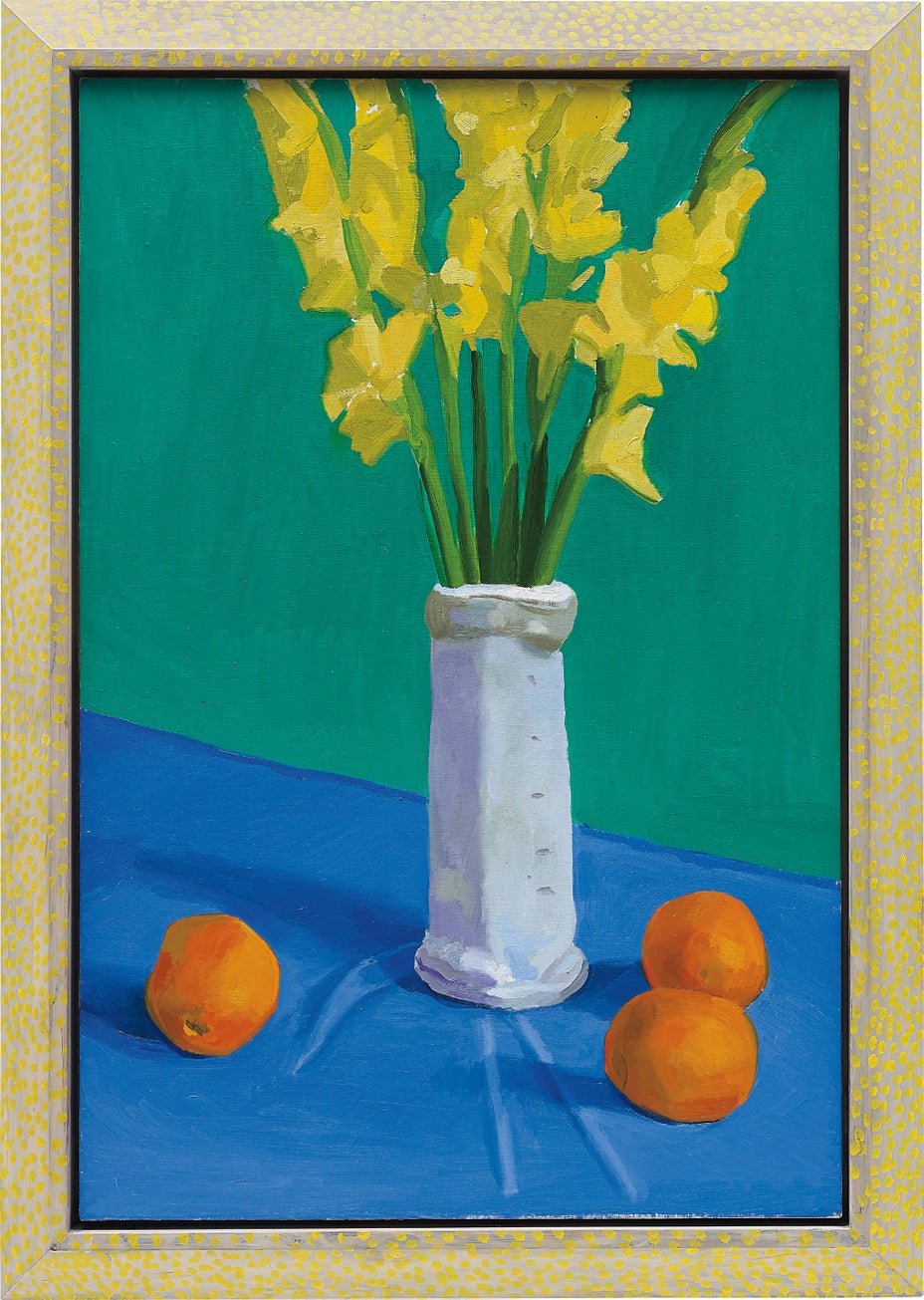
Three Oranges with a Vase
Full-Cataloguing
Born 1937 in the north of England and gaining critical acclaim in the 1960s, David Hockney is considered to be one of the most influential artists of our time. His remarkable oeuvre, which currently is subject of a major retrospective at Tate Britain in London, oscillates among the greatest avant-garde movements of the 20th century while simultaneously defying any strict categorization. While the subject matter of flowers had arguably already been an interest of Hockney’s at earlier stages of his career, they assumed an elevated position following his visit to the 1995 exhibition Claude Monet, 1840-1926 at the Art Institute of Chicago. "I came out of that exhibition and it made me look everywhere intensely. That little shadow on Michigan Avenue, the light hitting the leaf. I thought: 'My God, now I've seen it. He's made me see it'… I came out absolutely thrilled'" (David Hockney, quoted in Hockney on Art: Conversations with Paul Joyce, New York, 1999, p. 203).
Three Oranges with a Vase is testament to Hockney’s deep understanding of the venerable lineage of the floral still life motif within the pantheon of art history, while also exemplifying his broader pre-occupation with the experience of looking in the 1980s and 1990s. As is typical for paintings from this period, the present work is characterized by the colliding of flatness with the illusion of spatial depth: while the folds in the tablecloth, modulation of the oranges and the cast shadows articulate Hockney’s eye for veracity and imply three-dimensionality, the broad, simplified brushstrokes with which the gladiolus and the green backdrop are rendered essentially flatten the composition. At the same time, the artist’s frame is joyously decorated with all over yellow polka dots imbuing the entire object with a sense of levity and turning an otherwise two-dimensional painting into a near-three-dimensional tableau. Evoking Henri Matisse and Paul Cezanne, the seemingly straightforward composition of the floral still life ultimately becomes a means for exploring questions of color, form and space. This question of how we see the world, and how that world can be captured in two dimensions, is a concern that Hockney has pursued over six-decades of art-making to this day.
Hockney's intense occupation with the genre of still-life painting enabled him to focus on the pure act of painting and the pleasure inherent to it. As he once stated, "I think anyone who makes pictures loves it, it is a marvelous thing to dip a brush into paint and make marks on anything" (David Hockney, quoted in Nikos Stangos, ed., David Hockney by David Hockney, London, 1976, p. 28). The breadth and depth of Hockney’s creative endeavors all contribute to this seemingly straightforward, but deeply personal and revelatory, composition. Three Oranges with a Vase is an intimate vignette of a very specific period in the artist’s career, one that rewards a passing glance with immediate beauty and an extended viewing with a wealth of emotive information.
David Hockney
British | B. 1937 D. 2026David Hockney is one of the most celebrated artists of the 20th and 21st centuries. With a career spanning over seven decades, Hockney’s practise embraced many mediums including painting, edition-making, and collage, with his more recent digital iPad drawings defining the later part of his career. From semi-abstract representations of domestic life and vibrant still-lifes, to detailed portraits of his closest friends, Hockney’s artworks are nothing short of electric, reflecting the eccentric personality of one of Britain’s greatest artists.
Hockney’s works have been exhibited at the Museum of Modern Art in New York, the Royal Academy of Arts in London and the Van Gogh Museum in Amsterdam, among many other institutions. On the secondary market, his work has sold for more than $90 million.