

10
Cildo Meireles
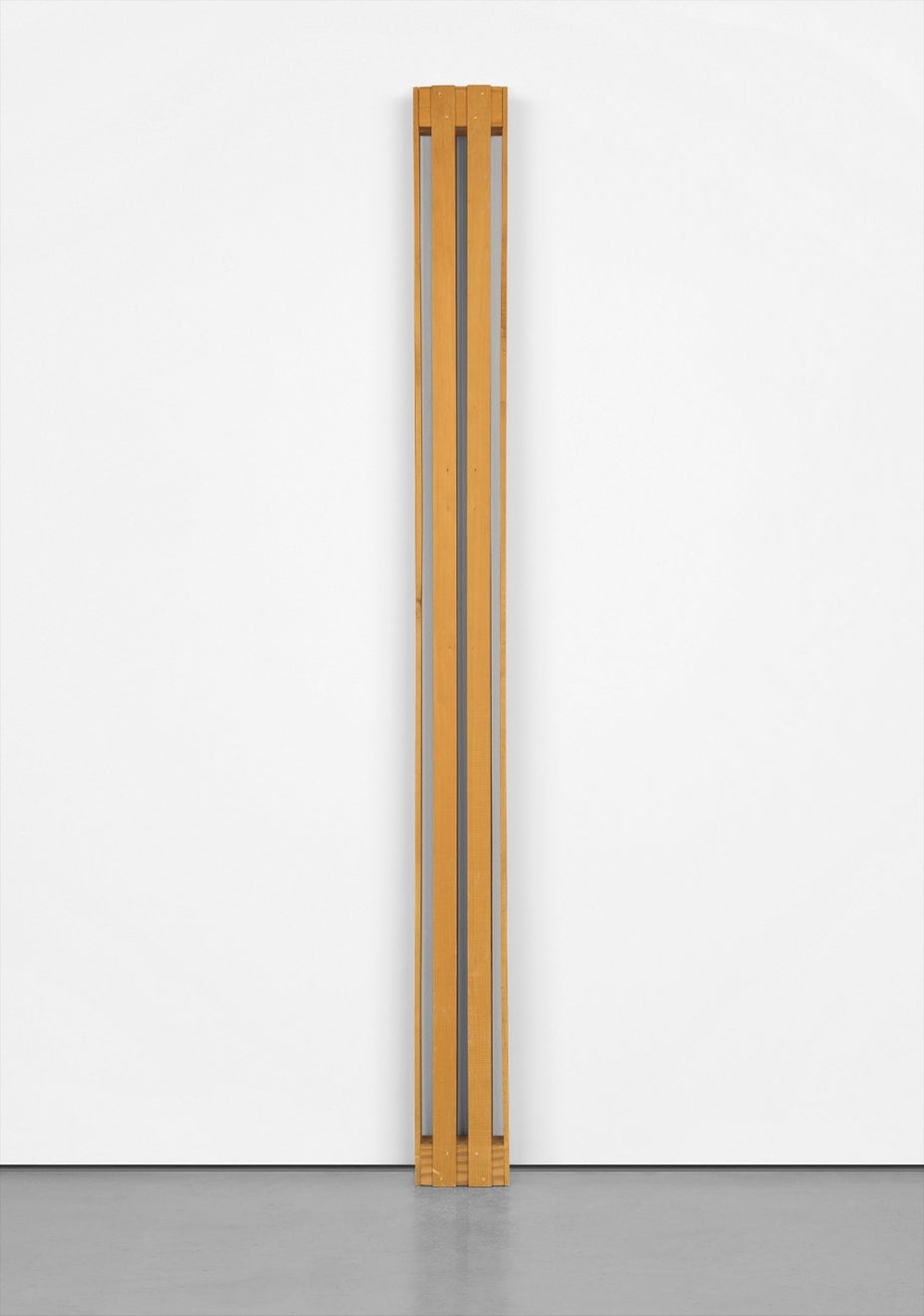
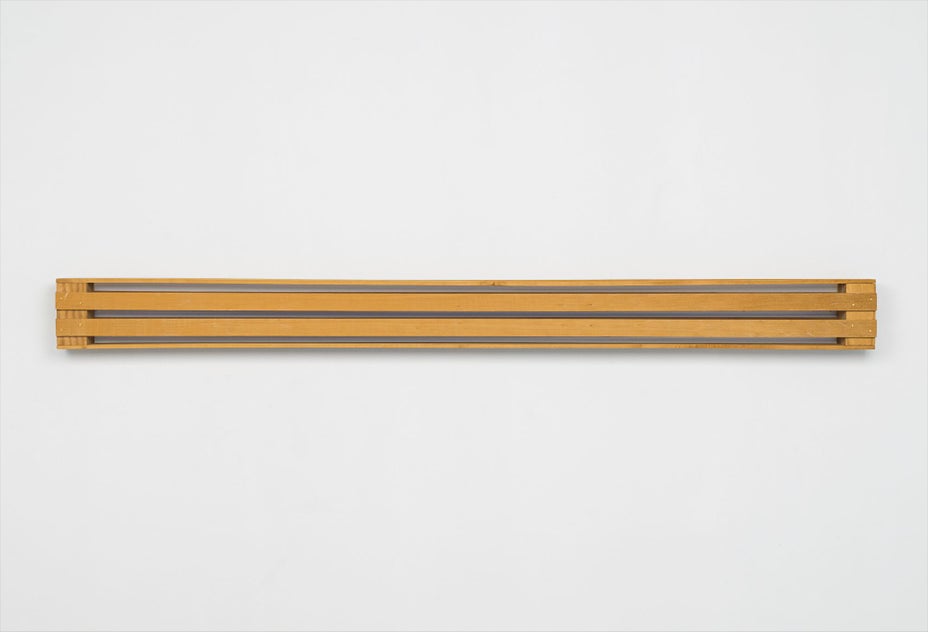
Ouro e paus: Engradados (Wood and Gold: Crates)
- Estimate
- $200,000 - 300,000
$212,500
Lot Details
pine wood and eighteen carat gold nails
78 3/4 x 7 x 4 in. (200 x 17.8 x 10.2 cm)
Signed, titled and dated "Ouro e paus: Engradados - Cildo Meireles - 1995" on the reverse.
Specialist
Full-Cataloguing
Catalogue Essay
“I believe that the economy is an illusion that has gone too far,” Meireles remarked at the turn of the century. “I believe that we are heading straight for a ‘Midas’ situation. Yes, Midas, the guy who transformed everything he touched into gold, and one day had nothing left to eat because gold, no matter how valuable, cannot be turned into food. We have gone too far in the race for value, and we have forgotten the true meaning of what it really is.” Things are rarely as they seem in Meireles’s work, and the duplicity of appearances has remained a philosophical preoccupation of his practice since its beginnings in the 1960s. In the early years of Brazil’s military dictatorship, amid currency devaluations and changes that lasted into the 1980s, the value of money—its fungibility, its symbolism, its real worth—became a leitmotif of his work. In pieces such as Money Tree (1969), Zero Cruzeiro, Zero Centavo (1974-78), and his well-known series Insertions into Ideological Circuits: Banknote Project (1970), in which he stamped paper currency with dissident messages and then returned the bills to circulation, Meireles has reflected on the conceptual chasm between the art object and the art market, use value and exchange value.
Constructed from pinewood and eighteen-carat gold nails, Ouro e paus presents a similar conundrum in its pairing of discrepant materials, each conveying its own historicity. The choice of medium is here, as elsewhere in his work, deliberate and allegorical. A sacred tree to the Tupi people, pine forms half of his paradigmatic wooden cube, Southern Cross (1969-70); combined with the cube’s other half, formed of oak, the work distills the indigenous belief that the friction created by rubbing the woods together would manifest divinity, evoked through fire. In Ouro e paus, narrow planks of Brazilian pine are punctured by nails of gold, a commodity coveted by the Portuguese, a fixture of Baroque architecture, and long a recognized, international standard of exchange. As in the work Fio (1990-95), in which a gold needle laces 190 feet of gold thread through 48 bales of hay, the nails in Ouro e paus are only modestly visible, the luster of the metal blended against the tawny brown wood. The nails remain functional even as their substance is semantically transformed and structurally conditioned. “I am interested in this kind of inversion, the paradoxical relationship between objects,” Meireles has explained. “I believe that even when I try to avoid it, things sometimes make themselves quite explicit to me through paradox, through the relationship between thesis and antithesis. I am forever trying to look for this hypothetical synthesis.”
The present work, one of a set of elongated crates, belongs to a larger series of the same name that encompasses “pallets” and “cases” made from identical materials. The crates differ very slightly in dimension as well as in the number of wooden slats and the spaces between them; as a series, they explore mathematical and perceptual questions of density, the different means and possibilities of shaping space. Particularly in their vertical orientation and even more so when installed directly on the floor, the crates engage the physical space that they inhabit, not least that of their viewers. Neither purely self-referential nor simply a prop for phenomenological experience, as indicated in North American Minimalism, Ouro e paus acknowledges the social and symbolic history of its materials, whose “paradoxical relationship” remarks further upon the invisible systems and structures of the economy. “I try to establish a repertoire of objects which are simultaneously substance and symbol—a familiar repertoire,” Meireles allows. “There is a moment in which the objects are articulated, revealing their privacy. In other words, there is an internal, constitutive order, which is invisible.” An abstraction of capital and the contingencies of value in the contemporary world, Ouro e paus meditates on global economies of scale and of power, elegantly distilled in its simple wooden boards and trenchant nails of gold.
Abigail McEwen, PhD
Constructed from pinewood and eighteen-carat gold nails, Ouro e paus presents a similar conundrum in its pairing of discrepant materials, each conveying its own historicity. The choice of medium is here, as elsewhere in his work, deliberate and allegorical. A sacred tree to the Tupi people, pine forms half of his paradigmatic wooden cube, Southern Cross (1969-70); combined with the cube’s other half, formed of oak, the work distills the indigenous belief that the friction created by rubbing the woods together would manifest divinity, evoked through fire. In Ouro e paus, narrow planks of Brazilian pine are punctured by nails of gold, a commodity coveted by the Portuguese, a fixture of Baroque architecture, and long a recognized, international standard of exchange. As in the work Fio (1990-95), in which a gold needle laces 190 feet of gold thread through 48 bales of hay, the nails in Ouro e paus are only modestly visible, the luster of the metal blended against the tawny brown wood. The nails remain functional even as their substance is semantically transformed and structurally conditioned. “I am interested in this kind of inversion, the paradoxical relationship between objects,” Meireles has explained. “I believe that even when I try to avoid it, things sometimes make themselves quite explicit to me through paradox, through the relationship between thesis and antithesis. I am forever trying to look for this hypothetical synthesis.”
The present work, one of a set of elongated crates, belongs to a larger series of the same name that encompasses “pallets” and “cases” made from identical materials. The crates differ very slightly in dimension as well as in the number of wooden slats and the spaces between them; as a series, they explore mathematical and perceptual questions of density, the different means and possibilities of shaping space. Particularly in their vertical orientation and even more so when installed directly on the floor, the crates engage the physical space that they inhabit, not least that of their viewers. Neither purely self-referential nor simply a prop for phenomenological experience, as indicated in North American Minimalism, Ouro e paus acknowledges the social and symbolic history of its materials, whose “paradoxical relationship” remarks further upon the invisible systems and structures of the economy. “I try to establish a repertoire of objects which are simultaneously substance and symbol—a familiar repertoire,” Meireles allows. “There is a moment in which the objects are articulated, revealing their privacy. In other words, there is an internal, constitutive order, which is invisible.” An abstraction of capital and the contingencies of value in the contemporary world, Ouro e paus meditates on global economies of scale and of power, elegantly distilled in its simple wooden boards and trenchant nails of gold.
Abigail McEwen, PhD
Provenance
Literature
Cildo Meireles
Brazilian | 1948At the core of Cildo Meireles' conceptual artistic practice is an interest in the functions of economic and political systems. Meireles forms part of the younger generation of Brazilian Neo-Concrete artists who were chiefly concerned with integrating spectator participation in the execution of their artworks, provoking the viewer's sensorial awareness.
In his seminal series, Insertion In Ideological Circuits 2: Banknote Project (1970), Meireles printed politically subversive messages on American and Brazilian banknotes and sent them into circulation. This vandalism forced viewers to confront the reality of their political and economic systems and question their role and participation within said systems. This one series is emblematic of his larger body of work, which continues to intrigue and confound viewers today.
Browse ArtistIn his seminal series, Insertion In Ideological Circuits 2: Banknote Project (1970), Meireles printed politically subversive messages on American and Brazilian banknotes and sent them into circulation. This vandalism forced viewers to confront the reality of their political and economic systems and question their role and participation within said systems. This one series is emblematic of his larger body of work, which continues to intrigue and confound viewers today.