Article | Shaped Watches Non Round Watch Cases Phillips Hong Kong Fall 2026 Online Auction
Thinking Outside the Circle: When Watchmakers Break from Round Cases
A closer look at how case shape can become one of a watchmaker’s most powerful means of expression.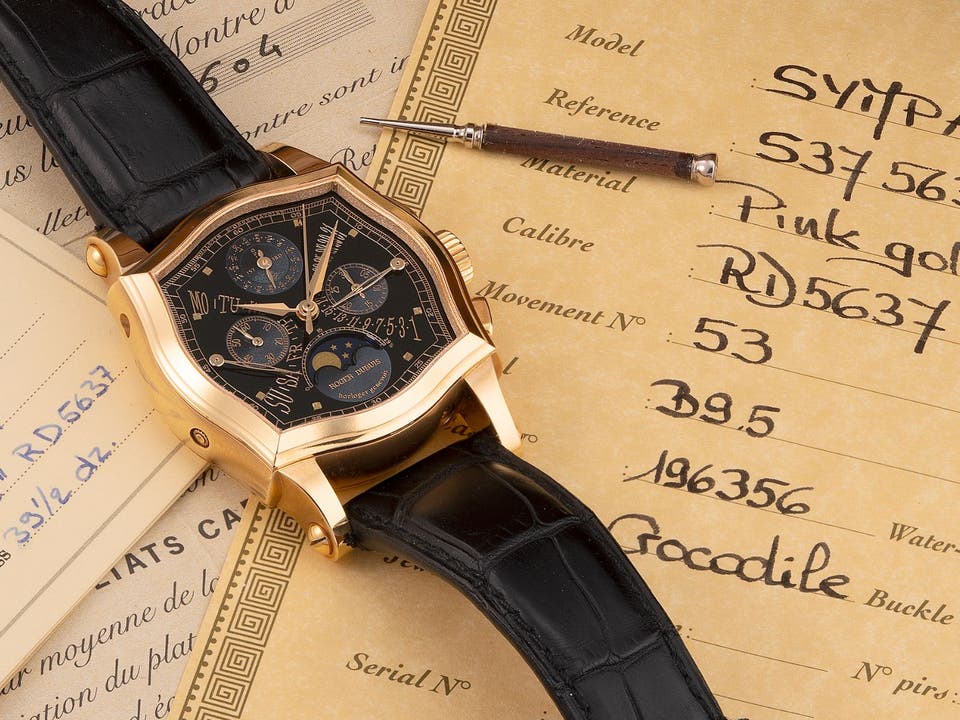
Phillips in Association with Bacs & Russo is pleased to present The Hong Kong Sessions, Fall 2026, an online auction running from 17–24 September. Featuring more than 150 exceptional luxury timepieces from leading makers including A. Lange & Söhne, Audemars Piguet, F.P. Journe, Vacheron Constantin, and Patek Philippe, the sale includes all seven watches featured in this story.
There is good reason why, when asked to draw a watch, most of us would probably start with a circle. For much of the history of portable timekeeping, round has been the dominant shape.
The earliest watches of the 16th century could actually be quite varied, taking the form of everything from books and flowers to crosses and animals. But by the 17th century, circular and oval movements had become prevalent, while the growing practice of carrying watches in pockets favored flatter cases without protruding corners.
The mechanics helped too. A conventional watch is largely an assembly of rotating parts, while its hands tend to travel around a central axis and naturally lend themselves to a circular display. By the time the pocket watch reached maturity, the round case was firmly established.
As wristwatches emerged around the turn of the 20th century, however, watchmakers gained greater freedom to experiment with case design. And they wasted little time exploring it.
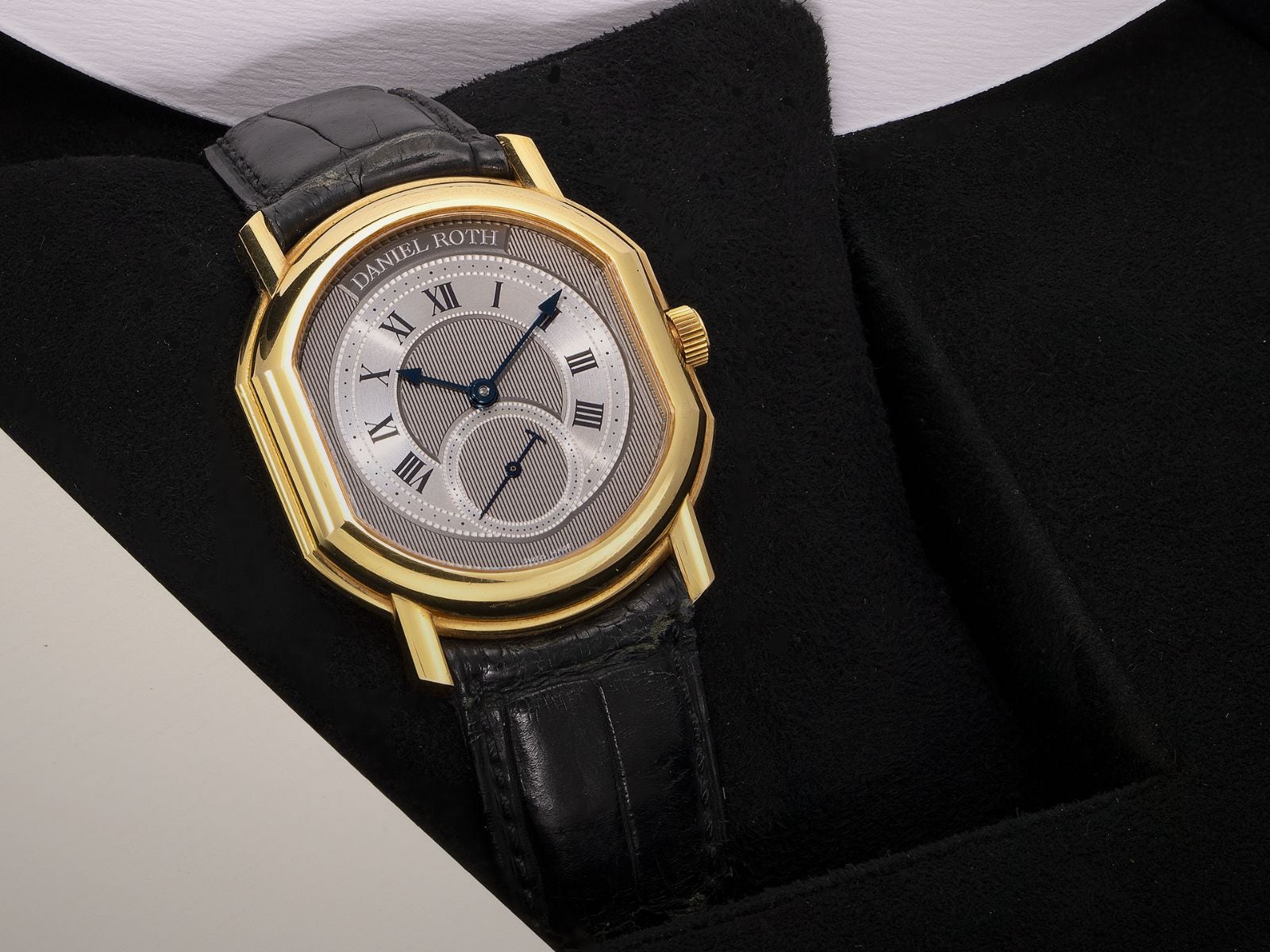
Lot 8072: A circa 1998 Daniel Roth Small Seconds Ref. N207 in 18k yellow gold, included in the Phillips Hong Kong Sessions, Fall 2026. Estimate: HKD $60,000–120,000
Rectangular, square, tonneau, and cushion-shaped watches all appeared during the formative decades of the wristwatch, establishing case shapes that remain part of the watchmaker's vocabulary more than a century later.
Round has nevertheless remained overwhelmingly dominant. So when a watchmaker does decide to break from the circular case, the effect can be immediately eye-catching. Some turn to established non-round shapes; others modify them. And occasionally they devise a geometry so individual that just the outline can tell you who made the watch.
The Hong Kong Sessions, Fall 2026, offers examples of all three approaches.
Right Angles
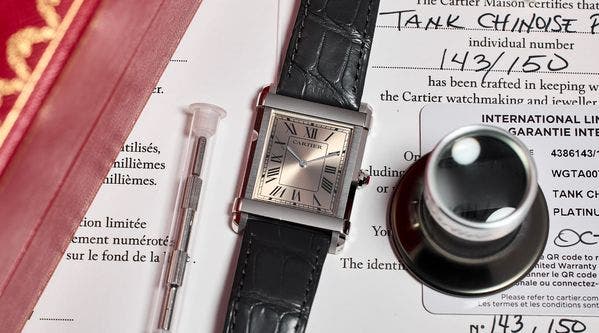
Among the earliest alternatives to the round wristwatch case was the rectangle, and no watchmaker has done more to make the shape its own than Cartier. The Tank, designed by Louis Cartier in 1917, turned the geometry of the case into an integral part of the watch's identity. Its two parallel brancards extend along either side of the dial and into the strap, producing the long, straight lines that have characterized the family ever since.
Two watches in the Hong Kong Sessions demonstrate just how much scope exists within that basic architecture.
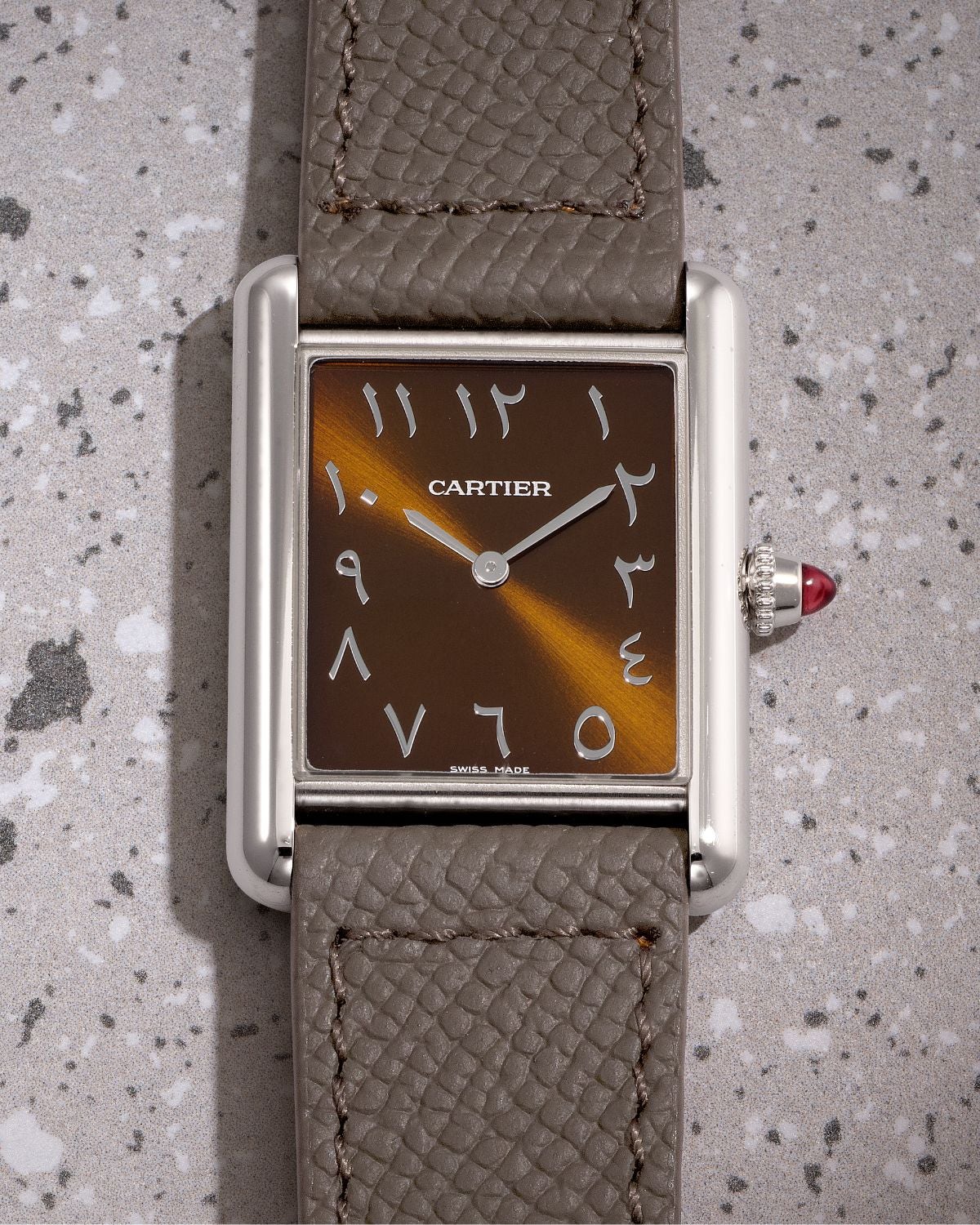
Lot 8056: A circa 2025 Cartier Tank Louis Cartier Ref. WGTA0279 in platinum, included in the Phillips Hong Kong Sessions, Fall 2026. Estimate: HKD $80,000–160,000
The first is a 2025 Tank Louis Cartier Ref. WGTA0279 in platinum, one of 200 examples made for the Middle East. Despite its contemporary execution, the watch remains faithful to the design Louis Cartier established more than a century earlier. Measuring 33.7mm by 25.5mm, it pairs the familiar rectangular case with a brown sunray dial bearing Eastern Arabic numerals, rhodium-finished sword hands, and a ruby cabochon crown.
The second takes the rectangle somewhere rather different. The Tank Basculante was introduced in 1932, at a time when protecting a watch during sporting activity presented a practical challenge. Its answer was a case that could be released from its frame, rotated vertically, and turned over to protect the crystal.
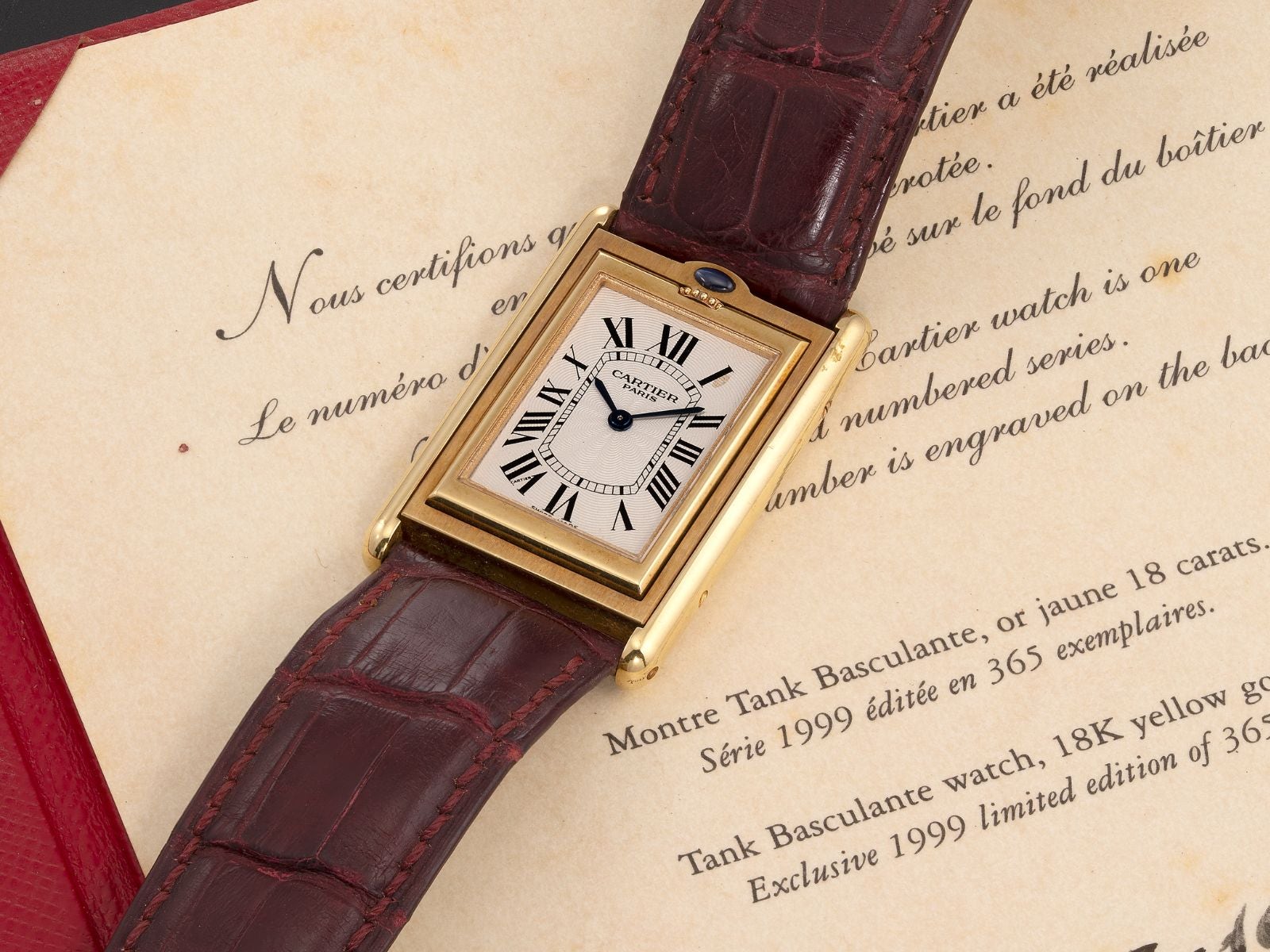
Lot 8100: A circa 1999 Cartier Tank Basculante Millennium Edition CPCP Ref. 2391 in 18k yellow gold, included in the Phillips Hong Kong Sessions, Fall 2026. Estimate: HKD $40,000–80,000
Our circa 1999 Tank Basculante Ref. 2391 comes from Cartier's Collection Privée Cartier Paris and was one of 365 examples produced to mark the turn of the millennium.
Barrel Form
If the rectangle is easy to define, the tonneau is a little harder to pin down. Its name comes from the French word for barrel, and the shape typically combines an elongated profile with curved sides.
In 2001, Parmigiani Fleurier made that geometry part of its visual language through a collection initially known as Forma and later renamed Kalpa, a name associated in Indian philosophy with vast cycles of time.
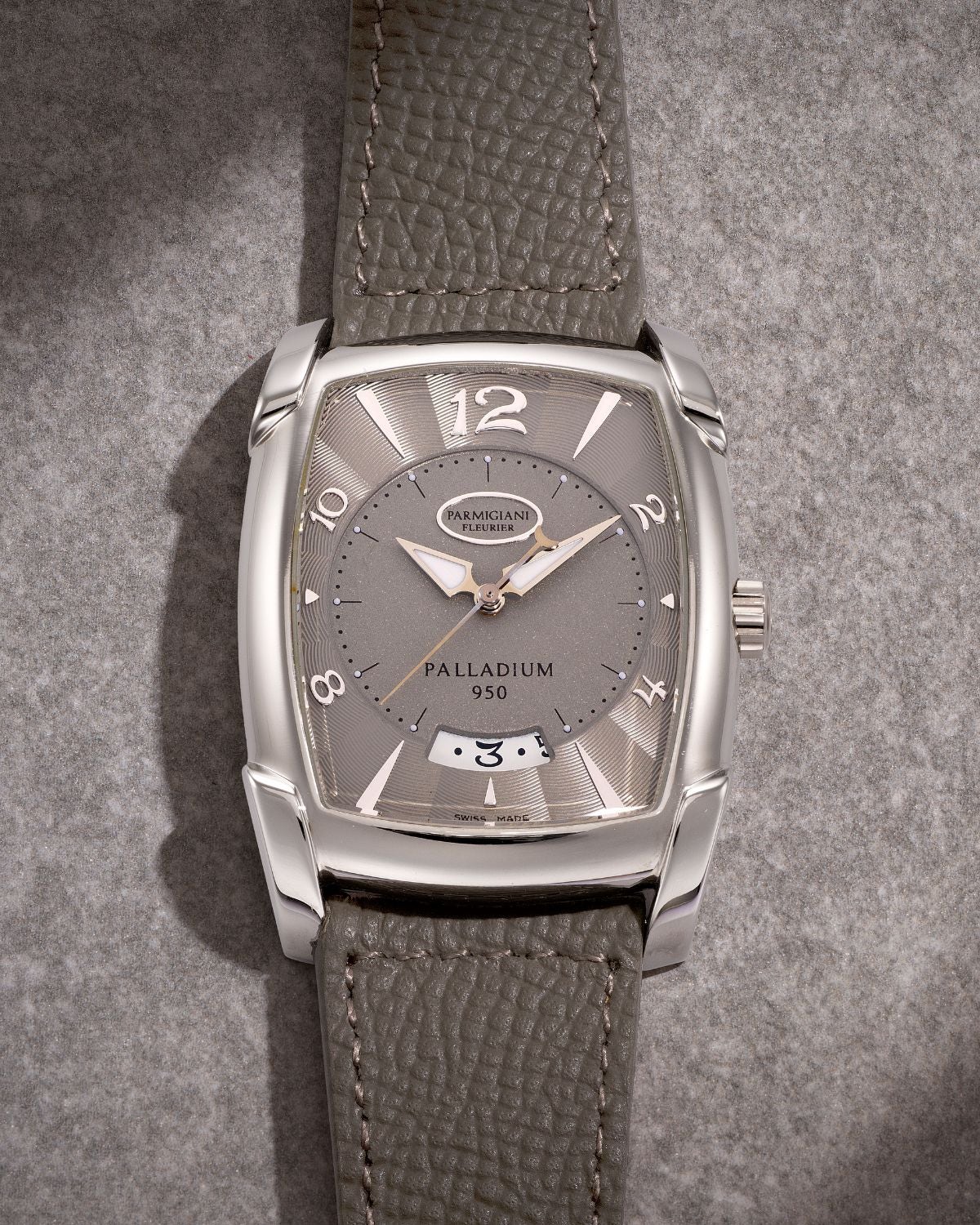
Lot 8134: A circa 2006 Parmigiani Fleurier Kalpa Grande Ref. PF011128.01 in palladium, included in the Phillips Hong Kong Sessions, Fall 2026. Estimate: HKD $30,000–50,000
The Kalpa Grande in this sale, Ref. PF011128.01, dates to circa 2006 and is an emphatic expression of Parmigiani’s take on the tonneau. Its case measures 46mm by 33mm, with bowed flanks flowing into the distinctive elongated lugs. The shape is carried through the watch, its stepped guilloché dial following the outline of the case, while the elongated hour markers radiate around its perimeter. Adding to its presence is the use of palladium, a precious metal less frequently seen in watch cases.
While the exterior steals the show, inside is the PF331, PF’s first self-winding manufacture caliber, which uses twin barrels mounted in series to provide a 55-hour power reserve.
Softening the Square
A cushion case occupies another part of the shaped-watch spectrum. Broadly speaking, take a square, soften its corners, bow its sides, and you begin to arrive in cushion territory. Unlike the more elongated tonneau, the proportions stay closer to a square.
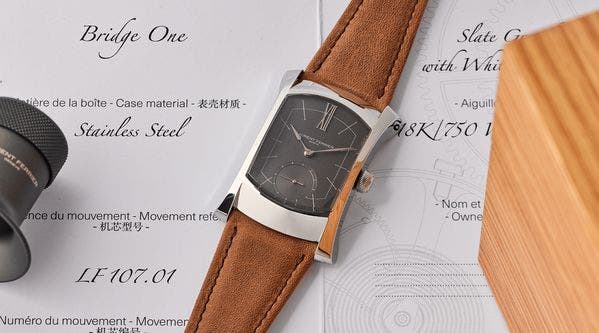
That provides a useful way of approaching the Laurent Ferrier Sport Auto.
First presented in 2022, the Sport Auto developed out of the Grand Sport Tourbillon that Laurent Ferrier had presented three years earlier.
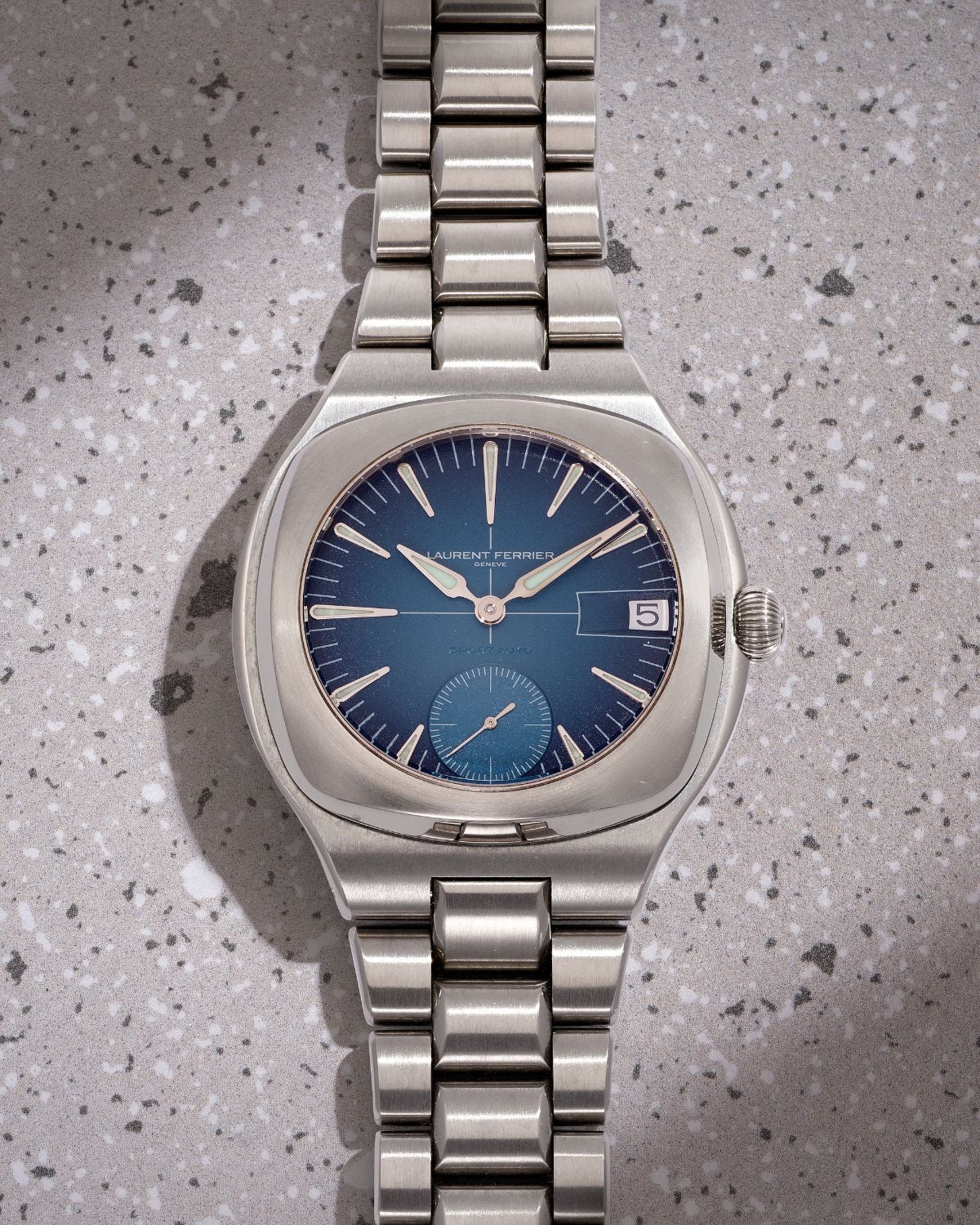
Lot 8026: A circa 2022 Laurent Ferrier Sport Auto in Grade 5 titanium, included in the Phillips Hong Kong Sessions, Fall 2026. Estimate: HKD $150,000–300,000
Its Grade 5 titanium case measures 41.5mm across and uses a rounded square bezel over a similarly softened case body. There are no hard corners and little of the angularity often associated with integrated-bracelet sports watches.
There is a reason for those curves. Laurent Ferrier has linked the form to the lines of racing cars, an appropriate reference given the story behind the watch – and indeed the brand.
In 1979, Ferrier, François Servanin, and François Trisconi drove a Porsche 935 Turbo to third place overall at the 24 Hours of Le Mans. Ferrier later gave Servanin a Patek Philippe Nautilus to mark the achievement, prompting Servanin to suggest that one day they should make their own watch. Three decades later, the two men would go on to found Laurent Ferrier together.
A Double Ellipse
Come the late 1980s and Daniel Roth was not simply choosing between established case categories. He wanted a shape of his own.
Roth had spent 13 years helping rebuild Breguet before establishing his eponymous operation and launching his first wristwatch under his own name in 1989. The case he devised would become one of the signatures of his work: the double ellipse.
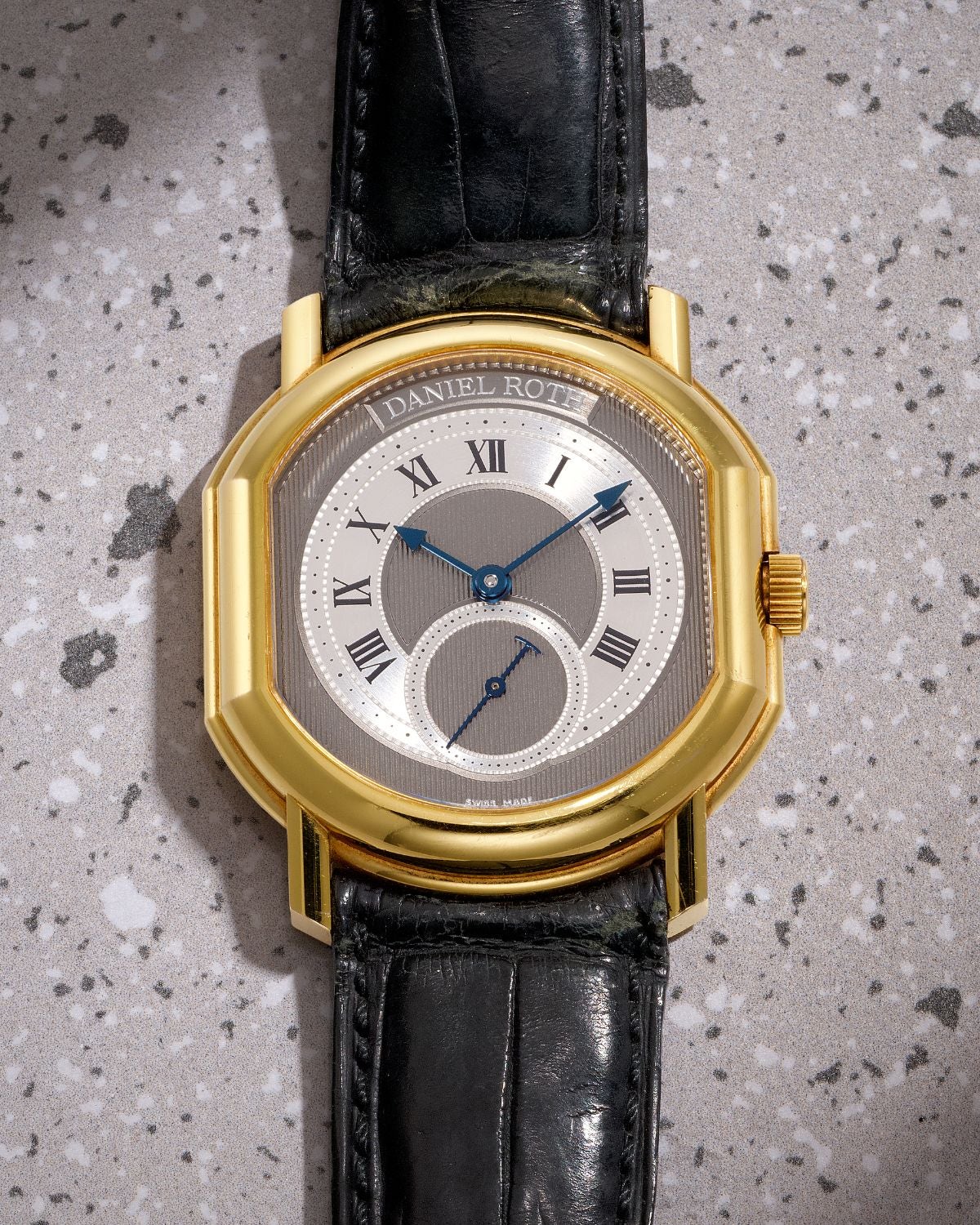
Lot 8072: A circa 1998 Daniel Roth Small Seconds Ref. N207 in 18k yellow gold, included in the Phillips Hong Kong Sessions, Fall 2026. Estimate: HKD $60,000–120,000
Its origins are interesting because Roth himself struggled to explain where the idea came from. He later recalled having a complex combination of round, square, and curved forms in his head, making hundreds of drawings and gouache paintings before arriving at the final design. Once he had it, he decided the shape would be used across his collection, from tourbillons and chronographs to perpetual calendars and automatic watches.
Two watches here illustrate that versatility. The circa 1998 Small Seconds Ref. N207 pairs the double-ellipse case with a relatively sober dial, its vertical pinstripe guilloché contrasting with the circular graining of the hour chapter ring. This fetching dress watch dates from the period after Roth sold the company to The Hour Glass in 1994 but remained involved in the business.
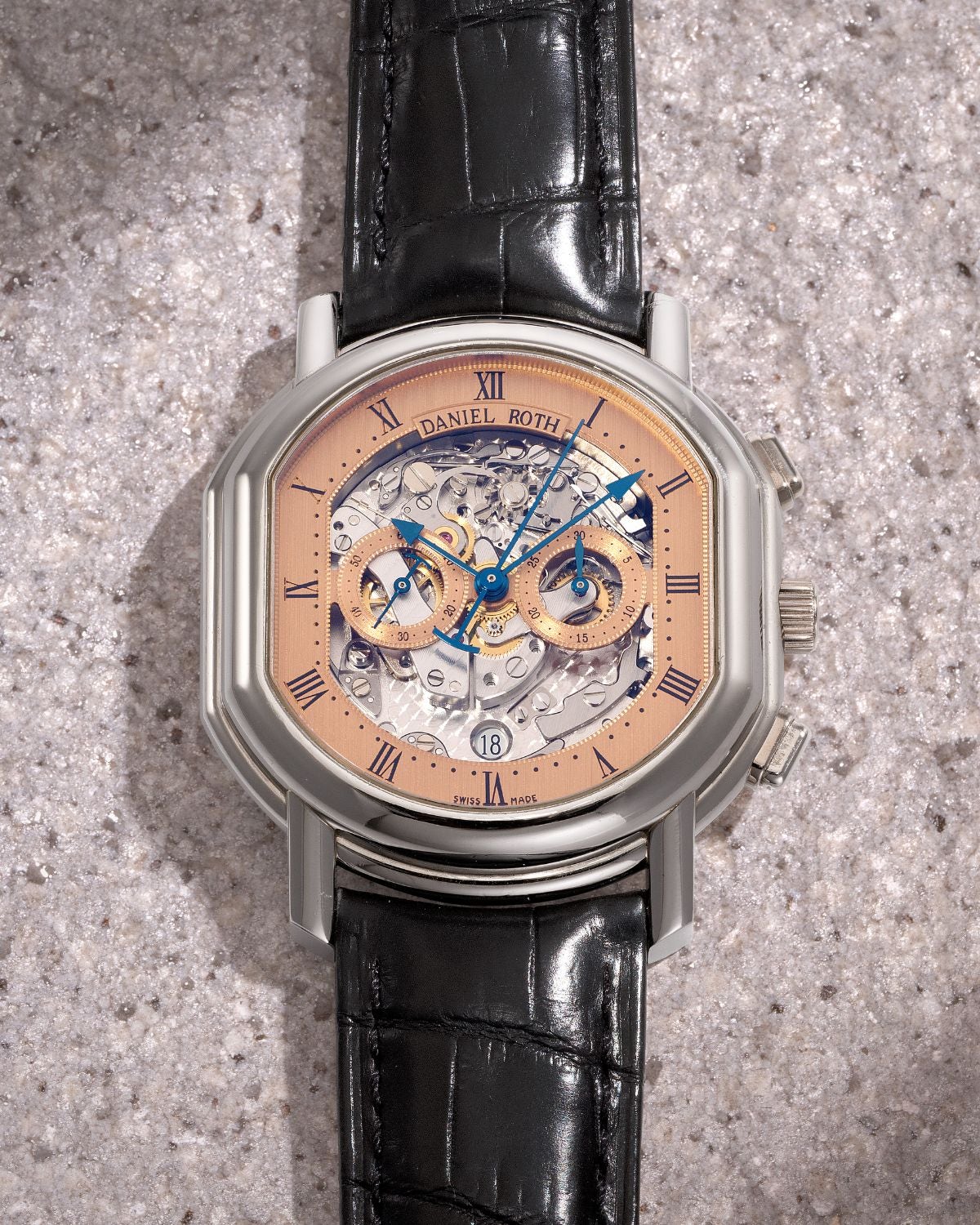
Lot 8071: A circa 2000 Daniel Roth Master’s Chronograph Ref. 447.X.70 in platinum, included in the Phillips Hong Kong Sessions, Fall 2026. Estimate: HKD $65,000–125,000
The circa 2000 Master’s Chronograph Ref. 447.X.70 comes from the very end of that chapter, around the time Bulgari acquired the company. Its larger platinum double-ellipse case houses the automatic DR101 caliber and frames a salmon dial that has been openworked to reveal the mechanics within.
The watches may be different, but their outlines leave little doubt that they belong to the same maker. And that was exactly Roth's intention.
Complex Curves
Roger Dubuis took the idea of a signature case somewhere more complicated still.
After spending years in the Grandes Complications workshop at Patek Philippe and later working independently, Dubuis joined forces with entrepreneur Carlos Dias in 1995 to establish a company bearing his name. The Sympathie, launched the following year, was one of its first two collections.
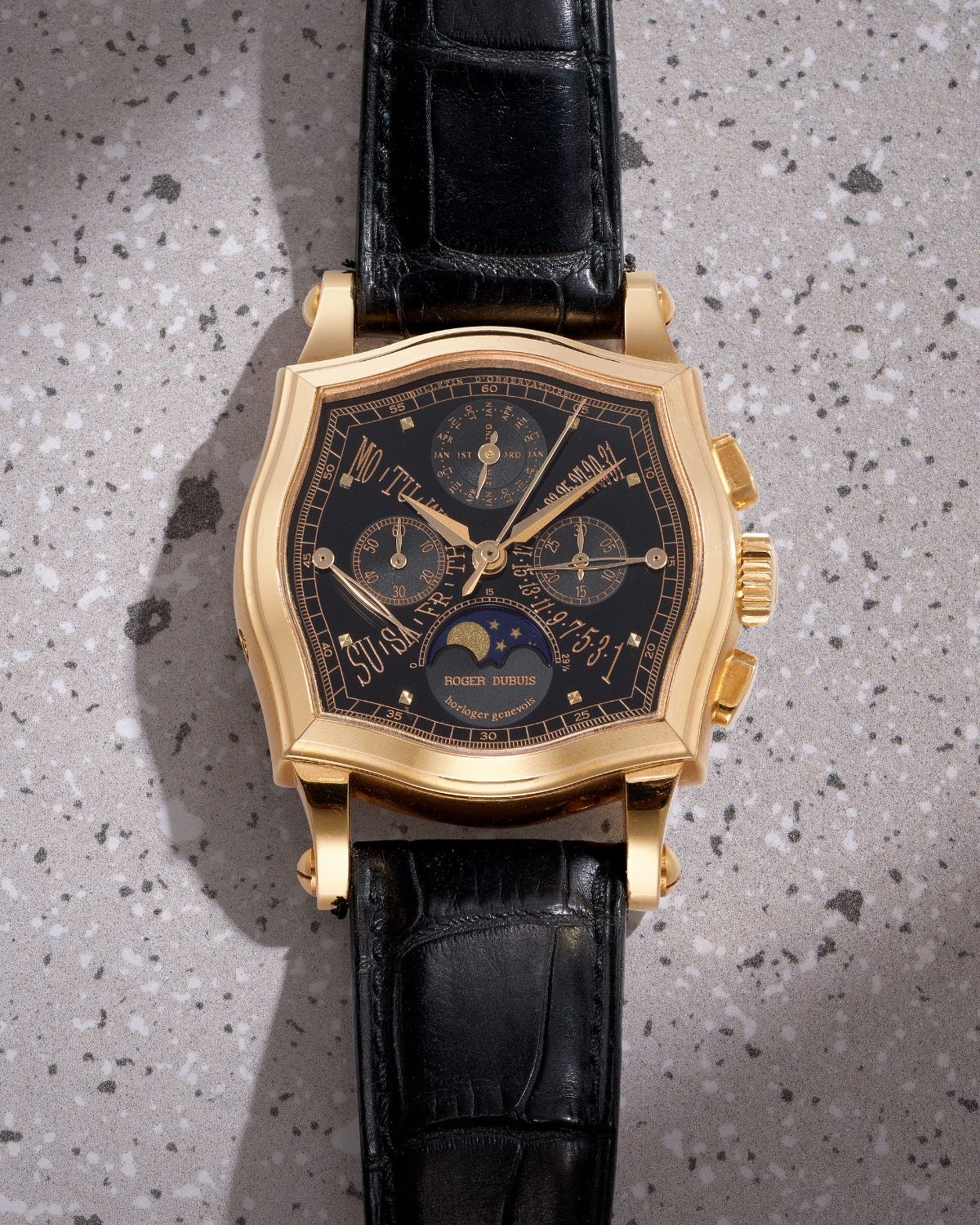
Lot 8043: A circa 1998 Roger Dubuis Sympathie Bi-Retrograde Perpetual Calendar Ref. S37 5637 5 in 18k pink gold, included in the Phillips Hong Kong Sessions, Fall 2026. Estimate: HKD $150,000–300,000
Trying to describe the Sympathie’s case by referring to conventional shapes is tricky. It combines curves with sharp points, sweeping inward and outward around the dial before extending into elongated lugs. Impressively, on these early examples the crystal itself was cut to trace this complicated perimeter rather than adopting the simpler circular form found on some later versions.
The circa 1998 bi-retrograde perpetual calendar chronograph in pink gold demonstrates just how ambitious that architecture could be. The dial follows the contours of the 37mm case, with the railway track snaking around its perimeter. Within it, retrograde day and date displays sweep across either side of the dial, while subdials indicate the month, running seconds, and elapsed chronograph minutes, with moon phases at 6 o’clock.
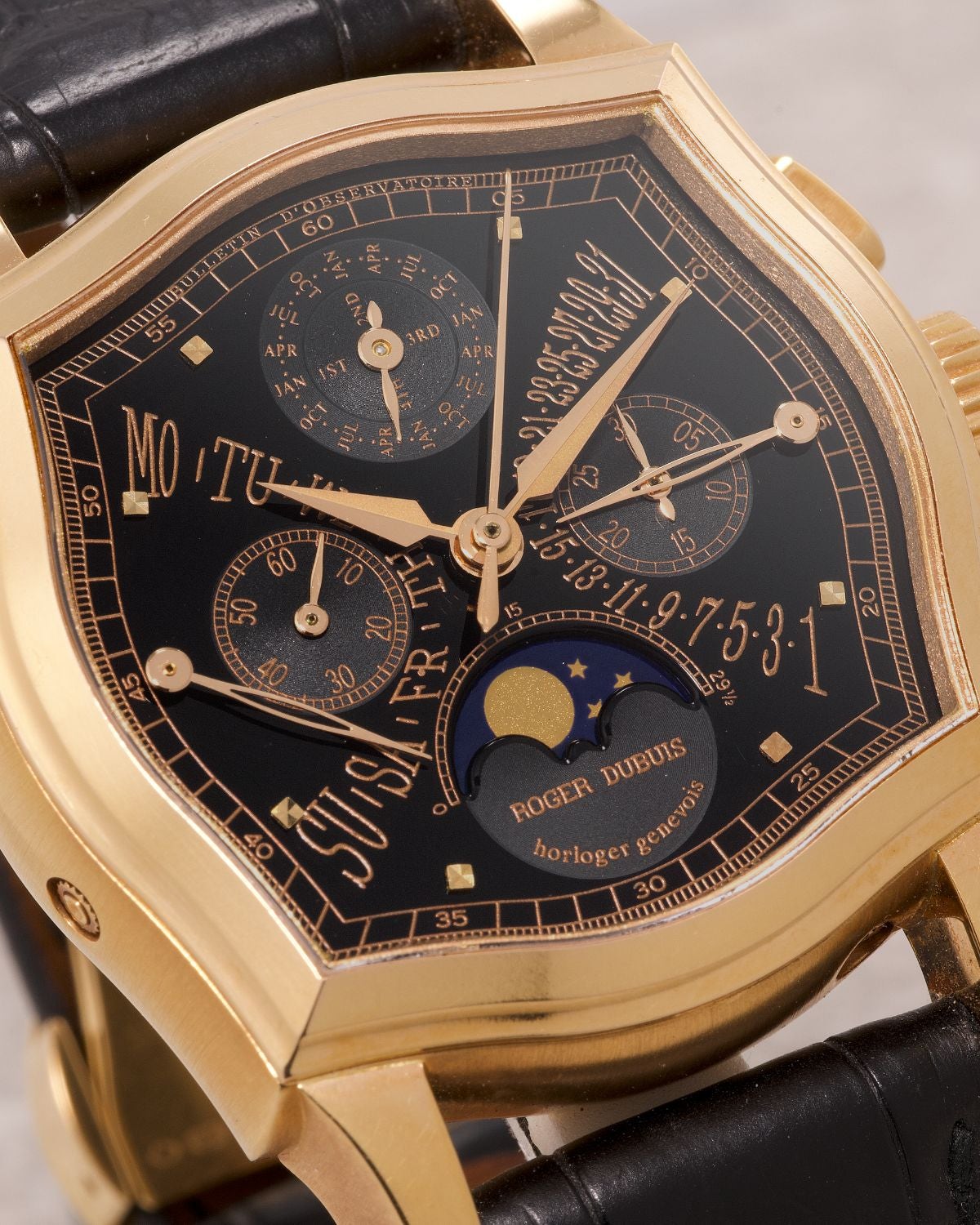
Lot 8043: A circa 1998 Roger Dubuis Sympathie Bi-Retrograde Perpetual Calendar Ref. S37 5637 5 in 18k pink gold, included in the Phillips Hong Kong Sessions, Fall 2026. Estimate: HKD $150,000–300,000
That harmonious arrangement of so many indications is made possible by the manually wound RD5637, based on the Lemania 2310 architecture and fitted with a module developed by Dubuis and movement specialist Jean-Marc Wiederrecht. By moving the day and date away from conventional subdials and onto retrograde displays, they freed up space for the remaining indications while giving the dial its striking symmetry.
Shape of Things
We have covered only a small sample of shaped watches, with much more territory still to explore: square, oval, asymmetrical, triangular, octagonal, and other forms could each warrant a story of their own. But these seven watches demonstrate why breaking from a round case can be a thoroughly rewarding exercise.
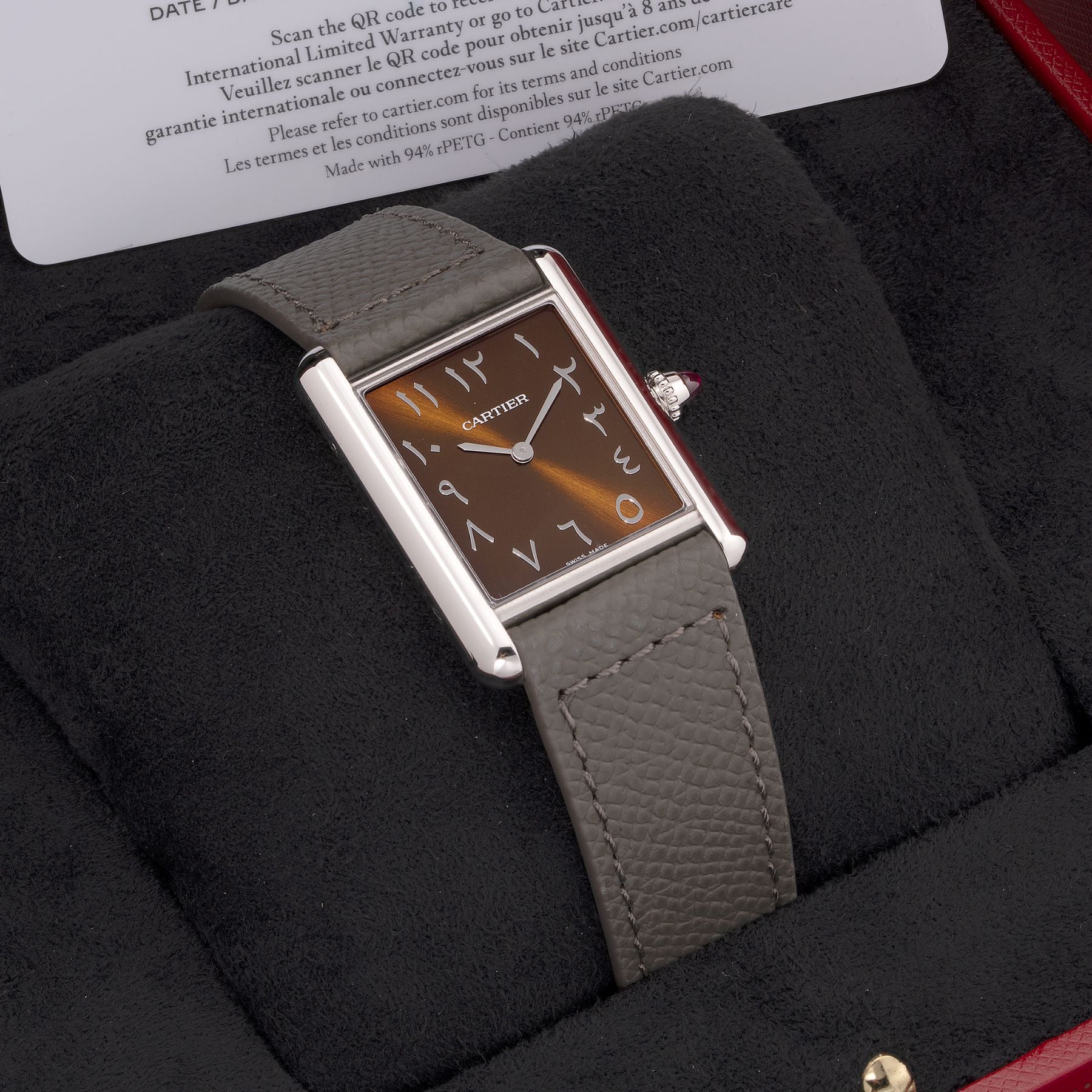
Lot 8056: A circa 2025 Cartier Tank Louis Cartier Ref. WGTA0279 in platinum, included in the Phillips Hong Kong Sessions, Fall 2026. Estimate: HKD $80,000–160,000https://www.phillips.com/detail/cartier/236914
Perhaps that is because the familiarity of the round watch can make us take its outline for granted. Depart from the circle, though, and the shape of the case suddenly becomes something we notice in its own right. It makes us look again at something so fundamental to a watch that we might otherwise barely notice it at all.
You can learn more, place a bid, and view the entire Hong Kong Sessions, Fall 2026, catalog here.