Article | Picasso Warhol Auction Hong Kong September 2026
The Pitcher and the Glove: Picasso, Warhol and the Art of the Everyday
Each artist began by defining what a thing was, only to discover what else it might become.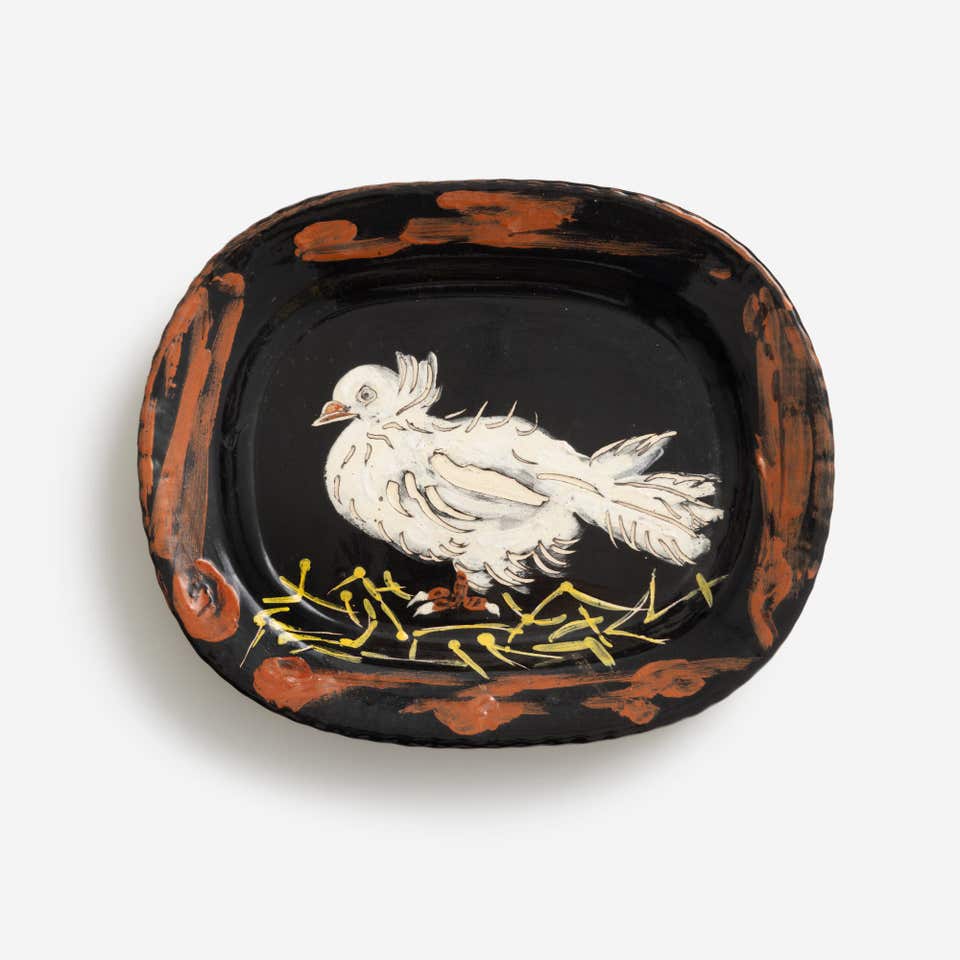
PABLO PICASSO, Colombe sur lit de paille, 1949. Modern & Contemporary Art Hong Kong.
On either side of the Atlantic, in the decades following the Second World War, Pablo Picasso and Andy Warhol repeatedly found artistic possibility in familiar objects. Phillips’ Modern & Contemporary Art Sale in Hong Kong on 30 September brings the two into conversation: six works by Picasso — five Madoura ceramics and a lithograph — alongside six fashion illustrations by Warhol from an important single private collection.
“I would like them to be found in every market, so that, in a village in Brittany or elsewhere, one might see a woman going to the fountain to fetch water with one of my jars.”
— Pablo Picasso
“When you think about it, department stores are kind of like museums.”
—Andy Warhol
Clay in Vallauris, Ink in Manhattan
Although separated by a generation, Picasso and Warhol shared a conviction that the line between art and life was far more porous than it seemed at face value. Warhol, born in Pittsburgh, approached things from the commercial side, turning window displays, shoe advertisements, and fashion magazines into a visual language that would dissolve distinctions between "high" art and "low" commercial design. Picasso first encountered Suzanne and Georges Ramié at the Madoura pottery in Vallauris, France, in 1946, returning the following year to begin an intensive engagement with clay that would continue for over two decades. Working alongside the artisans of the workshop, he experimented with modeling, glazing, incision and painted decoration, rapidly expanding the technical and pictorial possibilities of the medium. Warhol received his degree from the Carnegie Institute of Technology in 1949 and relocated to New York, where his first assignment was to draw illustrations for a Glamour magazine story called “Success is a Job in New York.” Arriving with an inventive portfolio, he was quickly championed by the leading tastemakers of the day, producing a prolific output for Barneys, Neiman Marcus, Glamour, Vogue and Harper’s Bazaar. Before long he was regarded as Manhattan’s most sought-after commercial illustrator.
The Figure in the Thing
For both artists, any ordinary object could hold a life within it. Picasso’s ceramics frequently begin with the recognition that the shape of a vessel already suggests a human or animal body: handles become ears, wings, or limbs, swollen ceramic bodies assume the presence of torsos, and the opening of a pitcher may become a mouth or the crown of a head.
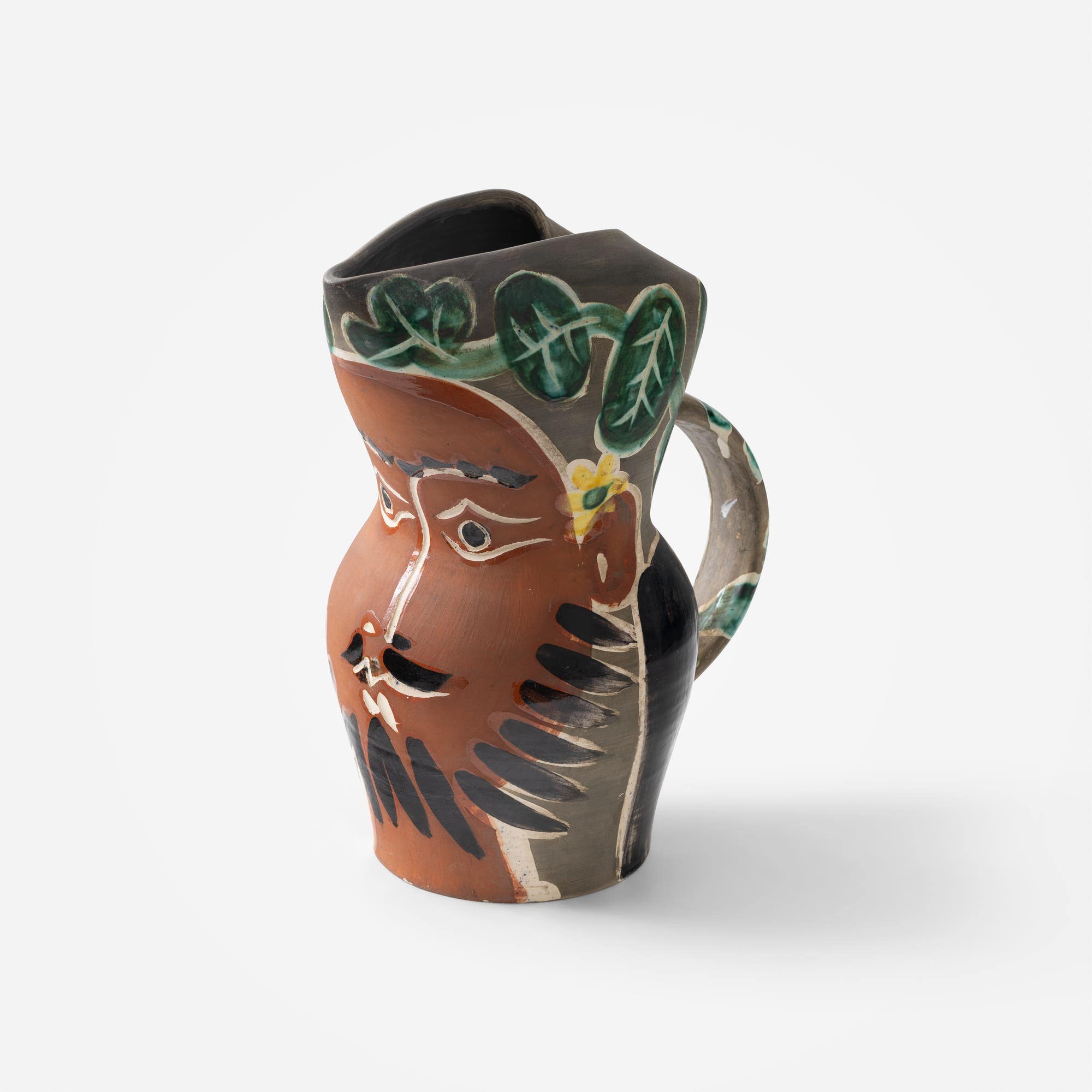
PABLO PICASSO, Le Barbu (Alain Ramié 217), 1953. Modern & Contemporary Art Hong Kong.
In Le Barbu, 1953, the curved profile of a pitcher is transformed into a bearded man. Painted features extend across its irregular surface such that the vessel is perceived simultaneously as functional object and portrait. The existing form of the pottery is not concealed, but rather incorporated directly into the figure: a household object acquires a discernible personality.
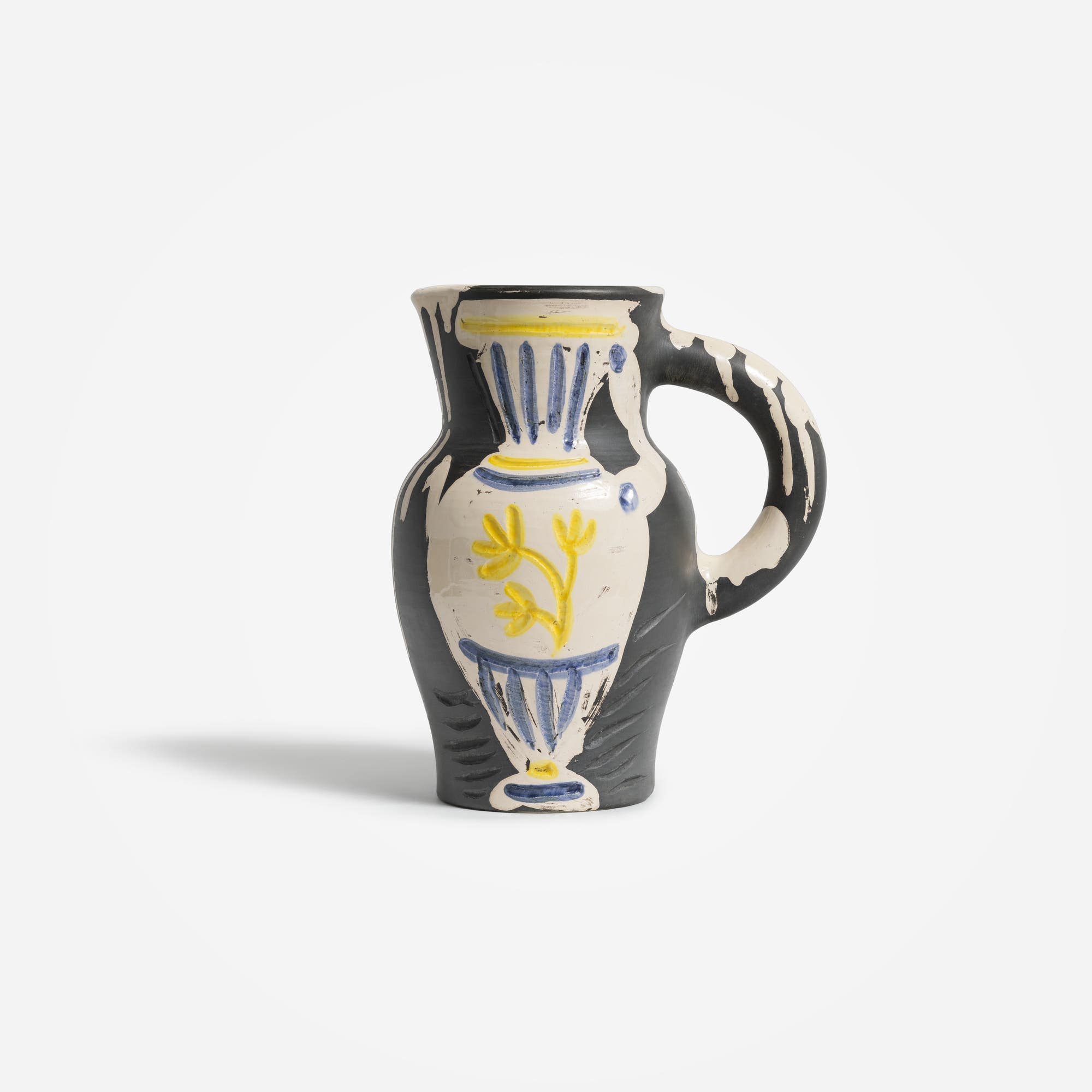
PABLO PICASSO, Pichet au vase (Alain Ramié 226), 1954. Modern & Contemporary Art Hong Kong.
Pichet au vase, from 1954, adds an inward layer to the game. Here the body of one pitcher carries the painted image of another vase, so that the ceramic is both support and subject; an object that contains a image of an object. The result is a compact visual exchange between physical item and its representation.
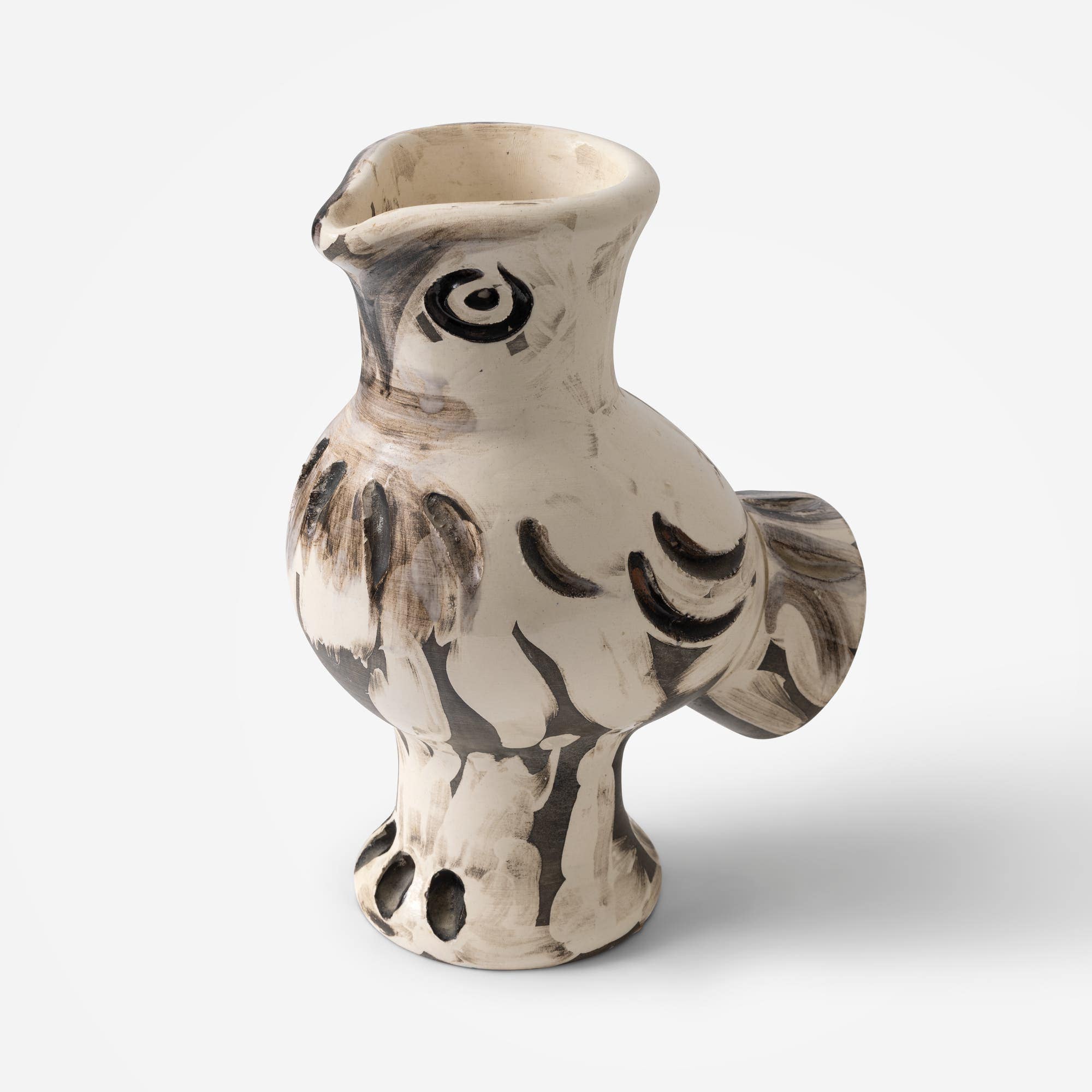
PABLO PICASSO, Chouette (Alain Ramié 603), 1969. Modern & Contemporary Art Hong Kong.
With 1969’s Chouette, executed later in Picasso’s ceramic practice, the transformation becomes increasingly sculptural. The rounded body of the pitcher becomes the breast of an owl, while painted and incised markings articulate the bird’s eyes, feathers, and claws. The owl was a particularly significant motif for Picasso after 1946, when he encountered an injured bird at Antibes and cared for it with Françoise Gilot, and it recurred often across his ceramics and sculpture at Vallauris. The vessel’s original function remains perceptible, yet its form is now inseparable from the creature Picasso discovered within it.
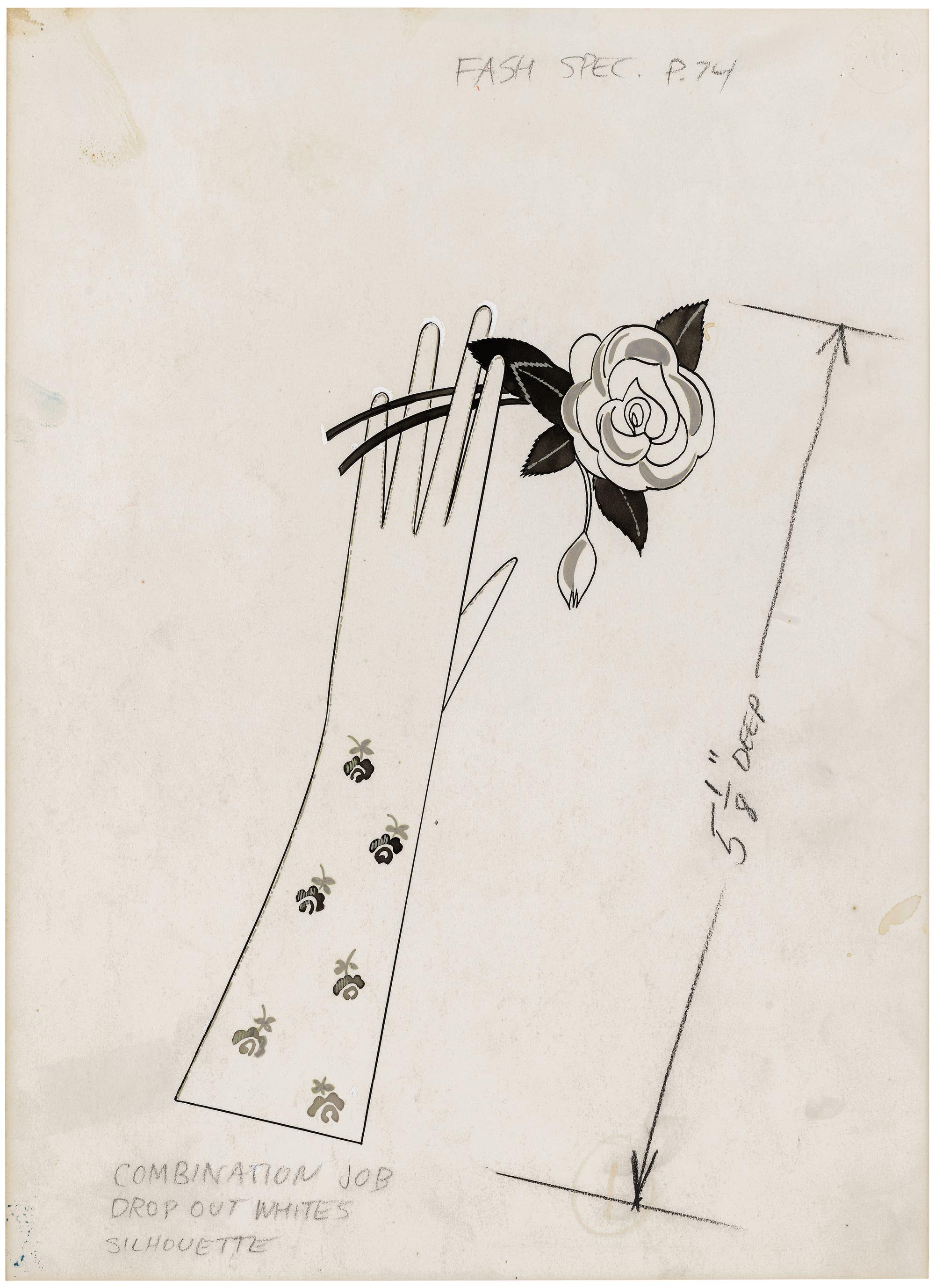
ANDY WARHOL, Glove and Rose, circa 1958. Modern & Contemporary Art Hong Kong.
Over in New York, Warhol performed a comparable transformation on the objects of the fashion world. Shoes became a particularly fertile subject. From 1955 to 1959, I. Miller employed Warhol to create advertisements for The New York Times, transforming commercial footwear into an object of wit and fantasy. Alongside these commissions, he also made more elaborate shoe drawings as independent works, including a series of gold-leaf shoes associated with different celebrities was exhibited in New York in 1956 and subsequently featured in Life magazine.
Glove and Rose, circa 1958, extends this sense of the accessory as a stand-in for its wearer. An elongated, elegant opera glove holds a stylised, fully bloomed rose alongside a delicate, unopened bud. A subtle repeating floral pattern runs along the forearm, crisp black ink defines the glove’s sleek contour, and shaded dark leaves frame the open white rose against the light background. The hand that should fill the glove is absent, yet the composition carries an unmistakably romantic allure.
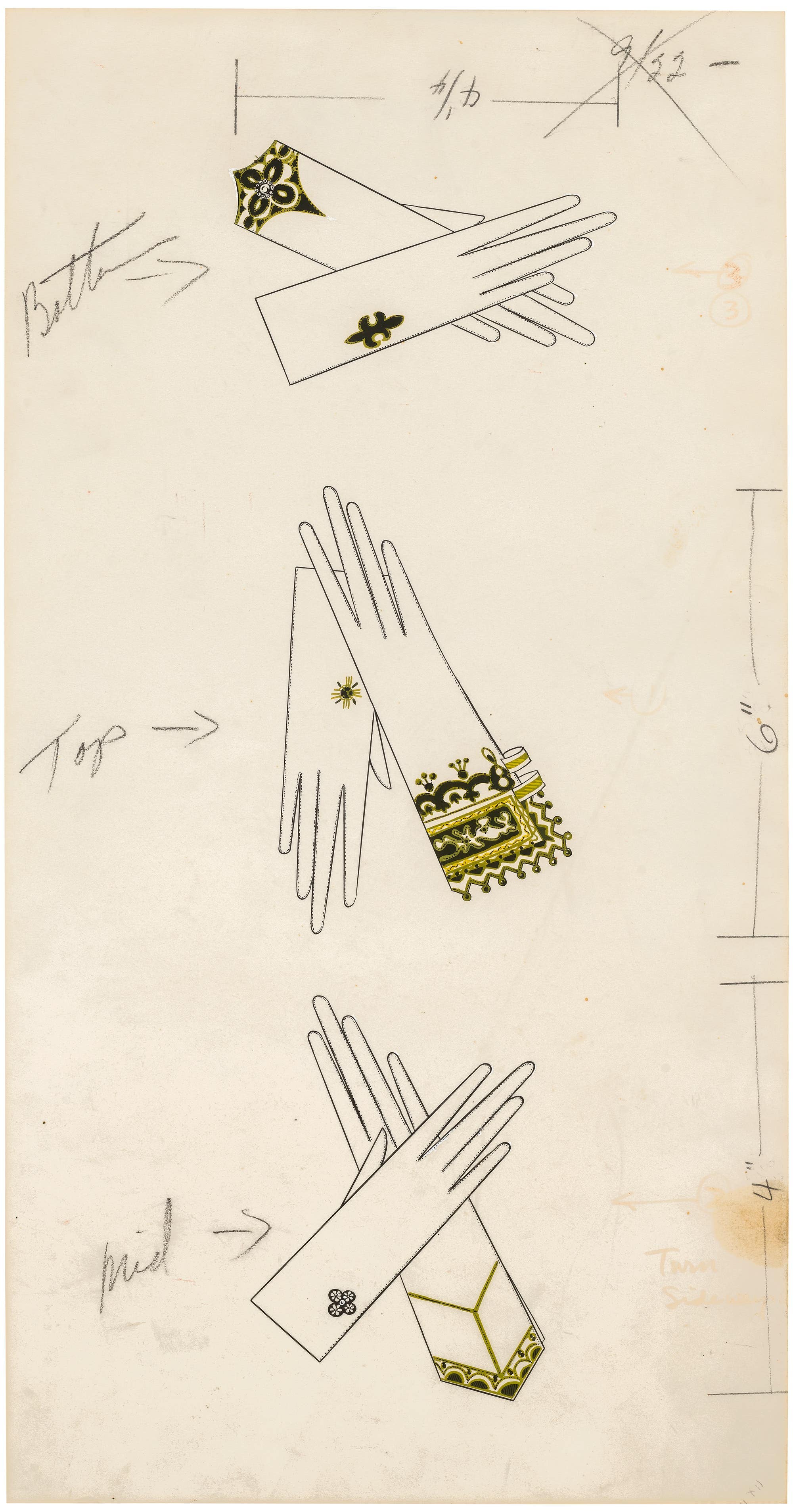
ANDY WARHOL, Three Pairs of Gloves, circa 1958. Modern & Contemporary Art Hong Kong.
In Three Pairs of Gloves, from the same period, three pairs of long, elegant ladies’ gloves are arranged in a clean vertical composition, each embellished with intricate gold patterns, ornate cuffs, and delicate ornamental motifs. Rich metallic tempera set against fine contour lines transforms a utilitarian accessory into a study of glamour and refinement. Where Picasso found a bearded man inside a pitcher, Warhol found a luxurious world inside a glove.
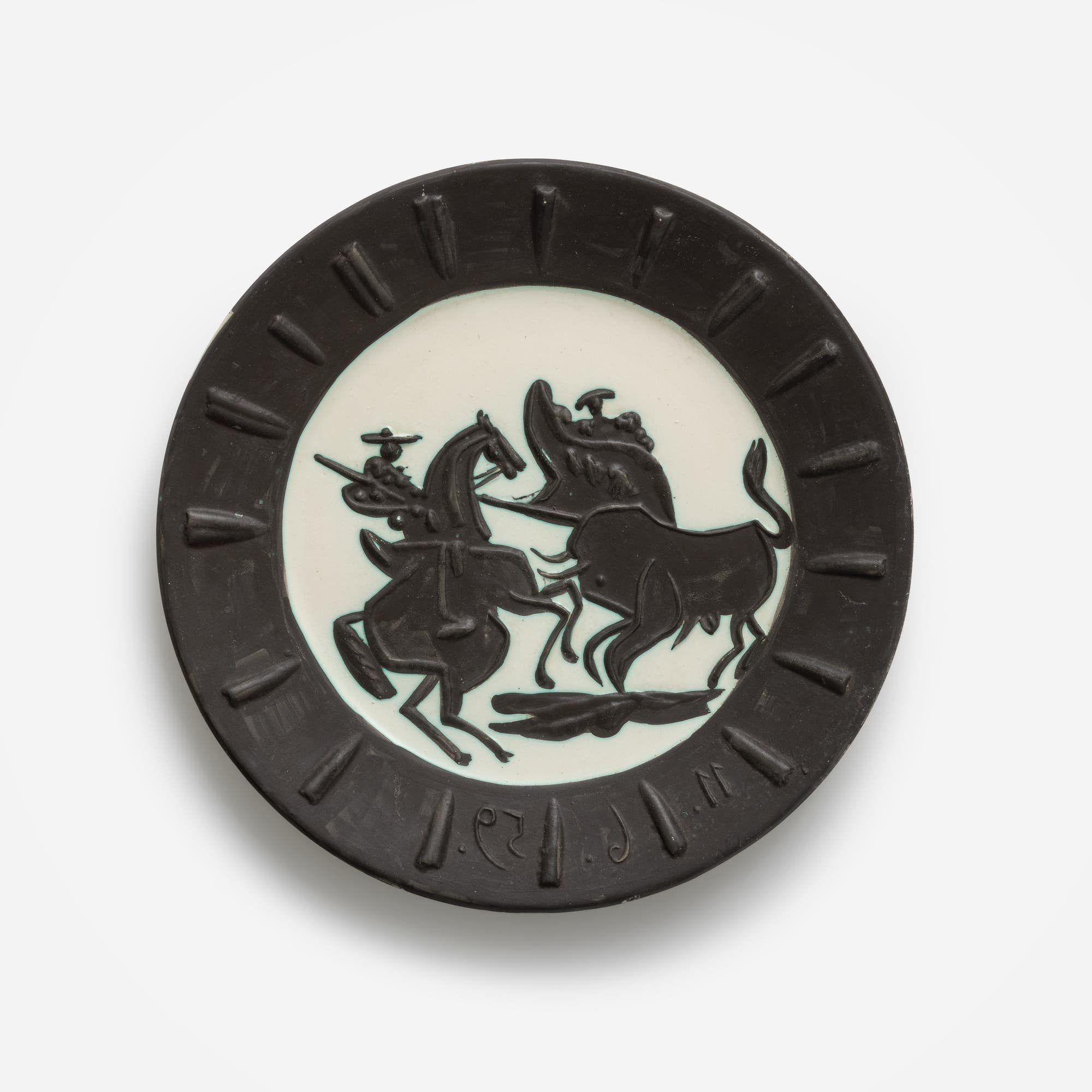
PABLO PICASSO, Scène de tauromachie, 1959. Modern & Contemporary Art Hong Kong.
Both artists inherently understood how the format of an object could frame and dramatise an image. For Picasso, the bullfight offered an especially fertile subject. In Scène de tauromachie, the circular ceramic form becomes an enclosed arena. Bull, horse, and figures are compressed within the field, while the surrounding rim reinforces the sense of a contained spectacle. Picasso had returned to the imagery of bullfighting throughout his career, but within ceramics the subject acquired a new relationship to form.
PABLO PICASSO, Colombe sur lit de paille, 1949. Modern & Contemporary Art Hong Kong.
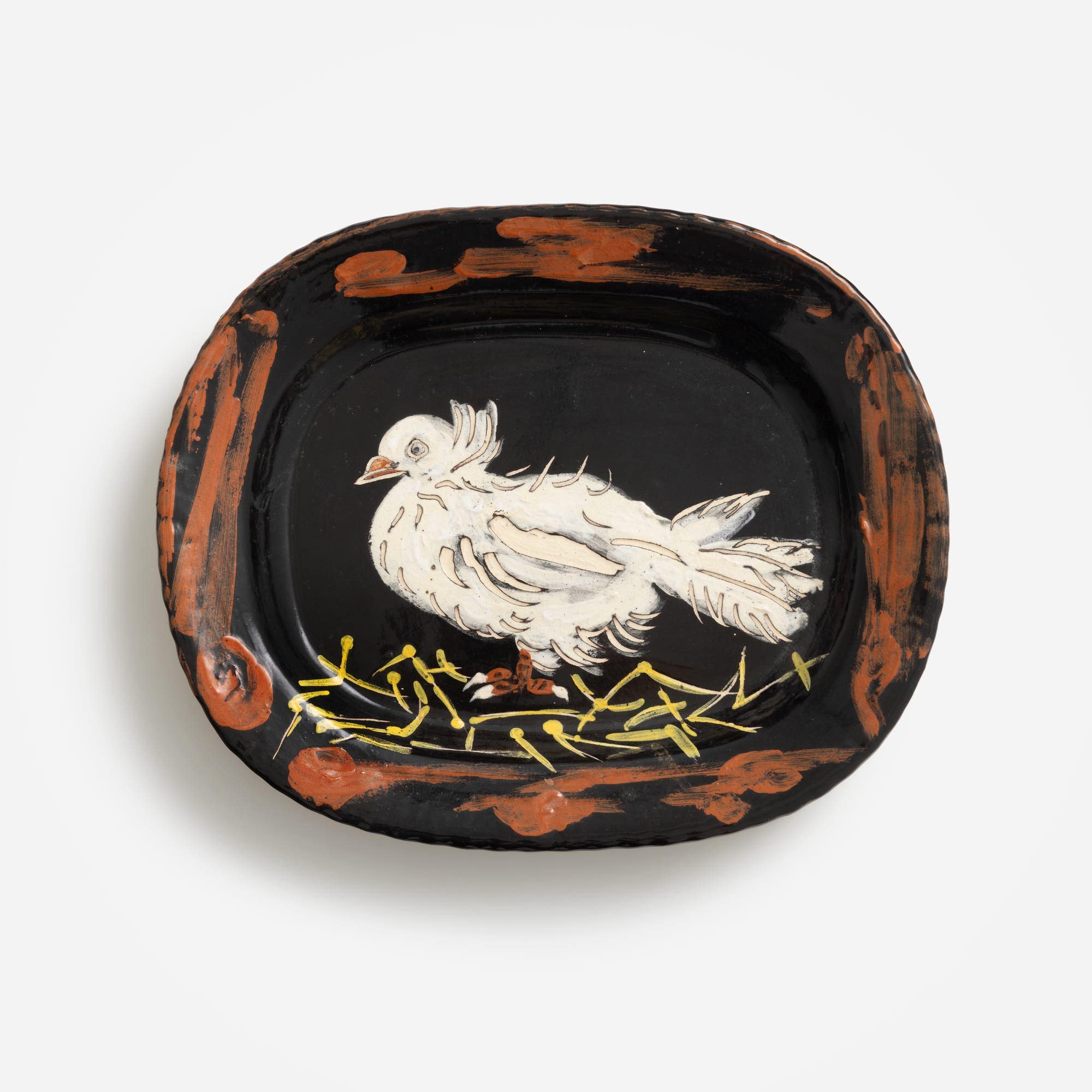
Executed in 1948, Colombe sur lit de paille shows the same instinct at its most pared-back. The pale bird stands in sharp contrast against the dark ground, while the enclosing rim concentrates the composition. With an economy closer to drawing, Picasso translates a few graphic marks into a vivid ceramic image.
ANDY WARHOL, Hat, Boots, Mitten, Vest, Belt and Two Purses, circa 1955. Modern & Contemporary Art Hong Kong.
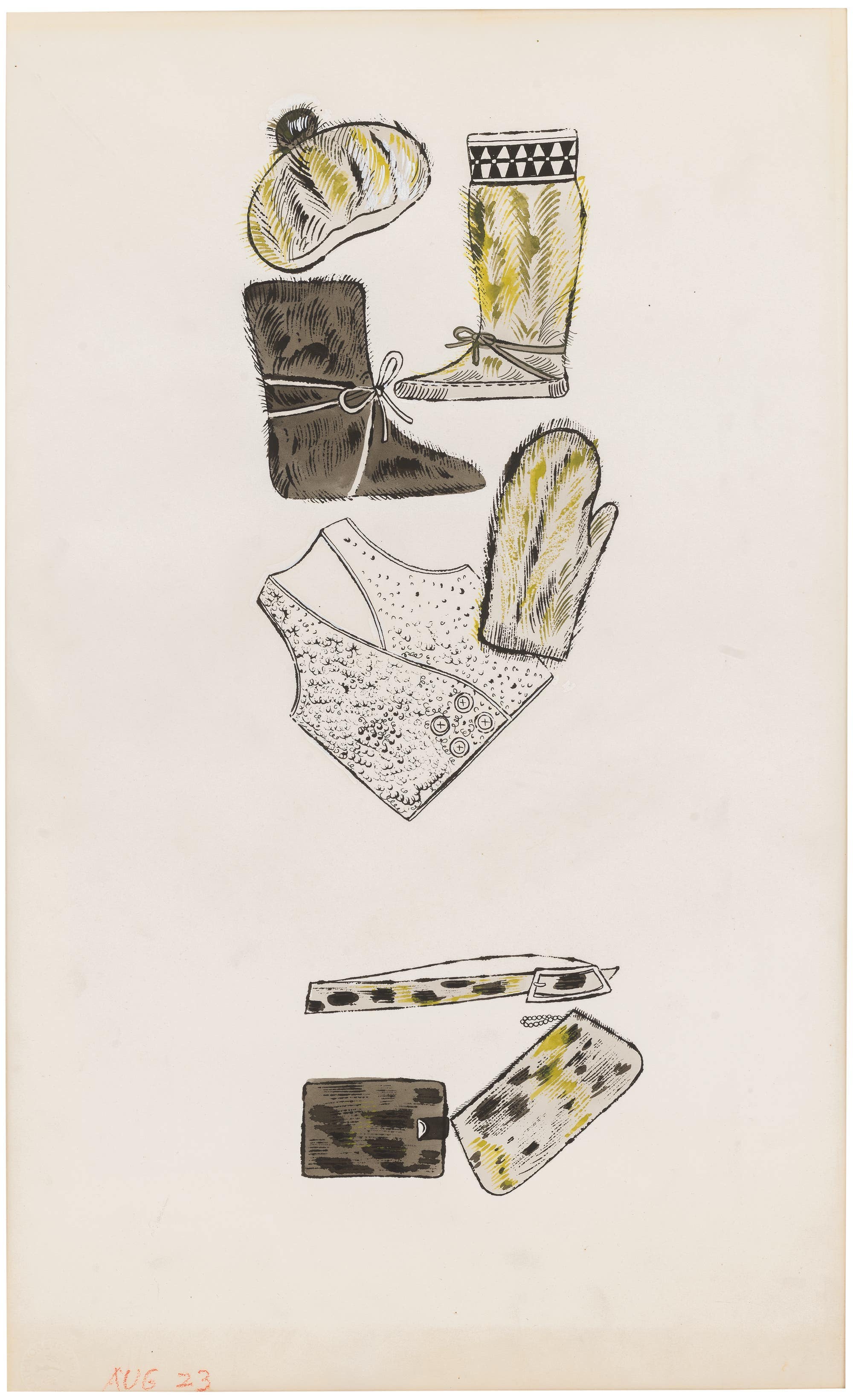
Warhol’s stage was the shop window. His artistic foundation was forged through designing retail displays, an experience that prompted his observation that department stores are “kind of like museums.” That sensibility is evident in Hat, Boots, Mitten, Vest, Belt and Two Purses, circa 1955, in which a collection of winter wear is curated vertically down the sheet: a beret-style hat, two textured boots, a cozy mitten, a patterned vest, a slim belt and a pair of matching printed bags. Warhol’s whimsical linework and understated color scheme give each item room to be admired. Long before his Pop Art screenprints defined the 1960s, drawings such as this demonstrated his ability to transform everyday consumer goods into charming, intimate art objects.
A Line You Can Recognize
PABLO PICASSO, Têtes de béliers, 1945. Modern & Contemporary Art Hong Kong.
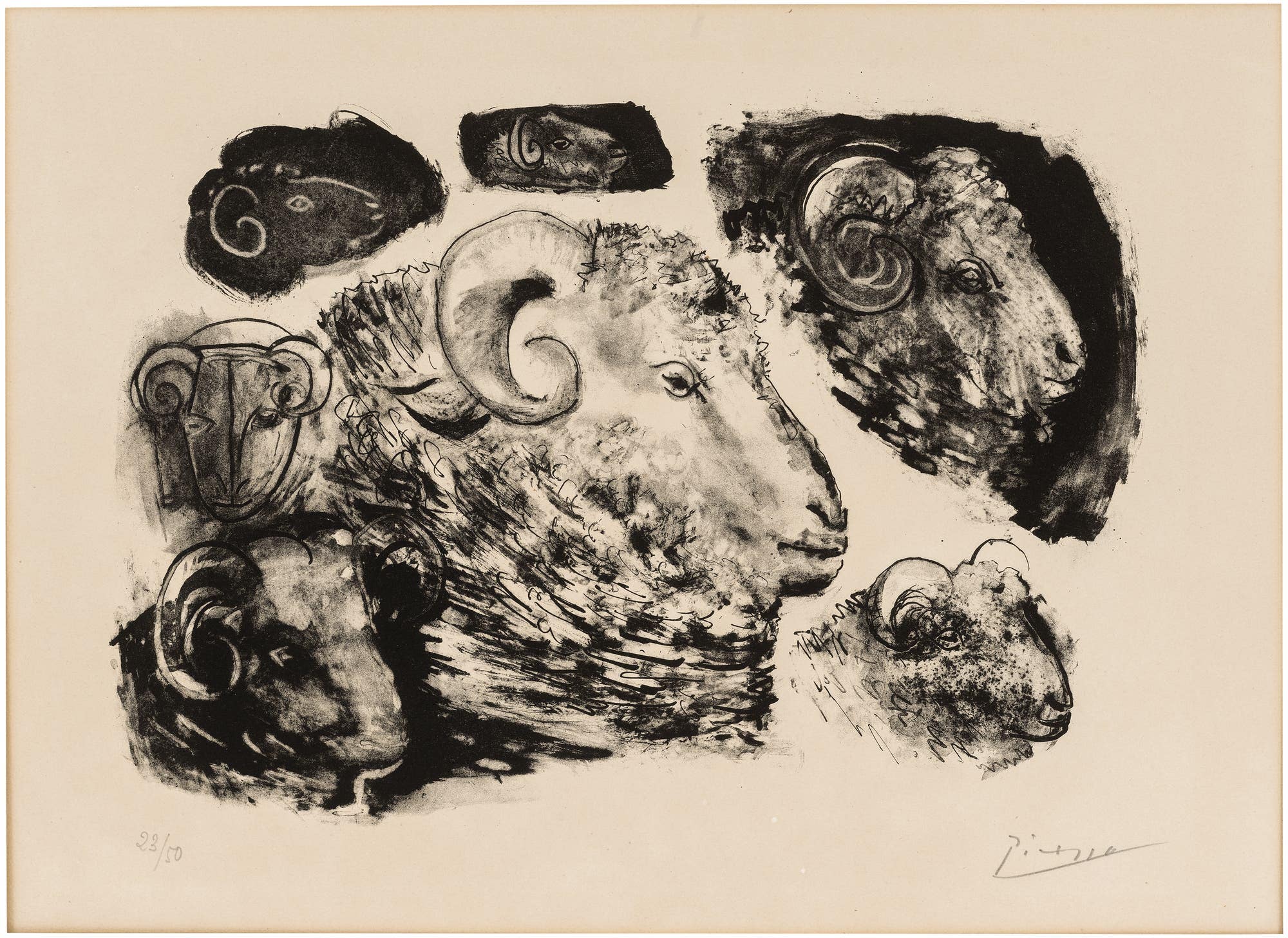
In Têtes de béliers, a lithograph from 1945, overlapping rams' heads emerge from an accumulation of graphic marks, showcasing the speed and assurance with which Picasso could establish volume through drawing alone. Warhol’s line, by contrast, was deliberately broken. At the heart of his commercial success was his signature blotted-line technique, which he learned at the Carnegie Institute of Technology. By transferring wet ink drawings from tracing paper onto absorbent sheets, he created irregular, stuttered lines that imbued each image with an intimate, hand-wrought lyricism.
ANDY WARHOL, Female Fashion Figure, circa 1960. Modern & Contemporary Art Hong Kong.
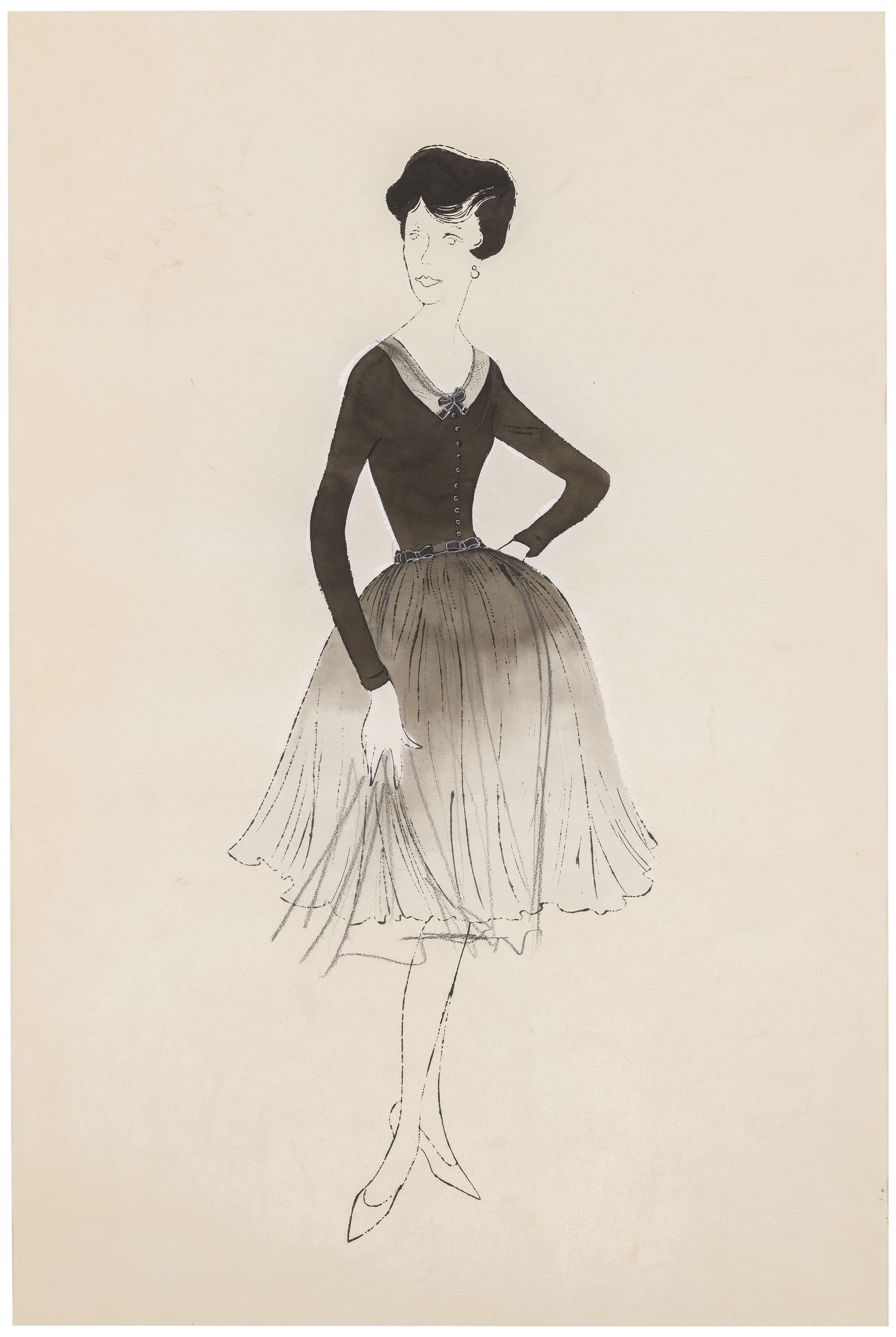
That lyricism lends Female Fashion Figure its air of poise. A chic woman stands hand on hip in a classic New Look silhouette: a fitted, dark long-sleeved top with a subtle bow-trimmed collar and buttoned front, a narrow belted waist, and a voluminous, sheer, A-line skirt that fades into delicate graphite line work, suggesting soft pleating and fluid movement. A stylized dark coiffure and poised, pointed heels complete a portrait of mid-century sophistication, drawn during the transition period during which Warhol bridged the worlds of high fashion commercial illustration and fine art.
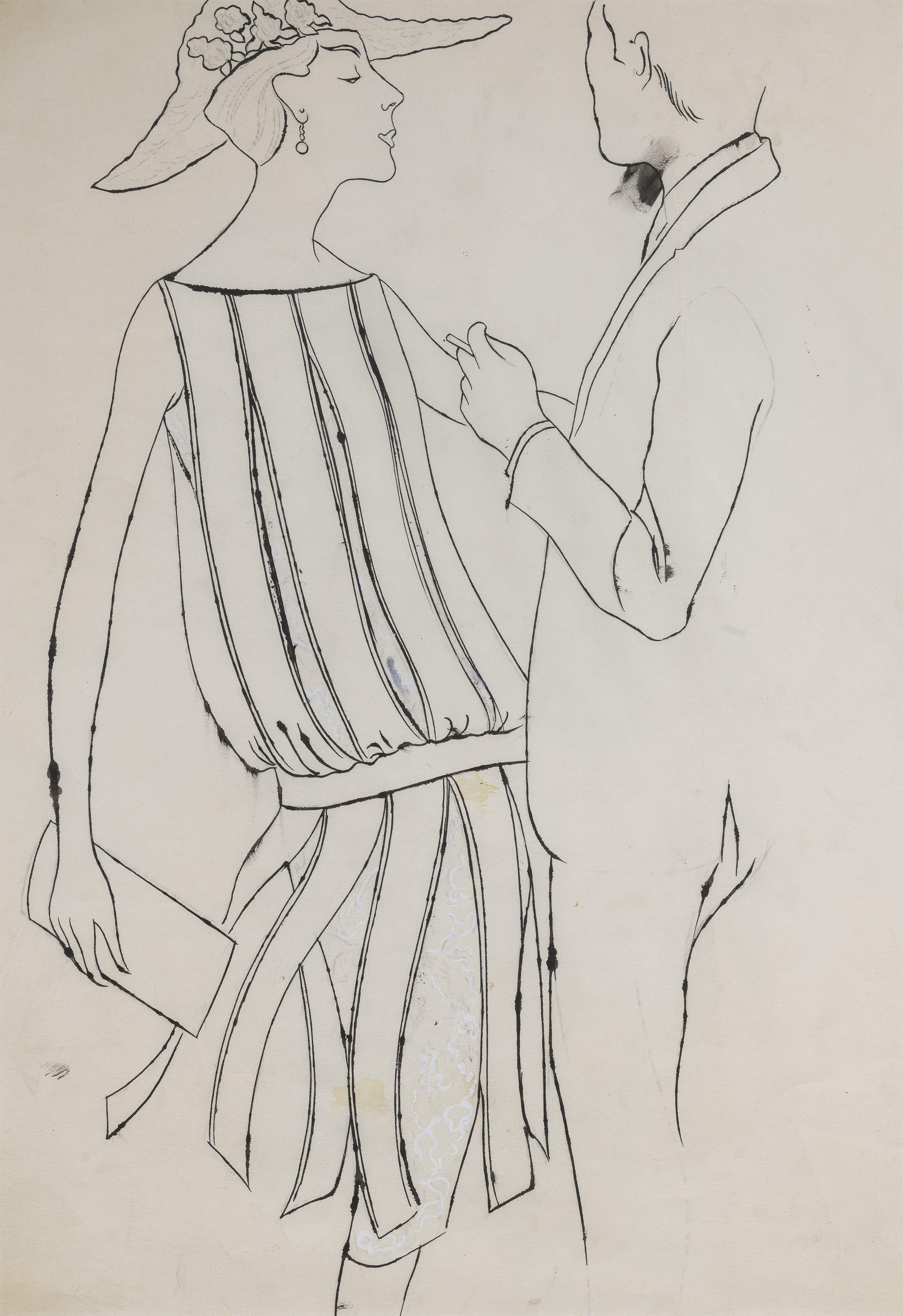
ANDY WARHOL, Female and Male Fashion Figures, circa 1960. Modern & Contemporary Art Hong Kong.
Female and Male Fashion Figures depicts a stylish couple in an intimate, interactive pose. The woman, in a wide-brimmed floral hat, drop earrings and a1920s-style flapper dress with bold vertical ink stripes, clutches a slender envelope purse as she gazes towards her companion. He is outlined in light graphite and minimal ink, standing in profile in a tailored suit and gesturing softly towards her. Warhol’s expressive, variable line weight lends the composition movement, charm, and editorial elegance.
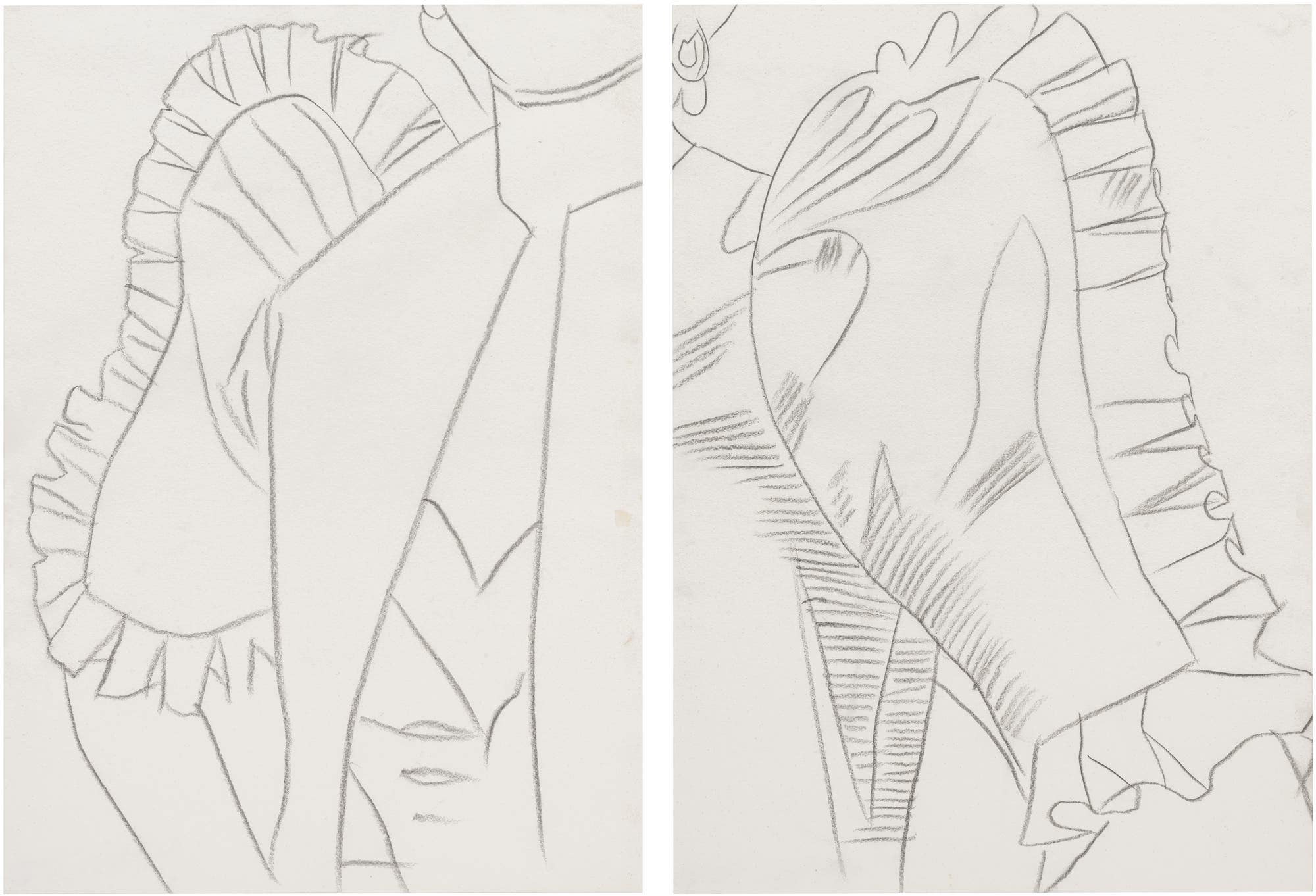
ANDY WARHOL, Fashion, circa 1983. Modern & Contemporary Art Hong Kong.
The two-sheet Fashion, circa 1983, finds Warhol returning to fashion themes later in his practice. By then the intersection of art and glamour had come full circle: in 1969, he had founded Interview magazine, fusing fashion, art and high society, and forged close bonds with designers such as Karl Lagerfeld and Yves Saint Laurent. Executed in clean pencil lines, the paired drawings capture the exaggerated silhouettes of 1980s haute couture, focusing on sharp jacket lapels and high-volume statement sleeves trimmed with delicate pleated ruffles. The closely cropped composition favors architectural form over individual portraiture.
Repetition and Reinvention
Another connective line between Picasso and Warhol was their embrace of repetition. The production of editions at Madoura allowed Picasso’s ceramic designs to circulate more widely and still retaining the physical immediacy of painted, glazed, and incised clay, a process that paralleled his engagement with printmaking, in which an image such as Têtes de béliers could circulate beyond the singular object.
Warhol’s blotted-line technique offered a different form of repetition, allowing him to transfer and vary a motif across multiple drawings. In both practices, multiplication became a creative method in its own right, allowing ideas to shift and assume new forms while demonstrating the hallmarks of each artist.