Article | On The Resonance Of Tension Modern Contemporary Art Auction London October 2026
On the Resonance of Tension
For these Black artists from around the world, unanswerable questions form a kind of poetry.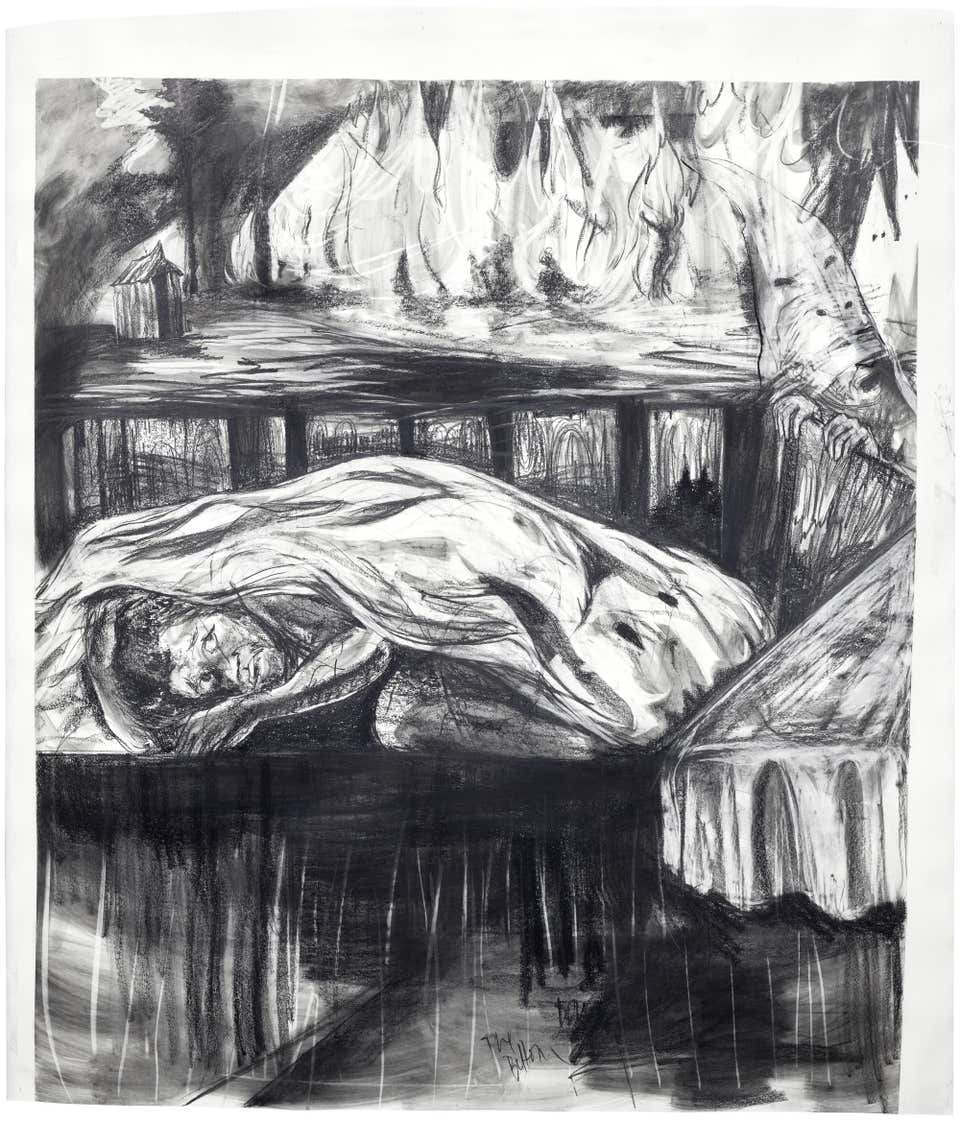
KARA WALKER, Kilroy Was Here, 2010. Modern & Contemporary Art, London.
Artists across Africa and its diaspora, from Europe to the US and the Caribbean, often develop a visual language that interrogates and subverts limiting views of African and Black life through materiality, form, and process that allows meaning to unfurl slowly over time. For these artists, peripheral materials that were once dismissed now evoke aesthetic possibilities. Canvases are drenched in thick swabs of paint, etched over in layers, or smeared with vibrant oil sticks. Strings tether figures to charred surfaces overlaid with charcoal. Geometric abstractions and illegible texts refer to African textiles and veer towards obfuscation, respectively. Rather than resolve themselves, these works sustain the tension between beauty and violence, memory and reinvention.
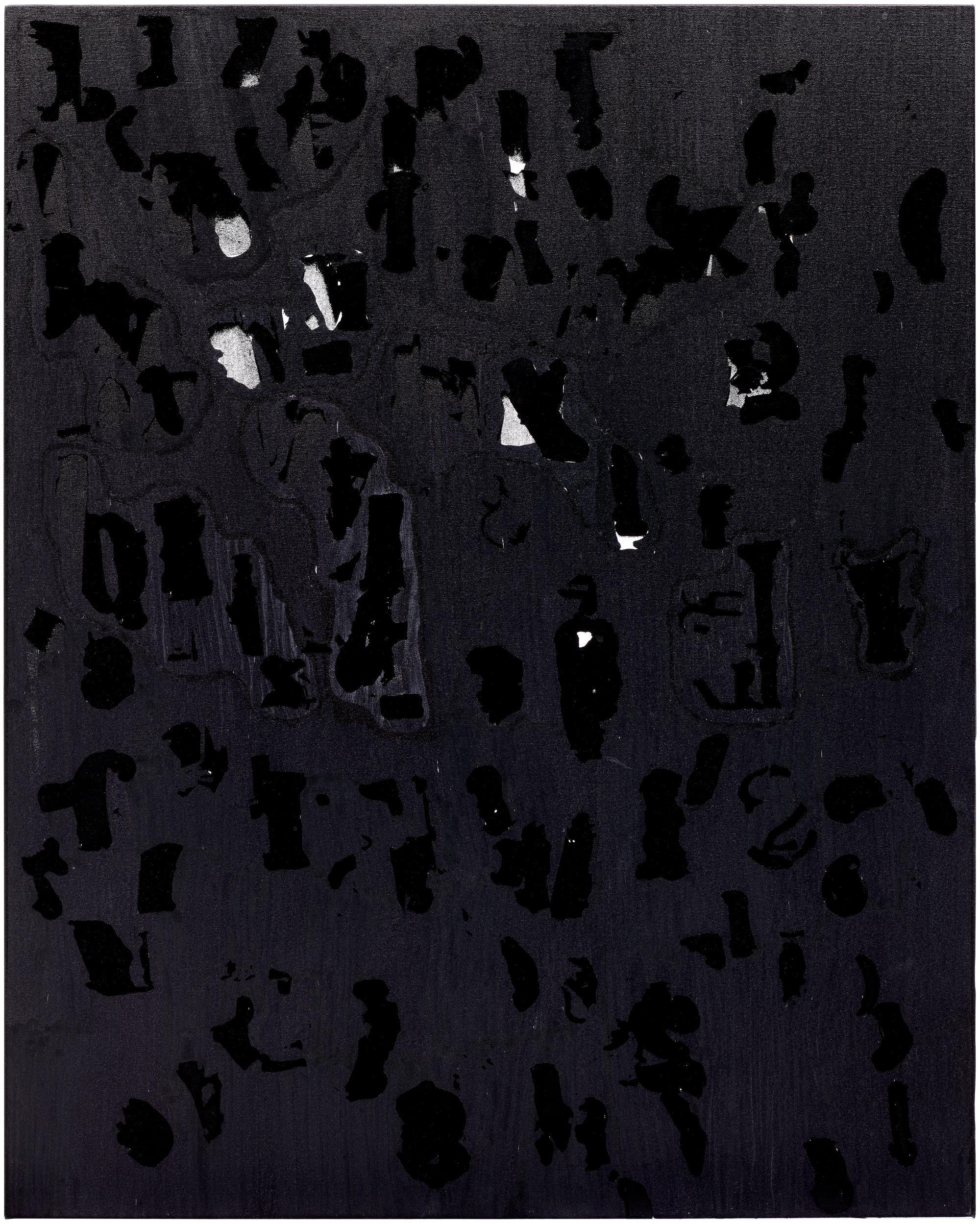
GLENN LIGON, Study for Debris Field #27, 2018. Modern & Contemporary Art, London.
In their practices, Kara Walker and Glenn Ligon interrogate visual and textual archives of racial violence and the subjugation of Black American life. For Walker, large graphic silhouettes depicting antebellum plantation life and overt scenes of violence became her visual language. Her latest public commission, Fortuna and the Immortality Garden (Machine) at the San Francisco Museum of Modern Art, featured eight life-sized mechanical Black figures, performing repetitive movements positioned atop 35,000 pounds of obsidian glass sourced from Mount Konocti in California. In Kilroy Was Here (2020), Walker wields a monochromatic palette of graphite and pastel on paper to portray Jim Crow-era violence. In the work, we see a Black man hiding from a Klan mob. Behind him, flames destroy surrounding structures, as a Klan member looks away, his mouth exposed from under the white sheet of his mask. Walker unflinchingly renders racial terror, imploring viewers to confront how violence shapes America’s conscience.
Ligon interrogates history, race, sexuality, and violence through text-based work, drawing on the work of literary titans from Zora Neale Hurston to James Baldwin. In his flat graphic works, texts disappear in a flurry of repeated words layered atop each other in a succession of straight lines. For Ligon, language is shaped by history, identity, and racial politics. Stenciled texts smudge surfaces, becoming illegible, reminding us that history and systems of power take time and work to understand. Built from layers of black ink on stretched canvas, the letter forms and gestural marks in Study for Debris Field #27 (2018) deconstruct language with fragmented texts. The work is mostly black, albeit with small swatches of white that pierce through the canvas. Ligon occludes the words he borrows, insisting on illegibility. His sixth exhibition, ‘Prompts’ opens at Thomas Dane on Oct 13th in London and brings together early and recent bodies of work into conversation to re-contextualize each other.
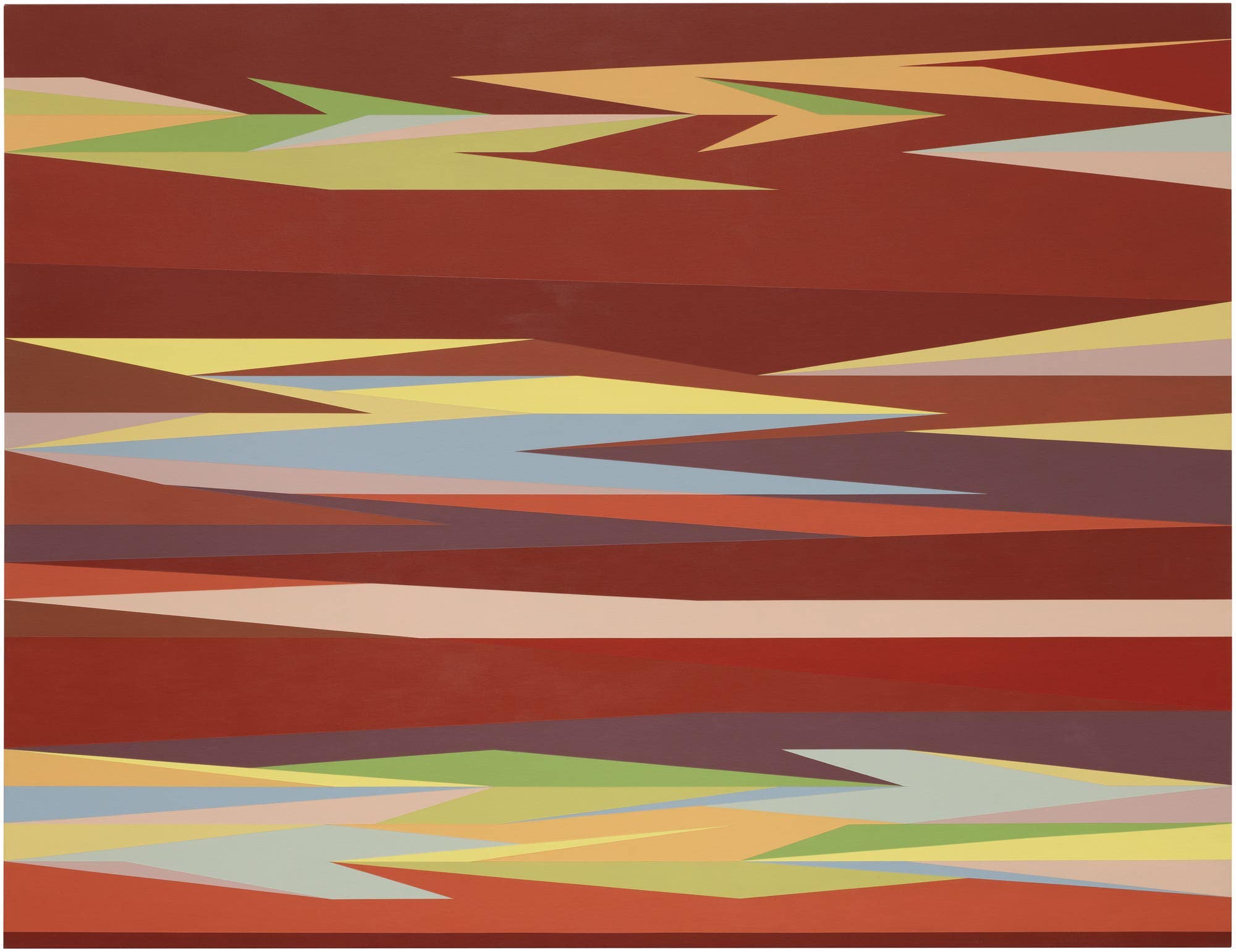
ODILI DONALD ODITA, Stream of Consciousness, 2004. Modern & Contemporary Art, London.
The Nigerian-born, Philadelphia-based Odili Donald Odita narrates his paintings not with words but with color and abstract forms. For the artist, it’s a space of complexity. Color becomes a site of diasporic memory, carrying personal and collective histories. Geometric shapes splinter and refract on canvases. Triangles and polygons rendered in well-saturated hues explore questions of race, migration, and the politics of representation. The painting, Stream of Consciousness (2024), blends his signature angular lines with muted browns and burgundies that criss-cross over jagged vertical lines, suggesting that cultural memory is neither fixed nor singular, but contains multitudes. Complicating distinctions between Nigerian traditions and Western modernism, Odita treats them both as sites of negotiation. Moving beyond the canvas, much of Odita’s recent work includes murals, public commissions, installations, and prints. His large-scale commissioned installation at MOMA is on view until early next year.
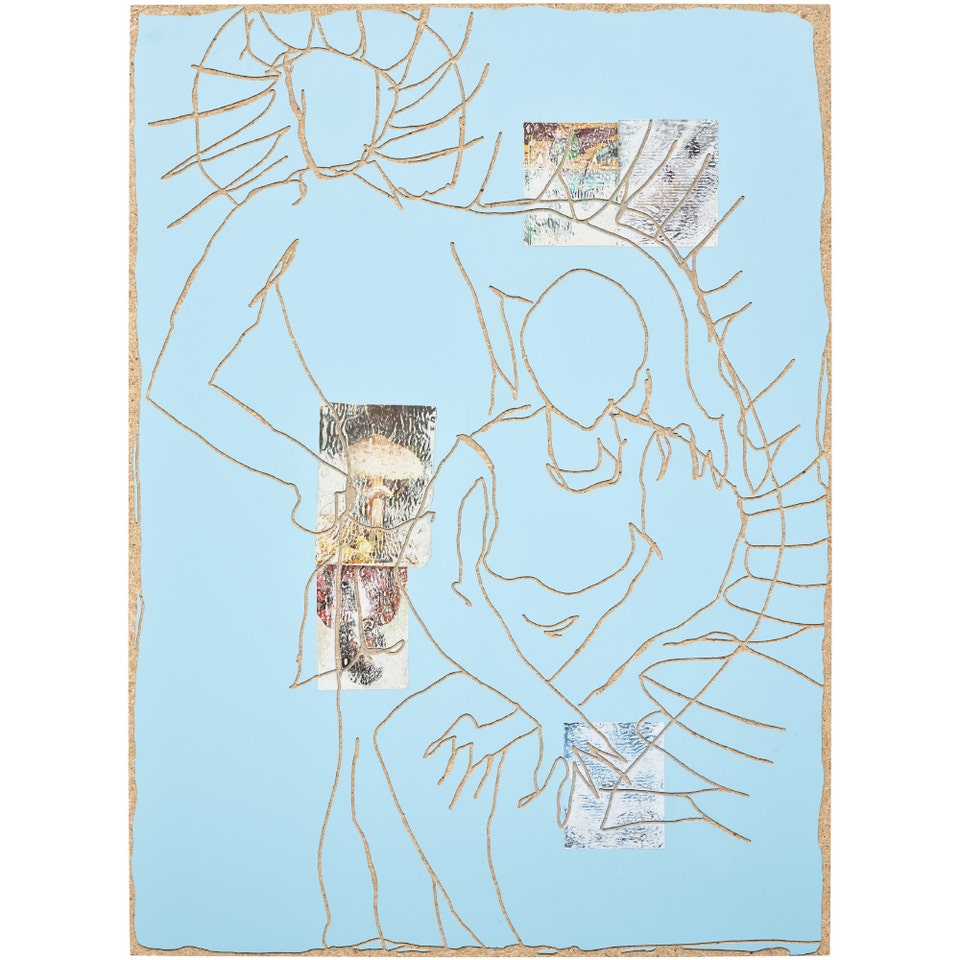
Through diverse mediums, Julien Creuzet and Lavar Munroe traverse collage, sculpture, and large-scale installation, drawing on African diasporic symbolism. Creuzet’s To live together, to live together, to be together, to smile together, to breathe together, together we feel good, together we look like each other, together until transparency, we loved each other until we disappeared (2019) offers an alternative to the visual density typical of his practice, where subtle gestures of intimacy and collective belonging are imagined and then realized. Here, simplicity and sweeping gestural lines depict a standing line-drawn figure cradling its arm around a seated companion. The light blue paper fixed to laminated plywood evokes a sense of calm, while paper collage is distributed across the picture plane. Included in Dissident Chorus at the Busan Biennale this year, Creuzet salvages and reclaims material, complicating the formal and historical relationships between Africa, the Caribbean, and the West.
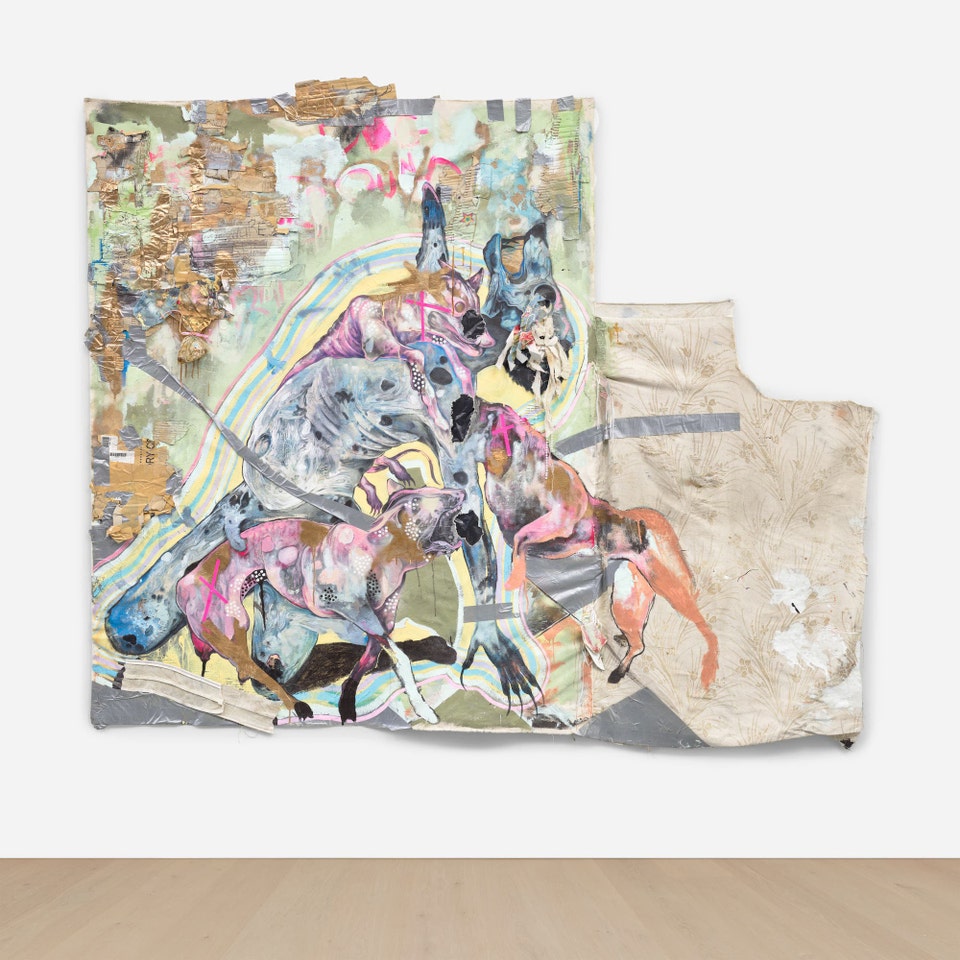
In Munroe’s Boy Predator Boy Prey (2012), a confrontation between predator and prey unfolds where vulnerability and power remain unstable. Three small pink snarling animal figures attack a larger fourth animal rendered in bluish-gray hues as its head tilts back, and mouth hangs open gasping in pain. The oblong canvas reveals Munroe’s signature material interventions. Duct tape is affixed across the canvas. Discarded cardboard is painted over and crosses the canvas's edge, carrying its composition beyond it. His collages challenge hierarchies of material and artistic production. Shreds of fabric hang from the ear of the 'animal' boy, who is, as the title tells us, both predator and prey. Munroe's work in the Bahamas Pavilion at this year's Venice Biennale, titled In Another Man's Yard: John Beadle, Lavar Munroe, and the Spirit of (Posthumous) Collaboration, is on view through Nov 22.
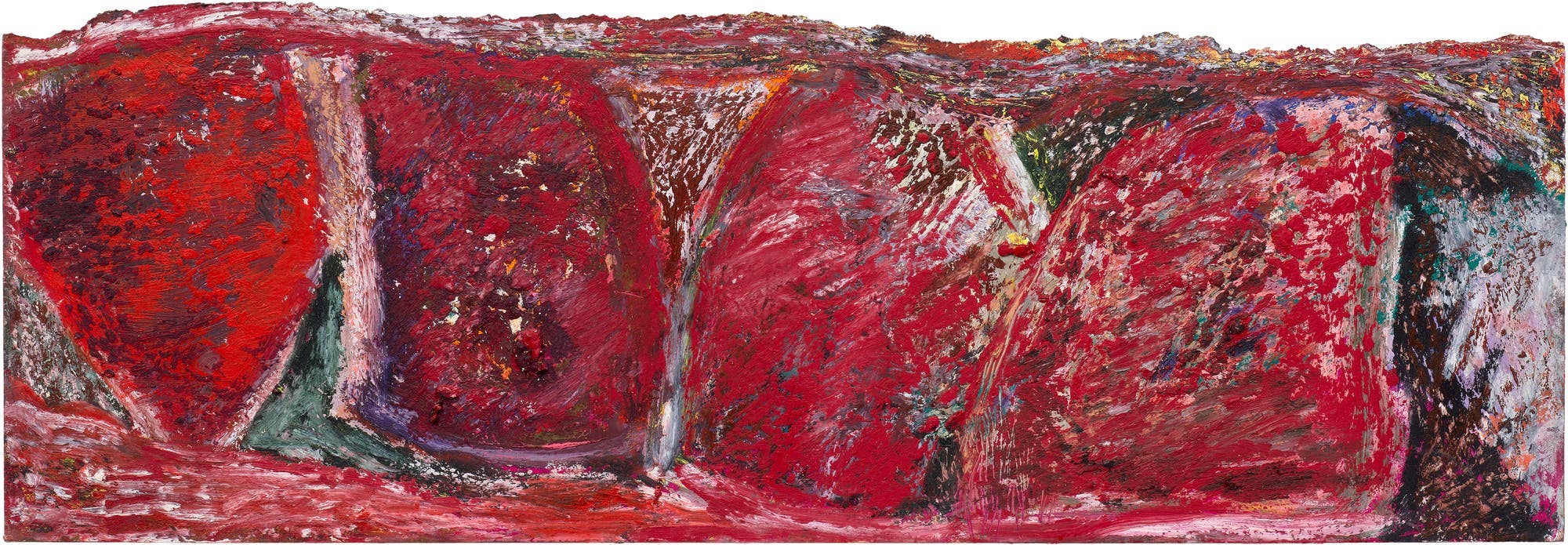
RACHEL JONES, A sliced tooth, 2020. Modern & Contemporary Art, London.
Rachel Jones pushes the boundaries between abstraction and figuration through canvases drenched in pastel oil sticks that reveal her preoccupations with the body — specifically the mouth, tongue, and teeth — as sites of exploration. In A sliced tooth (2020), four tooth-like forms in varying shades of red confront one another at opposing angles. Like many of Jones’ compelling abstractions, this work on paper, made of oil pastel and oil stick, emphasizes color to engage the body, Blackness, and cultural references. As a London-born British artist, Jones uses the language of abstraction to examine the physical and emotionally resonant dimensions of Black life with resolve.
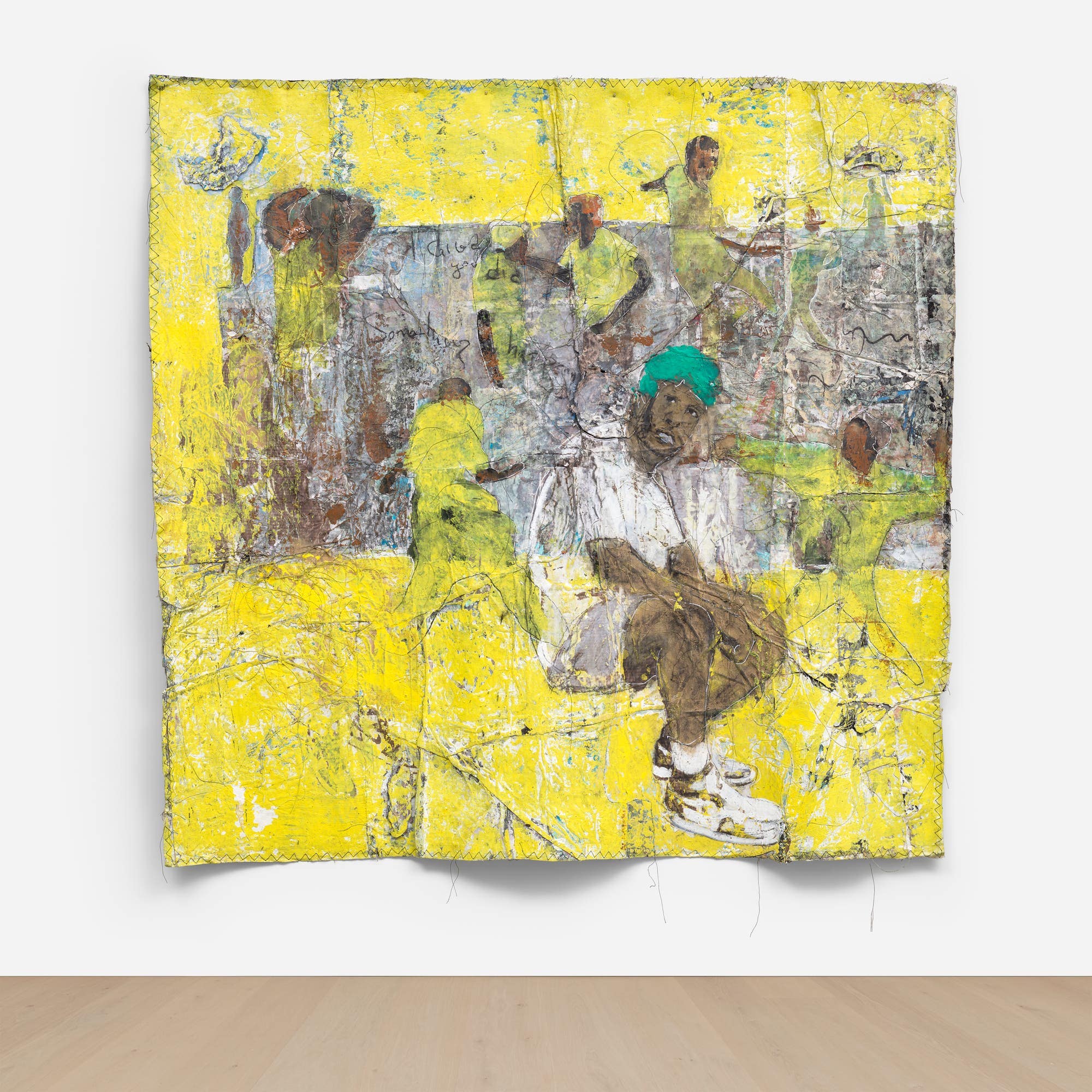
KALOKI NYAMAI, No Leloni, 2021. Modern & Contemporary Art, London.
Kaloki Nyamai’s sweeping large-scale works featured in this year’s Venice Biennale bring ancestral ties and oral histories into figurative paintings that cascade off walls or at times hang from ceilings. For Nyamai, contemporary Kenyan life remains shaped by the challenges of its postcolonial history. This informs his large-scale works. In No Leloni (2021), a lone male figure pierces his gaze directly at the viewer. Casually dressed in a white shirt, grey shorts, and white and yellow sneakers, he sits while figures in motion behind him raise their arms, and bodies twist in the background. The painting's color-blocked ground is bright yellow. Strings hang from its edges. Pieces of canvas are sewn together and laid atop each other, deepening its layers. Materially, Nyamai deploys a myriad of laborious processes that cut, rip, and char canvases before stitching them back together. A visual metaphor for the complexities of Kenyan life in need of repair and reclamation.
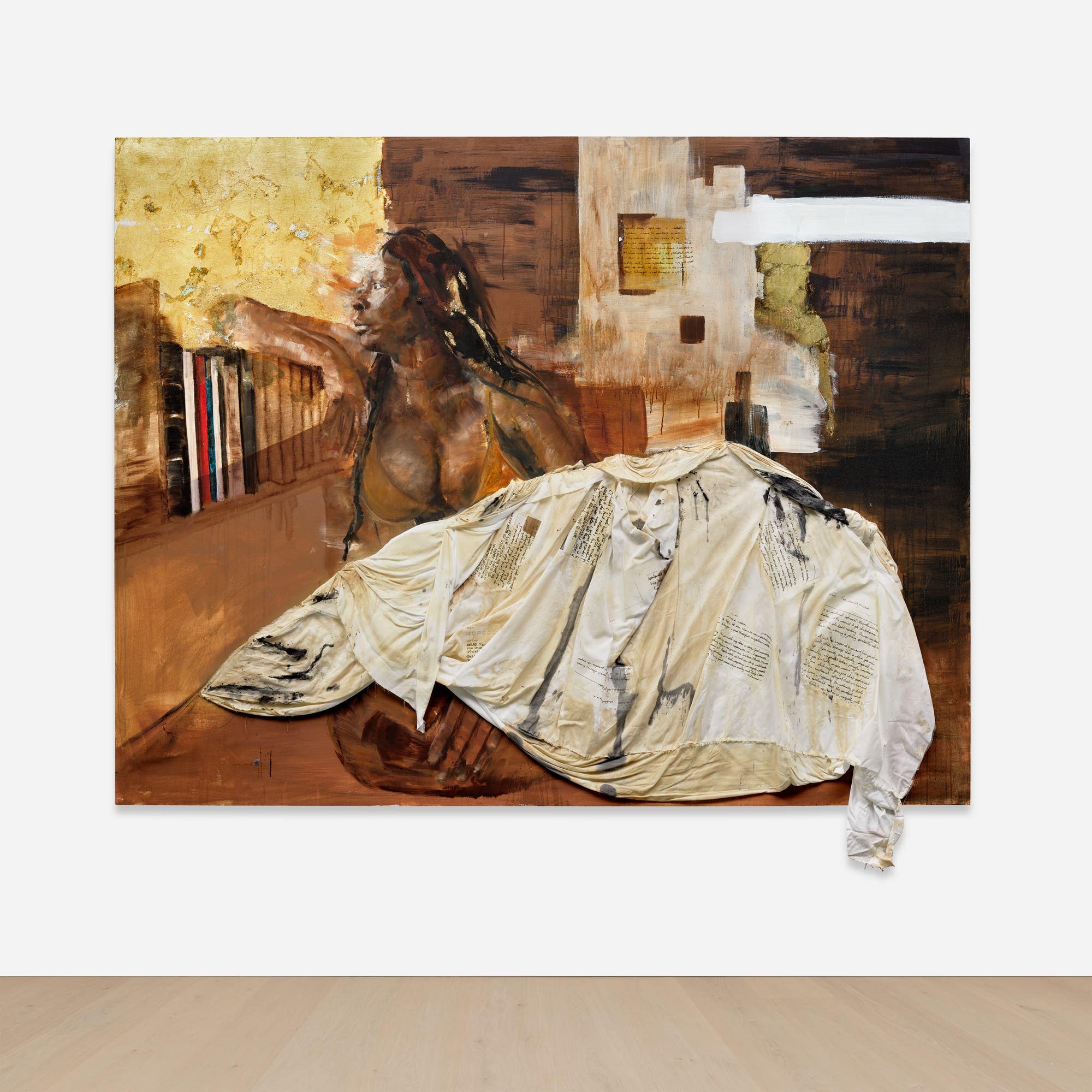
EMMA PREMPEH, Windows of Emotion, 2020. Modern & Contemporary Art, London.
For London-based Emma Prempeh, investigating her Ghanaian and Vincentian roots begins in darkness. On large canvases, figures emerge from black paint while reflective metallics shimmer against dreamlike scenes of everyday life. Her self-portrait, Windows of Emotion (2020), features oil, acrylic, and imitation gold leaf on canvas that wrestles with longing, desire, and sensuality. Here, as in much of her work, she employs fabric, draping it past the canvas’ edge, to extend its composition below the frame. In recent years, the artist has presented works at Frieze New York and Gagosian Gallery in New York, and her first solo exhibition at Perrotin in Paris closed this September.