Article | Modernism An Avant Garden Of Delight Editions Auction New York October 2026
Modernism: An Avant-Garden of Delight
Throughlines in the shifting shape of the avant-garde.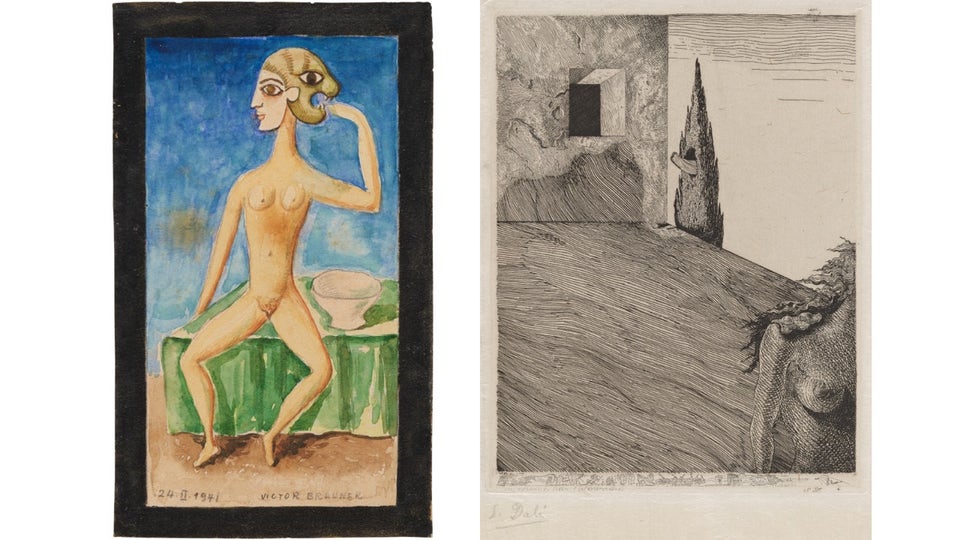
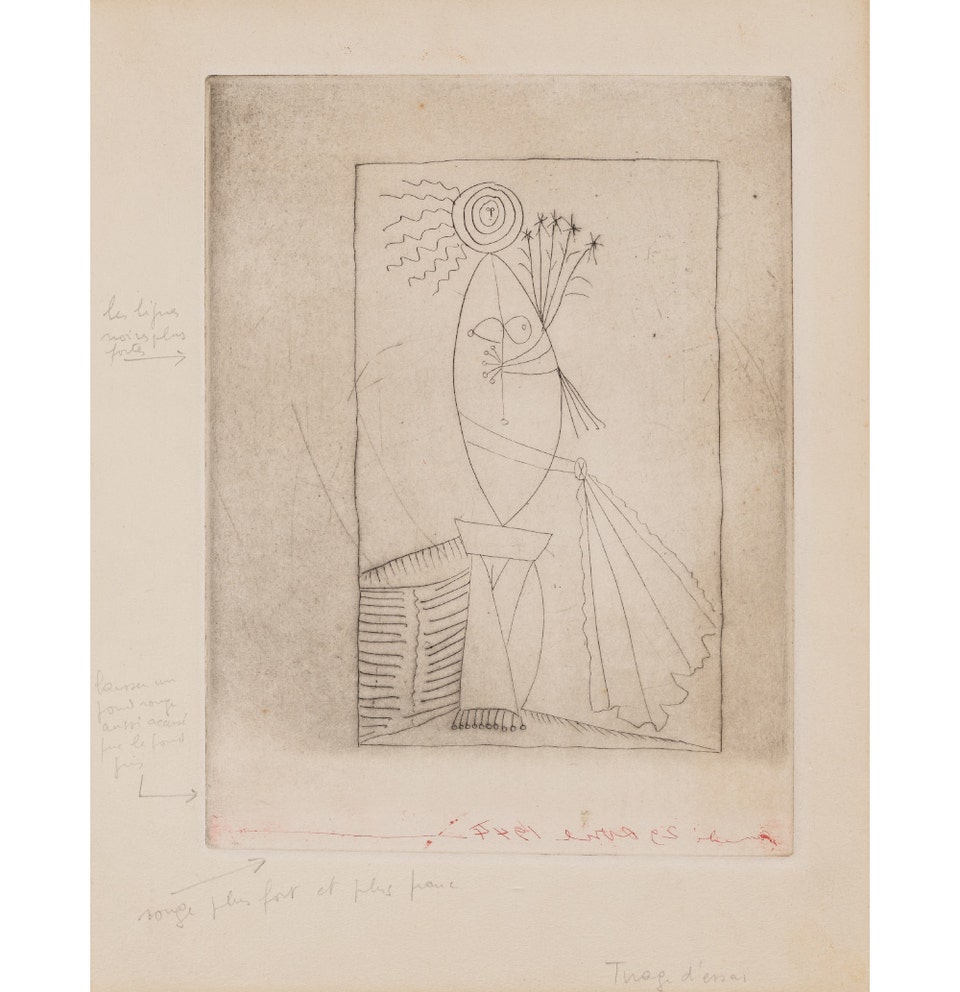
LEFT: VICTOR BRAUNER, Projet pour l'Offrande (Project for the Offering), 1941. Editions & Works on Paper: Modernism.
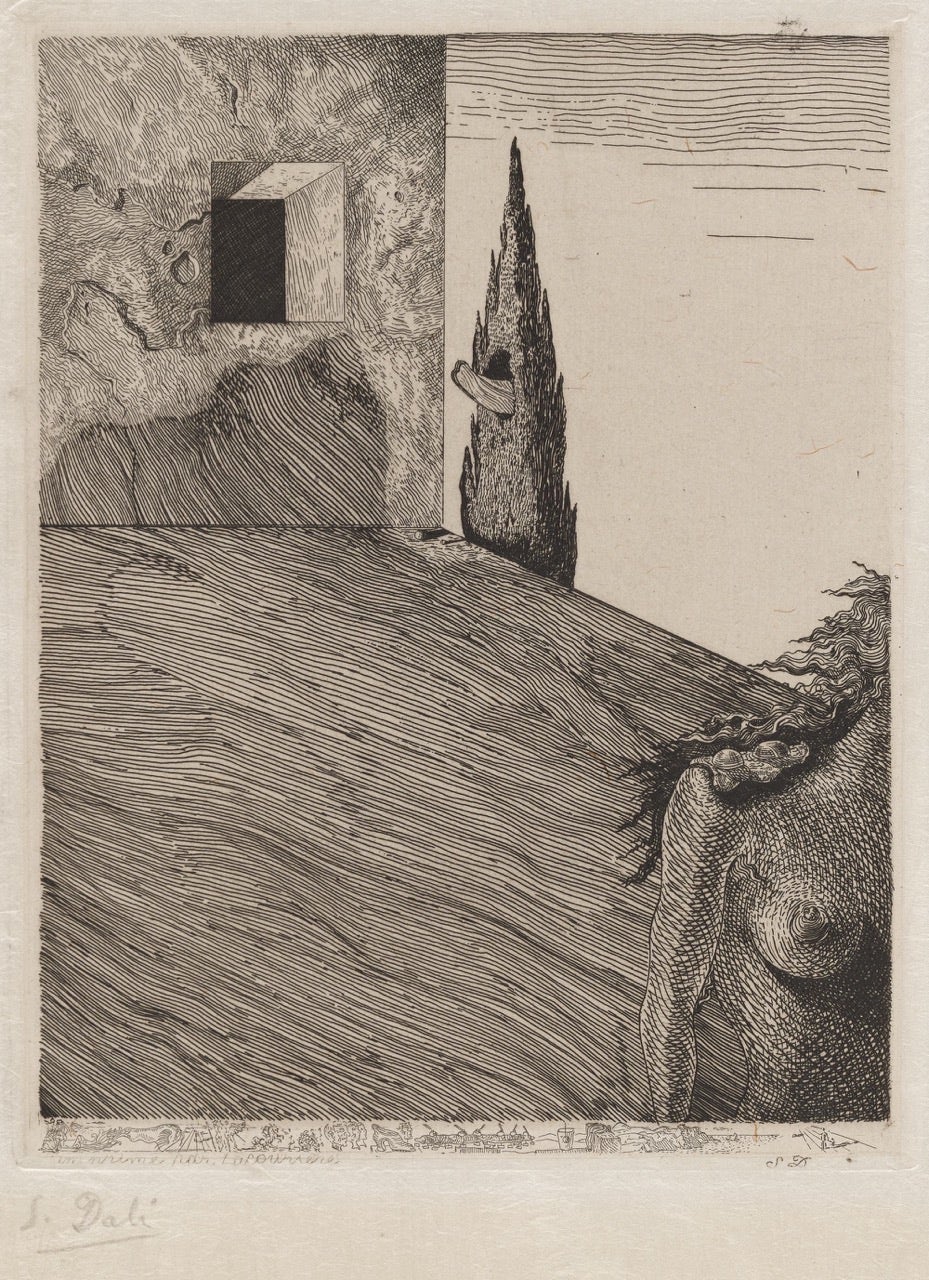
RIGHT: SALVADOR DALÍ, La Revolver à cheveux blancs (The Gun with White Hair), 1932. Editions & Works on Paper: Modernism.
It is the badge of any great artist to be able to render the intangible aspects of our world, with its strangeness and confluences, into a visual form that speaks to its time, whether directly or in conversation with past works that inspire new ways of looking at their or our present. For these avant-garde artists featured in our upcoming Editions & Works on Paper: Modernism sale, that ability is brilliantly evident in several surprising groupings that explore how they found harmony in a century of visions.
Sacred inversion
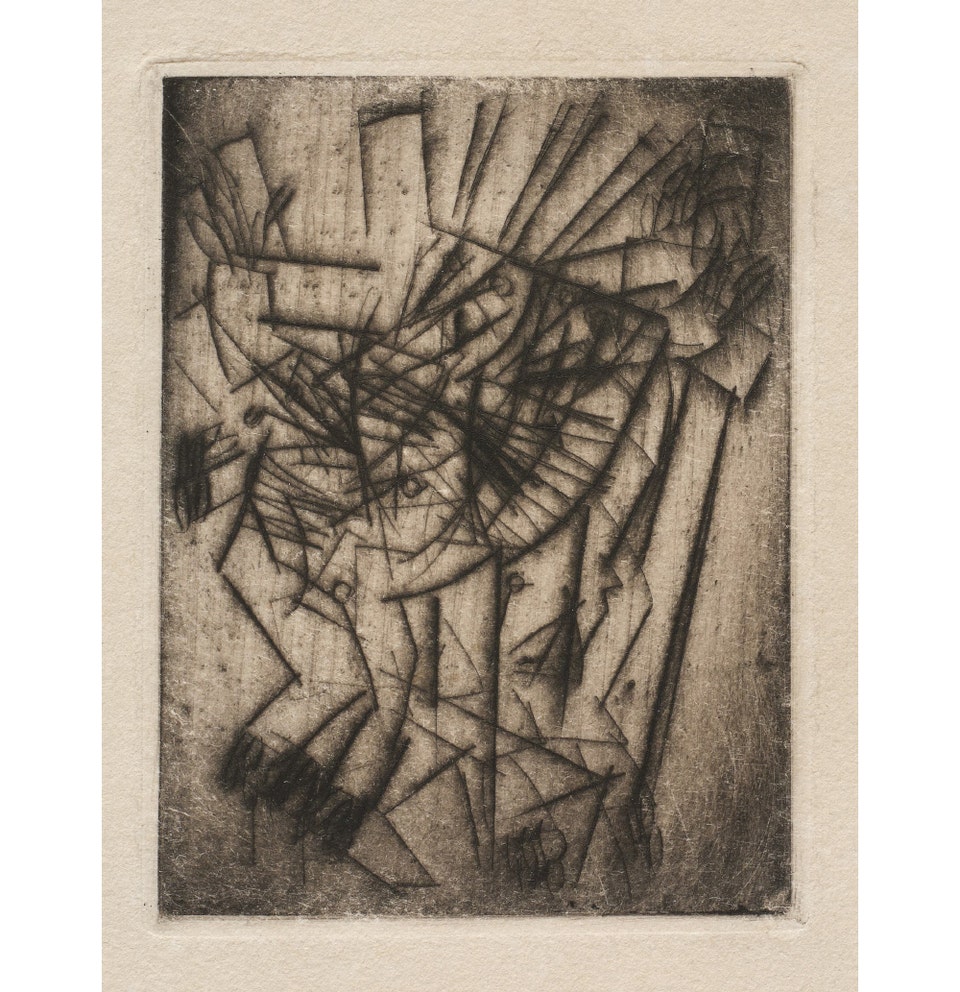
JEAN (HANS) ARP, Crucifixion , 1914. The only example of the artist’s first print. Editions & Works on Paper: Modernism.
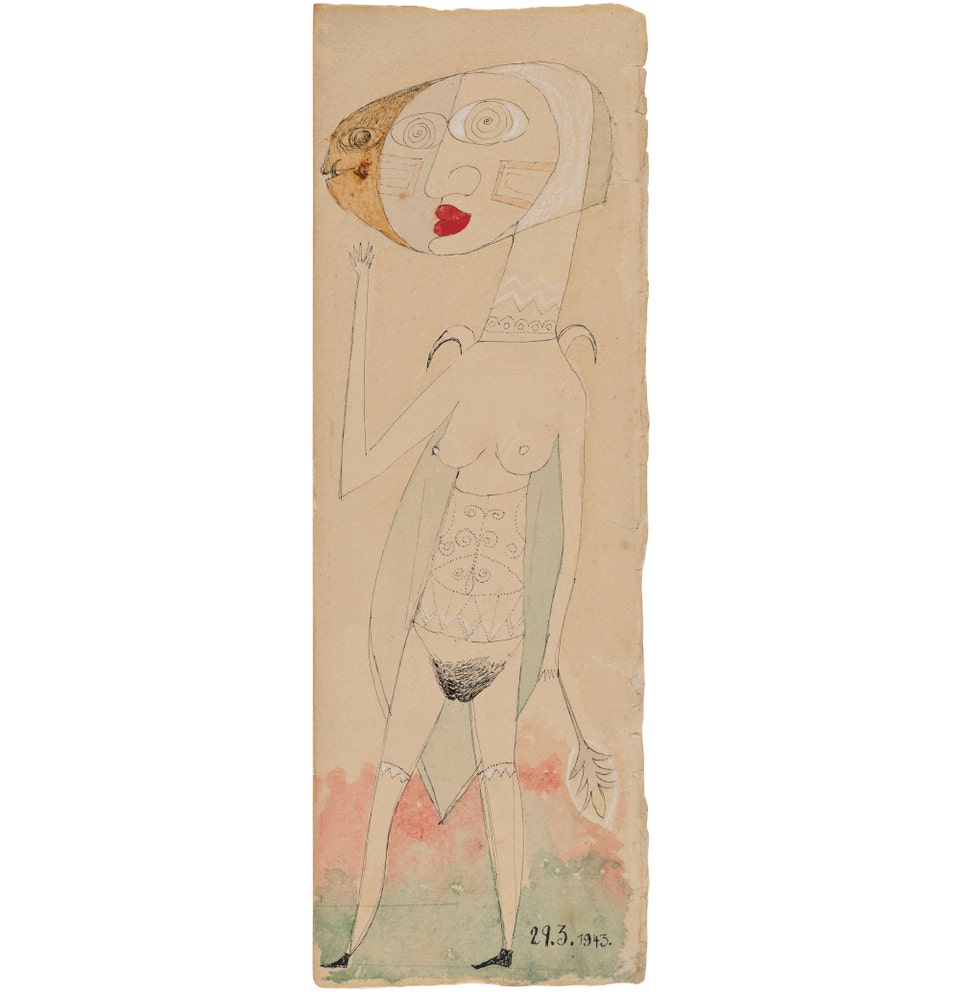
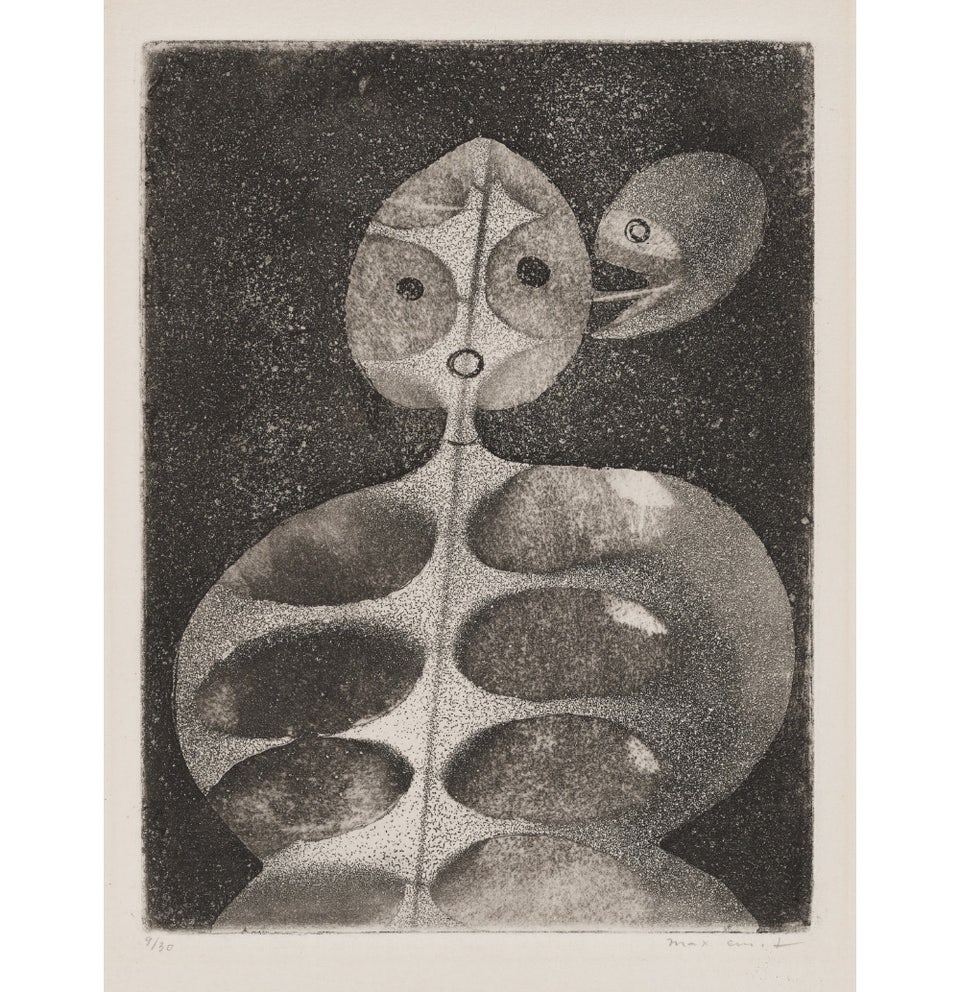
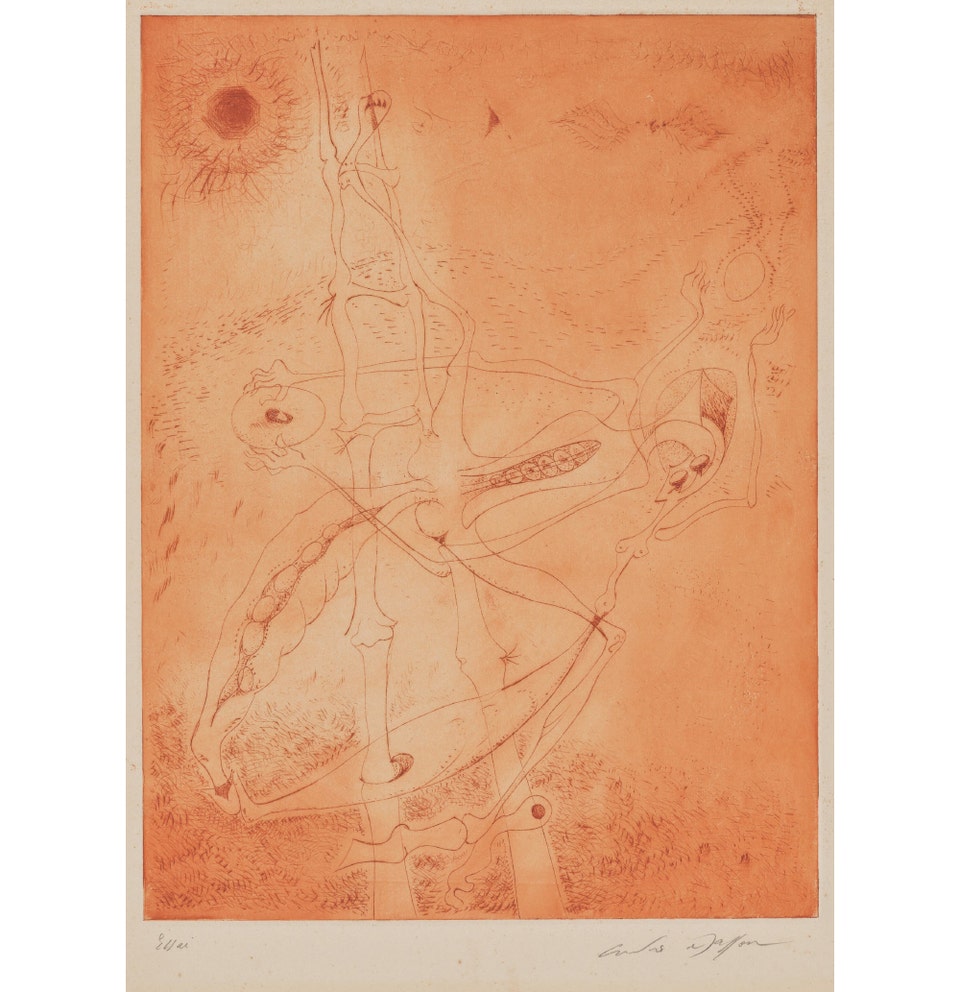
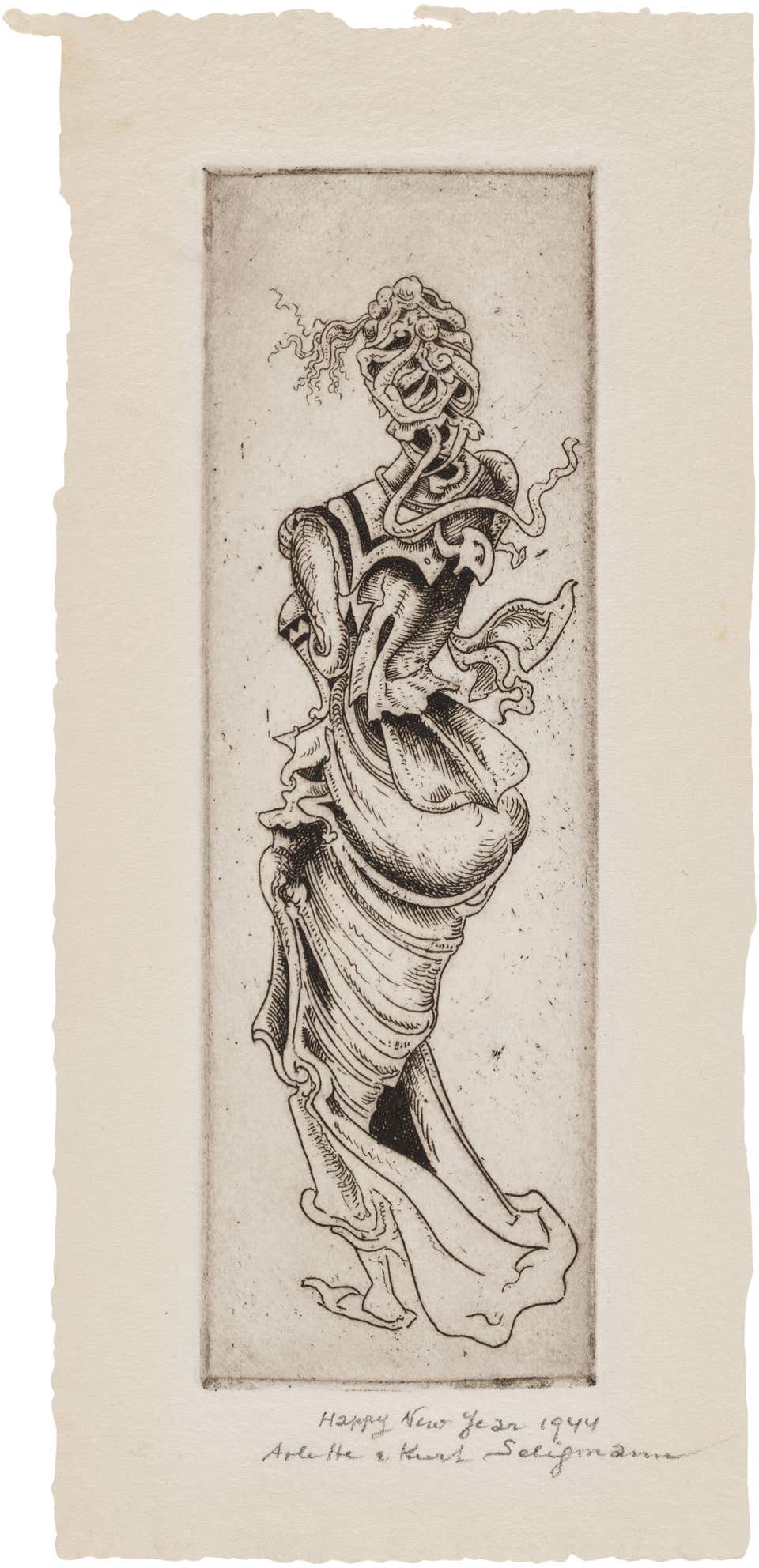
What’s old becomes new again, so the story often goes, but for these avant-garde artists, ancient myth and religious imagery are a fruitful ground to explore new psychologies. Across these works we see a new sort of interiority affixed to stories and myths we know so well. From the rich associations of Arp’s early “essential” crucifixion scene, which suggests the struggle of Christ bearing the cross through velvety Futurist movement, to the works by Brauner and Ernst that echo ancient totems and otherworldly mysticism — the states of Surrealist transformation between mental or spiritual planes, or even species, became an unending well of inspiration for artists making sense of their rapidly expanding world.
We see these themes further in works by André Masson and Kurt Seligmann, the former offering us a new understanding of the word “genius” by deconstructing its original meaning as an animating or divine spirit force inherent to a person, place, or concept. And the later revisiting Sophocles’ Antigone as a direct allegory for the displacement of people and the psychological crisis gripping Europe at the time. In Seligmann’s interpretation, Antigone takes the form of a swirling cyclone of associations, synthesized with her environment and caught in a flurry seemingly beyond her control.
Art in the everyday

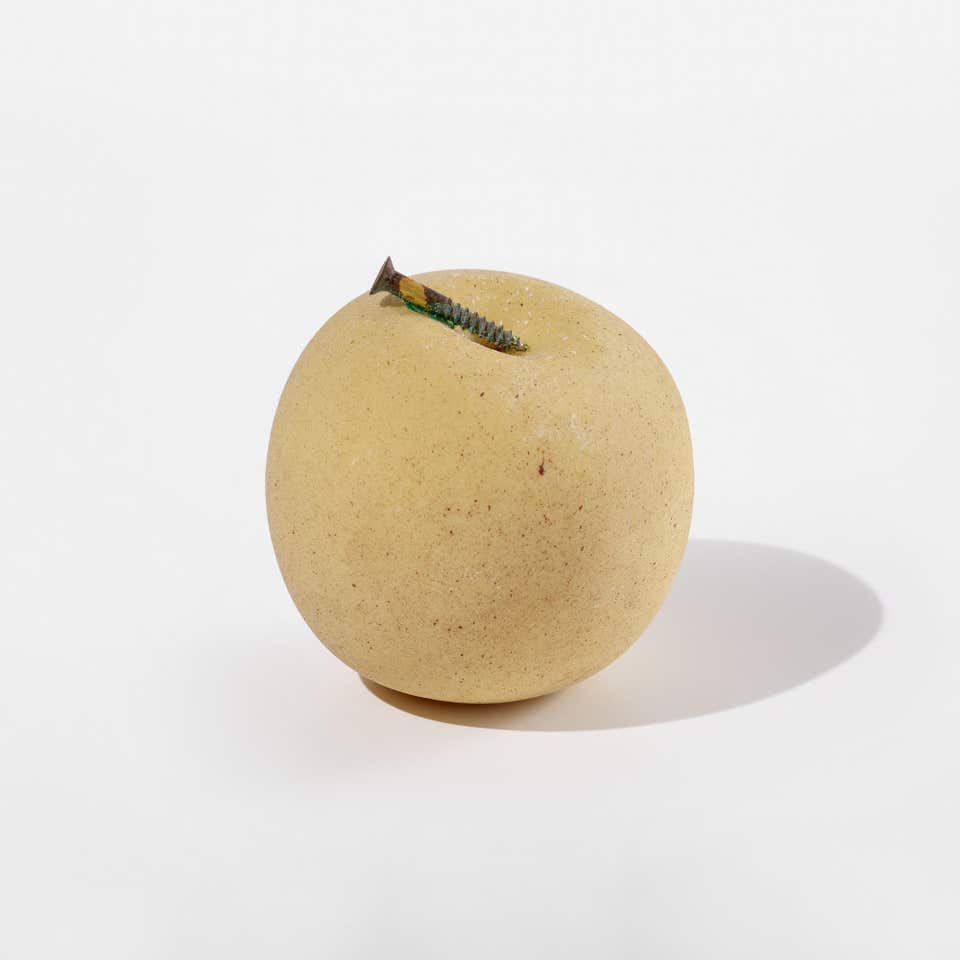
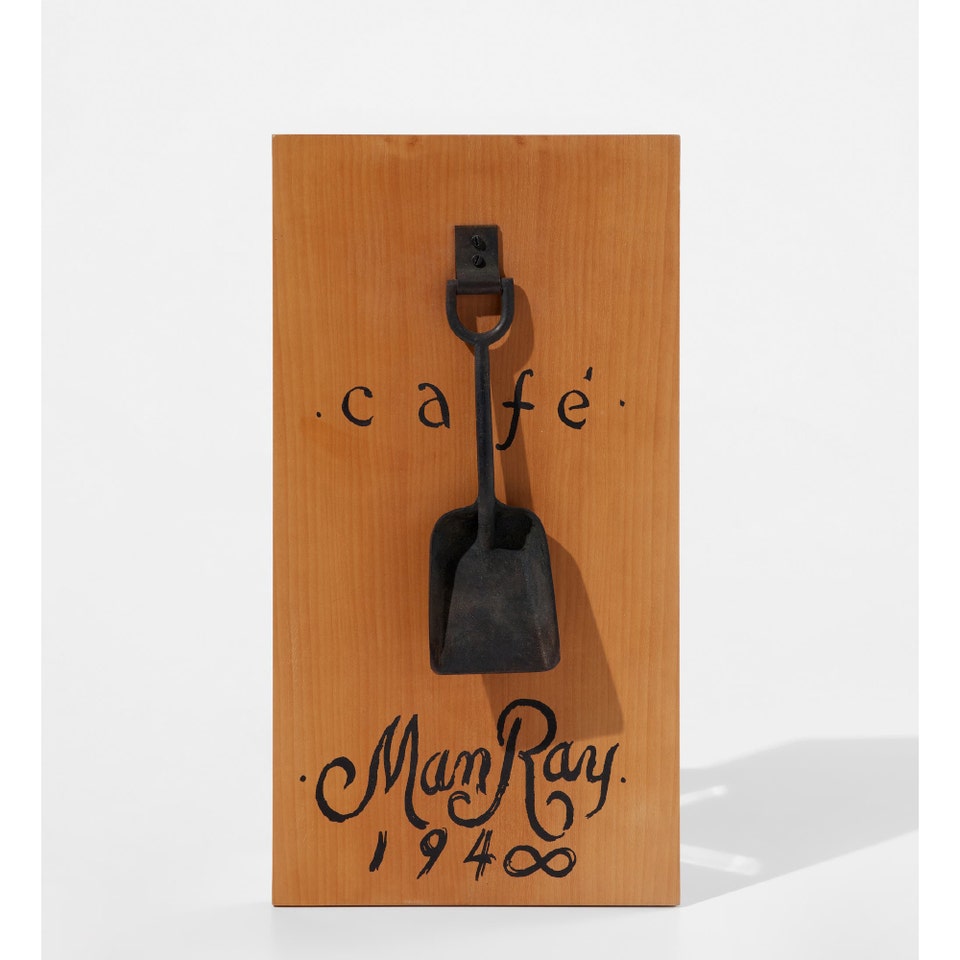
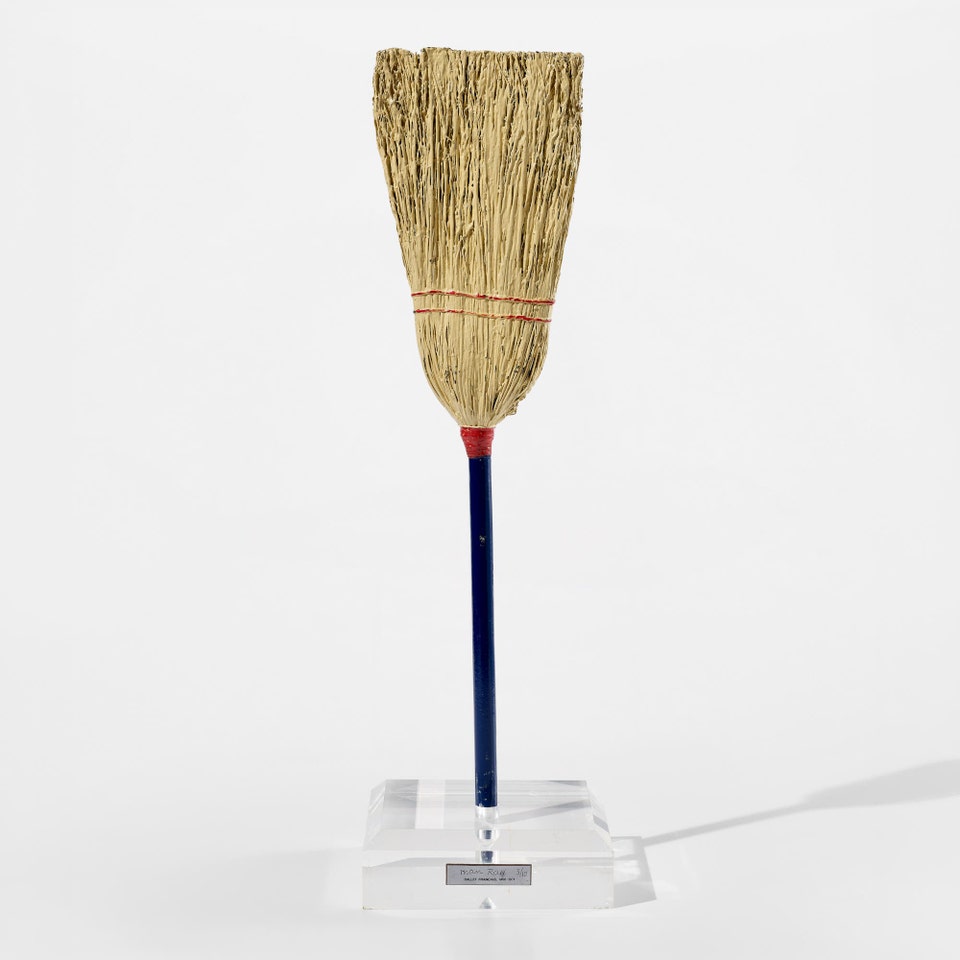
It’s fair to say that there is no such thing as an ordinary object to a Surrealist; all items within reach act as dormant forms-in-waiting to be animated by the artist’s hand. Man Ray is a perfect example of this enlivening process, with Pomme et vis standing out as an early example. First executed in 1931 and realized as an edition in 1973, the work places a screw atop an apple, connecting organic and mechanical forms. Is it a lighthearted juxtaposition, or a statement about the fruit’s stem connecting to the tree, to us, via industrial means? Ponder it at the Café Man Ray, similarly a work first rendered in 1948 and later editioned in 1971, in which the shovel acts as a logo and a subject. Ray effectively advertises a non-place andyet invites us to stay and linger, perhaps for eternity. With Ballet Français II, the artist flips the broom handle towards the dance floor in a shift of both perspective and expectation. There is a sense of delight that unites all three works, and this feeling lies in the alteration of each object from an everyday thing to an active subject, with its own categories, precepts,games, and incongruities.
Salvador Dalí’s Échecs: Hommage à Marcel Duchamp throws us for a surreal loop by paying tribute to the artist who brought the readymade to the art world and eventually left it behind to turn to the chessboard itself. Duchamp’s chess obsession, the pursuit of which led him to abandon art for about a decade, was well understood by his friend Dalí, whose homage evokes a fantasy game between the two giants of the genre. Executed in 1971, shortly after Duchamp’s final Étant donnés assemblage, we see all the hallmarks of Surrealist intervention: the rationality of the pieces’ functions is interrupted by fantasy (casts of Dalí’s and Gala’s fingers and teeth, salt shakers from the St. Regis hotel in sterling silver and gold vermeil), logic gives way to character, and the board abandons all calculated pretense. Instead, we imagine the two greats at either side, playing out a game whose rules are known to only them, and which can be modified, argued, or traded at any point.
The spectacle and the spectator
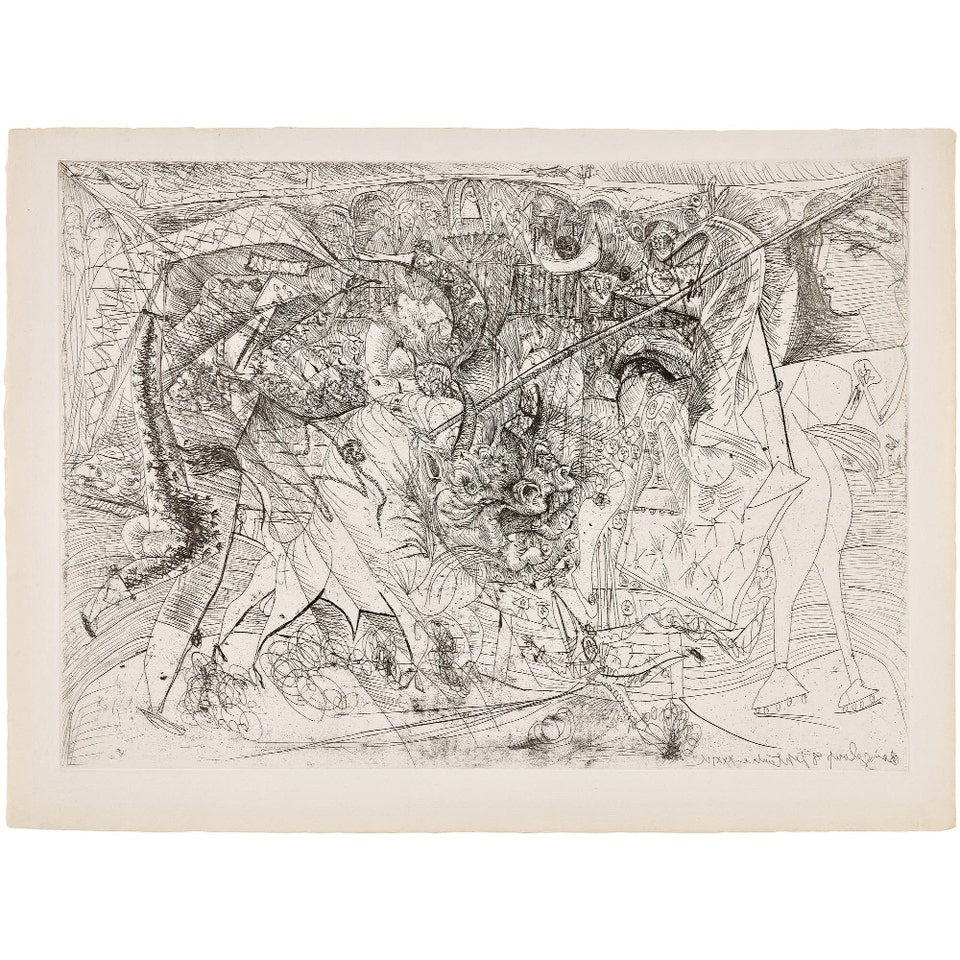
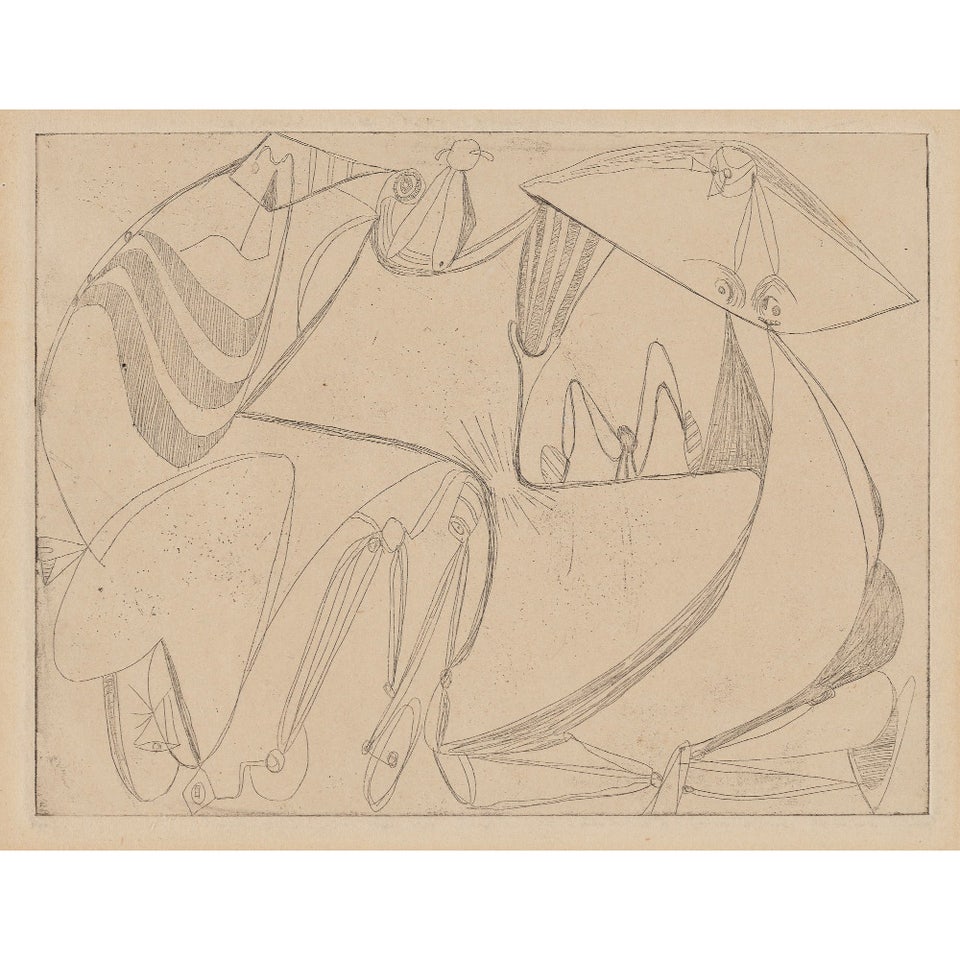
PABLO PICASSO, La grande corrida, avec femme torero (The Large Bullfight, with Female Bullfighter), 1934. Editions & Works on Paper: Modernism.
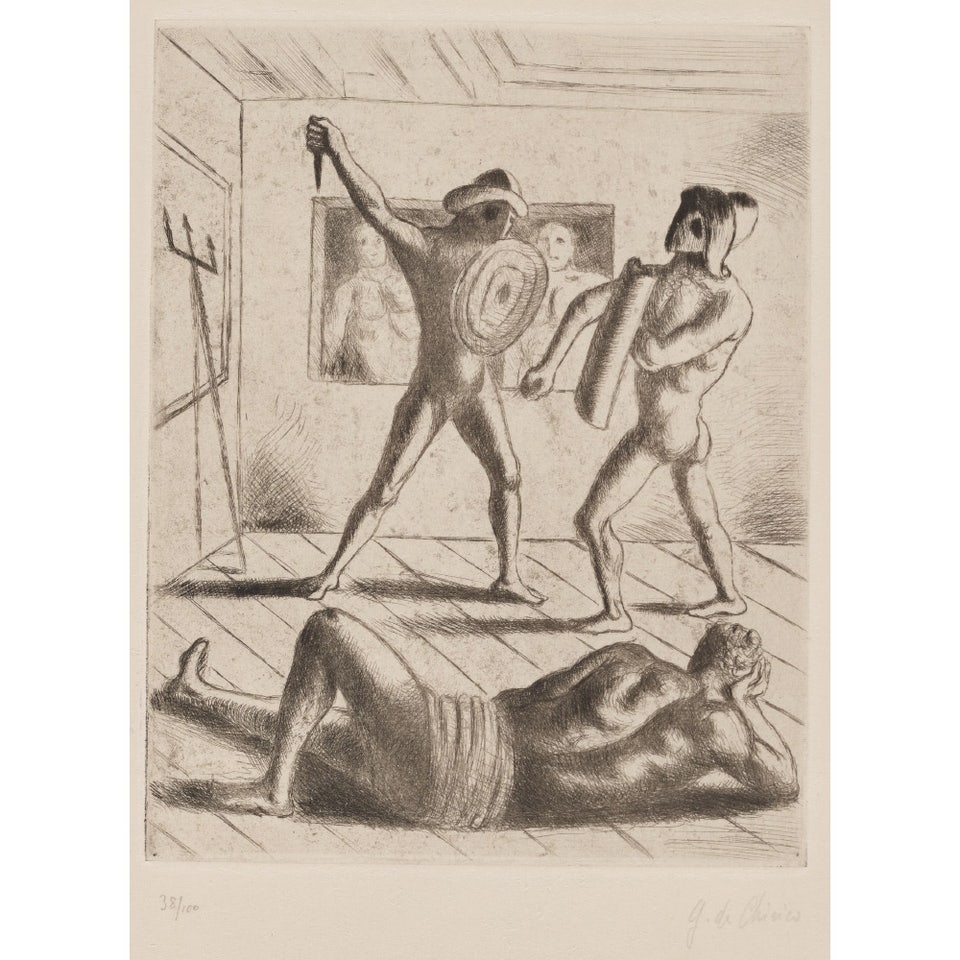
After the First World War and the uncertain calm that followed the Second, a number of artists returned to the arena as audience members. In Giorgio de Chirico’s 1928 work Scuola di Gladiatori, a studious viewer is seated at the outer edge of a training session: the combatants, already in close quarters, crowd one another as the room ends at either flank, giving us the compressed feeling of a front-row ticket to the fight. Six years later, Pablo Picasso staged La Grande corrida, avec femme torero with a similar head-on view, only now we witness the clamor and din of a bullfight with the freneticism of a thousand views at once. The event’s masculinity is inverted by the woman fighter, inviting more viewpoints — we chase the action throughout the work, from the wounded animals to the contestants, from the sharp lances to the clouding dust — as the scene’s choreography falls into chaotic violence.
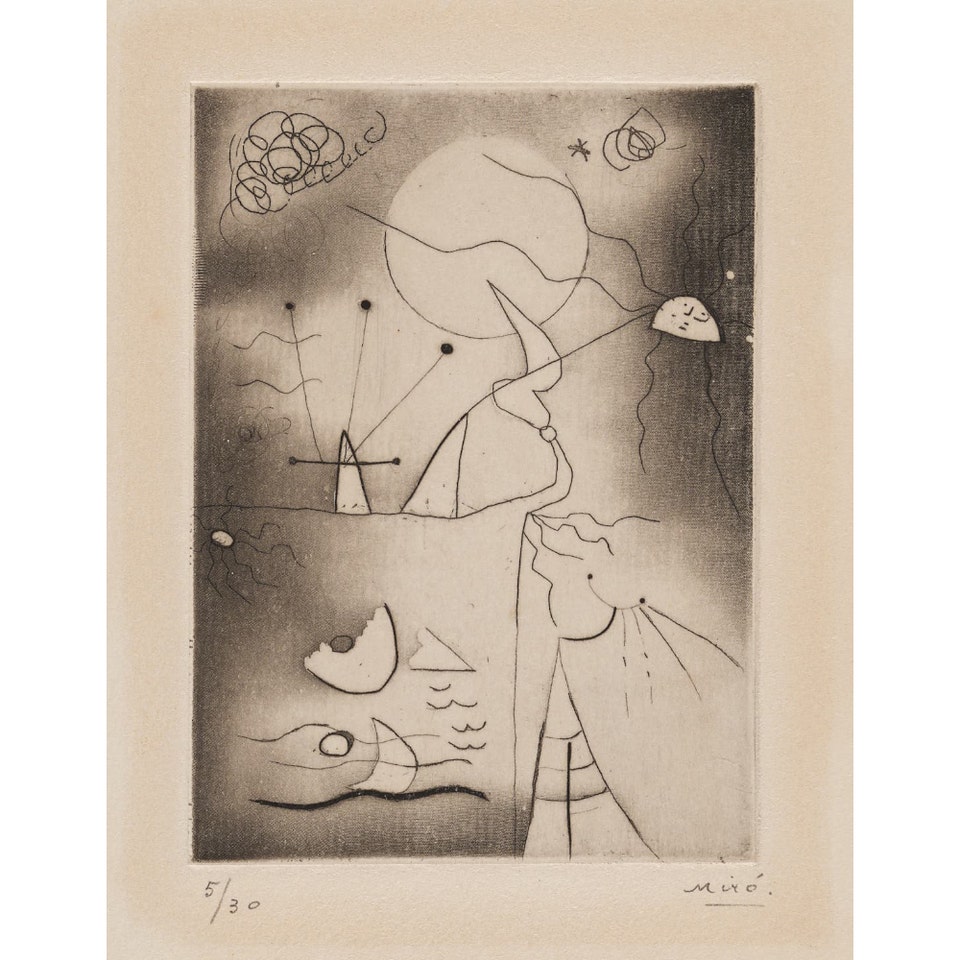
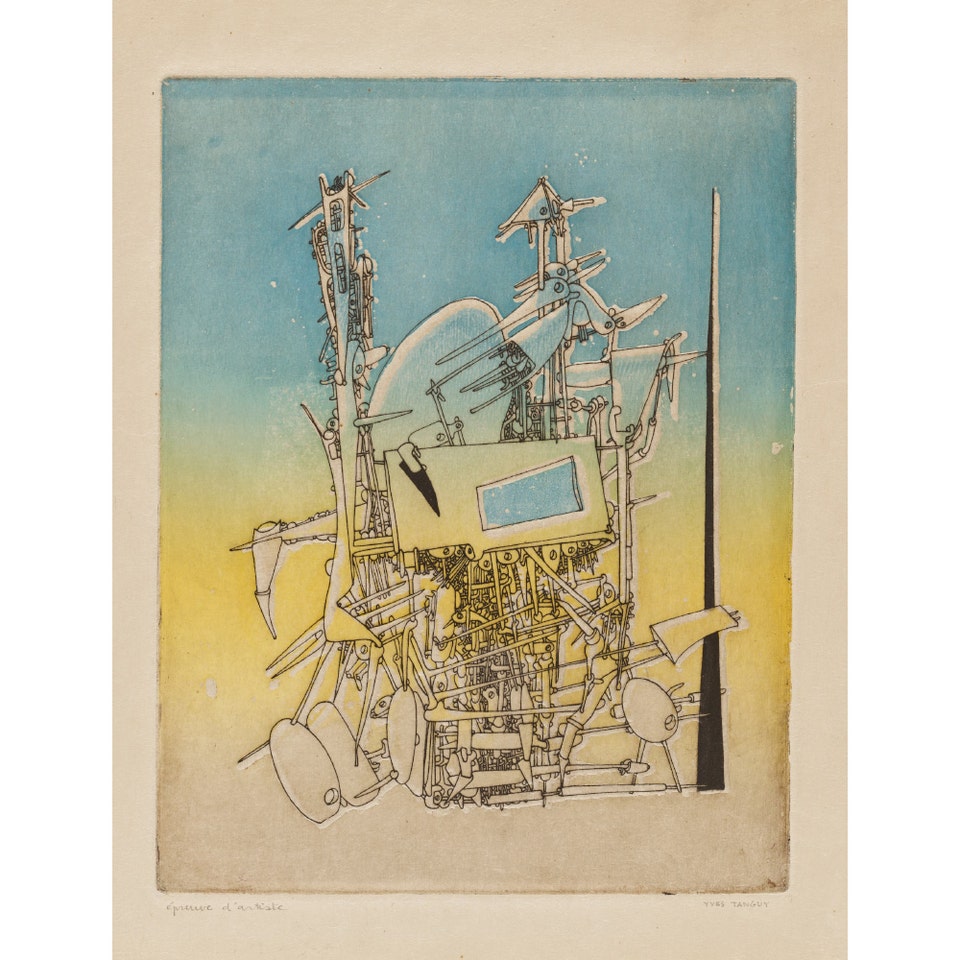
After de Chirico’s gladiatorial forms were obfuscated by Picasso, Miró dissolved the arena sequence entirely. Murderous Landscape, executed in 1938 as Europe stood at the precipice, no longer distances the viewer from the action. Instead, we are directly inside it, to the extent that we are involved in deciphering a kind of latent, biomorphic brutality that, while not immediately understandable through visual or narrative means, is felt intuitively, as though we are powerless to stop it. It is no surprise, then, that the spectacle finds a peacetime transformation in David Smith’s Cyclists. Created in 1946, the riders are rendered in rhythmic competition, whittling aggression from a world-swallowing event to man-against-man recreation or professionalized sport. Finally, Yves Tanguy collates each antecedent concept, sign, notion, shape, and impression into a surreal bit of accumulation: it is purely coincidental, but is it not illuminating, in that way that only the modern masters can do, that in this enigmatic structure, we might just see our gladiator’s dagger front and center, our matadora’s lance at the right, Miró’s jostling for position among the machine parts, and Smith’s contraption poised among the wreckage?
More than a muse
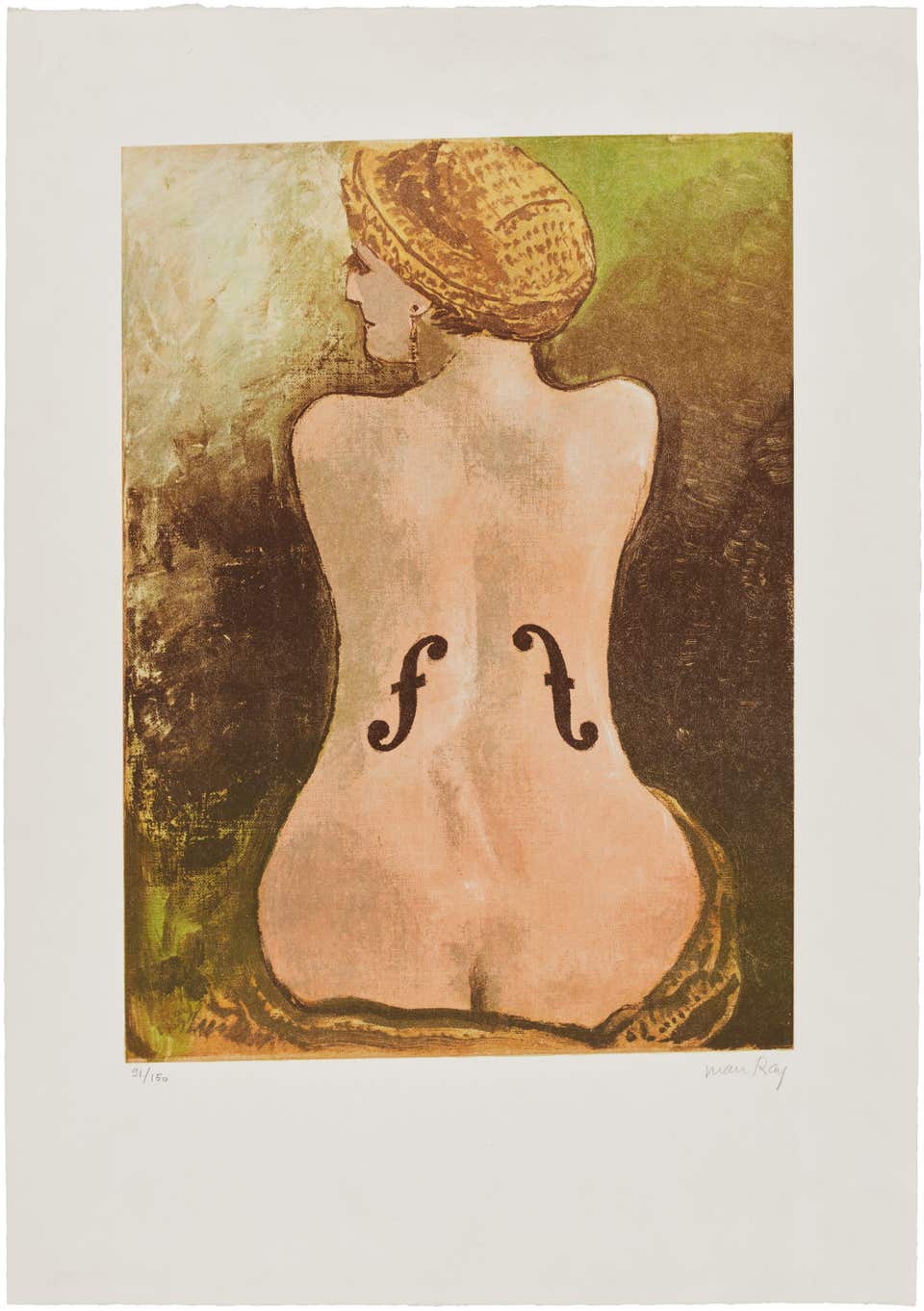
In the hands of an artist like Man Ray, the ancient Greek concept of the Muses as divine patrons of the arts gives way to whatever is directly in front of him. What was a spiritual process now becomes a metaphysical catalyst for psychological and formal experimentation. And what more perfect idea with which to explore this than music, the art form that takes its very name from the Muses?
In Man Ray’s Le violon d’Ingres, such an approach to the sight of his muse is on full display, as he depicts cabaret singer Kiki de Montparnasse with violin f-holes painted onto her back. By ascribing sonic possibilities to his subject and leveraging a French idiom for one’s hobby — itself a reference to painter J.A.D. Ingres’ amateur violin playing — Man Ray creates a web of associations beyond the purely visual, mirroring how his dear friend, composer Erik Satie, assigned musical qualities to typically silent, physical objects and everyday activities.
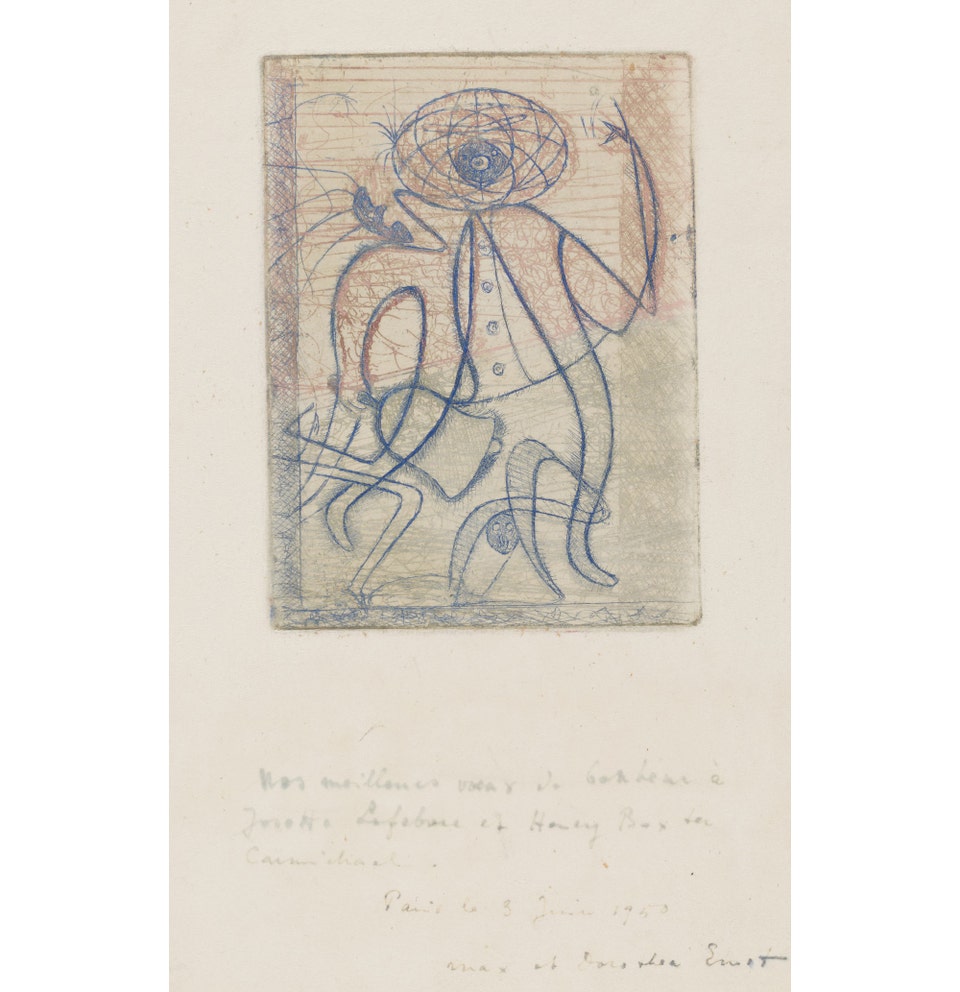
But, of course, the Muses also serve literature and poetry, so it’s no wonder these two fields are such fruitful ground as well. In Max Ernst’s Le Sonneur, Carte de l’Océan, Lewis Carroll’s absurd tale of the Bellman guiding a crew with a blank map becomes an invitation to the void. Likewise, Salvador Dalí’s response to André Breton’s poetry collection Le Revolver à cheveux blancs sees the written word itself as a muse, turning the Greek concept of poetic frenzy — mania — into a landscape of subconscious desire, oxymoron, and a visual dissonance as striking as any chord by Satie.
Phillips Editions is incredibly fortunate to be offering this dynamic group of Modernist material, some impressions are of utmost rarity with many coming from important estate provenances. We invite you to click into each lot and discover so many more gardens in an infinite universe of art history.