Article | Modern Contemporary Art Auction Hong Kong September 2026
Gerhard Richter and a New Generation: Painting in the Age of the Screen
By 1983, Richter was pushing the squeegee into a new balance of control and chance. Four decades on, the argument Abstraktes Bild (522-1) makes still resonates with a new generation of painters.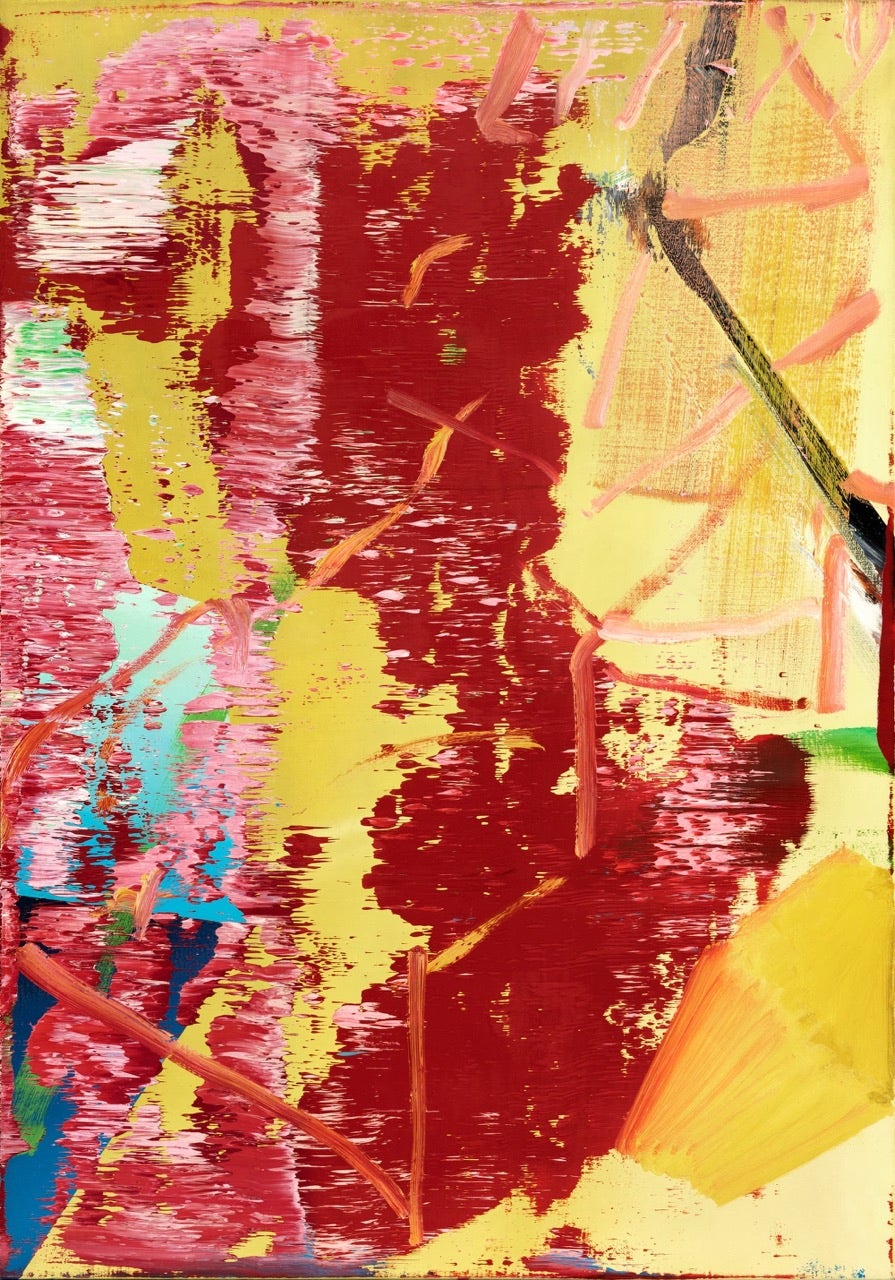
Lot 7: GERHARD RICHTER, Abstraktes Bild (522-1), 1983. Modern & Contemporary Art Evening Sale.
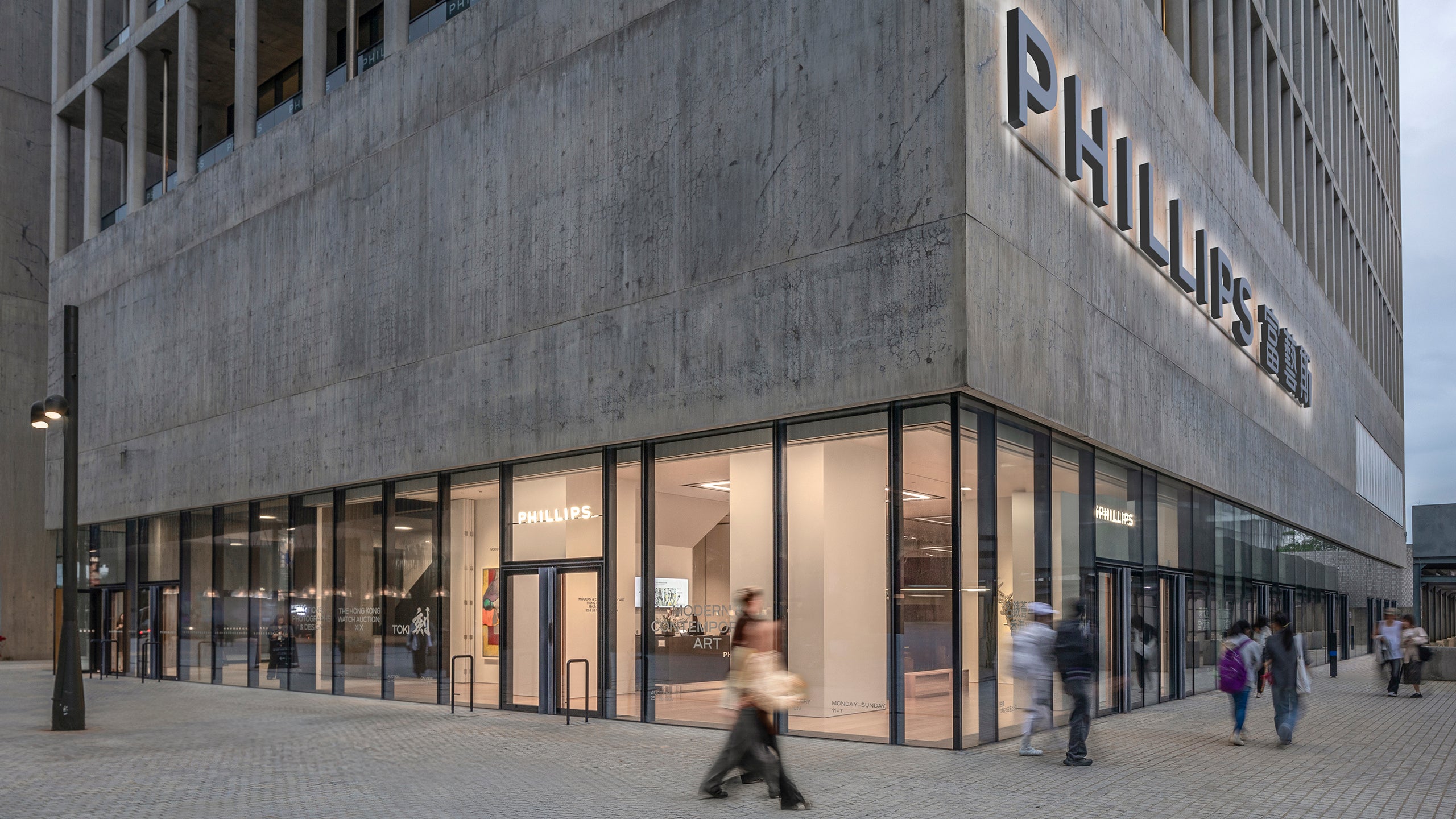
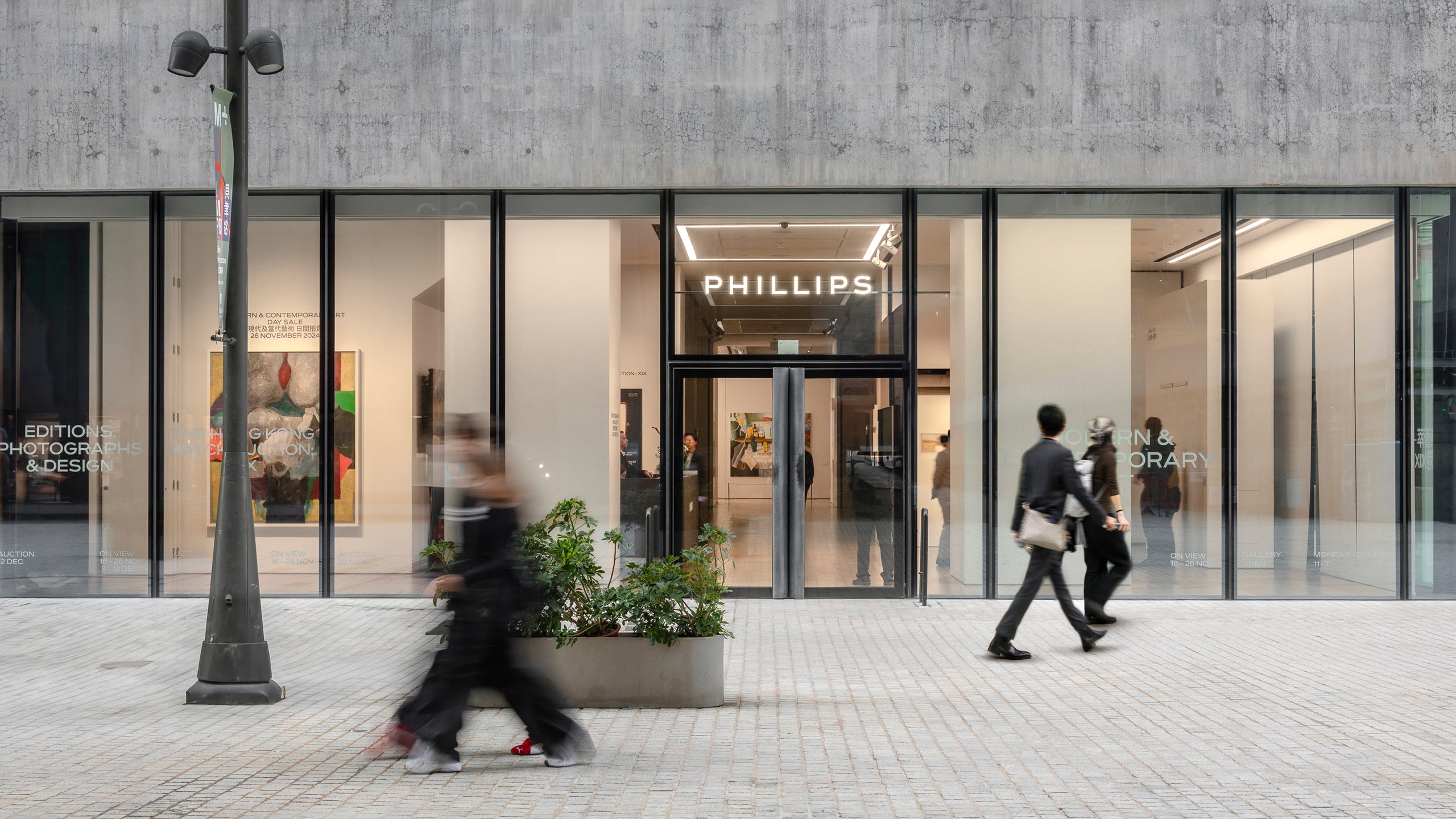
As Phillips presents its Modern & Contemporary Art Evening Sale and Modern & Contemporary Art sale in Hong Kong, a group of contemporary paintings traces a single question across four decades: what can painting still accomplish in a world saturated with images?
At its center is Gerhard Richter’s Abstraktes Bild (522-1) from 1983, joined by works by Adam Pendleton, Julie Curtiss, Issy Wood, Lauren Quin, Avery Singer and Julia Jo. Photoshop grids, pixel grain, internet imagery, and silkscreened words enter these works in different ways, while digital references and reproduced images repeatedly return to the physical surface.
“Painting is a luxury, but it is even more a necessity.”
—Gerhard Richter
Gerhard Richter and the squeegee
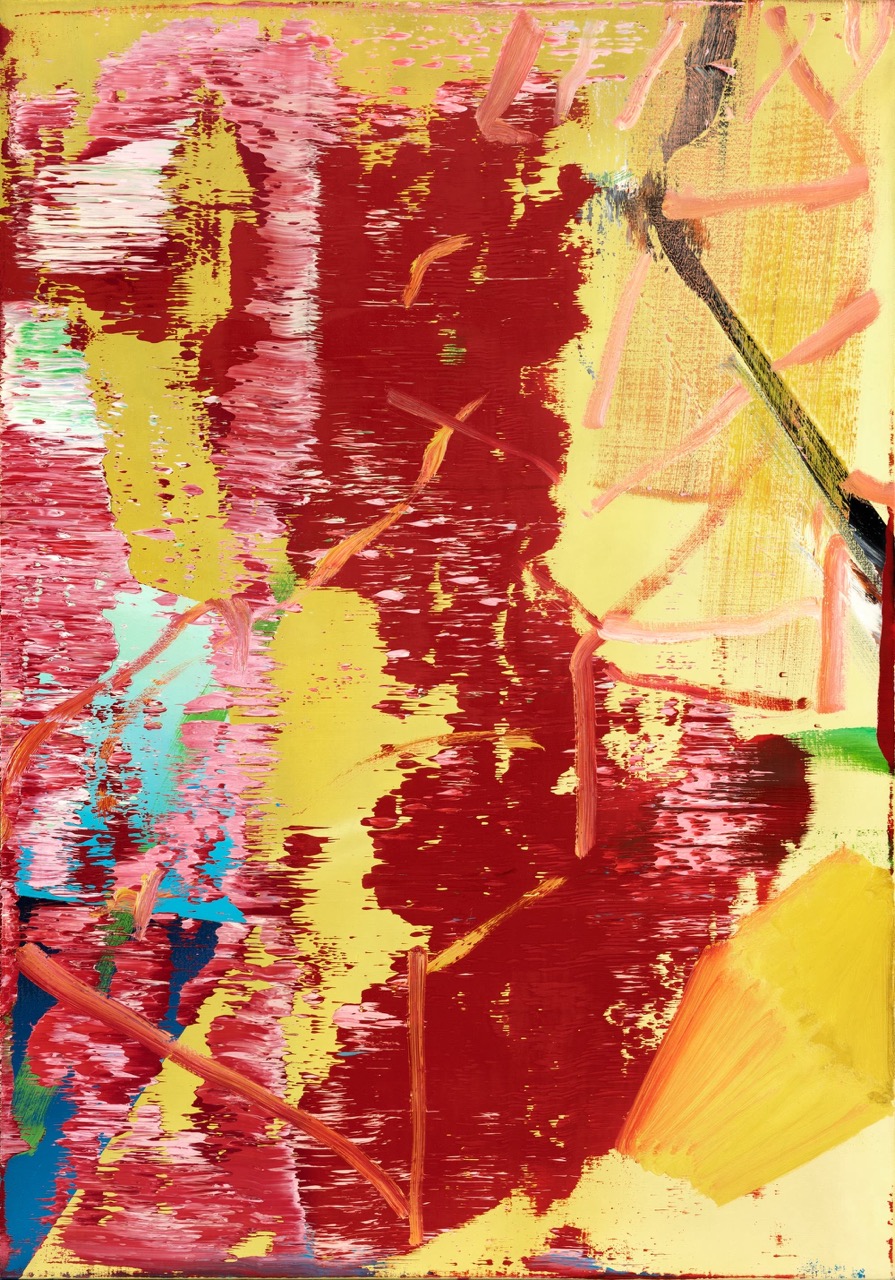
Lot 7: GERHARD RICHTER, Abstraktes Bild (522-1), 1983. Modern & Contemporary Art Evening Sale.
At the very center of Abstraktes Bild (522-1), a deep red tears through the surface, its edges dragged into fine horizontal striations like the strata of a geological fault line. Lemon yellow and pale pink interweave into luminous fields on either side, while a slash of cobalt blue and viridian intrudes from the lower left, striking a cold note against the warmer chorus. Several coral strokes cut diagonally across the composition like fragments of a code waiting to be deciphered.
Since 1980, Richter had been working with the squeegee, a rectangular rubber or plastic blade that he allowed to become a kind of co-author of the painting. He applied pigment thickly, then dragged the blade across the canvas at varying angles, speeds and pressures, so that layers of colour fused, tore and overlapped. The result is a meticulously orchestrated loss of control. In the present work at least three registers can be read: broad bands laid down by the squeegee with the cool regularity of industrial production, thicker accumulations of paint where red meets yellow, and slender hand-drawn lines that cut provocatively across the horizontal rhythm beneath.
1983 was a decisive year for Richter. It marked the height of his so-called “Wild Abstracts”, and it was also the year he completed the Candles and Skulls series, working simultaneously at the extremes of figuration and pure abstraction. At the end of the year, he left Düsseldorf, his base since fleeing East Germany in 1961, for Cologne. The painting went on to feature in the major 1986 retrospective Gerhard Richter: Bilder 1962–1985 at the Kunsthalle Düsseldorf and the Neue Nationalgalerie Berlin, and toured Paris, Bonn, Stockholm and Madrid in 1993 and 1994.
The deliberately generic title Abstraktes Bild offers little interpretive direction. Colour and texture are left to speak for themselves. As digital images flood our screens, his practice is a reminder of what cannot be transmitted through one: the drag of the blade across canvas, the cracking of pigment as it dries, the temperature of colour experienced in front of the original. Abstraktes Bild (522-1)offers a starting point for a question that recurs, in very different forms, across the younger artists in this group — what happens when the physical surface of painting meets an increasingly mediated world?
Adam Pendleton: A sentence Interrupted
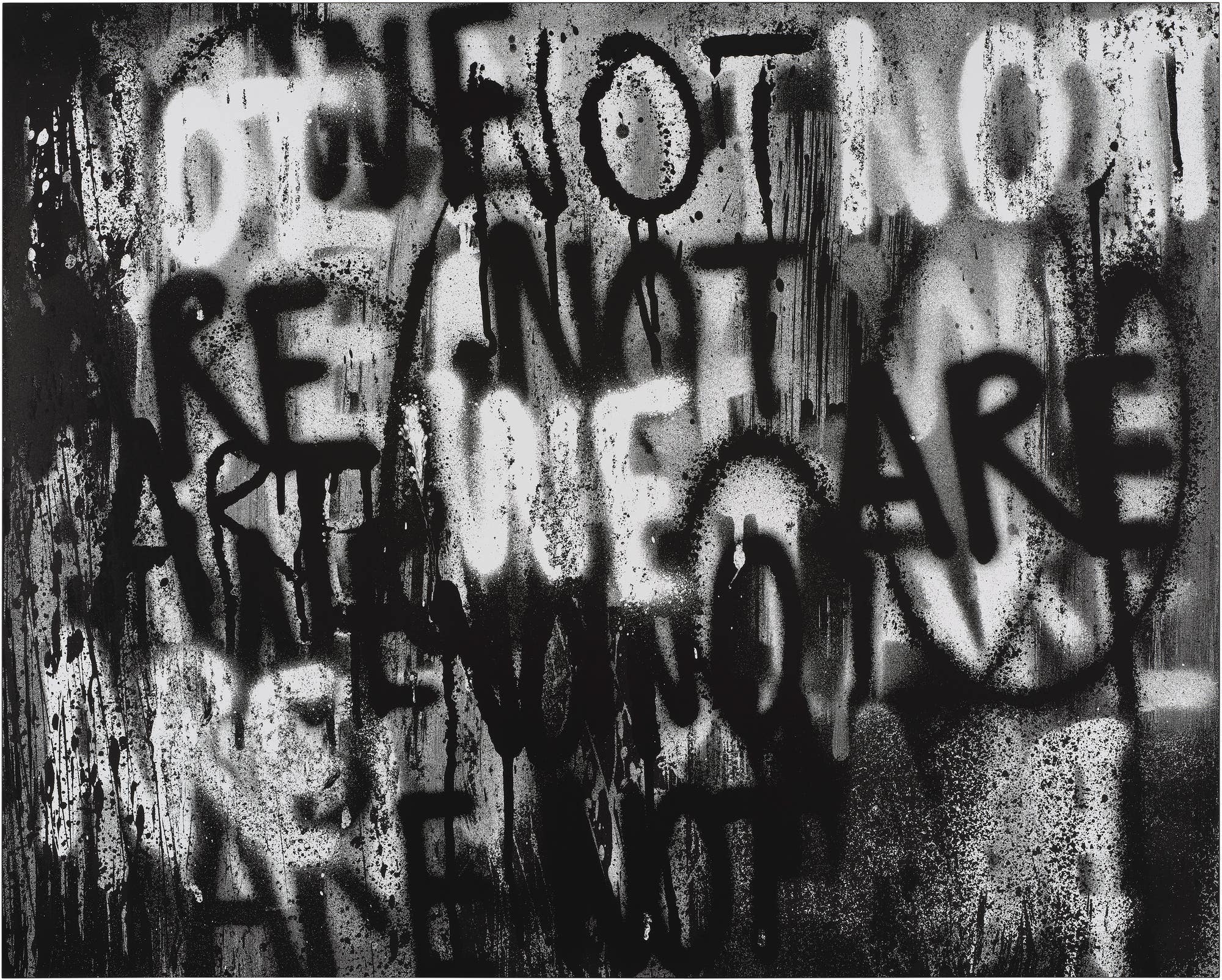
Lot 5: ADAM PENDLETON, Untitled (WE ARE NOT), 2023. Modern & Contemporary Art Evening Sale Hong Kong.
At nearly two and a half meters tall and over three meters wide, Adam Pendleton’s Untitled (WE ARE NOT) of 2023 is a wall of words that simultaneously demands and defies legibility. The phrase “WE ARE NOT” circles across the canvas in ghostly white and jet-black letterforms, layered over and into one another until the words become both mantra and cipher. The sentence withholds its object, and in that withholding lies the work’s quiet ferocity.
Pendleton’s surfaces are palimpsests of language, much as Richter’s are palimpsests of colour. Like Richter’s squeegee, his silkscreen places a mechanical process between the artist and the canvas, yet the result is anything but impersonal. In his word paintings, silkscreened fragments are repeated, smudged, dripped and overwritten, so that black letters hover over dripping white ones in a surface that resembles a tagged wall. Each layer overwrites another and is overwritten in turn, a rhythm of revision that recalls the endless refresh of words on a screen.
Born in Richmond, Virginia, in 1984, Pendleton works fluidly across painting, publishing, video and performance. Since 2008 his practice has unfolded under the banner of Black Dada, a term that braids Dada’s anti-art negations with Amiri Baraka’s poem Black Dada Nihilismus and reframes Blackness not as subject matter but as a generative position within abstraction. It is, in his words, “a way to talk about the future while talking about the past.” The present work was executed in New York following solo exhibitions at the Museum of Modern Art, New York, where his monumental installation Who Is Queen? was shown in 2021, the Montreal Museum of Fine Arts (2022) and mumok, Vienna (2023).
Julie Curtiss and the edited image
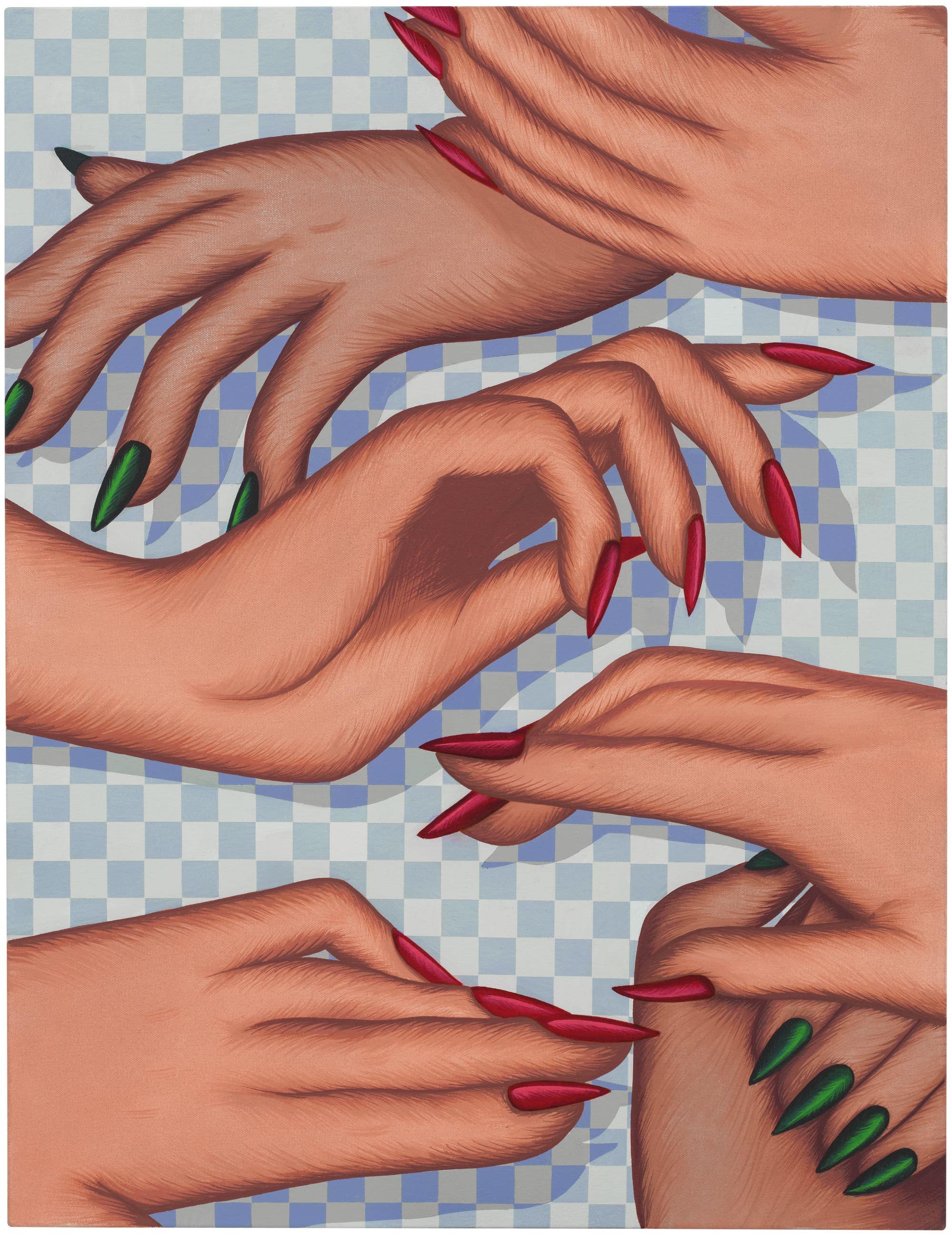
Lot 2: JULIE CURTISS, Shopped Hands, 2020. Modern & Contemporary Art Evening Sale Hong Kong.
In Julie Curtiss’s Shopped Hands of 2020, six impeccably manicured hands are suspended against a blue-toned chequered ground. The ground recalls Photoshop’s distinctive transparency grid, while the title alludes to “photoshopping” itself. The result suggests a reality that has been edited, extracted and reassembled.
Removed from any bodily context, the hands become objects to be admired, appraised and scrutinized. Burgundy and emerald-green nails draw the eye, and their long, pointed forms evoke claws, lending the work a darkly comic, animalistic edge. Rendered with Curtiss’s signature hair-like texture, the hands hover in an ambiguous exchange. Whether they are reaching towards one another or recoiling, the artist leaves open.
Women’s hands have a long history as expressive motifs, from Leonardo da Vinci’s Study of a Woman’s Hands of 1490 to Salvador Dalí’s disembodied, red-nailed hands of 1945. Curtiss carries that tradition into the age of the image editor, where hands become emblems of beauty polished almost to the point of commodity, and a site for thinking about display, agency and self-fashioning. Born in Paris and based in Brooklyn, Curtiss has built an increasingly international profile since White Cube began representing her jointly with Anton Kern Gallery in 2020, with solo exhibitions in London, New York, Hong Kong, Paris and Seoul.
“I am interested in the way we fashion our own image, to be seen, not only by men, but the world.” — Julie Curtiss
Issy Wood: “The medieval millennial”
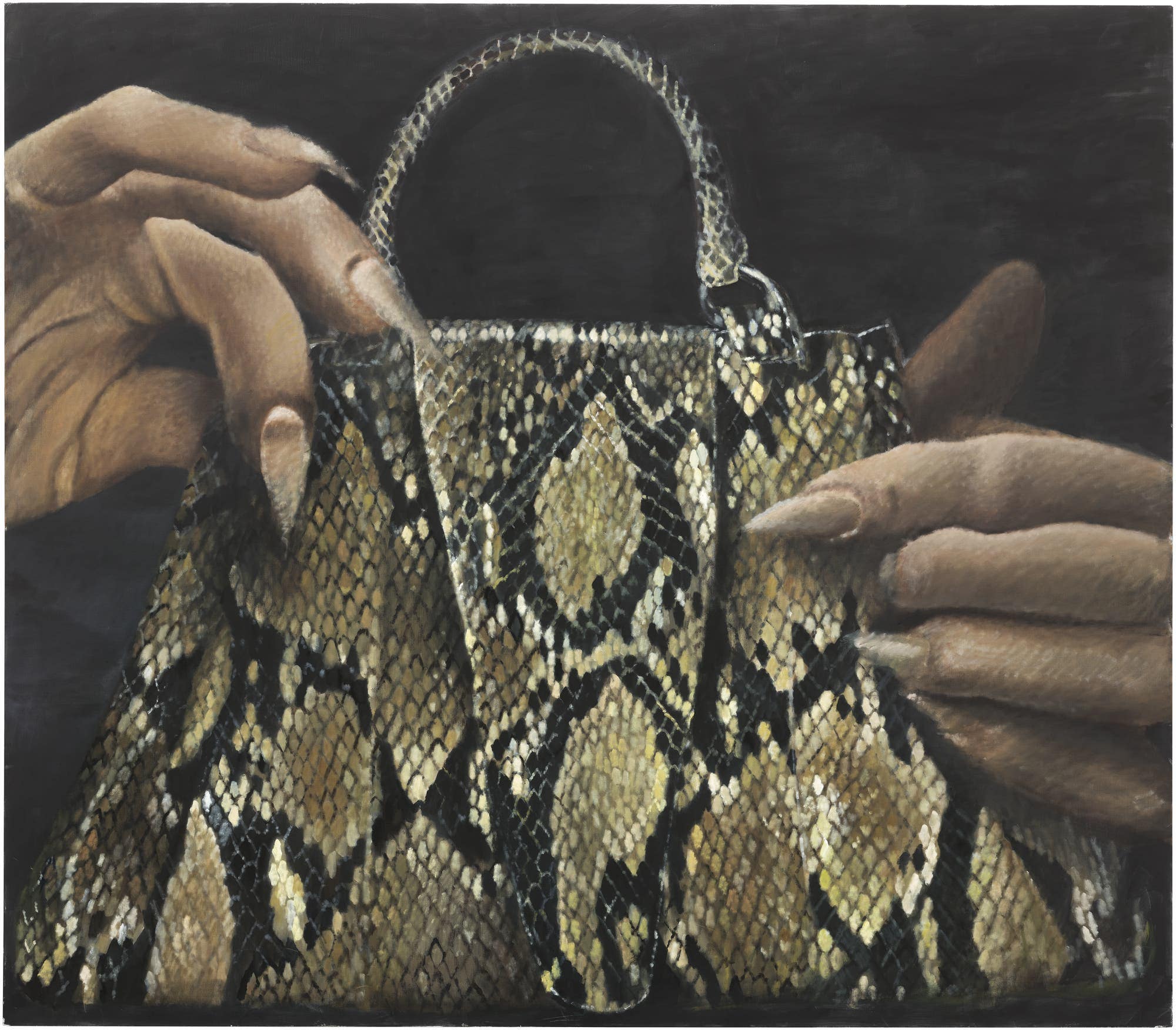
Lot 4: ISSY WOOD, Python! You could've asked! Pedestals!, 2019. Modern & Contemporary Art Evening Sale Hong Kong.
Self-described as a “medieval millennial”, Issy Wood works between the traditions of oil painting and the image-saturated culture of the present, drawing on internet imagery, advertisements, auction catalogues and popular culture. Through tight cropping, enlargement and distortion, she removes familiar subjects such as heirloom jewellery, clothing, cars and fragments of the body from their original contexts, turning them into enigmatic, psychologically charged images.
In Python! You could’ve asked! Pedestals! from 2019, a python-patterned handbag occupies the center of the large canvas, held between two cropped hands whose owners remain outside the frame. Human presence is reduced to the act of handling, and the bag itself becomes the principal subject. Enlarged to almost bodily proportions and isolated against a dark ground, it takes on an arresting, almost otherworldly presence in muted greens, ochres and blacks. The title adds its own riddle: three exclamations that read like fragments of an overheard exchange, with “You could’ve asked!” striking a note of reproach between the snakeskin of “Python!” and the display language of “Pedestals!”
Wood’s fascination with “everything shiny, everything pretty, everything beautifully photographed” speaks to the seductive power of images. By translating the immediacy of commercial imagery into the slower medium of oil paint, she interrupts habitual ways of looking and holds a familiar object up to prolonged scrutiny, without ever cancelling its allure. The viewer is left suspended between seduction and scrutiny, unable to separate the pleasure of looking from the mechanisms that produce desire.
Signals and Strata in Lauren Quin
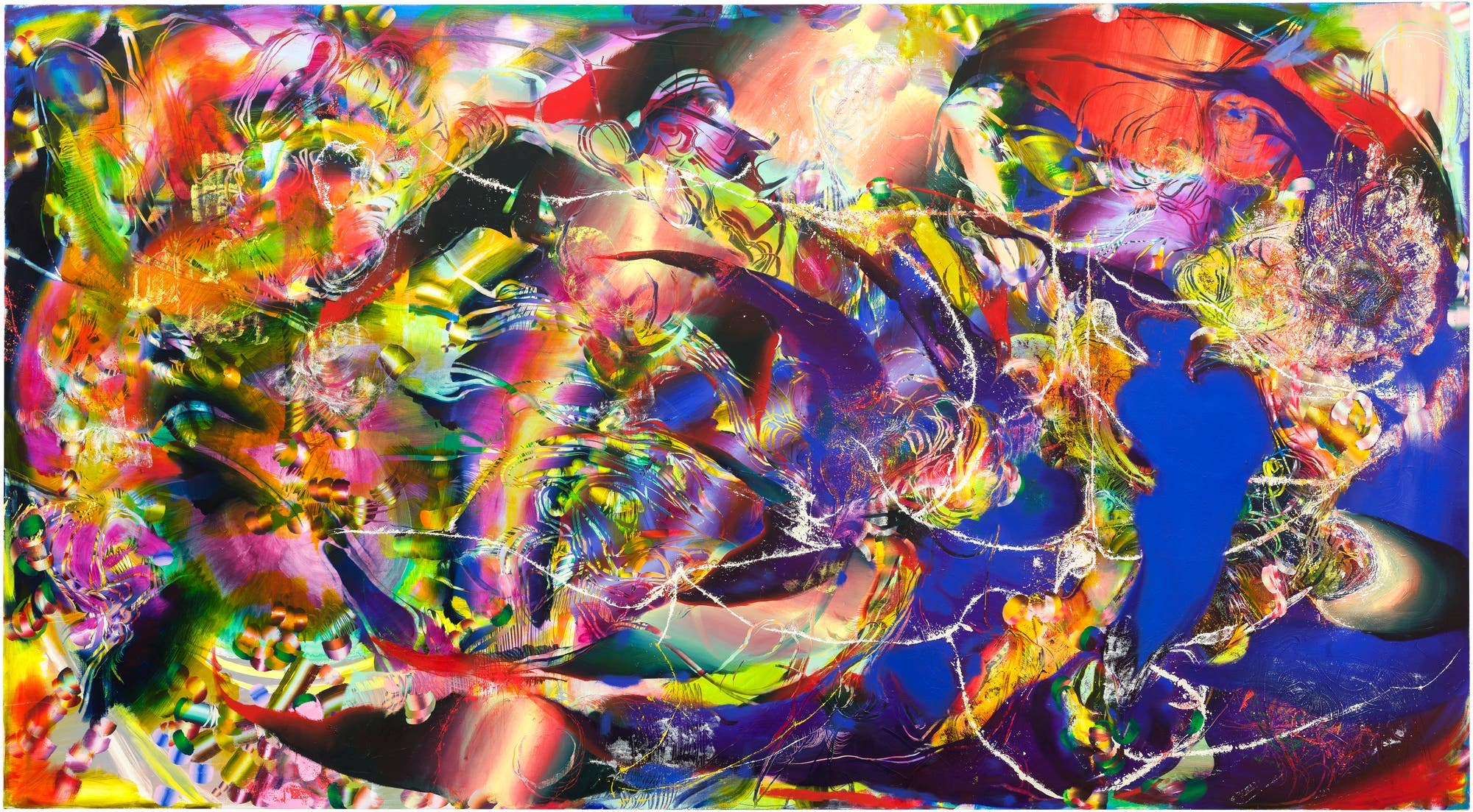
Lot 19: LAUREN QUIN, Spades, 2023. Modern & Contemporary Art Evening Sale Hong Kong.
Lauren Quin’s Spades of 2023 sweeps across more than three and a half meters of canvas, pulsing with psychedelic energy. It is built on the artist’s signature motif: cross-hatched, volumetric tubes that wind through the picture like conduits. They recall at once the arteries of the body, industrial piping and the glowing streams of fiber-optic cable, the infrastructure of the digital present.
The tube has a history. In The Card Players of 1917, Fernand Léger assembled armour-like metallic cylinders to rebuild a European sensibility shattered by war. Quin strips those cylinders of their weight, turning them into porous channels that intertwine, overlap and bleed across the picture plane. Where Léger looked outward to the machine, Quin turns inward, using the tube to capture the sensory saturation and psychological noise of the modern mind.
Her process recalls Richter’s layered surfaces. Quin builds up dense swathes of paint and then carves into them with a palette knife, an act of painterly archaeology that opens web-like fissures onto brighter colours beneath. Alongside these channels, she presses monoprinted transfers, phantom imprints of symbols and drawings, into the wet paint. Seen in person, the surface behaves like a living membrane: Moiré effects ripple across it, and glowing seams of unmixed pigment break through the darker layers.
Born in Los Angeles in 1992, Quin made her solo museum debut in 2023 with My Hellmouth at the Nerman Museum of Contemporary Art. On the secondary market, Quin’s work commands exceptional international demand: her auction record was established at Phillips New York in March 2022 when Airsickness achieved $587,451 USD, followed by Third Belly, which fetched HKD 1,905,000 at Phillips Hong Kong in March 2023. Her paintings are held in prominent public and institutional collections globally, including the Museum of Fine Arts, Boston; the High Museum of Art, Atlanta; and the Long Museum and Yuz Museum in Shanghai.
Avery Singer’s physical pixels
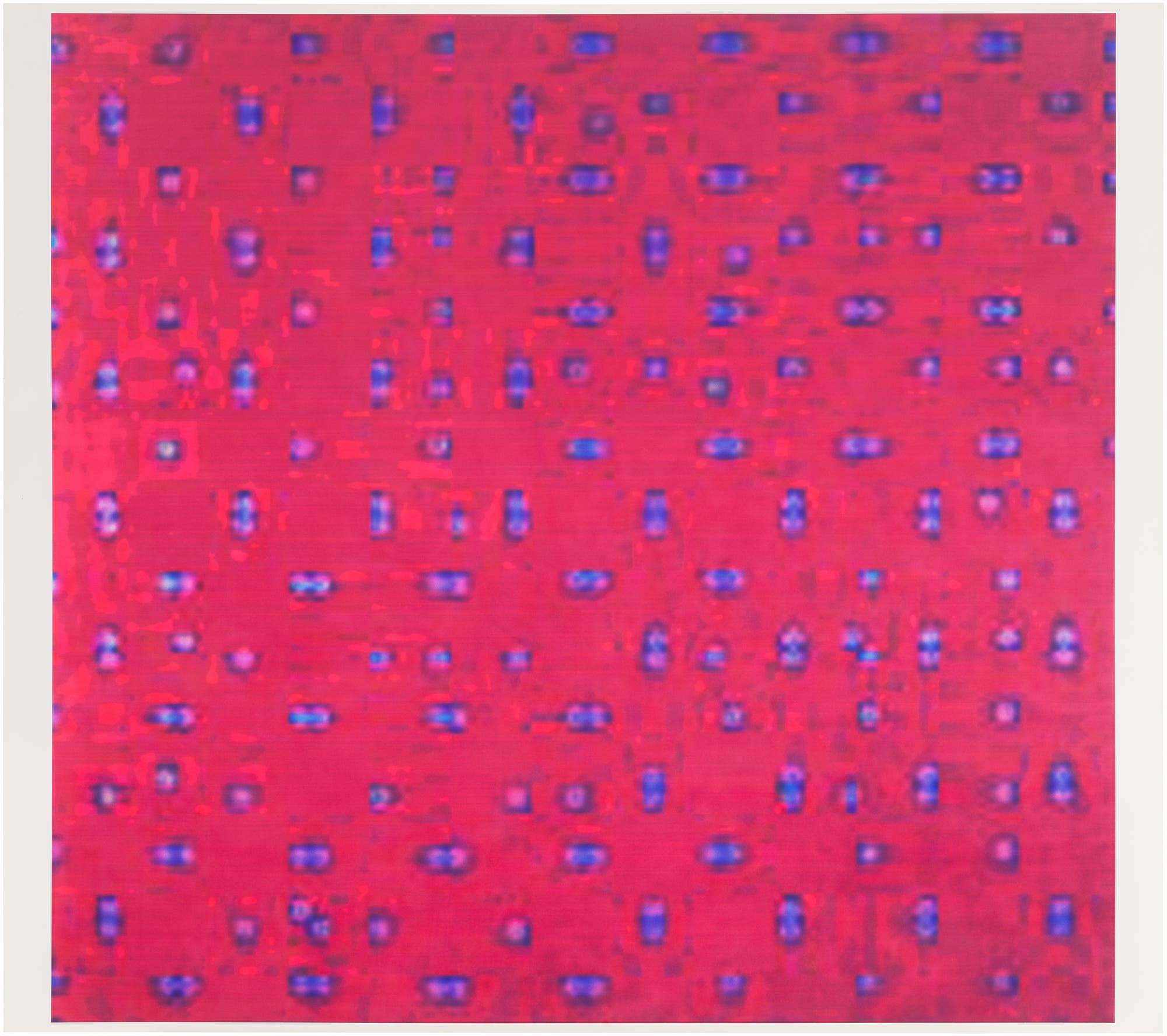
Lot 109: AVERY SINGER, Larry Poons, 2016. Modern & Contemporary Art Hong Kong.
In Avery Singer’s Larry Poons of 2016, blue-violet dots drift and gather across a field of red, magenta deepening towards crimson. From a distance, the painting reads as colour-field abstraction; up close, the softened edges of the dots and their faint pixel grain reveal how it was made. The dots are not painted by hand but rather rendered digitally and translated onto canvas with an airbrush.
The title names the painter who, in the early 1960s, arrayed dots and ellipses across monochrome grounds and was included in the Museum of Modern Art’s landmark 1965 exhibition The Responsive Eye. Poons’ dots rested on precise calculation and aimed at retinal vibration. Singer borrows the schema but replaces its logic — her dots follow no geometric law and instead carry the grain of a low-resolution image that has been enlarged. Poons responded to the precision of the mechanical age; Singer responds to the image production of the digital one.
Born in New York in 1987, Singer builds three-dimensional models in the architectural software SketchUp and translates them onto canvas through projection, masking tape and airbrush, a process that erases the trace of the hand while preserving the materiality of paint. In 2019, she appeared in the 58th Venice Biennale. Larry Poons was the only titled work in Sailor, her 2016 solo exhibition at the Vienna Secession, where it hung in the first room; the exhibition later traveled to the Kölnischer Kunstverein in Cologne. The bare canvas margin framing the image reads like the edge of a screen. Where Poons imitates the mechanical by hand, Singer hands the task to the algorithm, and in doing so, changes how we look directly into the picture.
Julia Jo: When the paint takes over
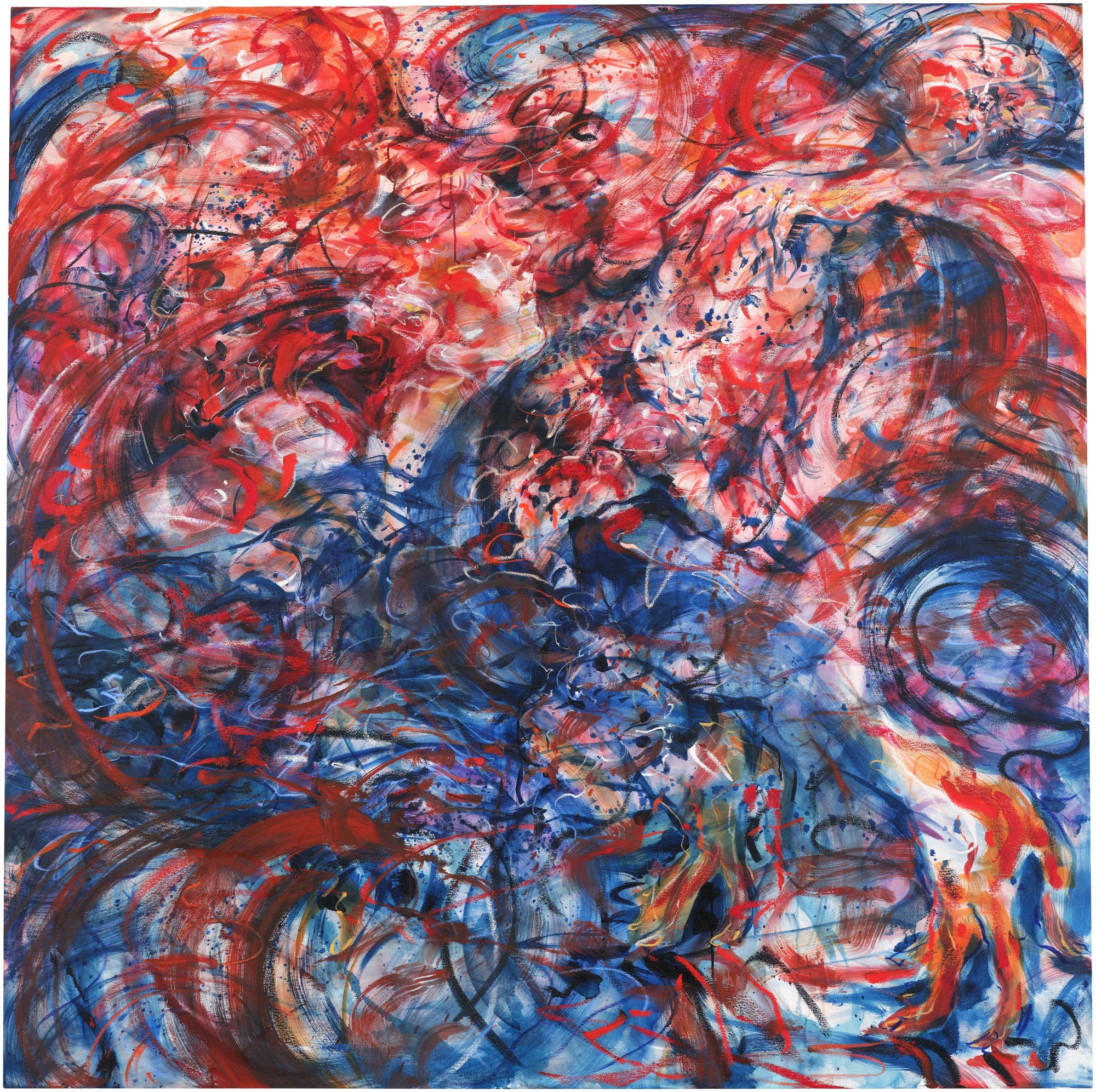
Lot 101: JULIA JO, All the Rage, 2024. Modern & Contemporary Art Hong Kong.
In Julia Jo’s All the Rage, paint layers build upon one another like the creases of emotion, while traces of fluorescent colour shimmer beneath the surface, suggesting a quiet fire that refuses to be extinguished. The title promises fury, yet Jo’s paintings do not portray anger outright. Instead, they explore its afterlife: the emotions that linger once rage has been flattened, folded away and absorbed into memory.
“I start with a figurative scene, but then I want the paint to take over, to create a space where the logic of the body breaks down and emotion becomes the primary architecture.” — Julia Jo
Jo’s canvases navigate the tension between figuration and abstraction. Heavy, sweeping brushstrokes first appear as frenetic abstract masses, then, on closer inspection, reveal recognizable forms such as limbs or faces. Her method begins with a figurative scene, which she then allows the paint to overwhelm, much as Richter let the squeegee carry his colour beyond his full control. For Jo, colour is an event that happens between the body and the world; drawing on the philosopher Merleau-Ponty, she describes it as the place where the brain and the universe meet. In an age of images consumed at a glance, her surfaces slow the viewer down and ask for a different kind of attention.
The conceptual weight of her practice is rooted in her experience as a Korean American who has moved frequently between South Korea and the United States, drawing on moments lost in translation and misread social cues. Born in Seoul in 1991 and based in Brooklyn, Jo has emerged as one of the most closely watched painters of her generation, and in 2024, her work was included in STRIKING (LIGHTNING) BLUE, a group exhibition at LOYAL in Sweden. Her work is held in the permanent collections of the ICA Miami and the High Museum of Art, and her 2026 solo exhibition Beckon was presented at Charles Moffett in New York. With gallery works increasingly difficult to obtain, this lot offers a rare and timely opportunity for collectors.